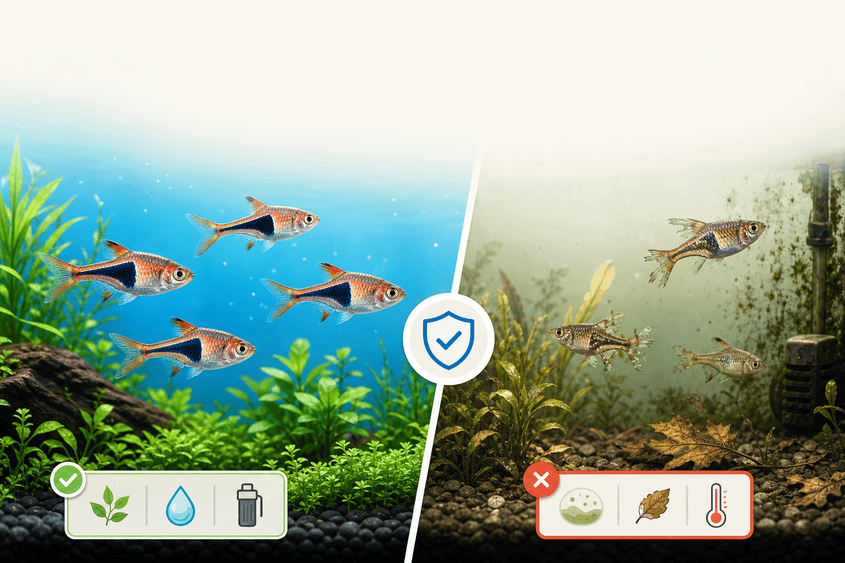
Your water tested perfect and your fish still died.
That sentence describes 80% of the people who land on this page. Ammonia zero. Nitrite zero. Nitrate low. And one by one, the galaxy rasboras drift to the surface, gulp at the air, and go.
The test kit is not lying. It is just answering a different question than the one that killed your fish. This guide walks through the seven things that actually kill celestial pearl danios, ranked by how often they do it, so you can stop the next death tonight.
Quick answer: the 3 causes that kill most galaxy rasboras
If you have 60 seconds, start here.
- New tank syndrome. The tank was not fully cycled. A nitrite spike suffocated the fish even though the test read zero an hour later.
- The pH crash. Soft, low-buffer water dropped its pH overnight. The swing killed the fish, not the final number.
- Shipping stress plus a fast acclimation. Wild-caught and farm-raised CPDs arrive exhausted. Dumping them into new water finishes the job.
Everything below explains how to tell which one hit your tank, and what to do in the next hour.
Cause 1: The tank was not really cycled
This is the number one killer, and it hides behind a clean test.
Galaxy rasboras are tiny. A celestial pearl danio reaches about 0.75 inches. That small body has almost no tolerance for nitrogen waste. A spike that a hardy zebra danio shrugs off will kill a CPD in hours.
Here is the trap. During cycling, your tank moves through a sequence: ammonia, then nitrite, then nitrate. Nitrite is the silent one. It binds to the fish’s blood and blocks oxygen from reaching the tissue, a condition called brown blood disease. The fish suffocates from the inside while floating in oxygen-rich water.
You test the water and read 0-0-5. You feel safe. But nitrite spikes and falls between feedings, and a strip read at 9pm tells you nothing about the 2am spike that did the damage. The fish gasping at the surface is your real test result. Trust it over the strip.
How to confirm it:
- Tank is less than 8 weeks old, or the filter was recently cleaned or replaced.
- Fish gasp at the surface or hang near the filter outflow where oxygen is highest.
- Deaths come one at a time over several days, not all at once.
What to do right now:
- Do a 50% water change with temperature-matched, dechlorinated water.
- Dose a conditioner that detoxifies ammonia and nitrite (Seachem Prime is the standard).
- Stop feeding for 48 hours. Less food means less waste while the filter catches up.
- Test ammonia and nitrite daily until both hold at zero for a week.
The single biggest mistake: adding galaxy rasboras to a tank under two months old. They are a finishing fish, not a starter fish.
Cause 2: The pH crash nobody warned you about
This one kills overnight, and almost no care guide mentions it.
CPDs come from soft, mineral-poor water. To recreate that, hobbyists use RO water, peat, driftwood, and almond leaves. All good. But soft water has a hidden flaw: it has almost no carbonate hardness (KH) to buffer pH.
KH is the shock absorber for your water chemistry. When it runs low, pH stops holding steady. It drifts down through the night as the tank produces CO2, then a water change resets it upward in the morning. Your fish ride a pH rollercoaster every 24 hours. The number you measure at noon looks fine. The 4am low is what stops their hearts.
The parameter targets that prevent it:
| Parameter | Safe range for CPD | Why it matters |
|---|---|---|
| pH | 6.5 to 7.5, stable | The swing kills, not the number |
| KH | 3 to 8 dKH | Below 3, pH becomes unstable |
| GH | 2 to 10 dGH | Soft to medium hardness |
| Temperature | 70 to 76 F | Cooler than most tropicals |
What to do right now:
- Test your KH. If it sits at or near 0 dKH, that is your answer.
- Add a small amount of crushed coral or a commercial buffer to lift KH into the 3 to 6 range. Go slowly. A fast correction is its own swing.
- Never chase an exact pH number. Chase stability. A rock-steady 7.4 beats a “perfect” 6.8 that bounces.
Cause 3: Acclimation that was too fast
The fish were already half-dead when they reached your tank. The acclimation finished them.
Galaxy rasboras travel badly. By the time they reach you, they have spent hours in a cooling, acidifying bag, with ammonia building from their own waste. Their reserves are gone. Now you float the bag for ten minutes and tip them in. The difference between bag water and tank water in pH, temperature, and TDS hits them like a wall.
The fix is slower than you think:
- Float the sealed bag for 15 minutes to match temperature.
- Open the bag and start a drip line from the tank, one to two drops per second.
- Drip for 60 to 90 minutes, until the bag volume has roughly tripled.
- Net the fish into the tank. Do not pour bag water in. That water is full of ammonia.
- Keep the lights off for the first few hours to lower stress.
If a vendor ships fish that arrive dead or dying on a correct drip acclimation, that is a vendor problem, not a you problem. Note it. A reputable seller honors a live arrival guarantee.
Cause 4: Temperature too high
People treat every tropical fish the same. CPDs are not the same.
Galaxy rasboras come from cool highland ponds in Myanmar. They do best between 70 and 76 F. Park them at 80 F to match a community tropical tank and you shorten their lives. Warm water also holds less oxygen and speeds up their metabolism, so they burn out faster and suffocate sooner.
What to check:
- Is your heater set to 78 F or higher? Drop it to 74.
- Does the tank sit in direct sun or near a radiator? A 10-gallon nano tank heats up fast and has little water volume to buffer the swing.
- A stuck heater can cook a small tank in a day. Verify yours with a separate thermometer.
Cause 5: They starved in plain sight
A galaxy rasbora can starve in a tank full of food.
CPDs are shy, slow feeders that spend much of their time in the lower half of the tank. Drop flakes in a tank with faster fish and the rasboras get nothing. Over two or three weeks they thin out, lose color, and fade away. No dramatic gasping. Just a quiet decline that looks like mystery deaths.
What to do:
- Feed small foods their mouths can handle: crushed flake, micro pellets, baby brine shrimp, daphnia, cyclops.
- Target-feed near the bottom or use a feeding ring so food does not all drift to the surface.
- Feed small amounts two to three times a day rather than one big drop.
- Watch them eat. If they are not getting to the food, change how you deliver it.
Cause 6: The school was too small
A lonely galaxy rasbora is a stressed galaxy rasbora, and stress kills slowly.
These fish read safety in numbers. Kept in groups of three or four, they hide, stay pale, and live in a state of low-grade fear that wears down their immune system. Then a minor parameter wobble that a confident school would survive tips a stressed fish into illness.
Keep a minimum of 8, and 10 or more is better. A proper group spreads out, colors up, and behaves like the fish you paid for. This is also the fix for “my CPDs are washed out and always hiding.”
Cause 7: Disease that rode in on new fish
Sometimes the killer arrived in the bag.
CPDs are prone to fin rot and to the usual nano-fish parasites, both triggered by the stress of shipping and poor water. Add new fish straight to your display and one sick fish can take the tank.
Watch for:
- Frayed or discolored fins (fin rot, usually a water-quality signal too).
- White spots like grains of salt (ich).
- Rapid breathing, flashing against decor, clamped fins.
Prevent it: quarantine new arrivals in a separate cycled tank for two to four weeks before they meet your display. It feels like overkill until the one time it saves every fish you own.
How to diagnose your own tank in 2 minutes
Match your symptoms to the cause.
| What you saw | Most likely cause |
|---|---|
| Gasping at surface, tank under 8 weeks old | New tank syndrome (Cause 1) |
| Fine at night, dead by morning, soft water | pH crash (Cause 2) |
| Died within 1 to 2 days of arriving | Acclimation or shipping stress (Cause 3) |
| Heater reads 78 F+, or tank in sun | Temperature (Cause 4) |
| Slow fade over weeks, losing color | Starvation (Cause 5) |
| Hiding, pale, few fish in tank | School too small (Cause 6) |
| Spots, frayed fins, flashing | Disease (Cause 7) |
Frequently asked questions
Why did my galaxy rasboras die when ammonia and nitrite read zero? Because a single test is a snapshot, not a recording. Nitrite spikes and falls between readings, and it blocks oxygen in the blood even at levels that fall by the time you test. In soft water, a nightly pH crash can also kill without ever showing on a daytime test.
How long should a tank cycle before adding CPDs? Wait until ammonia and nitrite both hold at zero for at least a week, which usually takes 4 to 8 weeks. Galaxy rasboras are a finishing fish for an established tank, not a fish to cycle with.
Can galaxy rasboras live in a 5-gallon tank? They can fit, but a 5-gallon is hard mode. The tiny water volume swings in temperature and chemistry far faster than the fish can handle. A 10-gallon is the realistic minimum for stable parameters.
Why are my galaxy rasboras pale and hiding instead of dying? Almost always too few fish, too little cover, or intimidating tank mates. Raise the school to 8 or more, add planting, and they color up.
Do galaxy rasboras need a heater? Usually yes, but a cool one. Aim for 70 to 76 F. If your room sits below that range, a low heater keeps them stable. If it runs hot, that itself can be the problem.
The one rule that prevents all seven
Stability beats perfection.
Galaxy rasboras do not die from a wrong number. They die from a moving number. A fully cycled tank, soft water with just enough KH to hold pH steady, a slow drip acclimation, cool temperatures, and a real school: each one removes a swing. Remove the swings and these fish live three to five years.
Get the rest of your survivors through tonight, then build the tank that keeps them.
This guide is for educational purposes. Water chemistry varies by source and region. Test your own parameters before making changes.