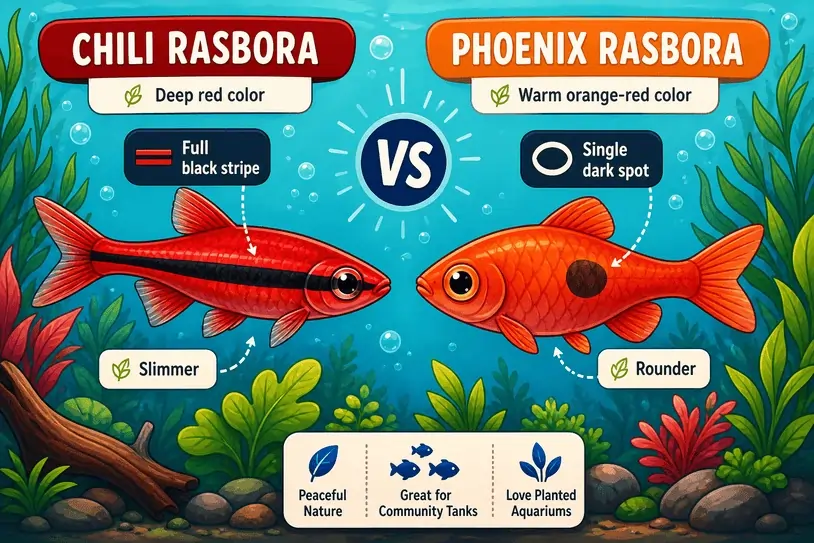
The chili rasbora you bought is probably a phoenix rasbora. Or the other way around.
These two fish get mixed in the same dealer tanks, sold under the same name, and shipped under the same label. Even scientists once argued they might be the same species. They are not. They look almost identical at a glance, and the one detail that separates them takes ten seconds to check once you know where to look.
This guide gives you that detail first, then the full breakdown: markings, color, size, water needs, and which one belongs in your tank.
Quick answer: the one marking that tells them apart
Look at the side of the fish, from gill to tail.
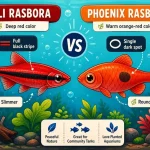
- Chili rasbora (Boraras brigittae): one solid black line running the full length of the body, gill to tail base. The whole body glows deep red.
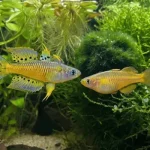
- Phoenix rasbora (Boraras merah): no continuous line. Instead a dark blotch near the gills and a short, broken dark mark. Red color clusters around those black marks, not across the whole body.
Solid stripe equals chili. Broken blotch equals phoenix. That single check settles 90% of cases.
Why these two get confused
Both are Boraras. Both are tiny. Both come from the same blackwater peat swamps of southern Borneo (Kalimantan), and in some regions their ranges overlap, so wild collectors net them together. That is exactly how they end up in the same shop tank with one price sticker.
The confusion runs so deep that the phoenix rasbora is usually sold as Boraras brigittae, the chili’s scientific name. For years hobbyists believed B. merah was just the female of the chili rasbora. It is not. They are two distinct species that happen to share an address.
Side-by-side: the differences that matter
| Trait | Chili rasbora (B. brigittae) | Phoenix rasbora (B. merah) |
|---|---|---|
| Body marking | One solid black line, full length | Broken blotch and short mark, no full line |
| Red color | Across the whole body, intense | Concentrated around the black marks |
| Adult size | About 18 mm (0.7 in) | About 16 mm (0.6 in) |
| Name origin | Named after Brigitte, wife of describer | “Merah” is Indonesian for red |
| Origin | SW Borneo peat swamps | S and W Borneo (Kalimantan) |
| Temperament | Peaceful, loose schooler | Peaceful, slightly more active |
| Shrimp safe | Yes | Yes |
| Trade label | Usually correct | Often mislabeled as brigittae |
The practical takeaways: the chili is the redder, more uniformly colored fish, which is why it commands the higher price and the bigger demand. The phoenix is marginally smaller and a touch more active.
Don’t confuse either with the imposter
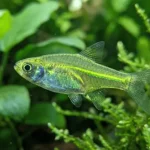
There is a third fish in the mix, and it is the one most often sold as a chili rasbora: Boraras urophthalmoides, the exclamation-point or sparrow rasbora.
How to spot the imposter: it is more orange than red, has weaker overall color, and carries a dark blotch at the tail base (the caudal peduncle) rather than a clean stripe. It is also slightly smaller. If the “chili rasboras” in the shop look orange and washed out with a spot near the tail, you are looking at urophthalmoides, not brigittae.
So the full ID logic is simple:
- Solid red, full black stripe to the tail → true chili (B. brigittae)
- Broken blotch, red around the marks, no stripe → phoenix (B. merah)
- Orange-ish, weak color, spot at the tail base → sparrow rasbora (B. urophthalmoides), the common stand-in
Care: where they match and where they don’t
Good news first. Their care is nearly identical, so a mixed bag of either will survive the same setup. Both want soft, acidic blackwater.
| Parameter | Target for both |
|---|---|
| pH | 5.0 to 7.0, stable |
| GH | soft, 1 to 8 dGH |
| KH | low but not zero, 1 to 4 dKH |
| Temperature | 72 to 79 F |
| Min tank | 10 gallons for a real school |
| School size | 8 minimum, 10+ better |
The one care difference worth knowing: the phoenix rasbora is a bit more active, so it appreciates a touch more open swimming room. In a heavily planted 10-gallon long, both thrive.
A warning that applies to both: soft blackwater has little buffer, so pH can swing overnight if KH drops to zero. Keep a small amount of carbonate hardness in the water to hold pH steady. The swing kills these fish faster than the wrong number does.
Can you keep them together?
You can. You should not breed them together.
Both are peaceful and will share a tank without conflict. The problem is genetic: in a mixed tank they can interbreed and produce hybrid fry, muddying both bloodlines. If you ever plan to breed, keep them in separate tanks. For a display-only community, a mixed group is fine.
Which one should you buy?
Choose by what you want from the tank.
- Want the most intense, all-over red? Chili rasbora. It is the redder fish and the reason this group is famous.
- Found a true, well-colored phoenix at a good price? Take it. It is slightly smaller, a little more active, and easier to ID with confidence because of its broken markings.
- Either way: look at the actual fish, not the label. Check the stripe. Buy a full school of one confirmed species rather than a mixed bag of mystery Boraras.
Frequently asked questions
What is the difference between a chili rasbora and a phoenix rasbora?
Chili rasbora (Boraras brigittae) has one solid black line running the full length of its body and is red all over. Phoenix rasbora (Boraras merah) has no continuous line, just a dark blotch and broken mark near the gills, with red concentrated around those marks. The chili is also slightly larger and redder.
Are chili and phoenix rasboras the same fish?
No. They were once thought to be the same species, and the phoenix is still often sold under the chili’s scientific name, but they are two distinct species from overlapping ranges in Borneo.
Which is bigger, chili or phoenix rasbora?
The chili rasbora is marginally bigger at about 18 mm, versus about 16 mm for the phoenix. The difference is small enough that markings, not size, are the reliable way to tell them apart.
Can chili and phoenix rasboras live together?
Yes, they are both peaceful and shrimp-safe. Avoid it only if you plan to breed, since they can hybridize.
Why is my chili rasbora orange instead of red?
It may not be a chili at all. The fish most often mislabeled as a chili rasbora is Boraras urophthalmoides, which is more orange and carries a spot at the tail base. A true chili in good water turns deep red.
Conclusion
Both fish are blackwater jewels under three quarters of an inch. The chili rasbora wins on color, the phoenix is a hair smaller and livelier, and the fish wrongly sold as a chili is usually the sparrow rasbora.
When you shop, ignore the sticker and read the body. One solid stripe and full red means you are holding the real thing.
This guide is for educational purposes. Species identification in the trade is inconsistent; inspect fish in person where possible before buying.