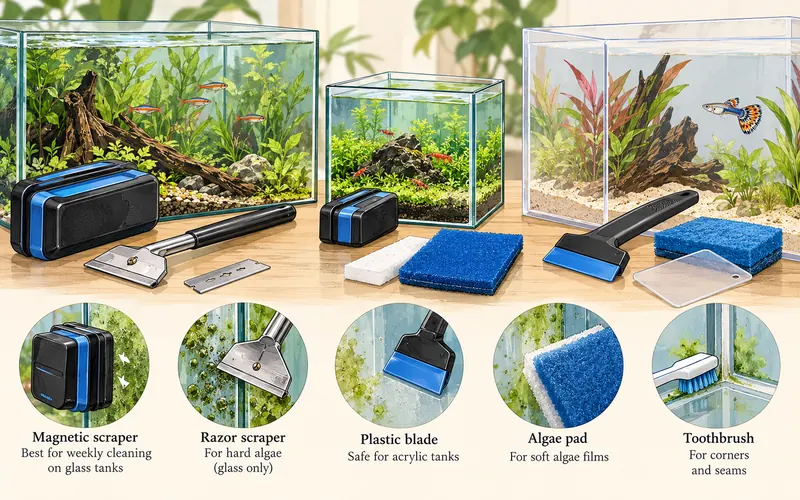
A scraper that cleans a glass tank in seconds can scar an acrylic tank in one stroke. For glass tanks, a floating magnet sized to the glass handles weekly film, and a razor handles hard spots. For acrylic tanks, use a soft pad, a plastic blade, or an acrylic-rated magnet. For nano tanks, use a magnet rated to 1/4 in. (6 mm).
The right aquarium algae scraper depends on the tank material, the glass thickness, and the algae on the glass. Glass scratches are close to permanent, and acrylic scratches need sanding to remove. This aquarium scraper guide rates every tool type for glass and for acrylic, with prices, magnet sizing by glass thickness, and safe technique for corners and silicone seams.
Links to Hygger and Amazon products are affiliate links. As an Amazon Associate, NanoFishNest earns from qualifying purchases at no extra cost to the buyer. Specs and figures below cite maker data or published sources. No product here has independent scratch-test data.
The right aquarium algae scraper by tank
Pick by tank material first, then by glass thickness, then by the algae on the glass.
Glass nano tank, 1 to 20 gal
- Use
- Floating magnet rated to 1/4 in., card scraper for corners
- Avoid
- Magnets rated for thick glass
Glass tank, 20 to 75 gal
- Use
- Magnet rated to 1/2 in., stainless razor for hard algae
- Avoid
- Dragging any pad into the sand
Acrylic tank
- Use
- Acrylic pad, plastic blade, acrylic-rated magnet
- Avoid
- Any steel blade or scouring pad
Green spot algae or coralline
- Use
- Blade: steel on glass, plastic or card on acrylic
- Avoid
- Sponges, which slide over it
Corners and silicone seams
- Use
- Plastic card or soft toothbrush
- Avoid
- Running a steel blade along the bead
In this guide
Aquarium Algae Scraper Comparison Table
| Tool type | Glass safe | Acrylic safe | Price | Handle | Scratch risk on glass | Scratch risk on acrylic |
|---|---|---|---|---|---|---|
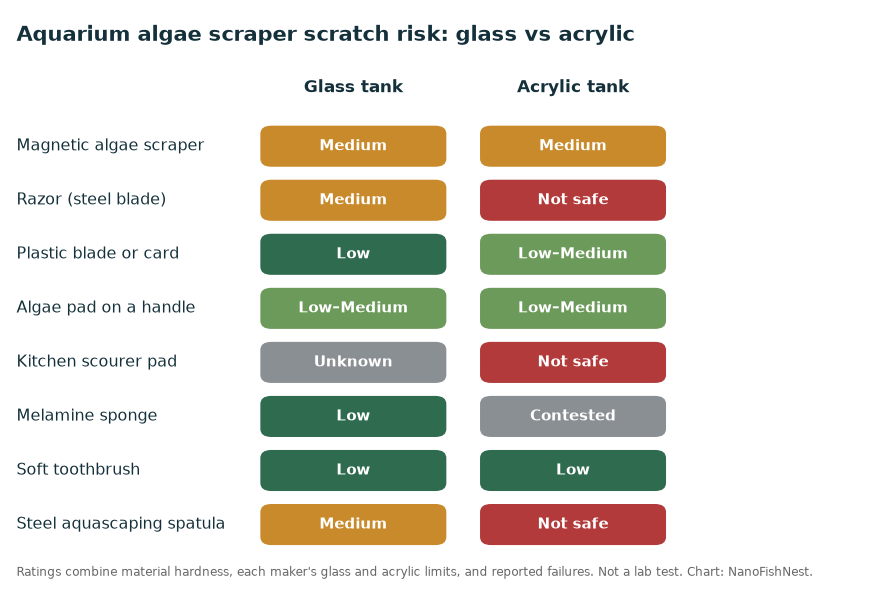
| Magnetic algae scraper | Yes | Acrylic-rated models only | $14 to $130 | None, outside magnet | Medium near the sand line | Medium, plastic blade only |
| Razor (stainless blade) scraper | Yes | No | $15 to $70 | 6 to 36 in. | Medium, low with a fresh flat blade | Not safe |
| Plastic blade or card scraper | Yes | Yes, with care | $16 to $30 | 10 to 28 in. | Low | Low to medium |
| Algae pad on a handle (API) | Glass version only | Acrylic version only | $9 to $11 | About 18 in. | Low to medium if gravel sticks | Low to medium if gravel sticks |
| Kitchen scourer pad | Plain, untreated pads only | No | Under $5 | None | Unknown, grade varies | Not safe |
| Melamine sponge | Yes | Contested | Under $10 | None | Low | Contested |
| Toothbrush | Yes | Yes | Under $5 | About 7 in. | Low | Low |
| Aquascaping spatula (steel) | Yes | No | About $15 in kits | About 12 in. | Medium | Not safe |
The scratch-risk ratings come from material hardness, maker limits, and the most common owner complaint. None comes from a lab test.
How the scratch-risk ratings work
- Hardness. Soda-lime glass measures about 470 to 585 on the Knoop scale (Valley Design). Razor-grade stainless steel measures about HV 620 to 650 (U.S. Patent 5,433,801), so steel and glass sit close together. Acrylic is far softer, at Rockwell M93 to M102 and pencil hardness 3H for cast and extruded sheet (ACRYLITE).
- Maker limits. Each maker’s own rules, such as “glass only”, “not for acrylic”, and maximum glass thickness.
- Owner complaints. The most common one is sand trapped under a pad or blade.
- Low means the blade or pad is softer than the tank surface and the design keeps grit away.
- Medium means the blade is close in hardness to the surface, or the pad works near sand.
- Not safe means the maker says so.
Best Aquarium Algae Scraper Picks (2026)
Prices are U.S. retail as found in October 2026 and change often.
| Pick | Best for | Glass or acrylic | Rating or size | Price |
|---|---|---|---|---|
| Flipper Float Nano | Nano tanks, floating magnet | Glass | Up to 1/4 in. (6 mm) | $29.99 |
| Tunze Care Magnet Nano | Curved or round-edged glass | Glass, plastic blade | 6 to 10 mm | $34.99 |
| Mag-Float Mini 25 | Betta tanks up to 10 gallons | Glass and acrylic | Up to 3/16 in. | $18.99 to $24.99 |
| Flipper Float Standard | 20 to 75 gallon tanks | Glass and acrylic (ABS blade) | Up to 1/2 in. (12 mm) | $49.99 |
| Hygger Float-up Magnetic Cleaner | Budget floating magnet | Steel blade for glass, plastic blade for acrylic | S 0.25 in., M 0.2 to 0.4 in., L 0.4 to 0.8 in. | $13.99 to $21.99 |
| Hygger Ceramic Blade Magnetic Brush | Saltwater glass tanks | Glass only | 6 to 15 mm | $18.99 to $22.99 |
| Continuum AquaBlade M | Coralline and green spot algae on glass | Glass, 316 stainless | Short handle | $20.47 |
| Seachem Algae Scraper | One tool for both tank types | Metal, plastic, and pad blades | 12 or 18 in. | $23.86 |
| Continuum AquaBlade P | Acrylic tanks | Acrylic | Short handle | $16.51 |
| Flipper Platinum 12 in. | Rimless nano tanks | Card blade for glass and acrylic | 12 in. shaft | $19.99 |
| API Algae Scraper for Glass | Cheapest pad on a handle | Glass only | About 18 in. | $9.18 |
| API Algae Scraper for Acrylic | Acrylic pad on a handle | Acrylic | Long handle | $10.94 |
| Hygger Small Fish Tank Cleaner Kit | 1 to 5 gallon tanks | Glass | 25.4 cm scraper | $9.80 to $11.47 |
Glass thickness ratings and sizes come from the makers.
Algae Scraper for Acrylic Tank: Soft Pads and Plastic Blades Only
Acrylic scratches far more easily than glass, and every maker restricts steel blades to glass. Seachem says its metal blade “will scratch acrylic”. It adds that “it is still possible to scratch acrylic with the plastic blade” and that “the safest choice for acrylic is the soft pad” (Seachem).
| Safe on acrylic | Not safe on acrylic |
|---|---|
| Acrylic-rated soft pads such as the API Algae Scraper for Acrylic | Any steel or razor blade |
| Plastic blades: Continuum AquaBlade P, Seachem plastic blade, Flipper ABS blade | The API glass scraper |
| Acrylic-rated magnets: Mag-Float Mini 25, Flipper Float Standard with the ABS blade | Hygger Ceramic Blade brush |
| Card scrapers such as the Flipper Platinum | Scouring pads and abrasive kitchen sponges |
| Soft toothbrush | Window sprays, ammonia, alcohol |
Trapped sand is the main risk on acrylic. Quartz sand is harder than glass, aragonite reef sand is harder than acrylic, and API warns that gravel will scratch acrylic surfaces (API). Keep every pad and blade well above the substrate.
Outside the tank, the acrylic sheet maker ACRYLITE rules out window-cleaning sprays, scouring compounds, and solvents (ACRYLITE). A damp microfiber cloth or an ammonia-free acrylic tank cleaner such as Fritz works on the outside.
Acrylic is soft enough to repair. Fine scratches come out with progressive wet sanding from 1500 to 12000 grit and a plastic polish such as Novus No. 2. Glass scratches need slow cerium-oxide polishing, and deep ones are close to permanent.
Nano Tank Algae Scraper: Thin Glass Needs a Small Magnet
Nano tanks use thin glass, and magnets rated for thick glass grip too hard on it. ADA Cube Garden tanks up to 60 cm use 4 to 6 mm glass. UNS 45U and 5N tanks use 5 mm, and Dennerle Nano Cubes use about 5 mm. Standard 10 gallon tanks have no published thickness, but Aqueon’s own tank weights suggest about 3 mm or less.
| Nano need | Pick | Why |
|---|---|---|
| 1 to 5 gallon betta or shrimp tank | Hygger Small Fish Tank Cleaner Kit | Written for 1 to 5 gallons, 25.4 cm scraper, $9.80 to $11.47 |
| Magnet for glass up to 6 mm | Flipper Float Nano | Rated to 1/4 in., floats, blade and scrubber in one |
| Glass and acrylic up to 10 gallons | Mag-Float Mini 25 | Up to 3/16 in., floats |
| Curved front or rounded corners | Tunze Care Magnet Nano | Rated for arched glass, 6 to 10 mm |
| Rimless planted nano | Flipper Platinum 12 in. | Short shaft, card blade for tight tanks |
On thin nano glass, match the magnet rating to the glass. An oversized magnet can crack the pane when the halves snap together. Lift every tool off before the polished rim of a rimless tank. Fish for small tanks are compared in the 15 best nano fish, and filters for small tanks in the best sponge filters for nano tanks.
Magnetic Algae Scraper: Match the Magnet to the Glass Thickness
A magnetic algae scraper has two strong magnets (neodymium) that pull through the glass. One half carries the pad or blade inside the tank. The other half stays outside in the hand, so hands stay out of the water.
Magnet pull falls off steeply with distance. In one measured test, a magnet pulling 6.44 lb on steel dropped to 3 lb with about 0.03 in. of paper in the gap (K&J Magnetics). Glass is that gap, so every magnetic aquarium scraper is sold by glass thickness. A magnet too weak for the glass slides off. A magnet too strong for thin glass will not slide, and its halves can slam together.
| Magnet | Glass thickness | Floats |
|---|---|---|
| Mag-Float Small | Up to 3/16 in., tanks up to 30 gallons | Yes |
| Mag-Float Large | Up to 5/8 in., tanks up to 350 gallons | Yes |
| Tunze Care Magnet Nano | 6 to 10 mm | No, needs the Care Booster float |
| Flipper Float Nano / Standard / Max | 1/4 in. / 1/2 in. / 1 in. | Yes |
| Hygger Float-up S / M / L | 0.25 in. / 0.2 to 0.4 in. / 0.4 to 0.8 in. | Yes |
Sand is the main risk. Flipper warns that “trapped sand can scratch aquarium glass” (Flipper). Tunze holds the inner magnet more than 3 mm off the glass so sand is less likely to jam under it. A floating inner half matters for the same reason, since a dropped half that floats never lands in the gravel.
Tunze’s manual warns that the halves clamp together with 5 to 20 kg of force on direct contact (Tunze manual). Place the inner half high on the glass first, then bring the outer half in slowly. Keep strong magnets at least 50 cm from pacemakers.
Razor Algae Scraper: Fresh Blade, Low Angle, Glass Only
A razor algae scraper is the aquarium glass scraper for the hardest growth, green spot algae and coralline crust. Green spot algae grows as a flat disc pressed to the glass and “generally cannot be wiped away with a sponge” (2Hr Aquarist). Coralline algae builds calcite into its cell walls and needs a steel edge.
A glass maker states that metal blades carry “a large probability for causing irreparable damage to glass” (Cardinal IG). Scratches come from a nicked edge, sand dragged under the blade, a steep digging angle, or a tempered pane. Some Aqueon tanks have tempered bottoms (Aqueon).
A fresh blade held low and flat rarely scratches untempered aquarium glass. Hobby builds a low 18° offset into its scraper head by design. Use light pressure, stroke from top to bottom, and stop about 0.5 in. above the substrate (UNS).
Blade metal matters in saltwater.
- Continuum uses 316 stainless “built to last and not rust in saltwater” (Continuum via BRS). Even 316 rusts if left in salt for long periods.
- The Hygger Ceramic Blade uses zirconia, which cannot rust, for glass only.
- Flipper recommends a new aquarium scraper blade every 3 to 6 months.
- Rinse and dry steel blades after every use, and replace any blade with a nick or rust pit.
Algae Pads and the API Algae Scraper: Soft Films Only
Fish tank cleaning pads remove soft films. Diatoms, biofilm, and fresh green dust come off with a pad because they hang on by a loose film of sticky polymers (Cheah and Chan, 2021). Pads do not cut green spot algae or coralline.
The API Algae Scraper puts a pad on an 18 in. handle and costs about $9 (API). API sells separate versions for glass and acrylic. The glass version is “not for use on acrylic or plexiglass”, and API warns that gravel caught in the pad “will scratch glass surfaces”. Rinse the pad whenever it touches the substrate.
Kitchen scourers save money but carry two risks.
- Heavy-duty scrub pads can contain hard mineral abrasives.
- Some kitchen sponges are treated with antimicrobial agents and labeled not for aquarium use (Snopes).
Buy a plain, untreated pad and keep it for the tank only, away from soap.
Melamine sponges remove film from glass quickly. Seachem sells melamine pads as safe for glass and acrylic but also calls them “powerful abrasives” (Seachem). Worn melamine sheds about 6.5 million fibers per gram (Phys.org on ES&T, 2024). Use plain, unscented sponges only.
Toothbrush: The Fish Tank Scrubber for Corners and Seams
A soft toothbrush reaches the inside corner where two panes meet and runs along the silicone bead without cutting it. Nylon bristles are softer than glass and acrylic, so the brush is gentler than any blade.
A toothbrush suits soft growth only. Diatoms, biofilm, and new green dust come off with a few strokes. Green spot algae and coralline do not, since both need a flat edge to lift them.
Use a new brush that has never touched toothpaste, and keep it for the tank. Work in short strokes with the bristles flat against the surface. A brush also cleans grit off the inner magnet half and the scraper head, so grit does not ride back onto the glass.
DIY Aquarium Scraper and Spatula: Use a Plastic Card on Acrylic
An aquascaping spatula is a flat steel blade for shaping sand slopes. Hygger lists its spatula for scraping algae too and sells it in its aquascaping tool kit for $14.99. The blunt edge is less likely than a razor to slice silicone, but it is still steel, so it is a glass-only tool.
The best DIY aquarium scraper is an old plastic gift card. 2Hr Aquarist lists an old card as a working tool for green spot algae on acrylic (2Hr Aquarist). A card has a flat edge that lifts spots and is soft enough for acrylic and for the inside corners of a glass tank. Flipper’s Platinum scrapers turn the same idea into a product with a replaceable card blade.
Avoid DIY scrapers made from utility knife blades or kitchen tools. Reef keepers report that hardware-store blades rust in saltwater within days, and a rusty edge drags grit across the glass.
Algae Scraper for Corners and Silicone Seams: Keep Steel Off the Bead
Silicone sealant is soft rubber (Shore A 25 in a common Dow grade) (Dow datasheet). Any blade slices it. A cut bead can start a lifted seam, so the corners need different tools from the open pane.
Makers design around the seam. EHEIM builds “integrated silicone protection” into its scraper (EHEIM). JBL fits a spacer to its blade. Tunze rounds the corners of its plastic blades so they pass along the aquarium edges without damaging the silicone joints. No maker publishes a safe distance in millimeters, so the common “1/4 inch” rule has no source behind it.
The corner routine:
- Stop the steel blade short of the silicone and never run it along the bead.
- Finish the last strip with a plastic blade, an old card, or a soft toothbrush.
- Clean the inside corner where two panes meet with the toothbrush, using strokes along the seam.
- Keep magnets away from the corners and the gravel line, as Mag-Float’s directions advise.
Black beard algae often grows on equipment and edges. Spot-treat it with liquid carbon before scrubbing so the tufts weaken first (Aquasabi).
Match the Algae Scraper to the Algae
| Algae on the glass | Best tool | Note |
|---|---|---|
| Green spot algae (hard green dots) | Razor on glass, plastic blade or card on acrylic | A sponge slides over it |
| Green dust algae (soft green film) | Pad, after waiting | Wait 2 to 4 weeks, wipe once, then do a large water change |
| Diatoms (brown film) | Pad or soft sponge | Common in tanks 1 to 3 weeks old |
| Cyanobacteria (slimy sheets) | Siphon | These are bacteria, not algae |
| Coralline (pink crust, reef) | Thick steel blade on glass | Plastic blade on acrylic |
| White waterline crust | Pumice or steel wool, razor last | Often a mineral and protein crust (hydroxyapatite), so vinegar can fail |
Green dust algae is the one case where waiting helps. Tom Barr and Aquasabi both advise leaving the film alone for 2 to 4 weeks. Early wiping spreads its swimming spores (Aquasabi). 2Hr Aquarist instead fixes the cause through dense planting, stable CO₂, and lower light.
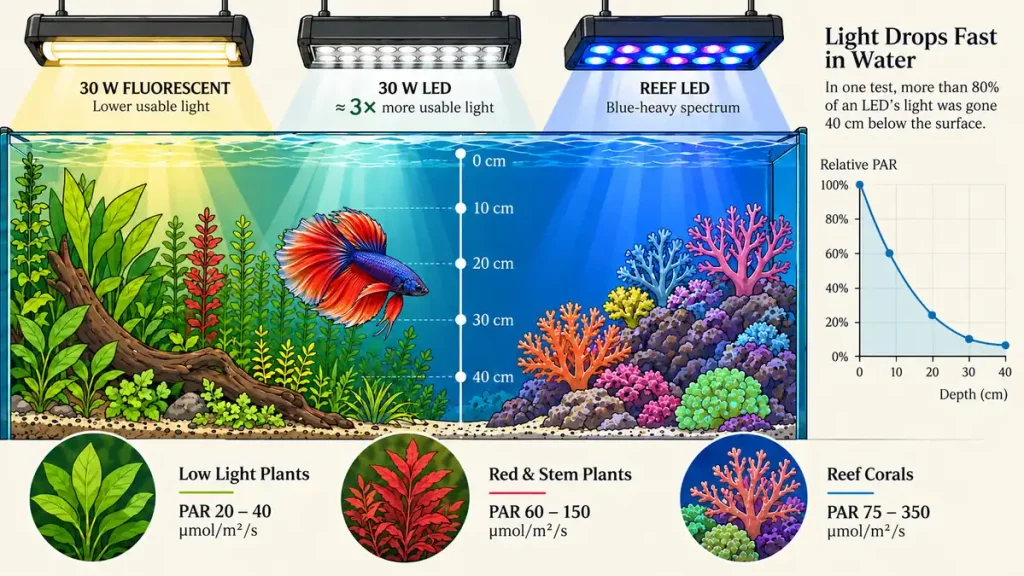
Light, nutrients, and CO₂ balance decide how fast algae returns, so scraping treats the symptom. The aquarium light guide covers PAR, photoperiod, and how light feeds algae.
How to Clean Aquarium Glass Safely
- Unplug the heater and every appliance before hands go in the water. Let a heater cool for 15 minutes before lifting it out (Hagen manual).
- Move snails, shrimp, and nerite eggs off the pane.
- Scrape from top to bottom before the water change, so loose algae settles where the siphon removes it.
- Stop above the gravel, and finish the corners with a plastic blade or toothbrush.
- Clean the outside glass with an ammonia-free cleaner sprayed onto a cloth, never into the tank.
- Rinse and dry every blade, and store it capped.
Grazers help between cleanings. Otocinclus eat diatoms and soft films but avoid green spot algae. Nerite snails are one of the few animals that eat green spot algae (Aquarium Co-op).
Aquarium Algae Scraper FAQ
What is the best algae scraper for a fish tank?
For glass tanks, a floating magnetic cleaner sized to the glass handles weekly film, and a razor scraper handles green spot algae. For acrylic tanks, use an acrylic-rated pad or a plastic blade such as the Continuum AquaBlade P.
What is the best algae cleaner for an aquarium?
The best algae cleaner matches the algae. Pads and magnets remove diatoms and soft film, blades remove green spot algae and coralline, and a siphon removes cyanobacteria.
Does an algae scraper scratch aquarium glass?
It can. A fresh stainless blade held flat rarely scratches untempered glass, but a nicked edge, trapped sand, or a tempered pane can scratch it.
Can a razor blade be used on an acrylic tank?
No. Every maker restricts steel blades to glass. Seachem says its metal blade will scratch acrylic.
What size magnetic algae scraper does a tank need?
Match the magnet to the glass thickness, not the gallons. Most nano tanks use 4 to 6 mm glass, which suits magnets rated to 1/4 in., such as the Flipper Float Nano.
How often should aquarium glass be cleaned?
No maker sets a schedule. A wipe during each weekly water change keeps films thin, since fresh algae films come off far more easily than old ones. Green dust algae is the exception, where waiting 2 to 4 weeks before wiping works better.
Is a magic eraser safe for an aquarium?
A plain, unscented melamine sponge is widely used on glass. On acrylic it is contested, since Seachem calls melamine pads powerful abrasives.
What is the best DIY aquarium scraper?
An old plastic gift card. It lifts green spot algae and is soft enough for acrylic and silicone corners.
How do I clean algae off the silicone in aquarium corners?
Use a soft toothbrush or a plastic card along the seam. Never run a steel blade along the silicone bead.
Sources
- Cardinal IG, glass cleaning recommendations: https://www.cardinalcorp.com/wp-content/uploads/2026/01/IG12_1-2026.pdf
- Valley Design, soda-lime glass properties: https://valleydesign.com/sodalime/
- ACRYLITE, pencil hardness and acrylic care: https://www.acrylite.co/resources/knowledge-base/article/what-is-the-astm-for-the-pencil-hardness-test
- K&J Magnetics, pull force and gap: http://www.kjmagnetics.com/blog/how-much-will-a-magnet-hold
- Tunze Care Magnet operating instructions: https://cdn.shopify.com/s/files/1/1051/3882/files/x0220.8882.pdf
- Mag-Float official specifications: https://www.magfloat.com/
- Tunze Care Magnet Nano specifications (BRS): https://bulkreefsupply.com/tunze-care-magnet-nano.html
- Flipper magnetic cleaners: https://flippercleaner.com/
- Seachem Algae Scraper: https://www.seachem.com/algae-scraper.php
- API Algae Scraper for Glass Aquariums: https://www.apifishcare.com/products/api-algae-scraper-glass-aquariums-handle
- Dow 732 sealant datasheet: https://m.aircraftspruce.ca/catalog/pdf/732%20MULTI-PURPOSE%20SEALANT%20TDS.pdf
- Cheah and Chan 2021, microalgal biofilm adhesion: https://pmc.ncbi.nlm.nih.gov/articles/PMC8806711/
- Aquasabi, green dust algae: https://aquasabi.com/aquascaping-wiki/algae/gda-green-dust-algae