This free aquarium fish stock calculator checks your nano tank plan. It checks adult size and swimming space, plus school size and water range. No signup.
For species profiles and group sizes, see the nano fish guide.
It won’t give you a maximum fish count. Nobody can work that out from a form. It shows you which requirement your plan fails, and where the advice comes from.
How to use the fish tank stocking calculator
- Measure your tank. Use internal length, width and height to the waterline. Don’t use the gallon number on the box. If you know the volume of water it holds, enter that as the measured volume.
- Add every animal at adult size. Enter the whole list, shrimp and snails too. A missing animal is not zero load. Tick the box for unlisted animals.
- Fix the red items first. “Revise this plan” means a check failed. “Needs review” means the tool can’t judge something, like your water or your filter. “Screened · not guaranteed” means no check found a conflict. It doesn’t mean safe.
Want to see how it reads a plan first? Load one of the four example buttons. They leave the water tests blank on purpose. A preset never says your filter or water has been tested.
How the calculator works
The tool does two jobs. It works out how much water you have. Then it checks each species against its own needs.
Volume
Gross volume is length × width × waterline height ÷ 1,000. Use centimetres and you get litres. Then the tool subtracts displacement for substrate and décor. The default is 15%, an editable example that isn’t a measured average. Enter a measured fill volume and it replaces the estimate. Your height should already end at the waterline. Don’t subtract an air gap twice.
A worked example
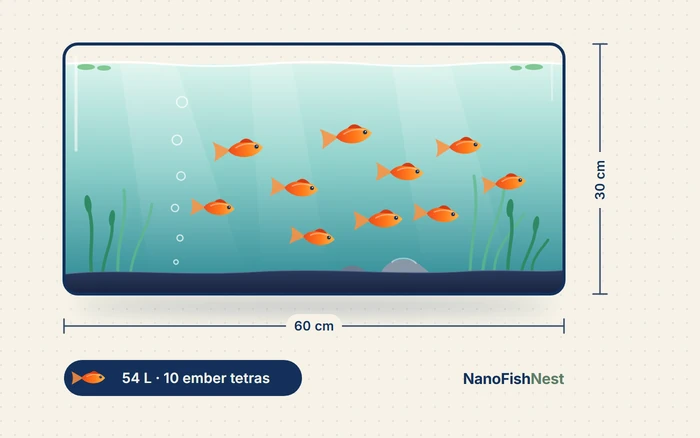
A 60 × 30 × 30 cm tank holds 54 L at the waterline. Take off 15% and you have 45.9 L of usable water. Ten ember tetras at 2 cm each come to 10 × 2 × 2 = 40 L on the fish-space screen. That’s under 45.9 L.
The fish-space screen
It allows 2 litres per centimetre of adult fish body length. That’s the cautious end of the RSPCA’s general tropical-fish guideline. It’s a rough length rule and it isn’t a bioload model. Passing it doesn’t mean you have spare capacity.
Species checks
These run alongside the screen. Any of them can fail a plan the screen passes.
- Base footprint, with length and width compared after rotating the tank
- Group size for each species
- Temperature, pH and GH (general hardness) reference ranges, plus whether your chosen species overlap
- Your own water readings, if you enter them
- Cycle status, ammonia, nitrite, flow, cover and maintenance
What it doesn’t do
Plants, a bigger filter and more water changes get no bonus. Shrimp and snails never cancel out fish waste. There’s no “stocked %” figure, because a percentage would imply a calibrated carrying capacity and this tool doesn’t have one. Feeding is a major source of ammonia (UF/IFAS). A form can’t see how much you feed.
Why inch-per-gallon fails in nano tanks
The old rule says one inch of fish per gallon. Ten ember tetras are about 7.9 inches of adult body length. So they pass a 10 gallon tank by that rule.
Then you measure the tank. A standard 10 gallon base is roughly 51 × 25 cm. The 45 × 30 cm reference for ember tetras is wider than that. Our ember tetra care guide questions the standard 10 gallon footprint for the same reason.
Equal length doesn’t mean equal behavior. Ten ember tetras and ten male scarlet badis both add up to 20 cm of fish. You can’t swap one for the other, because male badis can fight over territory (Seriously Fish). A length rule can’t see that.
Gallon labels are rough too. Substrate and décor take up room, so you get less water than the label says.
Our own fish-space screen is based on length as well. It’s stricter than inch-per-gallon at 2 L per cm against about 1.5 L per cm. But it has the same blind spot. That’s why it’s one check among several. The species checks can reject a plan it accepts.
Nano tank stocking examples: 5, 10 and 20 gallons
These are arithmetic examples under stated assumptions. They are not tested NanoFishNest tanks. All dimensions are internal, to the waterline, with 15% illustrative displacement.
| Example | Size (cm) | Gross litres | Usable litres | Stock | Fish-space screen | |
|---|---|---|---|---|---|---|
| About 5 US gal | 40 × 25 × 19 | 19.0 | 16.2 | 10 cherry shrimp | Not applicable | |
| About 10 US gal | 50.8 × 25.4 × 30 | 38.7 | 32.9 | 10 ember tetras | 40 L | |
| 54 L / 14.3 US gal | 60 × 30 × 30 | 54.0 | 45.9 | 10 ember tetras | 40 L | |
| About 20 US gal long | 76 × 30.5 × 32.6 | 75.6 | 64.2 | 12 kubotai rasboras | 48 L |
5 gallon: shrimp only
The 5 gallon example is cherry shrimp. Our ember and chili guides don’t recommend a 5 gallon tank for their schools. The tool gives no fish verdict here, and it flags the shrimp load as unquantified. Check chemistry, food supply and breeding.
10 gallon: the plan that fails
Ten embers get “Revise this plan”. Two reasons. The base is narrower than the 45 × 30 cm reference, and the 40 L fish-space screen is above the 32.9 L of usable water. Cutting the school to six or seven fish won’t fix it, because the group-size check would fail. You need a longer tank.
54 L: same fish, better box
The 60 × 30 cm base clears both the footprint and group checks. Add illustrative inputs of 24°C, pH 6.8, GH 6, a verified mature filter, shelter, weekly testing and zero ammonia and nitrite, and the engine reports no conflicts. Those inputs aren’t measurements from a real tank.
20 gallon long: a bigger school
Twelve kubotai rasboras need a 60 × 30 cm base, and this tank has more than that. The fish-space screen comes to 48 L against 64.2 L of water. It still needs a mature filter and matching water. Our kubotai rasbora care guide covers the water side. Want more options at this size? See our 20 gallon fish guide.
Minimum school sizes vs tank size
Schooling fish need a complete group. The tool treats group size as pass or fail. A bigger filter can’t offset a school that’s too small.
| Species | Group the tool uses | What the source says | Base reference (cm) | Our guide | |
|---|---|---|---|---|---|
| Ember tetra | 10 | 8–10 | 45 × 30 | Ember tetra care | |
| Chili rasbora | 10 | 8–10 | 45 × 30 (our guide: 45 L or more) | Chili rasbora care | |
| Kubotai rasbora | 10 | 8–10 | 60 × 30 | Kubotai rasbora care | |
| Pygmy corydoras | 6 | At least six | 45 × 30 | Pygmy corydoras breeding and care | |
| Celestial pearl danio | Review under 20 | Prefers 20 or more, no minimum stated | 45 × 30 | CPD breeding and group care | |
| Scarlet badis | No school | One male, or a sex-confirmed group | 45 × 30 | Scarlet badis breeding |
Where a source gives a range, the tool uses the top of it. Group and base figures come from specialist husbandry references like Seriously Fish. They’re care guidance. They aren’t experimentally tested limits.
The celestial pearl danio shows where the checks pull against each other. The source prefers 20 or more but gives no hard minimum, so a smaller group gets a review flag instead of a fail. Twenty of them come to 84 L on the fish-space screen. That’s more than the usable water in any example tank above. When a preferred group and the length screen disagree, the tool shows both. It doesn’t weaken one to produce a pass.
Scarlet badis aren’t schooling fish. They need small live or frozen foods. A microworm culture is one way to supply them. The tool always sends this species to review.
Stock for adult size, not store size
Fish in a shop are often smaller than they’ll end up. The calculator counts adults. The fish you plan for is the one you’ll house in a year.
Sizes in the tool are standard length (SL), which is body length without the tail. Total length is longer. Don’t mix the two when you compare a care sheet with the calculator. An ember tetra is about 2 cm SL. A pygmy corydoras is about 3 cm.
Don’t plan around the size you see in the shop either. “One small fish equals one inch” breaks as the fish grows. It tells you nothing about group size or territory. Shrimp make this harder, because a small group can grow into a colony. The tool doesn’t estimate a maximum colony.
Filtration, plants and heating
Plants, a stronger pump and weekly water changes can all help water quality. None of them adds swimming space. None removes territorial behavior. So the calculator gives no extra-fish bonus for any of them.
Filtration
A filter needs to be established before fish go in. A sponge filter is gentle and suits small fish. Our nano sponge filter guide covers assembled dimensions and the separate air pump. Thinking of skipping the filter? Read our filterless nano aquarium guide first.
Flow
Small fish need a calm place to rest. More flow doesn’t mean more stocking capacity, so don’t count it as extra room.
Plants and cover
Cover helps shy fish feel safe. It lets you check that they all reach the food. It doesn’t change the length screen.
Heating
Stable temperature matters more than a perfect number, so use a heater if the room swings. Our aquarium heater guide lists picks by tank size.
Add fish in stages
Cycle the tank first. A fishless cycle means adding an ammonia source and waiting until the filter can process it. Zero readings in an empty, unfed tank prove nothing. OATA’s freshwater aquarium guidance covers cycling.
Then add complete groups. A school of ten counts as one addition. Some calculators suggest adding two or three fish a week, but that doesn’t fit a school of ten. After each addition, test ammonia and nitrite. Wait until both stay at zero before you buy the next species. There’s no universal timetable, so let your test results set the pace.
Signs that need investigation
Stop adding animals and test the water if you see any of these:
- Detectable ammonia or nitrite
- Fast or labored breathing
- Ongoing chasing or aggression
- Fish hiding most of the day
- Missed meals
None of these proves overstocking. Illness, chemistry or one bad-tempered fish can cause the same signs. Test first. Our guide to why nano fish lose color lists other causes to rule out.
How this compares with other stocking calculators
Larger tools cover far more species. As of 5 October 2026, AqAdvisor displays 917 species and has a juvenile mode and shareable setups. AquariumStocking advertises 209. Aqulator says 250+ and App-aquatic says 763. Those are the publishers’ own counts.
This calculator has nine entries and doesn’t try to compete on database size. It’s built for checking a nano plan. It shows which requirement failed and where the guidance comes from. It runs in your browser and needs no account. It saves a plan as a file on your own device.
Sources and limits
The species and care data come from the sources linked in the table above and in the calculator. The fish-space screen follows the RSPCA. Cycling guidance follows OATA. The feeding and ammonia point follows UF/IFAS. We reviewed the sources on 5 October 2026. Most fish figures come from one specialist publisher. So the agreement between those pages isn’t independent confirmation.
The tool can’t tell you:
- The real maximum for your aquarium
- How much you feed, or how much ammonia your filter can process
- Dissolved oxygen
- How individual fish behave together
The code was checked for arithmetic and rule behavior. That’s not a welfare study. The example tanks above haven’t been maintained or tested. Treat a “Screened” result as the start of your checks.
Back to the calculator. It’s free, needs no signup and sends nothing to a server.