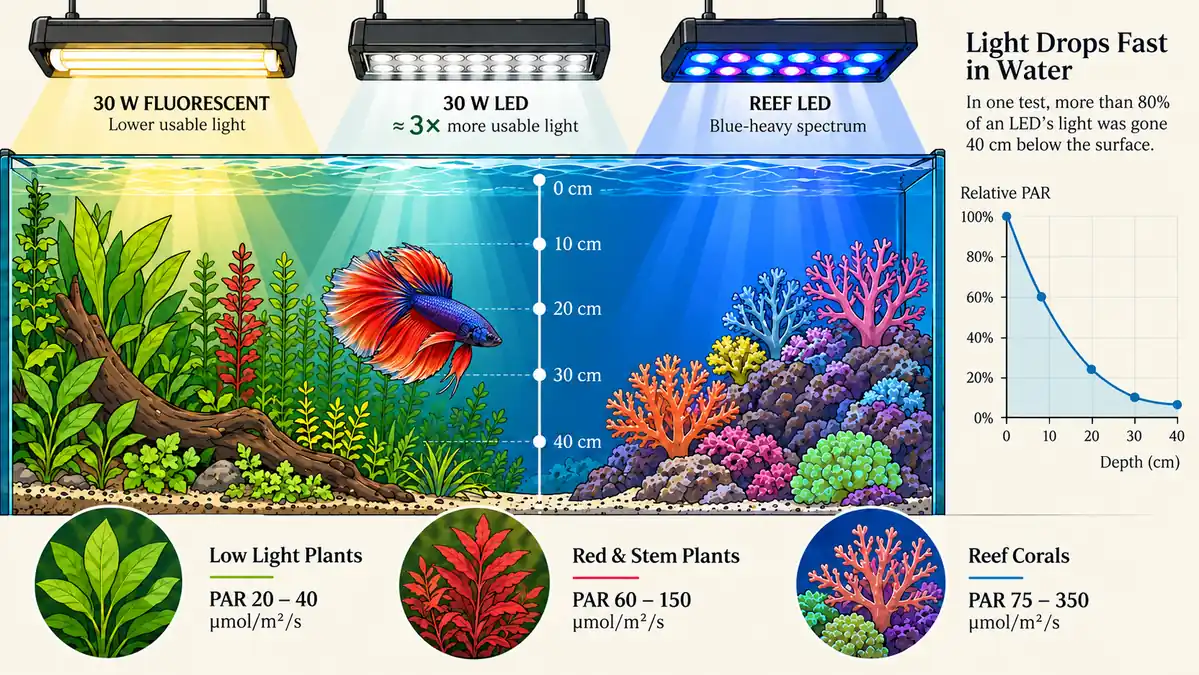
Watts on the box gives us almost nothing about how much light reaches the bottom of a fish tank. A good 30 W LED puts out about three times the usable light of a 30 W fluorescent tube.
In one test, more than 80% of an LED’s light was gone 40 cm below the surface. Too little light starves plants and corals. Too much grows algae. The right aquarium light depends on what lives in the tank, how deep the water is, and how long the light runs.
This aquarium light guide covers all three with measured PAR figures, a sizing chart by gallon, and light schedules by tank type. Each figure links to its source, from peer-reviewed studies to independent PAR meter tests.
The right aquarium light by tank type
Match the light to what lives in the tank, then check PAR at the gravel for the height of the tank.
Freshwater fish-only tank
- Light
- Any LED bar or LED hood sized to the tank length
- PAR
- No target, viewing only
- Hours
- 8 to 10, dark at night
Betta and nano tanks
- Light
- Clip-on or 12 to 18 in. bar, floating plants for shade
- PAR
- 20 to 40 if planted
- Hours
- 8 to 10
Low light plants
- Light
- Full spectrum LED, no CO₂ needed
- PAR
- 20 to 40 µmol/m²/s
- Hours
- 6 at first, then 7 to 8
Red and stem plants
- Light
- RGB planted LED with injected CO₂
- PAR
- 60 to 150 µmol/m²/s
- Hours
- 8 to 9, max 10
Reef tank
- Light
- Blue-heavy reef LED, ramped in over weeks
- PAR
- 75 to 350 by coral type
- Hours
- About 10 with ramps
In this guide
Why a Fish Tank Needs a Light
Fish need a day and a night. Plants and corals use light as food, but fish use it as a clock.
The pineal organ on top of the fish brain reads day length and releases melatonin at night. Melatonin brings on sleep. Sleeping zebrafish are harder to wake and catch up on lost sleep, the same signs used to define sleep in mammals (Yokogawa et al., 2007).
Darkness matters as much as light. Constant light nearly abolished zebrafish sleep within 3 days, and sleep came back only slowly over 1 to 2 weeks. Constant darkness was worse for young fish, since all zebrafish larvae kept in total darkness died before day 18 (Villamizar et al., 2014).
Breeding shows the same pattern. Betta pairs laid about 545 eggs per spawn under 16 hours of light and 8 of dark, against about 129 eggs under 24 hours of light (Giannecchini et al., 2012).
A fish-only tank in a room with steady daylight can manage without a fixture. Most rooms are too dim or too irregular, so the tank light becomes the clock. Keep the tank out of direct sun. Sunlight reaches about 100,000 lux against about 4,500 lux from a good aquarium LED. It drives algae and heat spikes (JBL).
Aquarium Light Numbers: PAR, Lumens, Watts and Kelvin
Five numbers show up on aquarium light boxes. Only PAR measures the light a plant or coral can use.
| Number | What it measures | Use it for |
|---|---|---|
| Watts | Electricity the light draws | Running cost |
| Lumens and lux | Brightness to the human eye | How bright the tank looks |
| PAR (PPFD, µmol/m²/s) | Photons from 400 to 700 nm landing on one spot each second | Plant and coral growth, measured at the gravel |
| µmol/J | Light out per watt in | Comparing efficiency between fixtures |
| Kelvin | Color of the white light | Looks only |
Why lumens mislead for plants
Lumen and lux meters are calibrated to the human eye. The eye is most sensitive to green at 555 nm. Plants count photons across 400 to 700 nm, and chlorophyll absorbs blue and red most strongly. Two lights with the same lux can deliver very different PAR. McCree showed in 1972 that photon counts predict leaf photosynthesis about twice as consistently as measures of light energy. PAR became the standard unit (LI-COR).
Why watts per gallon stopped working
The old rule of 2 to 5 watts per gallon came from T12 and T8 fluorescent tubes, when every watt produced about the same light. Fluorescent fixtures produce about 0.95 µmol of light per joule, ceramic metal halide about 1.46, and good LED fixtures 2.5 to 3.0 (Nelson and Bugbee, 2014 and Kusuma et al., 2020). American Aquarium Products measured a 34-fold spread in the watts needed per unit of PAR across aquarium LEDs alone.
Watts per gallon also ignores tank depth, footprint, and lens angle. Match PAR at the gravel to the livestock, and use watts only to estimate the power bill.
Full Spectrum Aquarium Light, RGB and Kelvin Explained
Plants use the whole band from 400 to 700 nm. Spectrum changes how the tank looks and how compact the plants grow far more than how much they grow.
Green light is not wasted
The common claim that only red and blue grow plants is wrong. Leaves look green because they reflect some green, but they still absorb most of it. Lettuce leaves absorbed 81.1% of green light against 91.6% of red and 93.2% of blue (Liu and van Iersel, 2021). At low light, green is the least efficient color. At high light, green drives photosynthesis as well as red or better. It passes the saturated top layer of the leaf and reaches chloroplasts deeper inside (Terashima et al., 2009).
Kelvin describes looks, not growth
Kelvin rates the color of white light. About 2,700K looks warm and yellow, 5,500 to 6,500K looks like daylight, and 10,000K and up looks blue. In white LEDs a higher Kelvin means more blue photons, about 30% at 6,500K and about 10% in a warm white.
Kelvin changes plant shape. Cool white light grows more compact plants than warm white, with the same total dry weight (Cope and Bugbee, 2013). JBL measured 131, 122, and 150 µmol/m²/s at 40 cm depth under the 2,700K, 4,000K, and 6,700K settings of one fixture (JBL). 6,500K is popular because it looks natural and because cool white LEDs make about 10% more light per watt than warm white.
Leggy stem plants usually lack light intensity. Very warm light with little blue can add to the stretching.
What full spectrum means on an LED
A white LED is a blue chip at about 450 nm coated with a yellow phosphor. “Full spectrum” has no legal definition. On aquarium lights it usually means white LEDs plus extra red, green, and blue channels (WRGB) that fill the gaps in the phosphor output. Ask the maker for a spectrum graph and a PAR table at depth before buying.
Why RGB lights make fish colors pop
Basic white LEDs are weak in deep red, so red fish, red plants, and shrimp look muted or yellowish. RGB and WRGB fixtures add narrow red and blue peaks, and red and blue animals reflect strong, saturated color under them (Aquasabi). The trade-off is a slightly artificial look and less light per watt than pure white. CRI measures color accuracy against a reference light, so a light with a modest CRI can still make fish look more vivid.
How Tank Depth Cuts Aquarium Light
Tank height matters more than wattage. JBL hung its 68 W LED Solar Natur 4 to 5 cm above a 1 m deep tank and measured PAR straight down. Light fell by more than half in the first 10 cm.
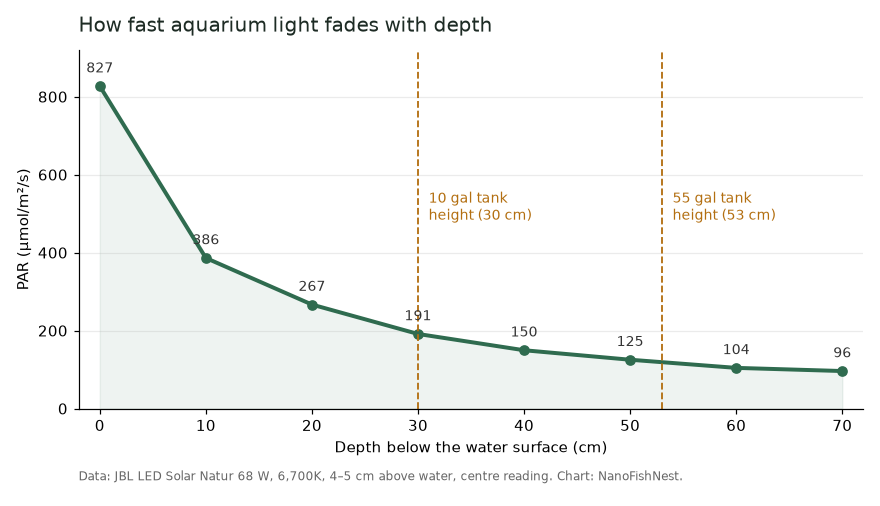
| Depth below the surface | PAR (µmol/m²/s) |
|---|---|
| Just below the surface | 827 |
| 10 cm (4 in.) | 386 |
| 20 cm (8 in.) | 267 |
| 30 cm (12 in.) | 191 |
| 40 cm (16 in.) | 150 |
| 50 cm (20 in.) | 125 |
| 70 cm (28 in.) | 96 |
Most of that loss comes from the beam spreading out. Pure water absorbs red first. Even so, 50 cm of pure water removes only about 27% of 700 nm light and under 1% of blue (calculated from the absorption data of Pope and Fry, 1997). Lens angle counts too. Narrow 60° optics delivered about 37% more PAR at 40 cm than 120° optics in a test by American Aquarium Products.
In hobbyist PAR tests, a clean glass lid removed about 10% of the light, and a dirty one removed up to half. Many published PAR figures are measured in air, and independent testers divide in-air readings by 1.32. Compare fixtures by in-water PAR at the depth of the actual tank. A standard 10 gallon tank is 12 in. (30 cm) tall and a 55 gallon is 21 in. (53 cm), so one light can be bright on the first and dim on the second.
Aquarium Lighting Types: LED vs Fluorescent vs Fish Tank Bulbs
LED is the default for every tank type. Fluorescent tubes still grow plants and corals but are being phased out, and incandescent fish tank bulbs belong in the past.
| Light type | Light per watt | Life | Heat | Verdict |
|---|---|---|---|---|
| LED | 2 to 3 µmol/J for good fixtures | About 50,000 hours to 70% output | Low, vented up through a heatsink | Default choice |
| T5 HO fluorescent | 71 to 83 lm/W | 90% output at 8,000 to 16,000 hours | Moderate | Works, contains mercury, being phased out |
| T8 and CFL | 40 to 70 lm/W | Shorter | Moderate | Obsolete |
| Metal halide | 50 to 90 lm/W | Shorter | Very high, often needs a fan or chiller | Old reef setups only |
| Incandescent bulb | About 10% of the power becomes light | Shortest | About 90% becomes heat | Replace with LED |
Why LEDs run cooler
Every watt a fixture draws ends up as heat. LEDs need fewer watts for the same light. Their waste heat leaves through a heatsink above the tank. Incandescent and metal halide lamps radiate infrared straight down into the water. LEDs still need cooling, since hot LED chips dim faster and lose about 10% efficiency between 25 and 85°C. A hot hood also warms the water, which changes the heater size a tank needs, as explained in the aquarium heater sizing guide.
Aquarium LED lifespan and T5 replacement
LED fixtures are typically rated for 50,000 hours to 70% output. The power supply often fails first. The hobby rule replaces T5 tubes every 9 to 12 months. OSRAM’s datasheet shows 92% output at 4,000 hours and 90% from 8,000 to 16,000 hours, which is 2 to 4 years at 10 hours a day (OSRAM). Hot, humid hoods may age tubes faster, so replace them when plant growth slows or colors shift. California banned sales of linear fluorescent tubes from 1 January 2025, and EU mercury rules are ending them in Europe.
Fish tank light bulb and hood replacement
Older hoods take screw-in bulbs or fluorescent tubes. LED screw-in bulbs cut heat and power use in incandescent hoods. Fluorescent hoods can take LED tubes. Ballast-compatible LED tubes plug straight in. Ballast-bypass tubes require rewiring the socket to mains power, which is a poor idea inside a wet hood. Aqueon sells LED replacement modules for its own hoods. For most other hoods a $30 to $60 LED bar is the cheaper fix.
Types of Aquarium Lights: Clip-On, Hood, Bar, Strip and Submersible
The tank decides which aquarium lights fit it. Rimmed tanks with jumping fish suit a hood or a bar on a glass lid. Rimless tanks suit clip-on and hanging lights.
| Type | Best for | Strengths | Weak points |
|---|---|---|---|
| Clip-on fish tank light | Nano and betta tanks of 1 to 10 gallons | $9 to $45, adjustable neck | About 1 ft of spread, dim corners, rarely any PAR data |
| Fish tank hood with light | Fish-only tanks, jumping fish, homes with cats or children | Jump-proof, cuts evaporation, $43 to $80 | Weak fixed light, traps heat and humidity, proprietary parts |
| Fish tank lid with light (kits) | First tanks | One purchase, tidy | Usually low to medium light, fits one tank only |
| Fish tank light bar on brackets | Most tanks from 10 to 125 gallons | Widest choice, $30 to $250, apps and timers | Must match tank length, one bar leaves the back of wide tanks dim |
| Hanging fish tank light or stand | Rimless aquascapes and open tops | Free access, height adjusts spread | Raising a light from 10 to 25 cm cuts PAR by 40% to 50% |
| Fish tank LED light strips | Accent glow, moonlight, GloFish | Cheap, hidden | Low PAR, adhesive fails in humidity |
| Submersible fish tank light | Light up fish tank effects, GloFish | Glow from inside the tank | Algae on the lens, suction cups fail, heat goes into the water |
Waterproof ratings
IP65 means splash-proof. IP67 survives immersion to 1 m for 30 minutes. IP68 is rated for continuous immersion under conditions the maker defines. The Fluval Plant 3.0 and Aquasky 2.0 are IP67, and the Hygger HG999 is listed as IP68.
The power supply and the DC plug carry no rating on most fixtures, and they are the usual failure points. Give every cord a drip loop, keep the power supply off the top of the stand, and plug the tank into a GFCI outlet.
Glass lid or open top
A glass lid protects unrated fixtures from splash and salt, cuts evaporation, and stops jumpers. Clean glass passes about 90% of the light. Wipe the lid every week, since film and calcium can halve the light that gets through.
What Size Aquarium Light a Tank Needs
Match the fixture to the tank length first. Buy the fixture whose bracket range starts at or just below the inside rim length, so the light body is as long as possible. Most bars light about 1 ft front to back, so tanks 18 in. wide need two bars or a wide-spread fixture (Aquarium Co-op). Tanks over about 16 in. tall need more output to reach the gravel.
| Tank | Size (L × W × H, in.) | Fixture to buy | Fish-only | Low and medium plants |
|---|---|---|---|---|
| 5 gallon and betta kits | About 16 × 8 × 10 | 12 to 18 in. or clip-on | Clip-on or the kit light | 12 to 18 in. planted bar |
| 10 gallon | 20 × 10 × 12 | 18 to 24 in., or a 20 in. hood | LED hood or budget bar | 18 to 24 in. planted bar |
| 20 gallon high | 24 × 12 × 16 | 24 to 30 in. | 24 in. bar | Stronger 24 in. bar |
| 20 gallon long | 30 × 12 × 12 | 30 to 36 in. | 30 in. bar | 30 in. planted bar |
| 29 gallon | 30 × 12 × 18 | 30 to 36 in. | 30 in. bar | Higher-output 30 in. bar |
| 40 gallon breeder | 36 × 18 × 16 | 36 to 48 in. | One 36 in. bar | Two 36 in. bars |
| 55 gallon | 48 × 13 × 21 | 48 to 60 in. | One 48 in. bar | One high-output 48 in. bar or two bars |
| 75 gallon | 48 × 18 × 21 | 48 to 60 in. | One 48 in. bar | Two 48 in. bars |
| 125 gallon | 72 × 18 × 21 | 72 in., or two 36 in. bars | One 72 in. bar | Two or three bars |
Light for a 10 gallon fish tank and nano tanks
A 10 gallon tank is 12 in. tall, so almost any 18 to 24 in. LED reaches the gravel with enough light for Anubias, Java fern, and crypts. Clip-on and small fish tank lights spread about 1 ft, so one clip-on lights the middle of a 20 in. tank and leaves the ends dim. For 2 to 10 gallon planted nanos, a gooseneck clip-on such as the Hygger Mini Pro (30 W, five brightness steps from 20% to 100%, and a 6, 8, or 10 hour timer) fits the size.
Betta tanks need moderate light, a dark night, and floating plants as cover. Kit lids on small betta tanks usually grow only low light plants. Fish for small tanks are compared in the 15 best nano fish, and stocking plans for 20 gallon sizes are in the 20 gallon aquarium guide.
Light for a 55 gallon fish tank
A 55 gallon tank is 48 in. long and 21 in. tall, so a 48 inch fish tank light fits. Planted 55s need a high-output bar, since the weakest budget bar in one 55 gallon test delivered only 43 µmol/m²/s at the gravel. A 75 gallon has the same length but is 18 in. wide, so a planted 75 needs two bars.
Planted Aquarium Lighting: How Much Light Aquarium Plants Need
Planted aquarium lighting comes down to PAR at the gravel that matches the species, and CO₂ that matches the light. Sources disagree on the bands. 2Hr Aquarist sets low light at 20 to 40 µmol/m²/s, while Aquarium Co-op calls 10 to 20 low.
| Light level | PAR at the gravel (2Hr Aquarist, 2026) | PAR (Aquarium Co-op) | Plants |
|---|---|---|---|
| Low | 20 to 40 | 10 to 20 | Anubias, Java fern, Bucephalandra, most crypts, mosses |
| Medium | 40 to 60 | 20 to 35 | Carpets such as Monte Carlo and dwarf hairgrass with CO₂, most stem plants |
| High | 60 to 150 | 40 to 50+ | Alternanthera reineckii, Ludwigia ‘Super Red’, red Rotala, usually with CO₂ |
Show tanks run moderate light. Tom Barr measured ADA show tanks at 35 to 55 µmol/m²/s at the substrate. Carpeting plants grow at about 40 µmol/m²/s when CO₂ is adequate.
Why CO₂ has to match the light
Light sets how fast a plant tries to grow. CO₂ and nutrients decide whether it can. Underwater, carbon is the usual bottleneck, since gases diffuse about 10,000 times more slowly in water than in air. Across 14 submerged species, photosynthesis roughly tripled when dissolved carbon was saturating (Pedersen et al., 2013).
A strong light over a tank without injected CO₂ raises demand the plants cannot meet. Growth stalls, and stressed leaves give algae the surplus light. Medium-demand plants need about 10 to 15 mg/L of CO₂ and advanced plants 15 to 30 mg/L.
Why red plants need more light
Red leaf color comes from anthocyanin, a pigment that works as a sunscreen. Plants build more of it when light exceeds what they can use, and low nitrogen strengthens the effect. Tropica rates Rotala rotundifolia and Ludwigia ‘Super Red’ as low light plants that turn red only in strong light. Red stems survive in low light and color up at about 70 to 100 µmol/m²/s with lean nitrate.
Low light fish tank plants
Shade plants break even at very low light. Egeria najas reaches its compensation point at about 6 to 22 µmol/m²/s and grows fastest at about 50. Slow growth means low nutrient demand, so fish waste and ambient CO₂ cover it. The one weakness is leaf life. Anubias leaves last for years, so strong light lets slow algae settle on them. Keep low light fish tank plants at about 20 to 40 µmol/m²/s.
| Plant | Light demand | Note |
|---|---|---|
| Anubias barteri var. nana | Low | Tie to rock or wood. Old leaves collect algae under strong light. |
| Java fern (Microsorum pteropus) | Low | Grows in almost all conditions |
| Cryptocoryne wendtii | Low | Tolerates hard water |
| Java moss and Christmas moss | Low | Thrives at very low light |
| Bucephalandra | Low | Benefits from slightly more light |
| Hornwort (Ceratophyllum demersum) | Low | Fast grower that absorbs spare nutrients |
| Vallisneria ‘Tiger’ | Low | Suits most light and water conditions |
| Monte Carlo | Medium | The easier carpet |
| Hemianthus callitrichoides ‘Cuba’ | High | Needs high light and CO₂ |
Ramp a new planted tank slowly
New plants rebuild their leaves for life underwater over several weeks. Run the light 6 hours a day for the first 2 to 3 weeks, then raise it to 8 to 10 hours (Tropica). Strong LEDs should start at 20% to 40% intensity. Most premium planted lights run at 30% to 40% on tanks under 45 cm tall.
Fish tank grow lights
Any light with enough PAR grows plants. Horticultural grow lights work over tanks but give a purple cast, no underwater PAR data, and a beam designed for benches. Most are not rated for use over open water. Purpose-built aquarium lights for plants give a spectrum that also shows fish and plants in natural color.
Planted Aquarium Lighting Calculator: PAR by Tank Size
Tank height and plant choice set the PAR target. Pick a tank size, the plants, and the CO₂ setup to get the PAR target at the gravel, a light that reaches it at that depth, the fixture length, and a starting schedule.
Planted aquarium lighting calculator
Pick the tank, the plants, and the CO₂ setup. The target is PAR at the gravel.
Estimates from in-water PAR tests by 2Hr Aquarist, Modest Fish, and DaniReef. Water depth assumes about 2 in. of substrate and 1 in. of gap at the rim. Check the maker’s in-water PAR table at this depth before buying.
The light classes come from in-water PAR tests. At about 28 cm (11 in.) of water, four budget and mid-range bars measured 65 to 140 µmol/m²/s and the Fluval Plant 3.0 measured 190. The Twinstar S III reached 220 to 320 at 30 cm on its two top settings. Always check the maker’s in-water PAR table at the depth the calculator shows.
Best Aquarium Light for Plants
The best aquarium light for plants delivers the PAR the plants need at the gravel of the actual tank, with dimming for a slow start. Once a light is full spectrum white or WRGB, intensity matters more than spectrum.
| Pick | Best for | Measured PAR (µmol/m²/s) | Price |
|---|---|---|---|
| Twinstar S (S III, S-Line V) | Best planted tank light overall, high-tech tanks | 22 to 320 at 30 cm across 7 dimmer settings. 389 at 17 cm, 125 at 37 cm. | $145 to $320 |
| Chihiros WRGB II and WRGB II Pro | Red plants and strong color | 130 to 150 at the gravel of a 60 cm tank with 36 cm of water, about 70 at 40% | $252 to $637 (Pro) |
| Week Aqua M series | High light for the money | About 200 at the gravel of a 60 × 31 × 36 cm tank at full power | SGD 120 to 271 |
| Fluval Plant 3.0 | App control, medium light, deeper tanks | 148 at 19 in. in a 55 gallon test. 107 to 136 at 30 cm in Fluval’s own table. | $118 to $240 |
| Hygger HG999 24/7 | Low to medium light on a budget, IP68, WRGB with a 15 minute sunrise ramp | 140 at 11 in. and 103 at 19 in. in a 55 gallon test (36 W). Hygger lists 110 to 212 by size, depth not stated. | $30 to $70 |
| NICREW ClassicLED Plus | Low light plants on a budget | 115 at 11 in. and 80 at 19 in. in a 55 gallon test | About $30 to $65 |
Sources for the PAR figures are 2Hr Aquarist, DaniReef, Gensou, and Modest Fish. Some makers publish PAR measured in air, which reads higher than PAR in water.
Aquarium lights for plants: what to compare
- An in-water PAR table at the depth of the tank, measured at the center and the corners.
- Dimming and a sunrise ramp, since new planted tanks start at 20% to 40% power.
- WRGB or RGB channels if red plants and fish color matter.
- A bracket range that matches the inside rim length.
- An IP67 or IP68 rating for tanks without a glass lid.
A five-light hands-on comparison with tank fit, controls, and replacement parts is in best LED aquarium lights for plants.
Aquarium Light and Algae
Light speeds algae up. It rarely starts an outbreak on its own. Algae follows a trigger such as ammonia, excess organics, unstable CO₂, or a new tank, and strong light makes the outbreak faster.
| Algae | Main trigger | What to do with the light |
|---|---|---|
| Hair and thread algae | Ammonia spikes with high light | Drop to 60 to 70 µmol/m²/s until fixed |
| Green dust algae | High light with nitrogen waste | Shorten the photoperiod |
| Black beard algae | Low or unstable CO₂ | Fix CO₂ first |
| Diatoms (brown algae) | New tank, silicate | Common in dim tanks, fades as the tank matures |
| Green water | Excess nutrients, direct sun | Block sunlight, a UV sterilizer clears it |
| Cyanobacteria | Organic waste, high phosphate with low nitrate | Not a light problem |
Sunlight is the extreme case. A tank in a sunny window gets about 20 times the light of a good LED, so move the tank before changing the fixture. No controlled study links blue light itself to algae in aquariums, so cut total intensity or hours instead of changing color.
How Long an Aquarium Light Should Stay On
Most tanks do best with 8 to 10 hours of light a day. Fish-only tanks can run up to 12 hours, and new planted tanks start at 6. A fixed schedule matters more than the exact number.
| Tank | Hours a day | At night |
|---|---|---|
| Fish-only freshwater | 8 to 10, max 12 | Dark |
| GloFish | Up to 12, blue light included | Dark |
| New planted tank, first 2 to 3 weeks | 6 | Dark |
| Planted tank without CO₂ | 7 to 8 | Dark |
| Planted tank with CO₂ | 8 to 9, max 10 | Dark |
| Reef | About 10 (1 hour ramp up, 8 hours peak, 1 hour ramp down) | Optional dim moonlight |
| Betta | 8 to 10 | Dark, floating plants |
| Cardinal tetras and other blackwater fish | 8 to 10 at reduced intensity | Dark |
Longer days add little for plants. In a tank without injected CO₂, plants use up the carbon in the first hours of light, and extra hours add algae growth without adding plant growth. Tropica caps lighting at 10 hours a day. With CO₂ and nutrients in balance, longer days can add growth, and Egeria densa grew more at 12 hours than at 8 in one trial.
Fish tank light timer
A timer switches the light on and off at the same time every day, including weekends away and busy weeks. Fish clocks anticipate dawn, and an irregular schedule forces them to reset. Algae tracks total light dose, so a fixed, limited photoperiod is the first algae control both Tropica and Aquarium Co-op recommend. Tropica also advises checking regularly that the timer still works.
- Mechanical plug-in timers switch in fixed steps and suit a single light.
- Digital plug-in timers hold several on and off times.
- Smart plugs add app control and vacation schedules.
- Built-in controllers on lights such as the Hygger HG999, Finnex Planted+ 24/7, and the app-controlled Fluval models add sunrise, sunset, and moonlight modes.
Planted tanks with injected CO₂ often run the CO₂ on a separate timer that starts before the lights.
Sunrise and sunset ramps
Fish sank or dove to the bottom when lights came on suddenly in a dark room, and public aquariums ramp their lighting. The UK Home Office code of practice for fish states that abrupt changes in light should be avoided. No controlled home-tank trial exists. Switching the room light on before the tank light, and off after it, costs nothing. Dimmable LEDs with a 15 to 60 minute ramp do the same job more smoothly.
Night Lights, Blue Light Fish Tank Setups and Black Lights
Turn the fish tank light off at night
Darkness is when melatonin rises and fish sleep, and zebrafish under constant light lost nearly all sleep within 3 days. A light left on 24 hours a day also feeds algae without a break. Even dim light at night counts. In European perch, 0.01 lux at night suppressed melatonin, while full moonlight peaks at about 0.3 lux. A second perch study found 1 lux disrupted melatonin without raising the stress hormone cortisol. Night light upsets the fish’s body clock even when it does not stress the fish.
Blue light fish tank and moonlights
Blue light makes a tank look like open ocean, since water removes red light first. Blue is a poor choice for all-night use, since the zebrafish pineal organ is most sensitive at about 512 nm, in the blue-green (Ziv et al., 2007). No study has measured commercial aquarium moonlights.
Run a moonlight at its dimmest setting for a short evening viewing window on a timer, then go fully dark. Planted tanks need the dark as well, so blue moonlight mode should not stay on overnight. A short, dim moonlight works well for watching nocturnal fish such as plecos, kuhli loaches, and catfish. Reef corals use moonlight as a spawning cue, and bright artificial light at night caused spawning failure in Acropora corals (Ayalon et al., 2021).
Black light fish tank and GloFish
GloFish carry inherited fluorescent proteins from jellyfish and coral genes. They are not dyed. The proteins absorb blue or near-UV light and give it back as visible color, which is why GloFish recommends blue LEDs and no more than 12 hours of light a day.
A black light emits UV-A, the weakest UV band. It makes GloFish glow, but UV can damage eyes, so nobody should stare into the lamp. Blue LEDs give the same glow without UV. Never use a UV-C germicidal bulb as a display light.
How light changes fish color
Bright light makes many fish pale. Pigment granules in the skin clump together under bright light and spread out under dim light (Song et al., 2022). Cardinal tetras lost color in their black and neon stripes at 500 to 2,700 lux. Their color was most vivid at 0 to 250 lux, although the red stripe grew stronger under bright light (Linhares et al., 2018). Shade-dwelling nano fish color up under dimmer light, floating plants, and dark substrate. Other causes of fading are covered in why nano fish lose color.
Marine Fish Tank Light and Reef Lighting
Fish-only marine tanks need light only for viewing and a day and night cycle. Reef tanks need light as food. Corals house algae called zooxanthellae, which pass as much as 90% of what they make to the coral.
Why reef lights are blue
Blue light penetrates clear seawater deepest, and the coral’s algae absorb mainly at 430 to 500 nm. In Stylophora corals, blue light caused no deaths at either intensity tested, while red-only light at 256 µmol/m²/s lowered survival and suppressed the algae (Wijgerde et al., 2014). Blue and violet light also excite the coral’s own fluorescent proteins, which produce the greens, reds, and purples reef keepers want. Red Sea’s own data show the effect for the ReefLED G2 115, where the usable share of PAR rises from 83% at 12,000K to 98% at 23,000K.
| Coral group | PAR at the coral (µmol/m²/s) |
|---|---|
| Soft corals | 75 to 150 |
| LPS corals | 75 to 250 |
| SPS corals | 200 to 350+ |
Bulk Reef Supply gives SPS 250 to 350+, while EcoTech and a second BRS guide start SPS at 200.
Acclimate corals to a new light
Sudden bright light bleaches corals. Light capture runs faster than the chemistry that uses it, and the excess creates free radicals (Cohen and Dubinsky, 2015). Coral algae need several days to about 15 days to adjust. Start a new LED at about 50% intensity and raise it over 3 to 4 weeks, or use the built-in acclimation mode.
UV Light Fish Tank Sterilizers Are Not Display Lights
A UV sterilizer is a water treatment device. It hides a 254 nm UV-C lamp inside a sealed chamber and kills free-floating algae and microbes in the water that flows past it. It does not light the tank.
| Display LED | Black light | Reef violet LED | UV-C sterilizer | |
|---|---|---|---|---|
| Wavelength | 400 to 700 nm | 315 to 400 nm | About 420 nm | 254 nm |
| Purpose | Viewing, plants, corals | GloFish glow | Coral color | Clears green water, reduces free-floating microbes |
| Sterilizes water | No | No | No | Only water passing through it |
| Safe to look at | Yes | Do not stare | Yes | Never |
UV-C fuses DNA bases so cells cannot reproduce. The effect drops to about zero above 300 nm, so black lights and violet reef LEDs cannot sterilize anything (U.S. EPA, 2006).
What a UV sterilizer does
Dose depends on flow, and halving the flow roughly doubles the dose. Free-floating algae and many bacteria need about 30,000 µWs/cm². Free-swimming freshwater ich needs about 100,000 µWs/cm² (UF/IFAS). Pentair rates one 40 W unit at 943 GPH for the algae dose and 157 GPH for a 180,000 parasite dose. A correctly sized unit clears green water in about 2 to 5 days when placed after the filter.
What a UV sterilizer does not do
UV does not cure ich. It reaches only the free-swimming stage that happens to pass through the chamber. Parasites on the fish and cysts on the gravel are untouched. In research systems, bacteria counts inside the tanks stayed the same with the UV on or off. Nitrifying bacteria live on surfaces, so UV leaves the biofilter alone.
UV breaks down chelated iron and vitamins in liquid fertilizer, so planted tanks need daily dosing or the unit switched off after dosing. Switch UV off during medication. Lamps lose about 40% of their UV output over 12 months while still glowing, so replace them every 6 to 14 months depending on the brand. Never run a bare UV-C lamp in the display, since salmon exposed to direct UV-C developed cataract-like eye damage and skin damage (Barrett et al., 2020).
Best Aquarium Light by Budget and Tank Type (2026)
The best aquarium light for a tank is the cheapest one that reaches the PAR target at the gravel and fits the tank length. Prices are U.S. retail as found in October 2026 and change often.
| Budget | Light | Price | Why it fits |
|---|---|---|---|
| Clip-on | Top Fin Flexible Nano (PetSmart) | $19.99 | Magnetic clips, sized for betta and small tanks |
| Clip-on | Hygger Mini Clip On | $18.99 to $25.99 | 6, 9, or 14 W for 0.5 to 19 gallons, white or red and blue modes, 6, 9, or 12 hour timer |
| Nano planted | Hygger Mini Pro | $48.99 | 30 W gooseneck for 2 to 10 gallons, five brightness steps, Hygger lists CRI 92 or higher |
| Submersible | Hygger Submersible LED | $15.99 to $36.99 | IP68, 6 to 16 W for 8 to 51 in. tanks, built-in sunrise, day, and moonlight cycle |
| Hood | Aqueon Deluxe LED Full Hood | About $55 to $80 | Jump-proof cover for fish-only tanks |
| App control | Hygger Bluetooth LED | $49.99 to $139.99 | 18 to 60 W for 12 to 55 in. tanks, app schedules, sunrise and sunset, 3,000 to 6,700K |
| Remote | Current USA Satellite Freshwater LED+ | $120 to $145 | Remote with weather effects |
| Premium pendant | Kessil A360X Tuna Sun | $499 | Shimmer, tunable from 6,000 to 9,000K |
| Budget marine | Hygger Saltwater Light | $69.99 | 50 W with blue, royal blue, violet, and UV channels for tanks up to 24 × 24 in. No independent PAR data found. |
| Reef | AI Hydra 32 HD | About $480 | 7+1 channels with UV and violet |
Planted bar picks with measured PAR, including the Twinstar S, Chihiros WRGB II, Fluval Plant 3.0, and Hygger HG999, are in the best aquarium light for plants table.
Top Fin is the PetSmart house brand, and Petco’s own brand is Imagitarium. Retailers list a 3-year warranty on the Fluval Plant 3.0.
Aquarium Light Running Cost
Aquarium LEDs cost little to run. At the 2026 U.S. average of 18.2¢ per kWh (EIA), a 30 W LED running 8 hours a day costs about $16 a year.
| Light | Cost per year at 18.2¢/kWh |
|---|---|
| 15 W LED, 8 hours a day | About $8 |
| 30 W LED, 8 hours a day | About $16 |
| 59 W LED, 10 hours a day | About $39 |
| 90 W reef LED, 10 hours a day | About $60 |
| Two 25 W incandescent bulbs, 10 hours a day | About $33, plus heat in the water |
Aquarium Light Troubleshooting
| Problem | Likely cause | Fix |
|---|---|---|
| Light flashing or blinking | Moisture at the DC plug or a failing power supply | Dry the plug, add a drip loop, replace the power supply |
| Light not working or switching off | Timer or app reset, corroded connectors | Check the timer settings and clean the contacts |
| Leggy, stretched plants | Too little light at the gravel | Raise intensity or lower the fixture |
| Algae after a new light | Too much light too soon, or too little CO₂ | Dim to 30% to 40% and ramp up over weeks |
| Fish hiding or pale | Light too bright for shade-dwelling fish | Dim the light and add floating plants |
| Water getting warm | Old hood bulbs, metal halide, or direct sun | Switch to LED and move the tank out of the sun |
Aquarium Light FAQ
What is the best aquarium light?
The best aquarium light is the one that fits the tank length and reaches the PAR target at the gravel. For fish-only tanks any LED bar or LED hood works. For planted tanks, a full spectrum or RGB LED with a published in-water PAR table and dimming is the right choice.
What is the best aquarium light for plants?
The Twinstar S and Chihiros WRGB II lead for red and demanding plants, the Fluval Plant 3.0 and Week Aqua M suit medium light, and the Hygger 24/7 suits low light plants on a budget. Match the light to the PAR the plants need at the depth of the tank.
How much light does a planted aquarium need?
Low light plants such as Anubias and Java fern need 20 to 40 µmol/m²/s at the gravel. Carpets and most stem plants need 40 to 60 with CO₂. Red and demanding plants need 60 to 150 with injected CO₂.
Does a fish tank need a light?
Fish use light as a clock for day and night. In a room without steady daylight, the tank light provides that day. Planted tanks and reef tanks need light as food and cannot run without one.
How long should a fish tank light be on?
Fish-only tanks need 8 to 10 hours a day, with a maximum of 12. New planted tanks start at 6 hours, and established planted tanks run 8 to 10. Reef tanks run about 10 hours with a ramp at each end.
Should I turn off my fish tank light at night?
Yes. Fish sleep in the dark, and even 0.01 lux at night suppressed melatonin in perch. A light left on all night also feeds algae.
Can a blue light stay on in a fish tank all night?
It should not. Blue light sits near the most sensitive range of the fish pineal organ. Run a dim moonlight for a short evening window on a timer, then switch to full dark.
What color light is best for a fish tank?
Full spectrum white at about 6,500K looks natural and grows plants. RGB lights make red and blue fish look more vivid. Blue light suits GloFish and reef tanks.
Does aquarium light cause algae?
Light speeds algae up once a trigger exists, such as ammonia, excess nutrients, or unstable CO₂. Long photoperiods and direct sunlight raise the risk the most.
What size light does a 55 gallon tank need?
A 48 in. fixture. Planted 55 gallon tanks need a high-output 48 in. LED or two bars, since the tank is 21 in. tall.
Are fish tank lights waterproof?
Only to their IP rating. IP65 is splash-proof, IP67 survives brief immersion, and IP68 handles continuous immersion. Most power supplies carry no rating at all.
Is a UV sterilizer the same as a UV fish tank light?
No. A UV sterilizer hides a 254 nm UV-C lamp in a sealed chamber to kill free-floating algae and microbes. Display lights, black lights, and violet reef LEDs cannot sterilize water.
Sources
- Yokogawa et al. 2007, sleep in zebrafish, PLoS Biology: https://pmc.ncbi.nlm.nih.gov/articles/PMC2020497
- Villamizar et al. 2014, lighting and zebrafish development, Zebrafish: https://pmc.ncbi.nlm.nih.gov/articles/PMC3991973
- Giannecchini et al. 2012, photoperiod and Betta splendens reproduction: https://scielo.br/j/rbz/a/drLghfRTbxkYDH9P5sWj43Q/?lang=en
- Kupprat et al. 2020, light at night and perch melatonin (IGB Berlin): https://www.igb-berlin.de/en/node/9536
- Liu and van Iersel 2021, blue, green and red light photosynthesis: https://www.frontiersin.org/journals/plant-science/articles/10.3389/fpls.2021.619987/full
- Kusuma, Pattison and Bugbee 2020, LED efficacy: https://pmc.ncbi.nlm.nih.gov/articles/PMC7105460/
- Pedersen, Colmer and Sand-Jensen 2013, underwater photosynthesis: https://www.frontiersin.org/articles/10.3389/fpls.2013.00140/full
- Tavechio and Thomaz 2003, light and Egeria najas growth: https://scielo.br/j/babt/a/fm3qwf7LcxswVn44PrRcJ6p/?lang=en
- JBL, PAR measurements of the LED Solar: https://www.jbl.de/fr-fr/blog/detail/500
- Linhares et al. 2018, light and cardinal tetra color: https://institutodepesca.org/index.php/bip/article/download/1319/1294/4433
- Wijgerde et al. 2014, red light and Stylophora pistillata: https://pmc.ncbi.nlm.nih.gov/articles/PMC3962463
- UF/IFAS FA164, Cryptocaryon and UV doses: https://ask.ifas.ufl.edu/publication/FA164
- US EIA, Short-Term Energy Outlook, October 2026: https://www.eia.gov/outlooks/steo/report/elec_coal_renew.php