A 5 gallon tank pushes back on an air pump with about 2 kPa. Every pump below that publishes a pressure rating is rated for at least six times that. Depth is never the problem. Too much air is.
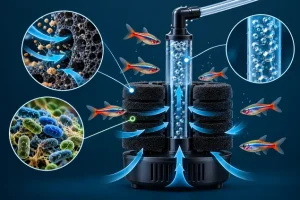
Many pumps sold for sponge filters move several times the air that one nano sponge uses. The surplus becomes a boiling surface, a jet from the uplift tube and a louder hum. The best air pump for a sponge filter in a 5 to 10 gallon tank delivers 0.3 to 1 L/min to the sponge in 5 gallons and 0.5 to 1.5 L/min in 10 gallons. A pump rated near that needs no adjustment. A larger pump needs a dial or a valve. Gallons are United States gallons (5 gal is 19 L, 10 gal is 38 L).
Best air pumps for sponge filters at a glance
| Pump | Choose it for | Rated airflow | Output control |
|---|---|---|---|
Tetra Whisper 10 / 20 | The default for 5 / 10 gallons | 0.5 / 1 L/min | Valve in the line |
Active Aqua AAPA3.2L | A dial on the pump | 3.2 L/min, set low | Dial |
EHEIM air100 | Long service, published spare parts | 1.67 L/min | Knob |
HITOP 2 W | A budget kit with valves | 1.5 L/min | Regulating valve in the kit |
Hygger HG199-2W | Power cuts | 1.5 L/min | 6 levels |
Rated airflow is the maker’s figure with the airline open to the room.
The Tetra Whisper is the default. Its rated output already sits inside the range, so nothing needs throttling. Pick another pump only for the reason in the table.
Best air pumps for sponge filters reviewed
Tetra Whisper 10 and 20
Tetra rates the Whisper 10 at 0.5 L/min and the Whisper 20 at 1 L/min. Both have one outlet, run on 115 V and carry a two-year warranty that excludes rubber parts. Use the 10 for a 5 gallon tank with one small sponge. Use the 20 for a 10 gallon tank or a larger sponge.
Tetra publishes no wattage, pressure rating, decibel figure or control on the pump. The manual says to regulate air with valves in the line. The listing does not mention tubing or a check valve in the box, so both are an extra purchase. A repair kit is listed only for the 60 and 100. Tetra sells UL-listed and non-UL versions, so the box label decides which one arrives.
Active Aqua AAPA3.2L
Hydrofarm lists 2 W, 3.2 L/min and 120 V. The pressure rating is more than 2.319 psi (about 16 kPa). The warranty is one year, an ETL registration is listed, and a dial sits on top of the case. The maker claims 40 dB at most. At 3.2 L/min the pump delivers more than double the top of the 5 gallon range. The dial is set low and left alone.
The pump is sold for hydroponics. The maker claims no aquarium or sponge filter use and names no spare diaphragm. The spec table lists 1/4 inch tubing while standard airline is 3/16 inch, so check that the hose seals on the outlet.
EHEIM air100
EHEIM’s manual rates the air100 at 100 L/h (1.67 L/min), 3.0 W at 120 V and 2 m of head. A knob sets the air volume. EHEIM’s pages list a three-year warranty for the range, and the manual carries a spare-parts table. None of the other pumps here publishes one. The body measures 3.6 x 5.9 x 3.0 in, larger than the budget pumps.
EHEIM has no product page for the 120 V version in the United States, and few stores stock it. Choose it to keep one pump running for years. The budget pumps run a sponge filter for far less.
EHEIM air pump manual (PDF) · Stockist
HITOP 2 W single outlet
HITOP lists 25 GPH (1.5 L/min), 2 W and a 3.5 x 2 x 1.6 in body. The kit holds a 1.5 m hose, an air stone, a check valve and a regulating valve. The valve in the kit reduces the output without another purchase. The seller rates the pump for tanks up to 15 gallons and offers 12 months of after-sales service. No pressure or decibel figure is published.
A regulating valve that squeezes the line raises back pressure on a diaphragm pump. A T-piece with an open bleed leg beside it avoids that. Pawfly’s 2 W compact pump belongs to the same class. It states 30 GPH, measures 3.3 x 1.8 x 1.6 in and ships with a check valve, tubing and a stone. No regulating valve is listed.
Hygger HG199-2W
The HG199 switches from mains to an internal 2,600 mAh battery when power fails. Hygger lists 2 W, six airflow levels, an intermittent mode, USB-C charging and a noise claim under 35 dB. The manual gives 24 GPH (1.5 L/min). Hygger claims 48 hours at the lowest setting and 16 hours at the highest, with no test conditions stated, so a middle setting falls between the two. The kit includes an air stone, a check valve and 5.1 ft of tubing.
Also checked
The Fluval A101 (90 to 110 L/h, 2 W, one dial, 2 m maximum depth, two-year warranty) fits the range. Fluval’s air pump page for the United States lists only the A101, A202 and A402. Few retailers carry the A101. Tubing and a check valve are sold separately. The Boxtech K1 (2 W) ships with a stone, check valve, control valve and tube. Its listing names sponge filters.
Pumps to skip for a nano sponge filter
Piezo and USB mini pumps are air-stone pumps. The Hygger HG811 is rated 0.42 L/min and 12 kPa. Its listing says it is “not strong enough to power sponge filter.” The UPETTOOLS Mini USB is rated 3 GPH (0.2 L/min). Its listing says it “only can be used with the matching air stones.” Both sit at or below the bottom of the working range, with no margin for a check valve and a clogging sponge.
Pumps rated for 100 to 600 gallons fail in the other direction. Dual-outlet models from Hygger, AQQA and Uniclife list 3 to 6 L/min (AQQA’s 3 W model lists 100 GPH). That is roughly two to ten times what one nano sponge filter uses. The tank rating on the box does not describe the air that reaches the sponge. These pumps work with a good valve, but most of the output is wasted.
How much air a nano sponge filter needs
Water pressure rises 0.98 kPa per 10 cm of depth. A 5 gallon tank holds 20 to 23 cm of water (2.0 to 2.3 kPa, 0.28 to 0.33 psi). A 10 gallon tank holds 25 to 29 cm (2.5 to 2.8 kPa, 0.36 to 0.41 psi). Makers that publish a rating give 12 to 20 kPa or more. EHEIM and Fluval give 2 m of depth, and Tetra gives up to 8 ft.
The rated airflow is the air moved with the line open to the room. The check valve, the tubing and the sponge’s diffuser all reduce it. No maker publishes a flow curve against depth. A working assumption is 65 to 85 percent of the rating at nano depths, so a 1.5 L/min pump delivers about 1.0 to 1.3 L/min.
No sponge filter maker publishes an air requirement. Hikari rates its Mini for up to 10 gallons and sells it without a pump. Hygger asks for at least 1.5 W for its small HG120, a power figure that says nothing about airflow. The ranges below are derived from airlift behavior and have not been measured on a bench.
| Tank | Water depth | Air at the sponge | Rated output to buy |
|---|---|---|---|
5 gallons (19 L) | 20 to 23 cm | 0.3 to 1 L/min | 0.4 to 1.5 L/min |
10 gallons (38 L) | 25 to 29 cm | 0.5 to 1.5 L/min | 0.7 to 2.5 L/min |
Prefer a pump with a dial or a valve in the kit.
Water lift in an airlift rises with the logarithm of the air flow (Parker and Suttle, 1987). That work used pipes wider than a sponge tube, so the shape carries over and the numbers do not. Doubling the air adds far less than double the water. Above about 1 L/min the extra air mostly becomes splash, noise and a stronger jet. A clogged sponge cuts flow at any air setting.
Too little air shows as a thin bubble stream and no water movement at the top of the uplift tube. Check the sponge, the line, the check valve and the diaphragm before buying a bigger pump.
Too much air shows as a boiling surface, spray outside the tank or a visible jet. Bettas and shrimplets are pushed around. Turn the air down until the surface only ripples. Wild bettas live in still or very slow water, and the betta tank mates guide covers flow for mixed tanks.
Air pump noise and vibration
Every decibel figure in this guide is a maker claim. None states a distance, a weighting or the room noise, and no independent measurement of these pumps exists. Claims run from under 24 dB (Fluval A101) to 40 dB at most (Active Aqua), so they cannot be ranked.
Electromagnetic pumps hum at twice the mains frequency, which is 120 Hz in the United States. A hard cabinet top, the glass or the lid amplifies that hum. Soft feet, a foam pad, slack in the line and no contact with the tank reduce it. Bubble noise at the sponge is a separate source, and it falls as the airflow falls.
Tubing, check valve and air control
Standard airline is 3/16 in (about 4.8 mm) inside diameter, and Hygger asks for standard 4 mm hose. Tubing that clouds or hardens needs replacing.
A check valve is a one-way valve. If the pump sits below the water line and loses power, water siphons back down the airline into the pump. Fluval’s manual recommends a check valve in every installation. Hydrofarm recommends one, and Tetra’s manual says to use one or keep the pump above the water. Fit the arrow so it points from the pump toward the tank.
A check valve lowers the risk, and placement still matters. The safest setup puts the pump on a shelf above the water line and adds a valve. The airline then rises in a loop above the surface before it drops to the tank. Check-valve listings give size and tubing fit. None states the pressure needed to open the valve, so a very weak pump has the least margin. Replace a valve that sticks.
A small control valve sets the bubble stream. On a diaphragm pump, squeezing the line shut raises back pressure and shortens diaphragm life. Fluval’s manual calls a ripped or weakened diaphragm the most common fault. Add a T-piece and let some air bleed through an open leg, or choose a pump with its own dial. One pump feeding two devices splits air by resistance, so the pump must cover the total.
How to set up an air pump with a sponge filter
- Place the pump on foam or a rubber pad, above the water line and clear of the glass and lid.
- Cut 3/16 in airline long enough to leave slack and a rising loop.
- Fit the check valve with the arrow pointing from the pump toward the tank.
- Add a small control valve after the check valve if the pump has no dial. On a larger pump, add a T-piece and leave one leg open.
- Connect the line to the sponge filter’s air inlet. Sink the filter and squeeze the sponge to release trapped air.
- Plug the pump in and watch the uplift tube. Aim for a steady stream and a calm surface.
- Adjust the air in small steps over a day. Rinse the sponge in tank water whenever the flow drops.
The sponge filter guide covers the filters themselves.
Which air pump to buy for a 5 or 10 gallon tank
Buy a Tetra Whisper 10 for a 5 gallon tank with one sponge, plus a check valve and a few feet of airline. Buy the Whisper 20 for a 10 gallon tank. Choose the Active Aqua AAPA3.2L for a dial on the pump and the EHEIM air100 for a pump built to be serviced. The HITOP 2 W is the budget kit and the Hygger HG199-2W covers power cuts. Skip piezo and USB mini pumps, and skip pumps rated for hundreds of gallons.
Air pump for sponge filter: FAQ
Is a check valve needed on an air pump?
Yes when the pump sits below the water line, since water siphons back into the pump after a power cut. Fluval’s manual recommends one in every installation. A pump on a shelf above the water line with a rising loop of airline adds a second layer.
Does an air pump have to be above the aquarium?
Tetra’s manual says the pump should have a check valve or sit above the water level. Hydrofarm says to place it above the water. Above the tank is the safer position.
Can one air pump run two sponge filters?
Yes if the rated output covers both and each line has its own valve. Air splits by resistance, so a clogged sponge on one line sends more air to the other. Check both streams after any change.
Does a betta tank need an air pump?
A betta breathes air at the surface, so it needs no pump. The pump is needed only when an air-driven sponge filter runs the tank, and the air is then turned down to a gentle stream.
How much electricity does an air pump use?
A 2 to 3 W pump uses about 18 to 26 kWh a year, which is the watts multiplied by 8.76.
Stocking for these tanks is in the 5 gallon guide and the 10 gallon guide.
Sources
- Tetra Whisper product page and manual
- Hydrofarm Active Aqua AAPA3.2L product page and instructions
- EHEIM air pump operating manual, revision 03.26
- Fluval A101 product page and A Series manual
- Hygger HG199 manual, HG811 manual, HG120 product page
- Hikari Bacto-Surge product page
- Parker and Suttle 1987, Aquacultural Engineering 6(2):97-110
- Hurtado-Parrado et al. 2019, bettas and pump flow, PMC6685671