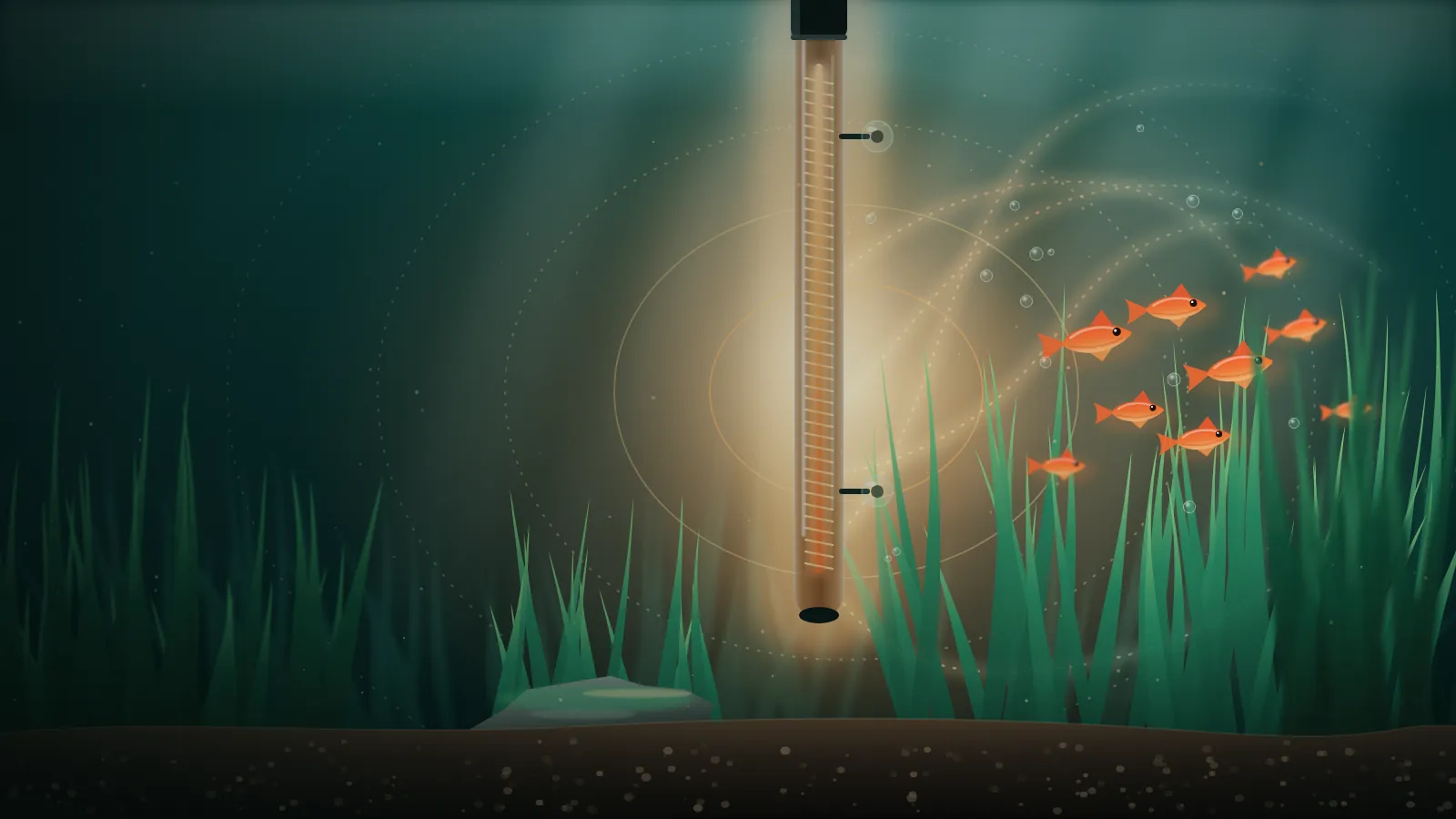
For most tanks get an EHEIM Jäger and size it to your room temperature as well as your gallons. Over about 40 gallons you should run two smaller heaters. Put both on a controller and switch its high-temperature cutoff on. The controller BRS calls the most popular ships with that cutoff set to 212 °F, the temperature water boils at.
Jump to: See the picks · Heater size chart · Wattage calculator · Stop a heater from cooking your tank · FAQ
Best aquarium heaters: quick picks
Best overall
EHEIM Jäger (thermocontrol)
Glass heater with a recalibration ring. Nine sizes from 25 to 300 watts.
- You can correct the dial when it reads off.
- Shuts itself off if it runs dry.
- 3-year warranty that excludes glass damage.
Check first: EHEIM says vertical mounting only, no deeper than 0.5 m.
Choose your wattage from the size table first.
Best for nano tanks and bettas
Fluval P10, P25 and P50
Preset polymer heater. No glass and no dial to bump.
- P10 covers up to 3 gallons. P25 covers up to 6.
- Holds 76 to 78 °F.
- 2-year warranty with proof of purchase.
Check first: You can’t change the temperature.
P10 is for up to 3 gallons, P25 for up to 6 and P50 for up to 15.
Best shatterproof heater
Aqueon Pro
Metal core under thermal plastic. No glass parts.
- Sizes from 50 to 300 watts.
- Adjustable from 68 to 88 °F.
- Limited lifetime warranty with a dated receipt.
Check first: It tops out at 88 °F.
Size it from the table above, not the gallon rating on the box.
Best for 55 to 75 gallons
Two Jägers plus an Inkbird ITC-306A
Two half-size heaters on one controller with its alarms set.
- If one heater dies, the other keeps the tank warm.
- If one sticks on, the tank warms slowly.
- The controller cuts power at your high limit.
Check first: Set the controller’s high alarm. It ships at 212 °F.
One controller runs two heaters. Set the high alarm on day one.
| Situation | Pick | Sizes | Why |
|---|---|---|---|
| Best overall | EHEIM Jäger | 25 to 300 W | Recalibration ring, dry-run shutoff, 3-year warranty |
| Nano tanks and bettas | Fluval P | 10, 25, 50 W | No glass. Sized for small water volumes. |
| 20 to 40 gallons | EHEIM Jäger 75 or 100 W | 75 to 100 W | EHEIM rates 75 W for 15.8 to 26.4 gal and 100 W for 26.4 to 39.6 gal |
| 55 to 75 gallons | Two Jägers + Inkbird ITC-306A | 2 × 100 W or 2 × 150 W | Backup heat, slower runaway, alarms |
| Shatterproof | Aqueon Pro | 50 to 300 W | No glass parts. Tilt, overheat and dry-run shutoffs. |
| Titanium | BRS Titanium Heater System – WiFi | 100 to 600 W | Titanium element on an Inkbird controller |
| Saltwater and reef | Innovative Marine Helio PTC | 100 to 700 W | Detects a heater or sensor out of water. Dual-element options. |
| Canister filter owners | Hydor ETH inline | 200 or 300 W | Nothing inside the tank |
What size aquarium heater do you need?
Size the heater to the gap between your coldest room temperature and your target water temperature. Gallons are only half the answer. For a typical 10 °F gap you need about 50 watts for a 10-gallon tank. You need 75 to 100 watts for 20 gallons and 150 watts for 55. A 75-gallon tank needs about 200 watts.
A heater doesn’t heat gallons. It replaces the heat your tank loses to the room. A tank in a 75 °F room barely loses anything at 78 °F. The same tank in a 63 °F basement loses heat all day. So measure your room on its coldest night first.
| Tank | +5 °F | +10 °F | +15 °F | +20 °F (extrapolated) |
|---|---|---|---|---|
| 5 gal | 15 W | 25 to 50 W | 50 W | 75 W |
| 10 gal | 25 W | 50 W | 75 W | 100 W |
| 20 gal | 50 W | 75 W | 125 W (pair: 2 × 75 W) | 150 W (pair: 2 × 75 W) |
| 30 gal | 50 W | 100 W | 150 W (pair: 2 × 75 W) | 200 W (pair: 2 × 100 W) |
| 40 gal | 75 W | 125 W (pair: 2 × 75 W) | 200 W (pair: 2 × 100 W) | 250 W (pair: 2 × 125 W) |
| 55 gal | 75 W | 150 W (pair: 2 × 75 W) | 250 W (pair: 2 × 125 W) | 300 W (pair: 2 × 150 W) |
| 75 gal | 100 W | 200 W (pair: 2 × 100 W) | 300 W (pair: 2 × 150 W) | 400 W (pair: 2 × 200 W) |
| 100 gal | 125 W | 250 W (pair: 2 × 125 W) | 400 W (pair: 2 × 200 W) | 500 W (pair: 2 × 250 W) |
How we built this table
- We fitted one formula to the published sizing charts of Aqueon, Fluval, Hydor, EHEIM and Finnex: watts ≈ gallons2/3 × temperature rise in °F.
- The 2/3 power is there because heat escapes through the glass and water surface, and surface area grows slower than volume.
- We rounded up to common heater sizes.
- It assumes a lidded glass tank with normal filter flow. Open-top tanks need more.
- It matches Aqueon’s own chart at 75 gallons (200 W for +10 °F and 300 W for +15 °F). It runs one size higher than Aqueon at 55 and 100 gallons for a +15 °F rise.
- No manufacturer publishes a +20 °F chart. Hydor’s 22 °F column is the closest, so treat our +20 °F column as an estimate.
How do you size a heater for a 75-gallon tank?
Say your room drops to 68 °F on winter nights and you want 78 °F.
- The rise is 10 °F (78 minus 68).
- The table says 200 watts total.
- Split it into two 100-watt heaters.
Aqueon’s chart agrees: 200 watts for 75 gallons at +10 °F.
If your room drops to 63 °F, the rise is 15 °F. Then you want about 300 watts, or two 150-watt heaters.
Why do brands disagree on 75-gallon heaters?
Ask nine brands and you get answers from 150 to 400 watts. Most of them don’t tell you the room temperature or lid they assumed. That hidden assumption drives most of the gap.
| Brand | Wattage that covers 75 gal | Stated assumption |
|---|---|---|
| EHEIM Jäger | 150 W (rated 53 to 79 gal) | Closed tank, 70 °F room, water up to 79 °F (older manual) |
| Aqueon (2020 manual) | 200 W at +5 or +10 °F; 300 W at +15 °F | Room at 68 to 72 °F |
| Aqueon (2011 manual) | 200 / 200 / 250 W | Same room |
| Finnex HMA | 200 W (rated 60 to 80 gal) | Enclosed tank, about +8 °F |
| Fluval M and E | M300 (80 gal) / E300 (100 gal) | E series: 68 °F room, 78 °F water |
| Marineland Precision | 300 W (up to 80 gal) | None stated |
| Hydor THEO | 300 W at up to +14 °F; 400 W at up to +22 °F | Rise stated |
| hygger HG273 | 300 W (rated 40 to 80 gal) | None stated |
Aquarium heater wattage calculator
Enter your water volume and your coldest room temperature. The estimate uses the same formula as the table above.
An estimate for a lidded glass tank with normal flow. Open-top tanks, drafty rooms and acrylic tanks change the answer. Verify with a thermometer either way.
Why a bigger heater isn’t safer
People buy big heaters “to be safe,” but a heater that sticks on dumps all its watts into the water. A bigger heater cooks the tank faster.
It takes 4,184 joules to warm one kilogram of water by 1 °C, per the USGS. A US gallon of water weighs about 3.8 kilograms.
So a stuck heater can warm your tank by at most about 0.41 °F per hour for every watt of heater per gallon of water. That’s the upper limit, because heat lost to the room slows it down.
| Setup | Watts per gallon | Max warming |
|---|---|---|
| 50 W in a 2.5-gallon betta tank | 20 | About 8 °F per hour |
| 100 W in a 10-gallon tank | 10 | About 4.1 °F per hour |
| 300 W in a 75-gallon tank | 4 | About 1.6 °F per hour |
| One stuck 100 W heater of a pair in 75 gallons | 1.3 | About 0.55 °F per hour |
The smallest tanks are the most dangerous ones to oversize.
- A 100-watt heater stuck on in 10 gallons can take you from 78 to 90 °F in about three hours.
- Hobbyist engineer BeanAnimal reached the same numbers for a 100-gallon tank: a stuck 150-watt heater adds about 0.6 °F per hour, and a stuck 500-watt heater adds about 2 °F per hour.
Two half-size heaters fix most of this.
- If one sticks on, it climbs half as fast.
- A stuck half-size heater can only push the water about half as far above room temperature as the pair. Say your pair is sized for a 15 °F rise and a summer day warms the room to 75 °F. One stuck half tops out around 82 to 83 °F. One stuck full-size heater could reach 90 °F.
- If one dies, your tank settles about halfway between room and target instead of crashing.
The last two points are our estimate. They assume heat loss grows in step with the temperature gap.
How we picked these heaters
We ranked heaters on reliability first. Then came safety features, accuracy, build material, adjustability, warranty and price.
- Reliability. Nobody publishes failure rates. So we read about 130 owner threads on Reddit, FishLore, MonsterFishKeepers, AquariumAdvice, ReefCentral and Reef2Reef. We counted first-hand reports per model. Those are anecdotes and don’t measure failure rates. We also checked CPSC, Health Canada and UK recall records.
- Accuracy. We used the one lab test we could verify. Bulk Reef Supply set five 300-watt heaters to 78 °F in 60-gallon tanks for 24 hours. They tested one unit per model, and BRS sells all of them. So treat it as a single data point.
- Specs and safety. Every spec comes from the manufacturer’s manual or product page.
- Warranty. We read the fine print. Several warranties exclude glass, require an authorized seller or need registration. Keep your receipt. EHEIM, Aqueon and Fluval all ask for proof of purchase.
The best aquarium heaters compared
1. EHEIM Jäger (thermocontrol): best overall
The Jäger is the heater most experts and owners keep coming back to. BRS made it the “Better” pick in its December 2025 heater video and called it the best budget heater in its April 2025 roundup. In our owner tally it had the most long-life reports, about 54 across 42 threads.
Its edge is the recalibration ring. In BRS’s lab test the Jäger settled at 76.1 °F when set to 78 °F. Four of the five heaters in that test missed their setting. The Jäger is one you can correct. Measure your water with a good thermometer, then turn the red arrow to match.
- Sizes: 25, 50, 75, 100, 125, 150, 200, 250 and 300 W
- Range: 65 to 93 °F (18 to 34 °C), with control accuracy of ±0.5 °C per EHEIM
- Safety: switches off if it runs dry, then switches back on after it cools
- Mounting: vertical only, no deeper than 0.5 m
- Warranty: 3 years, but it “does not include glass damage”, and EHEIM requires an authorized retailer
Buy it if
- You keep a freshwater or reef tank from 5 to 100+ gallons.
- You’ll spend two minutes calibrating it.
- You want in-between sizes like 75 or 125 W.
Skip it if
- You need to mount it flat. EHEIM says vertical only.
- Your sump is deeper than 0.5 m.
- You keep big, rough fish or turtles that can break glass.
What owners report (anecdotes, not rates)
Lots of decade-long success stories. One owner wrote that “the last one lasted over a decade.”
But we also counted 16 reports of units sticking on or running hot. Many date from about 2017 on, including units that wouldn’t go below 80 to 84 °F. One owner’s 75-watt unit would “stay at 90 no matter what” it was set at. It was replaced at no charge. So calibrate it and watch it for the first two days.
EHEIM’s 2018 and 2023 manuals said the heater “may not be operated with an additional timer or an additional control system.” The July 2025 edition no longer has that sentence. Plenty of owners and retailers run Jägers on controllers. We’re reporting what the manuals say.
Check the seller on the Amazon listing. EHEIM’s 3-year warranty applies only if you buy from an EHEIM-authorized retailer.
2. Fluval P: best for nano tanks and bettas
Small tanks need small heaters with a thermostat, and the Fluval P is both. It has no glass. Fluval describes the shell as “tough polymer so that it will not crack or break like traditional glass sleeve heaters.”
- Sizes: P10 (up to 3 gal), P25 (up to 6 gal), P50 (up to 15 gal)
- Temperature: preset to 76 to 78 °F. It shuts off when it gets there.
- Warranty: 2 years with proof of purchase
Buy it if you keep a betta, a shrimp tank or a nano fish community and want nothing to bump or break. Skip it if you need a different temperature. Then get an EHEIM Jäger 25 or 50 W instead. EHEIM rates the 25 W for 5.2 to 6.6 gallons.
The small size is a safety feature. A 10-watt heater can’t overpower a 3-gallon tank the way a 50-watt one can.
The manual has two odd lines. One says don’t immerse it “below the MAX. water level line.” Another says to keep it “completely submersed at all times.” Keep it under water and above the minimum line and you’re fine. Owner reports were too thin to judge long-term reliability.
Keep your receipt. Fluval’s warranty needs proof of purchase.
Alternative: the Sicce JOLLY PRESET comes in 6, 12, 25 and 35 W and holds 77 °F. BRS picked it as its “Good” option in December 2025. Don’t confuse it with the plain JOLLY. Sicce says the plain one “is always on when submersed.”
3. Aqueon Pro: most durable shatterproof heater
The Aqueon Pro has no glass at all. Aqueon describes a “metal core covered in thermal plastic.” So there’s no glass to shatter when a big cichlid slams into it.
- Sizes: 50, 100, 150, 200 and 300 W
- Range: 68 to 88 °F, accurate to ±1 °F per Aqueon
- Safety: shuts off if the top tilts below the bottom. Also shuts off when it overheats and resets when it cools. Aqueon says it’s protected against dry conditions.
- Warranty: limited lifetime. That means “for the life of the product,” for the original buyer only, with a dated receipt. You pay shipping to Aqueon.
Buy it if you keep rough fish, have kids around the tank or have broken glass heaters before. Skip it if you need more than 88 °F.
What owners report (anecdotes, not rates)
Mostly long runs. One keeper ran seven Pros “very accurate within 1 degree.” Another keeper with many tanks reported body splits and electrical leaks across several units. Plastic doesn’t crack like glass, but plastic heaters can still fail.
Ignore the gallon rating on the box. Aqueon rates the 100 W for up to 40 gallons on its site and 15 to 40 in its manual. Retailers list up to 30. Use the size table above.
Size it from the table above, not the gallon rating on the box.
That Pet Place charged $62.99 for 100 W and $69.99 for 300 W. The 150 and 200 W sizes sat in between.
4. BRS Titanium Heater System – WiFi: best titanium
Titanium heaters can’t shatter. But the element alone has no thermostat. BRS says it “does require a controller to operate.” This system pairs a titanium element with an Inkbird ITC-306A controller. BRS says the element is made by Schego in Germany.
- Sizes: 100, 200, 300 and 600 W
- Controller: two probes, two relays, two outlets and Wi-Fi alerts. The second probe flags a bad reading.
- Warranty: 3 years on the element, 1 year on the controller
Buy it if you run a sump, a big tank or saltwater. Skip it if you won’t set the controller’s alarms. Out of the box the high cutoff sits at 212 °F.
BRS sells this system and also ranks it. Its own customer reviews on the system pages averaged between 53 and 75 percent on Oct 5, 2026. One reviewer wrote that the controller “kept the heating element on.” The controller is the part that needs watching. BRS itself suggests replacing the Inkbird yearly.
BRS sale prices ran from $96.38 for 100 W to $117.44 for 600 W. The 300 W was $105.29.
5. Innovative Marine Helio PTC: best for saltwater and reef
If your reef is worth thousands, this is the heater with the most built-in checks of any we looked at. Its PTC elements limit their own temperature. Innovative Marine says that “as the heating element gets hotter, it will become relatively more difficult to become hotter.”
- Sizes: 100, 200 and 350 W, plus dual-element 200, 400 and 700 W
- Controller: 59 to 95 °F, ±1 °F, with error codes for a heater out of water or low flow (E5, E6) and a sensor out of water (E7)
- No Wi-Fi or app. Alarms only sound at the tank, so you won’t hear one from work.
- Warranty: 5 years on electrical parts. Register online within 14 days or the warranty is void.
The E7 code matters most. A probe that slips out of the water reads room air. If the room is cold, the controller keeps heating. One reef owner in our threads lost livestock that way at 96 °F. The Helio watches for it.
What owners report (anecdotes, not rates)
Mostly positive, like “bullet proof in my tank over 2 years.” One owner’s unit decided its sensor was out of the water and stopped heating. The alarm had been silenced, so nobody noticed for several days. Another saw a new unit drift 1 to 1.5 °F. Don’t silence alarms without checking the tank.
BRS sale prices ran from $132.80 for 100 W to $306.40 for the 700 W dual. The 700 W lists at $383 when it isn’t on sale.
6. Hydor ETH: best inline heater
If you run a canister filter, an inline heater keeps the display empty. The ETH sits on the return hose and uses a PTC element. It holds 65 to 93 °F.
- Sizes: 200 W (12 or 16 mm hose) and 300 W (16 mm hose)
- Mounting: Hydor’s manual says “VERTICAL POSITION ONLY”
- Rule: it can’t run dry, and trapped air “can cause irreversible damages”
It only heats water that flows through it. So if your filter stops, your heat stops. Skip it if your filter is often off for cleaning.
$74.99 for the 300 W at Talis US. The 200 W versions were out of stock there.
7. Inkbird ITC-306A: the controller that pairs with any of these
A controller turns your heater on and off from its own probe. On a big tank it’s the first upgrade we’d add. But it only protects you once you set it up.
- Load: heating only, two outlets switched together, up to 1,200 W at 120 V
- Protection: two probes, two relays, Wi-Fi alerts
- Timer: cuts power if heating runs 6 hours without reaching the set point (default)
- Calibration: ±15 °F offset, so you can match it to a reference thermometer
Set the high alarm the day you unbox it. Inkbird’s manual says the high-temperature alarm “will alarm and turn off heating output.” But its default is 212 °F. The low alarm defaults to 32 °F. Until you change them, neither will ever trigger in a fish tank. Set the high alarm 2 to 3 °F above your target.
What owners report (anecdotes, not rates)
Many years of good service. Also probes that drifted, including one that crept from 80 to 116 °F while the water stayed normal. And probes that fell out of the water. Check your probe placement every time you work in the tank.
Plug both heaters into it, then set the high alarm 2 to 3 °F above your target.
Glass vs shatterproof vs titanium vs PTC vs inline
| Type | Strengths | Weak spots | Best for | Example |
|---|---|---|---|---|
| Glass with built-in thermostat | Cheap. Widest size range. Some can be recalibrated. | Glass can crack. EHEIM’s warranty excludes glass damage. Thermostats can stick. | Most freshwater tanks | EHEIM Jäger, Fluval M |
| Shatterproof plastic | No glass to break. Aqueon Pro adds tilt and dry-run shutoffs. | All three U.S. heater recalls we found involved plastic-bodied heaters. Max 88 °F on the Aqueon Pro. | Rough fish, busy homes | Aqueon Pro, Fluval P |
| Titanium + controller | Can’t shatter. Thermostat sits outside the water. Alarms and Wi-Fi. | Element has no thermostat. The controller becomes the part that can fail. | Saltwater, sumps, big tanks | BRS titanium system |
| PTC element | Element limits its own temperature. Helio flags dry elements and loose sensors. | Still needs a thermostat. Pricey. PTC elements draw extra power at switch-on. | High-value reef tanks | Helio PTC, Hydor THEO |
| Inline | Nothing in the tank | Vertical only. Can’t run dry. Stops heating when the filter stops. | Canister filter tanks | Hydor ETH |
| Fixed-output pad or mini | Tiny and cheap | No thermostat. Aqueon says to remove its mini and flat heaters when the room tops 78 °F. | Avoid for bettas unless on a controller | Aqueon Mini, Aqueon Flat |
So which type should you buy?
- New freshwater tank: glass you can recalibrate, or shatterproof plastic.
- Big or rough fish: plastic or titanium.
- Saltwater or a sump: titanium or PTC on a controller with alarms.
- Betta: anything with a thermostat. Never use a fixed-output pad on its own.
About PTC inrush: Schego says its 600-watt PTC element draws about 950 watts for a moment at switch-on. If you pair PTC elements with a controller, make sure the controller can handle that.
Best heater by tank size
Best heater for 3 to 5 gallons and bettas
You need 15 to 50 watts depending on your room. Get a Fluval P10 or P25, or an EHEIM Jäger 25 W if you want to adjust it.
Three mistakes can kill bettas here:
- A fixed-output pad with no thermostat.
- A heater that’s too big. A 50-watt heater stuck on in 2.5 gallons can climb about 8 °F an hour.
- Corner placement. Three separate betta threads on Reddit describe fish trapped between a heater and the glass, some fatally. Leave a gap.
Best heater for a 10-gallon tank
Plan on 25 watts if your room sits 5 °F below your target, 50 at 10 °F and 75 at 15 °F. EHEIM rates its 50 W for 6.6 to 15.8 gallons. The common mistake is buying 100 watts “to be safe.” If it sticks on, it adds about 4 °F an hour.
Best heater for a 20-gallon tank
Plan on 75 watts for a 10 °F rise, though Aqueon rounds up to 100. An EHEIM Jäger 75 W covers 15.8 to 26.4 gallons. Put your thermometer at the far end from the heater, like Aqueon suggests. Planning stock? See our guide to the best fish for a 20 gallon aquarium.
Best heater for 30 to 55 gallons
You need 100 to 150 watts at a 10 °F rise and up to 250 at 15 °F. Around 40 gallons, two heaters start to make sense. Aquarium Co-Op recommends “two 100W heaters rather than one 200W heater.” BRS says the same for a 50-gallon tank. Put them in the flow at opposite ends.
Best heater for a 75-gallon tank: one or two?
Two. Use 2 × 100 W if your room stays near 68 °F and 2 × 150 W if it drops to about 63 °F. Put one at each end near the flow. Aqueon suggests a second heater for cold rooms. Aquarium Co-Op and BRS both prefer two smaller heaters.
Two heaters help in two ways:
- If one dies, the other holds part of the heat.
- If one sticks on, the tank climbs about 0.55 °F an hour instead of 1.6.
There are downsides too:
- You pay for two and need two outlets, though one controller can feed both.
- You also have two heaters that can fail.
- Mixed brands won’t agree on temperature. In the BRS test, five heaters all set to 78 °F settled anywhere from 75.2 to 77.8 °F.
So buy a matched pair and calibrate both.
Best heater for saltwater and reef tanks
Same wattage math, higher stakes. University of Florida extension material puts reef temperature “between 76°F–83°F.” Use titanium or PTC on a controller with alarms. In a sump, keep heaters and probes out of the return chamber. BRS warns it “increases the risk of exposure to air” as water evaporates. Marineland’s manual goes further and says never to put its heaters in a sump.
Best heater for a turtle tank
Big turtles can break fish heaters.
- The Royal Veterinary College says underwater heaters “are generally designed for fish, so can be easily destroyed and dangerous to large boisterous turtles.” It says heat sources should be guarded.
- The RSPCA calls for “an aquarium heater with a guard and an inbuilt thermostat.”
- Vets suggest a partition or a drilled PVC pipe over the heater.
- Zoo Med says to unplug its TurtleTherm if your turtle tries to bite or chew any part of it, cord included.
- Turtle tanks often run low water. Keep the heater above its minimum line and size it to the real water volume.
- Water temperature depends on the species. For red-eared sliders VCA gives 75 to 82 °F, so check your species with your vet.
How heaters fail, and how to stop one cooking your tank
A heater fails one of two ways. Stuck on cooks the tank and stuck off chills it. BRS calls a broken relay or switch “the most common failure.” Hobbyist engineer BeanAnimal explains why. The thermostat contacts arc every time they switch, and “it is not uncommon for the contacts to weld themselves together.” Controllers aren’t immune either. Inkbird’s ITC-306T manual warns that old relays can suffer “contact fusing or burning.”
In the threads we read, owners woke up or came home to tanks at 96, 100 and 105 °F. One lost every fish in a 60-gallon tank, discus included. No heater is failure-proof, so build a setup that survives one failing.
| Failure | What you see | How to prevent it |
|---|---|---|
| Stuck on | Temperature climbing past your setting. Fish breathing faster. | Two half-size heaters. A controller with its high alarm set. Heater dials set 1 to 2 °F above the controller. |
| Stuck off | Temperature drifting down. Aqueon links sudden drops to ich outbreaks. | A second heater and a low-temperature alarm |
| Cracked glass or water inside | A crack, fog or water in the tube | Keep it off gravel and rocks. Follow the warm-up and cool-down waits. If cracked, cut power at the breaker before you touch anything. |
| Pulled out while hot | Hot glass in air | Don’t put it back in the water. EHEIM and Fluval say let it cool for at least an hour. |
| Controller probe out of water | A probe in cold room air reads cold, so the heater keeps running | A second probe, the Inkbird 6-hour timer, or a Helio-style sensor alarm. Plus each heater’s own dial set just above target. |
| Sump water drops | Heater or probe in the return chamber hits air | Keep both out of the return chamber |
| Power outage | Nothing heats | Insulate the tank. Add warm dechlorinated water slowly. Don’t feed. |
How to build a failure-proof heater setup
- Two heaters, each about half the total from the size table, at opposite ends near the flow.
- A controller as the main thermostat. Set each heater’s own dial 1 to 2 °F above the controller target. BRS recommends that offset. Neptune Systems says to set a heater’s internal thermostat “slightly above” the controller’s off temperature. Then if the controller sticks on, the heater’s own thermostat still stops at your limit.
- Set the alarms. High alarm a few degrees above target, a low alarm, and the continuous-heating timer left on.
- An independent thermometer at the far end of the tank. Hydor warns that “a number of thermometers on the market are not accurate!” Calibrate against a good one.
- A drip loop and a GFCI outlet. Every manual we read asks for a drip loop. Zoo Med requires a GFCI. The CPSC says to test GFCIs monthly and after every power failure.
Not everyone agrees on step 2. Some reefers flip it. They let the heater run the tank and set the controller a few degrees higher as an emergency cutoff. Hydros recommends keeping a heater with its own thermostat as a backup in case the controller loses connection. Both setups beat a lone heater. Whichever you choose, set the alarms.
One more check if you use a controller. Make sure your heater keeps its setting after the power cycles. At least one owner reports an electronic heater going back to its default temperature after a power cut.
Recalls: why “shatterproof” isn’t “failure-proof”
We checked the CPSC’s recall database. All three U.S. aquarium heater recalls we found involved plastic-bodied heaters.
See the recalls we found
| Date | Product | Hazard |
|---|---|---|
| April 2011 (CPSC) | Marineland Stealth and Stealth Pro, about 1.2 million units | Wiring problem that could overheat or break the heater. 38 fire reports and 45 broken-glass reports. |
| August 2014 (CPSC) | Top Fin plastic heaters, about 33,000 units | “Insufficiently grounded, posing a risk of electrical shock” |
| June 2015 (CPSC, Health Canada) | Top Fin plastic heaters, about 112,200 units in the U.S. by the CPSC’s count | Fire or shock risk. 13 incidents reported, including 7 overheated tanks. |
| October 2024 (UK OPSS) | No-name 25 W and 50 W heaters sold via Amazon | “Inadequately earthed.” Turned away at the border. |
Health Canada lists a UL certification number on the recalled Top Fin units. So a safety mark helps, but it’s no guarantee. Aquarium heaters have their own safety standards, UL 1018 in the U.S. and IEC 60335-2-55 internationally. On a no-name marketplace heater, look for a recognized listing mark before you trust it with your fish.
What owners report (these are not failure rates)
We read about 130 owner threads and counted first-hand reports per model. These are anecdotes. Popular heaters show up more because more people own them. Angry owners post more than happy ones. So use it to spot patterns and don’t use it to rank brands.
See the owner counts by model
| Model | Threads | Long-life reports | Stuck on or ran hot | Stopped heating | Cracks, leaks, shocks, fire |
|---|---|---|---|---|---|
| EHEIM Jäger / thermocontrol | 42 | About 54 | 16 | 6, plus 5 unstated | 5 |
| Fluval E | 22 | About 19 | 0 clear cases | About 12 (mostly cool rooms) | 1 |
| Cobalt Neo-Therm | 13 | 11 | 9 | 0 | 3 |
| Aqueon Pro | 12 | 10 | 1 owner, several units | 3 | 5 |
| hygger (all lines) | 17 | About 14 | 4 | 6 | 8 |
| Top Fin | 9 | 2 | 1 | 4 | 2 |
| Fluval M | 10 | 7 | 1 | 2 | 0 |
Two patterns stand out. Cobalt won the lab test but still drew nine stuck-on reports in 13 threads. And Fluval E’s complaints were about underpowering and displays. We found no clear case of one cooking a tank. One owner who ran 50 Fluval E heaters wrote that their two failures “both times” shut off “instead of cooking the tanks.”
How to set up an aquarium heater
- Pick a spot in the flow. EHEIM says “place the heater in an area with a strong flow.” Fluval says near a filter or pump output. Keep it off gravel and rocks. Heaters rely on circulation. So if your tank has no filter, read our filterless nano aquarium guide first. A gentle sponge filter near the heater helps.
- Check your model’s mounting rule, because the manuals disagree. EHEIM says vertical only. Aqueon recommends horizontal near the bottom. Hydor’s inline ETH is vertical only.
- Respect the water lines and keep the heater above its MIN mark. EHEIM sets a max depth of 0.5 m. Some Fluval M units also have a MAX line.
- Let it sit before you plug it in. The waits run from a few minutes to 30 minutes, brand by brand (see the table below).
- Set it, then wait 24 hours. Aqueon says to run it a full day before adjusting. EHEIM says to readjust after 1 to 2 days if the dial and thermometer disagree.
- Check it with a separate thermometer at the far end of the tank. Then calibrate if your model allows it.
- Make a drip loop and plug into a GFCI.
- At every water change, unplug first. Then wait out the cool-down before the heater touches air.
- Clean it now and then. Fluval says deposits on the glass can “impair the heating performance and the sensitivity of the thermostat.” Look for fog or water inside the tube. Aqua One says to stop using a heater with moisture inside.
See wait times by brand
| Brand | Wait before plugging in | Wait after unplugging, before removing |
|---|---|---|
| Hydor THEO | “A few minutes” | 5 minutes |
| Fluval P and compact | 10 minutes | 30 minutes |
| Cobalt, Marineland | 15 minutes | 15 minutes |
| Fluval E | 20 minutes | 30 minutes |
| EHEIM | 20 to 30 minutes | 30 minutes |
| Aqueon | 30 minutes | Not stated in the manuals we read |
Lost your manual? Wait 30 minutes both ways, which satisfies every manual we read. The waits exist because of thermal shock. Glass can crack when its temperature changes fast.
Aquarium heater troubleshooting
| Symptom | Likely cause | What to do |
|---|---|---|
| Tank too cold | Heater too small for your coldest room, set too low, below the MIN line, poor flow, limescale, or a wrong thermometer | Recheck the size table. Raise the water. Improve flow. Clean the heater. Confirm with a second thermometer. |
| Tank too hot | Stuck thermostat or relay. Evaporation shrank the water volume. A warm room. | Unplug it and check with a thermometer. Top off evaporated water. A heater can’t cool a tank in a hot room. |
| Light on, no heat | Failed element, or the thermometer is wrong | Check with a second thermometer. Then replace the heater. |
| Temperature swings | Heater out of the flow, wide controller range, drafts or sun | Move the heater into flow. Narrow the controller’s range. Move the tank away from windows and vents. |
| Won’t turn on after a water change | A dry-run cutoff tripped, or a GFCI tripped | Resubmerge and wait. EHEIM restarts on its own after cooling. Fluval E error E1 needs an unplug to reset. Reset the GFCI. |
Can you repair an aquarium heater?
No. Replace it. Every manufacturer we checked says not to open or repair heaters yourself. EHEIM says “repairs must only be carried out by an EHEIM service centre.” Power cords can’t be swapped either. EHEIM’s U.S. manual says a damaged cord means the heater “must be discarded.” So use your warranty if you’re inside it. Warranties run from 90 days on Aqueon’s mini heaters to lifetime on the Aqueon Pro.
How long do heaters last? No manufacturer publishes a lifespan. BRS sells heaters and suggests replacing them every 1 to 2 years. Aquarium Co-Op’s own heater is now discontinued. It lit an end-of-life light after “17,520 hours, which is 2 years” of running. Treat those as opinions. Your thermometer tells you more than any schedule.
Aquarium heater FAQ
What is the most reliable aquarium heater?
Nobody publishes failure rates, so nobody can honestly name one. The most reliable setup is two half-size heaters on a controller with its alarms set. In the one lab test we could verify, only 1 of 5 heaters held within 0.2 °F of its setting out of the box.
What size heater do I need for a 75 gallon tank?
About 200 watts if your room is 10 °F colder than your target, split into two 100-watt heaters. If the gap is 15 °F you need about 300 watts or two 150-watt heaters. Aqueon’s own chart gives the same numbers.
How many watts per gallon does an aquarium heater need?
Plan on about 0.3 watts per gallon for every °F you raise the water above room temperature. That works out to the familiar 3 to 5 watts per gallon at a 10 to 15 °F rise. Small tanks need a little more per gallon.
What is the best aquarium heater for a small tank?
Get a heater with a thermostat sized for the tank, like a Fluval P10 or P25 or an EHEIM Jäger 25 W. Avoid fixed-output pads with no thermostat. Small tanks overheat fastest if a big heater sticks on.
What is the average lifespan of an aquarium heater?
No manufacturer publishes one, and warranties run from 90 days to lifetime. Retailer BRS suggests replacing heaters every 1 to 2 years. Your thermometer tells you more than any schedule.
Do I need an aquarium heater?
Yes if you keep tropical fish. Aqueon says tropical fish do best between 75 and 80 °F, while goldfish and other cold-water fish prefer water below 70 °F.
Can I leave an aquarium heater on all the time?
Yes, if it has a thermostat. It switches itself on and off. Fixed-output mini and flat heaters are the exception. Aqueon says to remove those when your room is above 78 °F.
Does an aquarium heater need to be fully submerged?
Most modern heaters are fully submersible but need water above their MIN line. A few, like some North American Fluval M units, also have a MAX line. Check your manual.
Can I use two heaters in one tank?
Yes, and on bigger tanks you should. Two half-size heaters give you backup heat if one dies. The tank also warms slower if one sticks on. Buy a matched pair and calibrate both.
How do I know if my aquarium heater is broken?
Let it run 24 hours, then compare your tank against a separate thermometer. A heater with a crack, fog or water inside the tube is done. Cut the power at the breaker, then remove it.
The bottom line
For most tanks, buy an EHEIM Jäger sized to your coldest room and calibrate it on day one. For a betta or nano tank, get a Fluval P or a small Jäger and never a fixed-output pad. At 55 gallons and up, run two half-size heaters on a controller. Then set the controller’s high alarm, because out of the box it sits at 212 °F. For rough fish, the Aqueon Pro has no glass to break. For saltwater, use titanium or the Helio PTC on a controller with alarms.
Heaters fail. What decides whether you lose fish is the setup around the heater. Set the controller’s high alarm the day it arrives.
Sources and spec checks
Show all sources
- Aqueon heater guide and water temperature article: sizing by temperature rise, tropical and cold-water ranges.
- EHEIM thermocontrol product page, 2025 manual and 2023 manual: sizes, range, mounting, warranty, controller wording.
- Fluval E manual and Fluval P manual: rating assumptions, error codes, cleaning, warranty.
- Hydor THEO and Hydor ETH: temperature-rise ratings and inline mounting rules.
- Inkbird ITC-306A manual: default alarm settings and the continuous-heating timer.
- Innovative Marine Helio and warranty terms.
- Bulk Reef Supply heater calibration test: five heaters set to 78 °F for 24 hours.
- CPSC recall records and UK OPSS product safety report.
- USGS on the heat capacity of water: the basis for our warming-rate math.
- Royal Veterinary College turtle care sheet and VCA on housing aquatic turtles.
- BeanAnimal on heater failure and Aquarium Co-Op on choosing a heater.
Last reviewed October 6, 2026. Prices and stock checked October 5, 2026. We’ll recheck prices, stock and recall records every six months.