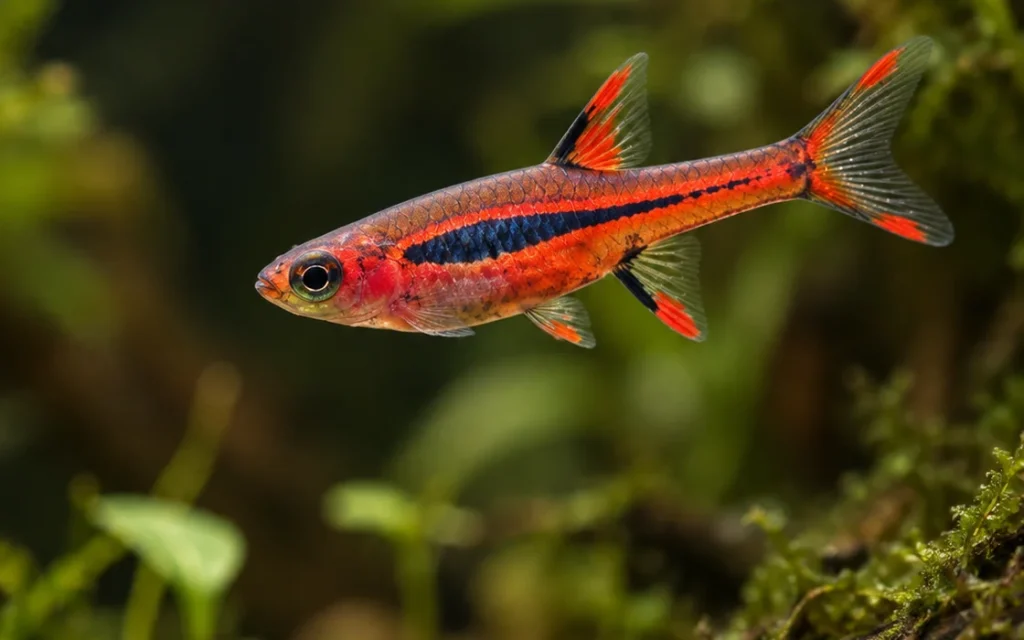
A nano fish can starve in a tank full of food.
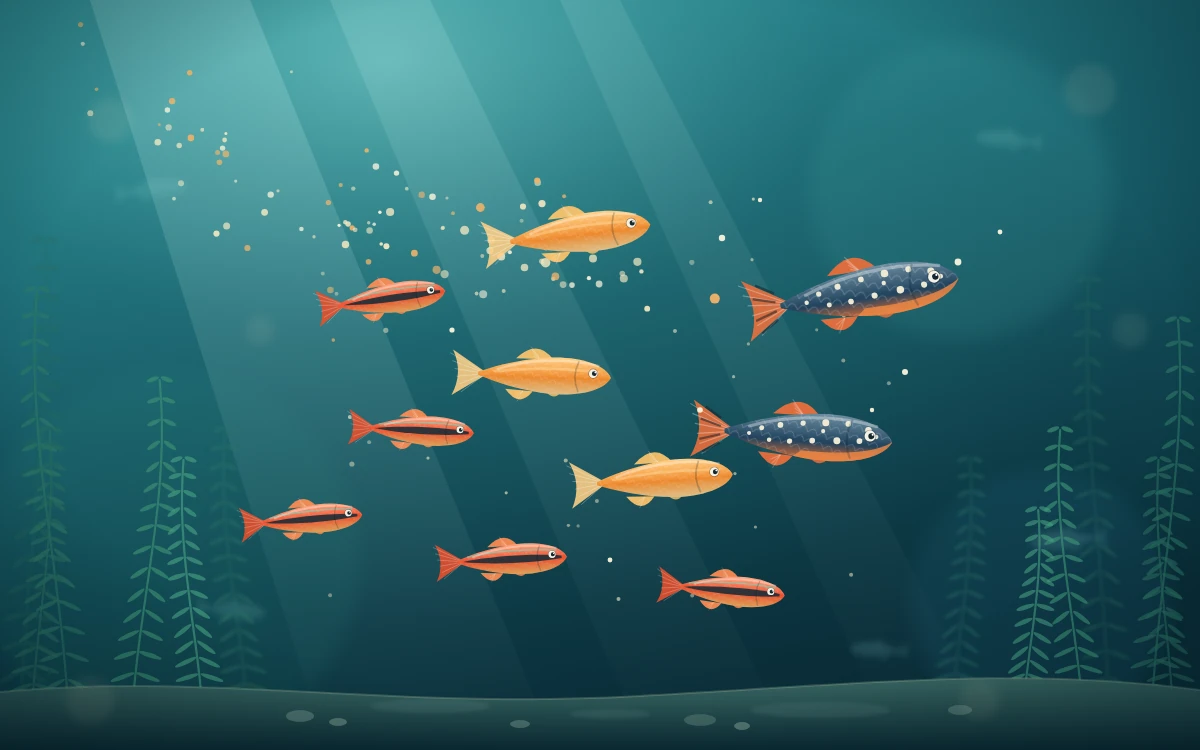
The label can promise 50 percent protein, but a pellet wider than the mouth delivers none of it. Size decides whether a food counts at all. Nutrition is the second question, and for most nano fish it is the simpler one.
No study has measured what a chili rasbora, a celestial pearl danio, or a scarlet badis needs from its food. The nearest data come from betta and guppy, which grow best at 30 to 43 percent protein, and from neon tetra juveniles, which kept growing faster up to the highest level tested, 53.5 percent. Commercial small-fish foods sit at 36 to 50 percent. Nothing in the evidence points to a special nano formula.
Three things do differ: the size of the piece, the place in the tank where it arrives, and the age of the fish. The finder below gives a plan for each fish. The sections after it show the reasoning, so any other fish can be worked out the same way.
Find the food for one fish
Choose a fish.
Chili, phoenix and exclamation point rasboras
Boraras brigittae, B. merah, B. urophthalmoides
- Staple
- Crushed flake or the finest granule. Hang it in the water, since settled food is ignored.
- Piece size
- 0.1 to 0.5 mm
- Frozen
- Baby brine shrimp, then cyclops once the fish are seen eating them.
- Live
- Newly hatched brine shrimp, microworms, copepods.
- Watch for
- Faster tank mates take the meal first. Algae wafers and spirulina flakes suit grazers. These fish hunt small prey.
Where no study exists for a species, the plan follows the nearest studied relative and says so.
Mouth size comes before nutrition
A tiny fish needs smaller pieces. Nothing shows that it needs a different diet.
Fish farming supplies the only published rule. Food works best at about 20 to 50 percent of mouth width, measured on sardine larvae, hatchery fish, and juvenile bass. No one has published a mouth width for a chili rasbora, a celestial pearl danio, or any other fish in this guide.
Numbers that circulate for these species have no source. A Boraras mouth of 0.1 to 0.2 mm appears on retail blogs without a reference. The rule that food should be no larger than the eye has none either.
Measured food sizes do exist, and they form a ladder. The chart puts live and dry foods on one scale. Bars show measured sizes or sizes printed by the maker, and a product with no printed size has no bar.
- American ultra-fine crumble100 to 200 µm · maker
- Small rotifer (S-type)100 to 210 µm · FAO manual, saltwater strain
- Copepod nauplius, first stageabout 120 µm long · freshwater cyclopoid
- Paramecium130 to 190 µm · larval feeding trial
- Microworm, juveniles180 to 290 µm long · UF/IFAS
- NatureHolic Nanofeed0.2 mm · retailer
- Moina, youngunder 400 µm · UF/IFAS
- Tetra Micro Granules0.3 to 1 mm · maker
- Tetra Micro Pellets0.4 to 1.2 mm · maker
- Newly hatched brine shrimp430 to 520 µm · FAO manual
- NorthFin Nano Bits0.5 mm · maker
- American krill-based nano pellet0.5 mm · shop page
- Ultra Fresh micro pellets0.6 mm · retailer
- Brine shrimp after 12 to 48 hours of enrichment660 to 790 µm · FAO manual
- Daphnia, newbornabout 0.8 mm · university reference
- Vinegar eel0.96 mm long, only 21 µm wide · measured
- NT Labs Pro-f Nano Tropical1 mm · maker
- Hikari Micro PelletsNo size on the maker page
Log scale from 0.05 mm to 2 mm. A bar spans a measured or stated range. A short bar is a single stated size. The faded bar for Moina means up to 400 µm.
Read the chart from the left. The smallest dry food sold to aquarists is an ultra-fine crumble at 0.1 to 0.2 mm. Almost every pellet sold as micro starts at 0.3 mm and runs up to 1.4 mm, roughly two to nine times larger. Live foods fill the gap below 0.3 mm, which is why fry depend on them in their first days.
What changes with the fish and what does not
| Factor | What the evidence shows |
|---|---|
| Piece width | Changes with the fish. Newly hatched larvae have mouths reported at 0.05 to 0.35 mm. Foods sold for adult nano fish run from 0.1 to 1.4 mm. |
| Feeding level | Changes with the fish. Surface, mid-water, and bottom feeders need food that floats, hangs, or sinks. |
| Gut | Changes with age and group. Neon tetra larvae have no stomach until day 20, and rasboras and danios never form one. |
| Protein range | No difference found. Growth-optimal protein in tested small fish runs from 30 percent in betta to above 50 percent in neon tetra juveniles, and commercial small-fish foods cover that range at 36 to 50 percent. |
| Vitamins, fatty acids, minerals | Unmeasured for nano species. Work on other fish suggests fatty acids matter most in first-feeding larvae. |
Stomach or no stomach
Rasboras, danios, and Trigonostigma have no stomach and chew with pharyngeal teeth. Tetras have a true stomach and a short gut. Since a stomachless fish cannot hold a large meal, small portions fit the anatomy, but no experiment has tested the rule in nano fish.
The two groups also respond differently to the same diet. In a 12-week trial, a lyophilized plankton supplement fed twice a week caused liver fat changes in glowlight rasboras and none in neon tetras. One feeding plan does not suit every fish in a community tank.
The swallow test
No mouth width is published, so the fish supply the measurement. Drop a pinch of food and watch the smallest fish in the group. Four outcomes cover almost every case.
- Taken and keptThe size is right. Keep it.
- Taken, then spat backThe piece is too large or too hard. Crush it between wet fingers just under the surface, so it sinks slowly instead of floating or dropping.
- Ignored while it sinks pastWrong depth. Chili rasboras ignore settled food, and celestial pearl danios rarely rise for floating food. Crush the food finer so it hangs, or feed in two small doses.
- Stuck on the surfaceA hard floating pellet stays on the film. Wet it first, or switch to a granule that sinks.
If crushing does not end the spitting after a few days, move to a finer granule.
Match the food to where the fish eats
Mouth shape follows feeding level. Pencilfish have an upturned mouth built for the upper water, and corydoras have a downturned mouth built for the bottom. Food that arrives at the wrong depth goes uneaten.
Surface and upper water
- Least killifish
- Clown killifish
- Spotted blue-eye
- Medaka
- Endler’s livebearer
- Dwarf pencilfish
Floating flake or a semi-floating granule. Crushed flake suits the smallest mouths.
Mid-water
- Chili rasbora
- Celestial pearl danio
- Ember tetra
- Neon tetra
- Emerald dwarf rasbora
- Kubotai rasbora
- Sparkling gourami
- Hastatus corydoras
A slow-sinking granule or crushed flake, wetted so it hangs. Celestial pearl danios rarely rise for floating food, and chili rasboras ignore settled food.
Bottom
- Pygmy corydoras
- Habrosus corydoras
- Otocinclus
A sinking pellet, dropped after the top feeders are full. Corydoras forage for small prey, so a sinking food with animal ingredients suits them.
Dry food: pellets, granules and flakes
A fine granule works as the staple for most nano fish. Killifish raised on pellets matched bloodworm-fed fish for length and reproduction, and the bloodworm group ate about 7.5 times more food mass for the same growth. Zebrafish on formulated diets grew and spawned normally.
Neither result covers a chili rasbora, so the claim stays modest. Pellets support normal growth in laboratory fish of similar size. They do not work as a first food, and they fail for fish that refuse them.
Pellet sizes by who states them
| Product | Size | Stated by | Label protein / fat | Behavior |
|---|---|---|---|---|
| American ultra-fine crumble | 0.1 to 0.2 mm | Maker | 55% / 6% | Suspends, then settles |
| NatureHolic Nanofeed | 0.2 mm | German retailer | 55% / 17% | Soft granule |
| Tetra Micro Granules | 0.3 to 1 mm | Maker | 53% / 11% (EU label) | Slow-sinking |
| Tetra Micro Pellets | 0.4 to 1.2 mm | Maker | 45% / 11% (EU label) | Floats, then slow-sinks |
| NorthFin Nano Bits | 0.5 mm | Maker | 50% min / 6% min | Semi-floating |
| American krill-based nano pellet | 0.5 mm | Shop page | 52% / 11% | Sinks after seconds, reviewers say |
| Ultra Fresh micro pellets | 0.6 mm | Retailer | None printed | Slow-sinking |
| NT Labs Pro-f Nano Tropical | 1 mm, or 0.8 mm per one retailer | Maker | 54% / 15% | Sinking |
| Hikari Micro Pellets | No size on the maker page. Reviewers report about 0.5 mm. | Nobody | 43% / 7% | Semi-floating |
| Fluval Bug Bites micro granules | 0.25 to 1 mm in retail copy. Verified buyers call them too large. | Retailer | 40% / 12% | Slow-sinking |
Maker sizes are claims. No independent caliper test or feeding trial of any aquarium micro pellet exists. Hikari, Dennerle, and sera Micron print no diameter on their product pages. Protein and fat are label values, minimum or typical as printed.
Which dry food for which fish
| Fish | Look for | Examples by label |
|---|---|---|
| Chili rasbora, phoenix rasbora, celestial pearl danio | The smallest granule. Crush anything above 0.5 mm. | An ultra-fine crumble (0.1 to 0.2 mm), NatureHolic Nanofeed (0.2 mm), Tetra Micro Granules (from 0.3 mm), a krill-based nano pellet (0.5 mm) |
| Ember tetra, neon tetra, emerald dwarf rasbora | A slow-sinking 0.3 to 0.5 mm granule. | NorthFin Nano Bits, Tetra Micro Granules, a krill-based nano pellet (0.5 mm) |
| Pygmy and habrosus corydoras | A sinking pellet with animal ingredients. | A 0.5 mm nano pellet that sinks after seconds, NT Labs Pro-f Nano Tropical (sinking) |
| Endler’s, least killifish, pencilfish, clown killifish | Floating flake or a semi-floating granule. | sera Vipan Baby (insect meal 4%, spirulina 3%) and TetraMin Baby micro flakes, both on European labels, and Hikari Micro Pellets |
| Fry after the first feeding | Powder to 0.3 mm. | An ultra-fine crumble, Hikari First Bites (soak it so it sinks), Golden Pearls, a marine larval diet in 300 to 500 µm |
| Scarlet badis | Not a dry-food fish. | See the refusers section |
These fits follow printed size and behavior. They are not results of feeding trials.
How to read the label
- Ingredients run in descending weight, with no quantities. Fish meal listed first does not mean mostly fish meal.
- The guaranteed analysis gives minimum protein and fat and maximum fiber, moisture, and ash. Fiber above 8 percent is low feeding value.
- European labels list categories such as fish and fish derivatives. American labels name each ingredient. The same brand reads differently on each side of the Atlantic.
- A higher protein figure is not a tested advantage, since no requirement study exists for nano fish.
Flake follows the same size rule. Only the dust of crushed flake suits fry, and breeders report that fry often refuse ground flake. Hikari lists artificial colors (Red 3 and Yellow 5) on its American Micro Pellets label, and no trial links them to better color.
Frozen food
Frozen food adds variety and does not replace the staple. The useful pieces are baby brine shrimp, cyclops, and the smallest daphnia, since they match the size ladder. Bloodworm is the common mistake.
Labels mislead on protein. A frozen baby brine shrimp cube is 97.5 percent water and lists 1.2 percent protein, which is about 48 percent of the dry matter. Compare protein only within one form. Dry food runs 40 to 55 percent, freeze-dried 60 to 66 percent, and frozen 1 to 12 percent as fed.
Bloodworm needs three warnings. Whole larvae are large for the smallest mouths. Specialist references link a bloodworm or Tubifex staple to obesity in scarlet badis. And in a 1992 German study, 36.1 percent of one group of hobbyists who handled bloodworm were sensitized to its allergen, so use tongs or a pipette.
Frozen cyclops and Cyclop-eeze are different animals. The maker of Cyclop-eeze describes it as a decapod microcrustacean of about 800 µm from an Arctic lake, frozen with ethoxyquin added.
Thaw a cube in a cup of tank water and add it with a pipette. Remove what remains. Keepers commonly offer frozen food 2 or 3 times a week, and no study sets a frequency.
Live food: which one for which job
Live food is not automatically better. At first feeding it is the proven choice. For adults, pellets matched live and frozen food in killifish, zebrafish, and guppy trials, so live food earns its place with fry and with fish that refuse dry food. For every other fish, it is variety.
| Live food | Size | Best job | Skip it for |
|---|---|---|---|
| Newly hatched brine shrimp | 430 to 520 µm | Egg-scatterer fry from week 2, livebearer neonates, picky adults | First-feeding larvae, and any use more than a few hours after hatching |
| Microworms | Juveniles 180 to 290 µm, adults 1.5 to 2 mm | A bridge for fry between infusoria and brine shrimp | The first meal of the smallest fry. Dead worms foul water within hours |
| Vinegar eels | 0.96 mm long, 21 µm wide | A top-up in the first weeks, since they stay suspended | A sole food. Rinse them before feeding |
| Paramecium and rotifers | Paramecium 130 to 190 µm, small rotifers 100 to 210 µm | First food for egg-scatterer larvae | Adults |
| Moina | Young under 400 µm, adults 0.7 to 1 mm | Fry too small for brine shrimp. It lives in fresh water | Frozen or dried forms, which lose nutrients fast |
| Daphnia | Newborns about 0.8 mm | Adult tetras and rasboras, using the smallest animals | Tiny mouths, and as the only food |
| Grindal worms | Centimeter scale | Larger juveniles, and scarlet badis keepers | Tiny-mouth adults |
| Copepods and cyclops | Nauplii 0.12 to 0.3 mm, adults 1 to 2 mm | Picky adult fish | Fry tanks, since wild cyclopoids kill larvae |
Guides for brine shrimp, vinegar eels, infusoria, grindal worms, and copepods are not published yet.
What the trials say about mixing
Guppy fry grew best on flake plus brine shrimp and worst on daphnia alone. In two Indonesian trials on juvenile neon tetras and juvenile celestial pearl danios, fish fed cladocerans alone grew slowest. A mix looks safer than a single live food.
Color depends on carotenoids, which dry and frozen foods can carry too. Brine shrimp enriched with carotenoids raised the red color of a badis species with no change in growth. For fish that have lost color, see why nano fish lose color.
Handling risks
Brine shrimp nauplii carry 1,000 to 100,000 times more bacteria than the cysts they hatch from, and rinsing does not remove them. Laboratory work has traced mycobacteria to live feeds in zebrafish, and no home-aquarium case has been found. Wild cyclopoid copepods eat fish larvae, so keep them out of fry tanks.
Fry need a different food, not a smaller portion
In one laboratory trial, neon tetra larvae fed dry food from the first day survived at 0.8 percent. Larvae fed live brine shrimp survived at 22 percent. Larvae switched from brine shrimp to dry food at 12 or 17 days did as well as the live group. The stomach does not form until day 20, and weaning worked before that.
A meta-analysis of 47 studies on 27 freshwater species found a 2.5 times higher risk of death on compound diets at first feeding. Fry differ from adults in more than size. Their mouths are reported at 0.05 to 0.35 mm in the first two weeks, their gut is incomplete, and breeders report that they ignore food that does not move.
Livebearer fry are the exception
Endler’s and least killifish fry are born swimming and large enough for powdered flake, crushed granule, and newly hatched brine shrimp on day 1. Guppy and mosquitofish neonates took daphnia within days in a lab trial. Zebrafish larvae of the same size caught suspended prey on 20 percent of strikes against 90 percent for guppies.
The fry ladder
Stage timings come from breeders, since no trial exists for most nano species.
The ladder lives in the finder. Switch it to Fry, choose a fry type, and step through the five stages. A tag on each step shows whether a trial or breeder practice supports it.
Weaning
Overlap foods for about three days when switching. Angelfish raised on live food for longer grew faster, so rushing gains nothing. Feed three to five small meals a day while the fry are small, keep the rearing container small so food stays within reach, and siphon leftovers daily.
Species timelines are in the guides to chili rasbora breeding, celestial pearl danio breeding, and pygmy corydoras breeding. Microworm culture covers the bridge food.
Fish that refuse dry food
Some nano fish refuse dry food outright. Scarlet badis head the list.
Scarlet badis
Keepers writing in German, Polish, Czech, Russian, and Dutch describe the same result. Flake and pellet are refused, some fish accept frozen food after weeks, and live food is the dependable diet. No weaning method is published. One Russian magazine reprint says small granules may be accepted, and its author did not test it. Scarlet badis care covers the rest of the husbandry.
Small daphnia, Moina, grindal worms, mosquito larvae, and newly hatched brine shrimp carry the diet. Bloodworm and Tubifex as a staple lead to obesity. No source supports fasting a badis into accepting dry food.
The routine below is assembled from keeper reports. No trial has tested it.
- Start with live food the fish already takes: newly hatched brine shrimp, small daphnia, and microworms for juveniles.
- Add frozen cyclops or brine shrimp in the same spot at the same time as the live food.
- Raise the frozen share over weeks, as the fish eat it without hesitation.
- Offer a few crushed granules last. If they are refused, stop. The diet stays live and frozen.
Other fish that reject prepared food
Dwarf puffers usually refuse dry food and take small live and frozen prey. Bumblebee gobies often reject prepared food, and some never accept it, though a drip of frozen food from a pipette can trigger a strike. Sparkling gouramis take dry food once they recognize it but stay in better condition on small live and frozen food. Otocinclus ignore wafers in many tanks and starve in tanks without mature biofilm.
Why a fish will not eat
The fish take the food and spit it out
The fish ignore food that sinks past
A new fish refuses everything
One fish is thin while the others are fat
Bottom fish never get any
The fish eat frozen food but refuse dry
Fry stop growing
Species by species
Tap a fish name for its care page.
| Fish | Feeds at | Dry food | Staple | Frozen and live | Watch for |
|---|---|---|---|---|---|
| Chili and phoenix rasborasBoraras brigittae, B. merah, B. urophthalmoides | Mid-water | Takes dry food only if it is powder fine | Crushed flake or the finest granule. Hang it in the water, since settled food is ignored. | Baby brine shrimp, then cyclops once the fish are seen eating them. Newly hatched brine shrimp, microworms, copepods. | Faster tank mates take the meal first. Algae wafers and spirulina flakes suit grazers. These fish hunt small prey. |
| Celestial pearl danioDanio margaritatus | Mid and lower water | Takes small dry food, but new imports may need live food first | Slow-sinking micro granule or crushed flake. Floating-only food is wasted, since the fish rarely rise for it. | Baby brine shrimp, cyclops, the smallest daphnia. Newly hatched brine shrimp and microworms. | One live food alone is a weak plan. In a 2025 Indonesian trial, juveniles fed worms or brine shrimp grew more than juveniles fed daphnia alone. |
| Emerald dwarf and kubotai rasborasDanio erythromicron, Microdevario kubotai | Mid-water | Takes small dry food | Micro granule or crushed flake. | Cyclops, baby brine shrimp, the smallest daphnia. Newly hatched brine shrimp. | No wild-diet study exists for either species, so the plan follows other small danionids. |
| Neon and green neon tetrasParacheirodon innesi, P. simulans | Mid-water | Takes pellets and flake | Micro granule or crushed flake. | Baby brine shrimp, cyclops, bloodworm cut small. Newly hatched brine shrimp, small daphnia. | The cardinal tetra, a close relative, eats mostly micro-crustaceans and midge larvae in the wild, so keep some animal food in the rotation. Tubifex carries a hygiene risk no study has measured. |
| Ember tetraHyphessobrycon amandae | Mid-water | Takes crushed flake and nano granules | Slow-sinking nano granule or crushed flake. | Cyclops and baby brine shrimp. The smell of frozen brine shrimp brings new fish to feed, keepers report. Newly hatched brine shrimp, Moina, grindal worms. | New fish often take a pellet and spit it out. Crush it finer and dim the light. |
| Endler’s livebearerPoecilia wingei | Upper and mid water | Takes flake and granules | Fine flake or micro granule, with some plant-based food. | Daphnia, cyclops, baby brine shrimp. Newly hatched brine shrimp, microworms. | Wild guppies eat detritus first and invertebrates second, so an all-protein pellet misses that part. Endler’s itself has not been studied. |
| Least killifishHeterandria formosa | Upper water | Takes small dry food | Fine flake or granule, with spirulina or algae in the mix. | Small daphnia, baby brine shrimp. Newly hatched brine shrimp. | Wild fish graze periphyton and take small cladocerans. Fry are large enough for powdered food and nauplii from birth. |
| Sparkling gouramiTrichopsis pumila | Upper and mid water | Takes dry food once it recognizes it | Fine floating granule. | Small daphnia, baby brine shrimp, bloodworm cut small. Newly hatched brine shrimp, small daphnia. | Keepers report better condition with small live or frozen food in the mix. |
| Pygmy and habrosus corydorasCorydoras pygmaeus, C. habrosus | Bottom, pygmy also mid-water | Takes sinking food that reaches the bottom | Sinking pellet with animal ingredients. Soak it so it drops fast. | Baby brine shrimp, sifted daphnia, bloodworm cut small. Microworms, newly hatched brine shrimp. | Top feeders take sinking food first. Corydoras forage for small prey and do not clean up leftovers. |
| Hastatus corydorasCorydoras hastatus | Mid-water, more than other corydoras | Takes small dry food | Slow-sinking granule. This cory forages in open water. | Baby brine shrimp, small daphnia. Newly hatched brine shrimp, daphnia. | Treat it as a mid-water fish with a bottom-fish name. |
| Scarlet badisDario dario | Mid and lower water | Usually refuses dry food | Small live food. No dry staple works for most fish. | Frozen cyclops or brine shrimp. Some fish accept them after weeks of habituation. Newly hatched brine shrimp, small daphnia, Moina, grindal worms, mosquito larvae. | Bloodworm and Tubifex as a staple lead to obesity. No weaning method is published. |
| Dwarf pencilfishNannostomus marginatus | Upper water, upturned mouth | Takes small dry food | Floating or slow-sinking micro granule. | Baby brine shrimp. Newly hatched brine shrimp, Moina, grindal worms. | A related pencilfish needed infusoria-size food as larvae before it could take nauplii. |
| Clown killifishEpiplatys annulatus | Surface | Takes small floating dry food | Floating micro granule or crushed flake. | Baby brine shrimp, daphnia. Newly hatched brine shrimp, Moina, grindal worms. | A surface fish, so feed floating food. |
| Spotted blue-eyePseudomugil gertrudae | Upper and mid water | Accepts small floating dry food | Fine or crushed floating food. | Small daphnia, Moina. Newly hatched brine shrimp, Moina, microworms. Keepers aim for much of the diet to be live. | Particle size is critical in this small-mouthed fish, and flake alone is not enough, keepers report. |
| OtocinclusOtocinclus species | Plants, glass and bottom | Often ignores wafers | A mature tank with biofilm first. Add a fishmeal-based sinking food. | Not needed. Not needed. | Starvation in tanks without mature biofilm is the common loss, keepers report. In a juvenile trial on a related species, a fishmeal diet gave 86 percent survival against 69 percent on a spirulina diet. |
| Medaka (ricefish)Oryzias latipes | Upper water, upturned mouth | Takes pellets | Micro granule, powder fine for fry. | Baby brine shrimp. Paramecium for larvae around day 10, then newly hatched brine shrimp. | In a Czech thesis, live brine shrimp beat frozen and refrozen brine shrimp for larvae. |
Five feeding plans
| Plan | Foods | Fits |
|---|---|---|
| 1. Dry only | One fine granule chosen by the swallow test, in 1 or 2 small feeds a day. | Ember, neon, Endler’s, least killifish, and chili rasboras on the finest granule. It fails for scarlet badis. |
| 2. Dry and frozen | Plan 1, plus one frozen food 2 or 3 times a week. Baby brine shrimp suit the smallest mouths, and cyclops suit tetras and rasboras that are seen eating it. | Most tanks |
| 3. Dry, frozen, and live | Plan 2, plus one culture such as microworms or daphnia. Rotate worm, brine shrimp, and cladoceran items, since daphnia alone gave the slowest growth. | Fish that need variety to feed well, and tanks with breeding fish |
| 4. Breeder | The fry ladder: Paramecium, then microworms and vinegar eels, then brine shrimp, then crushed granule. | Egg-scatterer fry |
| 5. Difficult feeder | Live and frozen only, following the routine in the refusers section. | Scarlet badis, dwarf puffers, bumblebee gobies |
How often and how much
Advice runs from one feed a day to three, always limited to what is finished in about 1 to 2 minutes. No study has tested an adult nano ration. Juvenile guppies grew more slowly on one meal a day than on two to four, so two or three small meals suit juveniles.
Leftovers do the damage in a small tank. Brine shrimp nauplii die within 30 to 60 minutes in fresh water, and dead microworms foul water within hours. No one has measured how fast uneaten dry or frozen food raises ammonia in an aquarium, so the rule stays practical. Feed what is finished, remove what is not, and skip a meal when in doubt. Frozen portions look large but carry little protein, since most of a cube is water.
Claims that do not hold
| Claim | What the evidence shows |
|---|---|
| All small fish need powdered food. | Only first-feeding larvae do. Adults take pieces sized to the mouth, and no source asks for powder in adults. |
| Chili rasboras need live food. | No study tests it. Keepers recommend live or frozen food for condition, and the same keepers report that fine dry food is accepted. |
| Neon tetras eat only flake. | The cardinal tetra eats mostly micro-crustaceans and midge larvae in the wild, with algae in about 1 stomach in 8. Juvenile neons accepted pellets and grew fastest on worms in a small trial. |
| Corydoras clean up leftovers. | Corydoras forage for small prey. A wild study of Corydoras aeneus found aquatic insects as the main food. |
| Baby brine shrimp suit every fry. | Zebrafish larvae cannot swallow them at 5 to 7 days, and pencilfish larvae were fed microalgae and infusoria first. |
| Live food always beats pellets. | True at first feeding. Killifish on pellets matched bloodworm-fed fish, and zebrafish diets could not be ranked. |
| Hikari Micro Pellets measure 0.5 mm. | The maker prints no size. The figure comes from reviewers and retailers. |
| Food should be no larger than the eye. | No source supports it. The published rule uses mouth width. |
| A higher protein figure means a better food. | No requirement study exists for nano fish. Betta peaked at 30 to 33 percent, guppy near 40, and neon tetra still gained at 53.5 percent. |
Questions about feeding nano fish
What do nano fish eat
How often to feed adult nano fish
What size pellets for chili rasboras
Do nano fish need live food
Can nano fish live on flakes
What to feed nano fish fry
How long nano fish can go without food
Are bloodworms safe for nano fish
Sources behind the numbers
- Lipscomb et al. 2023, neon tetra larval digestive system and early weaningFish Physiology and Biochemistry
- Sales 2011, first feeding of freshwater fish larvae with live feed or compound diets, a meta-analysisAquaculture International
- Walker 2004, food spectrum of the cardinal tetra in its natural habitatActa Amazonica
- Kasprzak et al. 2021, neon tetras and glowlight rasboras fed flakes and lyophilized natural foodAnimals
- Zak, Dykova and Reichard 2020, pellets against bloodworm in killifishScientific Reports
- Mearns et al. 2025, prey capture in teleost larvaeeLife
- Abe et al. 2019, larval feeding of Nannostomus beckfordiAquaculture Research
- Pluer, MacRae and Travis 2025, trophic ecology of the least killifishEcology and Evolution
- Yunita et al. 2018, natural foods for juvenile neon tetra, and Mahliana et al. 2025, natural feed for juvenile celestial pearl danioUniversitas Riau and Jurnal Perairan
- Lavens and Sorgeloos 1996, manual on the production and use of live food for aquaculture (Artemia nauplii)FAO Fisheries Technical Paper 361
- Rottmann et al., culture techniques of MoinaUF/IFAS Extension
- Ramee, Lipscomb and DiMaggio 2019, microworm cultureUF/IFAS Extension
- Interpreting a fish food package labelUF/IFAS Extension
- Treece and Davis 2000, culture of small zooplankters for the feeding of larval fishSRAC Publication 701
- Tetra Micro Granules, product pageTetra
- Nano Bits, product pageNorthFin
- Micro Pellets, product pageHikari