Choosing a nano sponge filter? For a 5–10 gallon aquarium, start with the Hikari Bacto-Surge Mini and Aquarium Co-Op Easy Flow Nano. Compare their full height and footprint, then adjust airflow to suit your betta, shrimp or fry. If you want two removable sponges and media chambers, consider the Hygger HG-908 after checking its assembled width.
Selections are based on documented features and tank fit, rather than hands-on comparative testing. Manufacturer tank ratings are a starting point; stocking, flow and an established biofilter still matter.
Three sponge filter designs to compare first
Simple foam filter
Hikari Bacto-Surge Mini
A conventional all-foam option to measure against the space in a small aquarium.
- Manufacturer rates the Mini for up to 10 US gallons.
- Separate air pump required.
Check first: Full assembled height, base clearance and the Mini variant.
See Hikari Mini options on Amazon (affiliate link; opens a new tab)Confirm the model and local availability in the listing.
Directional surface flow
Aquarium Co-Op Easy Flow Nano
A coarse-foam design with an air collar and curved outlet for directing return flow.
- Manufacturer suggests Nano for 5 gallons and up.
- Separate air pump required.
Check first: Uplift-tube height in shallow aquariums.
See Nano size at Aquarium Co-Op (opens a new tab)Check shipping availability for your location.
Removable paired sponges
Hygger HG-908 double sponge
Two foam assemblies and media chambers, with an adjustable outlet.
- Allows access to separate sponges for cleaning.
- Separate air pump required.
Check first: The double unit’s total width; it takes more space than a single sponge.
Check HG-908 sizes at Hygger (affiliate link; opens a new tab)Choose the exact double-sponge size before ordering.
Nano sponge filter comparison
Use this table to narrow the options by layout and features. “Mini” and “nano” are labels, not standardized dimensions. Check the full assembly rather than just the foam.
On small screens, swipe the table sideways to see every column.
| Filter / accessory | Why compare it? | Check before buying |
|---|---|---|
| Hikari Bacto-Surge Mini | Conventional foam; manufacturer rating up to 10 US gal. | Mini variant, full height and base clearance; air pump separate. |
| Co-Op Easy Flow Nano | Approximately 25 PPI foam, air collar and curved outlet. | Manufacturer suggests 5 gal and up; tube height can limit shallow-tank fit. |
| ATI Hydro-Sponge I | Fine 30 PPI or coarse 10 PPI versions; manufacturer rating up to 15 gal. | Model I and Mini are different sizes; confirm which is offered. |
| Hygger HG-908 | Paired sponges, media chambers and adjustable outlet. | S/M variant and assembled width; larger tank ratings do not prove nano-tank fit. |
| AQUANEAT Corner Bio Sponge | Corner-style layout. | Exact model, dimensions and included parts vary by listing. |
| Qanvee QS100A | Retailer documentation describes a 100 g media compartment. | Assembled width and included media; retailer rating below 15 gal is not a performance test. |
| XINYOU XY-2830 | Simple sponge design; one specialist lists about 15 × 10 × 4.5 cm overall. | Exact XY-2830 model, pack quantity and full dimensions. |
| UPETTOOLS Mini USB air pump Accessory, not a filter | A possible air-supply accessory for a small air-driven setup. | US listing advertises 1.5–7 gal. Check operating depth and filter compatibility. |
Which sponge filter fits your nano tank?
Sponge filters for a 5-gallon betta tank
Compare the Hikari Mini and Co-Op Nano first if you want a single sponge. Leave room around the foam and check the outlet height. An adjustable air supply helps you tune the current; watch whether your betta can rest and reach the surface comfortably.
Compare the Hikari Mini and Co-Op Nano fit checks.
Sponge filters for a 10-gallon shrimp or fry tank
Look for a broad, protected intake surface, room for water to pass through the foam and manageable return flow. A compact single sponge can be considered with suitable stocking and water testing. If you want paired removable sponges, measure the Hygger’s total width before choosing it.
See the HG-908’s space and maintenance trade-offs.
Choosing a sponge filter for a 20 L tank
A 20 L tank holds about 5.3 US gallons before substrate and décor. Start with the aquarium’s internal dimensions. Pump ratings alone do not establish water flow through a particular filter. Keep the foam and outlet clear of hardscape.
For shallow tanks and narrow containers
Measure base-to-outlet height, total width, suction cups and the airline bend. The XY-2830’s reported overall length is about 15 cm, so it will not suit many narrow containers. A filter fitting inside a container does not establish that the container is suitable housing for fish.
Before you buy: check the whole setup
- Filter fit: Measure the assembled height and footprint against usable tank space.
- Air supply: Most models here need a separate aquarium air pump and compatible airline.
- Backflow protection: Follow the pump and check-valve instructions, especially if the pump sits below the waterline.
- Flow adjustment: Use the pump’s intended control or a suitable valve arrangement.
- Cycling: New foam is not an established biofilter. Plan ammonia and nitrite testing.
- Total cost: Compare the filter plus any pump, tubing, valve and missing parts—not the filter price alone.
See the setup steps before adding livestock.
Nano sponge filter models: features and fit
Hikari Bacto-Surge Mini
Hikari identifies the Mini as item 96038 and rates it for aquariums up to 10 US gallons. It uses polyether foam with an uplift tube and air diffuser. The air pump is not included.
Compare it when you want a conventional sponge design in limited space. Confirm the complete assembled dimensions; a foam measurement alone does not tell you the outlet height.
Hikari manufacturer specifications (opens a new tab)
Choose the Mini variant; check what’s included.
Aquarium Co-Op Easy Flow Nano
The coarse version uses approximately 25 PPI foam. An air collar disperses bubbles, and a curved uplift tube directs return flow near the surface. Aquarium Co-Op suggests the Nano size for tanks around 5 gallons and up.
Compare it if you want directional flow. Measure the tube height in a shallow aquarium; the manufacturer describes tube adjustments for shorter tanks. An air pump, airline and check valve are separate supplies.
Confirm the foam version and shipping location.
ATI Hydro-Sponge I
ATI lists Hydro-Sponge Mini for up to 10 gallons and Hydro-Sponge I for up to 15 gallons. Foam options include fine 30 PPI and coarse 10 PPI. A compatible air pump or powerhead can drive the design.
Compare the foam choices and full assembly size. A powerhead changes the current and intake-safety assessment around shrimp and fry.
Check ATI model sizes and foam options (opens a new tab)
Hygger HG-908 double sponge
This design has two removable sponge assemblies, two media compartments and an adjustable outlet. It is useful to compare when you want separate foam pieces to maintain, provided the whole unit fits your aquascape.
The manufacturer lists larger tank capacities for its S/M double variants. Those ratings do not establish that the filter will fit a 5-gallon tank. Measure the assembled width, height and clearance for removing the sponges.
Cleaning one sponge at a time can leave part of the established media undisturbed. Keep testing water quality after maintenance; ceramic chambers do not establish superior performance over every single-sponge design.
Air pump separate. Select the exact double-sponge variant.
AQUANEAT Corner Bio Sponge
A corner-style filter is worth comparing if its geometry uses an otherwise awkward part of your tank. Confirm the seller’s exact dimensions, media configuration and supplied parts before ordering.
A corner label alone does not tell you whether the assembled filter clears the substrate or fits under the rim.
Search results can include other models; match the listing to your tank.
Qanvee QS100A
A specialist retailer describes a 100 g media compartment and recommends this model for tanks below 15 gallons. Compare its full width, media contents and access for maintenance.
The media capacity does not establish a tested filtration advantage. Check exact product documentation before buying.
Powered alternative: Hygger HG176 USB sponge filter
The HG176 uses a USB-powered water pump rather than a separate external air pump. It is a different product from the air-driven HG-908 above.
Check the specific variant, intake protection and current around shrimp or fry. Hygger says a USB wall adapter is not included and specifies a suitable DC 5 V supply. Confirm all power requirements before purchase.
Check HG176 specifications and power requirements (opens a new tab)
XINYOU XY-2830
One specialist retailer lists the overall unit at approximately 15 × 10 × 4.5 cm. Compare the complete assembly against the space in your aquarium; it is too long for many narrow-container layouts.
The intended US Amazon listing identifies the XY-2830 as a four-pack. Check local model names, dimensions and pack quantities because regional destinations can differ.
Verify XY-2830 in the listing before ordering.
Optional accessory: UPETTOOLS Mini USB air pump
The UPETTOOLS Mini linked here is an air pump, not a sponge filter. Its US listing describes a mini USB pump with airline and an airstone, advertised for 1.5–7 gallon tanks.
If you are comparing a pump for a small air-driven setup, check operating depth, power requirements and compatibility with your filter. The pump’s advertised tank range is not proof that it will drive every sponge filter adequately; do not assume it suits a 10-gallon aquarium.
Check UPETTOOLS air-pump kit on Amazon (affiliate link; opens a new tab)
How sponge filters work—and what they cannot do
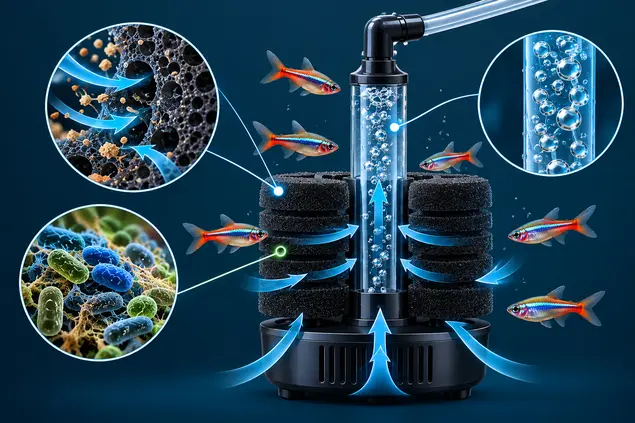
In an air-driven sponge filter, bubbles rising up a lift tube carry water with them. Replacement aquarium water is drawn through the foam. The foam catches some suspended debris and provides wetted surface for microorganisms. A mature biological filter helps convert ammonia-derived nitrogen through nitrite to nitrate; plants and water changes can help manage the resulting nutrients. Filter bacteria do not make water changes unnecessary.
Researchers have found that ammonia-oxidizing archaea and comammox Nitrospira can contribute substantially to nitrification in freshwater aquarium biofilters. Which organisms dominate differs among aquariums and over time; the organisms present vary among biofilters.
Does a sponge filter add oxygen? It moves water and bubbles, often increasing surface agitation and gas exchange. Oxygen reaches the water primarily through gas transfer, especially at the water–air interface; a filter does not generate oxygen. Actual results depend on temperature, tank cover, surface movement, oxygen demand and other equipment.
Coarse vs fine sponge: what PPI actually means
| Feature | Coarser foam | Finer foam |
|---|---|---|
| Debris | May let more fine particles pass; usually less resistance when clean | Can capture smaller debris but may collect visible waste faster |
| Clogging | Often needs less frequent rinsing in the same conditions | Can require more attention with heavy feeding |
| Newborn shrimp / fry | Check actual pore opening and keep suction gentle; tiny animals can hide in open pores | Smaller openings can reduce access into foam, but no setup is guaranteed risk-free |
| Biological filtration | Depends on usable foam volume, flow and maturity | Depends on usable foam volume, flow and maturity |
PPI is pores per inch, not a certification of shrimplet safety. Do not infer that new foam sinks, lasts a precise number of years or cleans itself from its pore count. If you add a finer sleeve to a coarse sponge, inspect it often: a protective covering that clogs can sharply reduce flow. For shrimp, watch the actual intake and animal behavior, not just the marketing label.
How to set up a nano sponge filter
- Check the entire filter height. Measure from base to outlet, including extension tubes. In a short aquarium, you may need a model with a shorter return or a manufacturer-approved tube adjustment.
- Assemble it as directed. Fit the internal strainer, sponge, base and uplift tube without blocking water paths. Submerge and gently squeeze the foam to release trapped air.
- Connect the airline. Use compatible tubing from an aquarium air pump to the filter’s air inlet. Most conventional air-driven sponge filters do not include the pump.
- Install a check valve if the pump could sit below the waterline. Follow the specific valve’s direction marking: an arrow indicating airflow should point from the pump toward the aquarium. Put the valve outside the aquarium, near the rim, and confirm bubbles flow normally. A pump mounted safely above water level adds another precaution.
- Adjust the bubble stream. Start with steady water movement and an outlet position that avoids a strong jet at resting fish or fry. Use the pump’s intended adjustment or an appropriate valve/bleed arrangement; don’t shut every line on a pump that requires an open outlet.
- Keep electrical equipment dry. Set the pump on a stable, dry surface, provide a drip loop, secure tubing and use aquarium-rated equipment. Never suspend an electrical pump by its power cable as a noise fix.
- Verify the biofilter. A clean new sponge is not cycled. Test ammonia and nitrite through establishment and after changes in stocking.
What size air pump do you need for a sponge filter?
There is no reliable universal litres-per-minute rule based on tank gallons alone. An air pump’s output depends on pressure at the aquarium’s water depth, tubing length, check-valve resistance, number of connected devices and filter geometry. Pump airflow is also not the same as water flow through the sponge.
Choose a pump whose manufacturer states it can work at your water depth and intended number of outlets. Start with a steady bubble column and visible, gentle return flow; adjust for the filter and animals.
When using one pump for multiple nano sponge filters, use a properly sized pump and individual flow controls, then check that every outlet still runs when another is adjusted. For a sponge filter with an air pump for a 20 L nano tank , a compact one-outlet aquarium pump is a reasonable type to compare—but no specific pump is automatically compatible without checking its output and the filter requirements.
How to cycle a new sponge filter
A new sponge provides surfaces for nitrifiers but has not yet built enough ammonia-processing capacity for your aquarium. An established filter can seed a new system, yet transferring it is not a guaranteed instant cycle: the donor’s capacity must match the recipient’s waste load. Also consider disease and parasite transfer if the donor tank’s health status is uncertain.
For fishless cycling, follow a reputable controlled-ammonia procedure and test with a reliable kit. Add livestock only after the system can process an ammonia input appropriate to the planned stocking and return ammonia and nitrite to safe, consistently undetectable readings on your test system. Cycling time varies with temperature, pH, oxygen, inoculum and ammonia loading; “four weeks” is not a proof of readiness. After introducing animals, test again and stock gradually.
If you run two sponges in one established aquarium, you can clean them on separate occasions or transfer one after it has been operating and processing waste. Never assume a recently added spare is fully seeded because it looks brown.
Are sponge filters safe for shrimp, bettas and fish fry?
Sponge filter for a shrimp tank
An exposed sponge is generally less hazardous to small shrimp than an unprotected impeller intake because suction is spread across the foam. It is not an absolute safety guarantee: open pores, accessories, other pumps and strongly driven return currents still deserve inspection. Shrimp may graze on microorganisms and trapped particles, but sponge biofilm is supplementary and cannot be assumed to meet the entire diet.
Sponge filter for a betta tank
The benefit is adjustable current, not the claim that all bettas come from identical stagnant rice paddies or that every air pump is perfect. Watch whether the fish can rest and reach the surface without being carried away. If the bubbles or outlet are too strong, adjust the air supply or reposition the return while keeping sufficient circulation and gas exchange.
Sponge filter for a fry or breeding tank
A sponge intake can lower the risk of fry being pulled into a powered filter, provided the whole system is appropriately assembled and operated. A mature filter also supports water quality during heavy feeding. Some fry may pick at small organisms on the sponge, but biofilm is not a guaranteed complete first food. Plan actual size-appropriate live foods and monitor ammonia after feeding. For species-specific examples, see the chili rasbora breeding guide and pygmy corydoras breeding guide.
Sponge filter vs HOB vs canister: when each makes sense
| Consideration | Air-driven sponge | HOB filter | Canister filter |
|---|---|---|---|
| Inside-tank footprint | Foam and base occupy tank space | Usually small intake in tank; body hangs outside | Intake/outlet inside, canister outside |
| Fry / tiny-shrimp intake | Broad sponge intake when properly sized | Fit a secure, appropriate prefilter | Fit a secure, appropriate intake guard/prefilter |
| Flow control | Adjust air supply and outlet | Varies by model | Varies by model and plumbing |
| Mechanical polishing | Depends on foam fineness; often limited for tiny particles | Fine pads/floss may be available | Multiple stages often available |
| Chemical media | Only if design has a dedicated media compartment | Usually possible on suitable models | Usually possible on suitable models |
| Power outage | Can run from a compatible battery air pump | Requires electricity; restart behavior varies | Requires electricity; restart behavior varies |
A sponge filter is often sufficient for a lightly stocked, fully cycled nano aquarium with adequate flow and regular maintenance. A HOB or canister may be preferable when you need different circulation patterns or fine mechanical polishing. No filter type fixes overstocking or replaces appropriate water changes. A fitted sponge prefilter can make a powered-filter intake more protective, but it will need cleaning as debris accumulates.
Can you run a sponge filter in a planted nano tank with CO2?
Yes, but stronger bubble-driven surface agitation can increase gas exchange and may make it harder to retain injected carbon dioxide. The size of that effect depends on the tank, surface movement, CO2 dosing and other conditions; a single reported pH change cannot be converted into a universal ppm-loss figure. Keep sufficient oxygen and circulation for livestock regardless of your planting goals. A powerhead-driven sponge can change the circulation pattern, but it does not guarantee “no CO2 loss.”
How to clean a sponge filter without a mini-cycle
Clean according to reduced water flow or visible debris loading, not a compulsory once-a-month date. During a water change, lift the sponge inside a clean container or bag to catch sludge. Gently squeeze it in removed aquarium water or appropriately treated, temperature-matched water until the major debris is gone; it need not become spotless. Reinstall promptly and restore flow. Never use soap or hot water. If you have multiple sponges, staggering their cleaning is a sensible precaution.
Untreated tap water with chlorine or chloramine can harm the biofilter. That does not mean every brief contact with all tap water immediately kills every organism; the risk depends on water chemistry and exposure. Aquarium water is a straightforward default. If you must replace deteriorating foam, operate old and new media together where possible, and test ammonia and nitrite afterward rather than relying on an arbitrary six-week overlap. Hikari says replacement depends on condition and stocking; fixed five-to-ten-year lifespans are not guaranteed.
How to make a sponge filter quieter
First identify which part makes noise: the air pump vibrating against furniture, the bubble stream, or the outlet splashing. Put the pump on a stable vibration-damping pad, secure the airline, check for a clogged diffuser and reposition the outlet according to its instructions. An air collar or compatible airstone can change bubble size and sound, but noise depends on the pump, installation and bubble stream. Never hang a powered pump by its electrical cable or put it where water can drip into the plug.
Frequently asked questions
What is the best sponge filter for a nano tank?
There is no single proven winner for all nano aquariums. Start by comparing total dimensions, adjustable flow, sponge area, replacement-part availability and the needs of your animals. For compact 5–10-gallon layouts, measure the Hikari Mini and Co-Op Nano; for detachable paired sponges, evaluate whether the Hygger HG-908 will physically fit.
What is the smallest sponge filter for an aquarium?
“Mini” and “nano” are retailer labels, not standardized dimensions. Measure the full unit, including base and tube. Check the full assembly, rather than a sponge-only measurement, for any narrow space.
Can a sponge filter work without an air pump?
Traditional air-driven sponge filters need a separate air pump or compatible air supply. A powerhead-driven sponge or Hygger’s HG176 USB electric model uses a water pump instead. It still needs a safe electrical power source and an appropriate intake/flow arrangement.
Is a sponge filter enough for a 5-gallon aquarium?
It can be, provided the tank is suitable for its livestock, the filter is mature and sized appropriately, circulation is adequate, and ammonia/nitrite remain controlled. A brand’s “up to 10 gallons” label is not a substitute for measuring water quality.
Can a sponge filter suck up baby shrimp?
A properly assembled exposed sponge spreads intake suction and is often a safer design than an unprotected pump inlet, but tiny shrimp can enter large pores or encounter other hazards in the system. Check foam opening size, flow and other equipment.
Do sponge filters remove ammonia and nitrate?
A mature biofilter helps oxidize ammonia to nitrite and then nitrate. A typical sponge filter does not automatically remove the resulting nitrate. Plant uptake and appropriate water changes remain relevant.
Should I run a sponge filter 24/7?
Continuous operation is the sensible default for a system that relies on its filtration and circulation. The effect of an outage depends on oxygen, temperature, stocking and duration; a brief outage is not proof that every bacterium died. A compatible battery air pump can help maintain circulation during extended power loss.
Do I need a sponge filter and an HOB together?
Not necessarily. A mature sponge may adequately handle a lightly stocked nano aquarium, while a HOB can provide different circulation and finer mechanical media. Add equipment to solve a real flow, safety or water-quality problem—not because two filters must always outperform one.
Ready to choose your sponge filter?
For a compact 5–10 gallon setup, compare the Hikari Mini and Co-Op Nano against your tank dimensions. Choose the Hygger HG-908 if you want paired removable sponges and have room for the double assembly. Include the air supply in your budget and cycle the filter before relying on it for livestock.
Return to the three-design shortlistCheck the supplies you need
Sources and specification checks
- Hikari Bacto-Surge official product and size details — manufacturer’s claims and product identification.
- Aquarium Co-Op coarse sponge official product page and size FAQ — PPI, sizing and components.
- ATI Hydro-Sponge official size chart — model I versus Mini and foam choices.
- Hygger HG-908 official specification and Hygger HG176 official page.
- Sauder et al., PLOS ONE 2011 and McKnight & Neufeld, Applied and Environmental Microbiology 2024 — aquarium nitrifier communities.
- Aquarium Science filtration media hobby tests — not independent peer-reviewed proof of finished-product rankings.
- Aquarium Co-Op check-valve guide and University of Alabama fishless-cycling guide.