
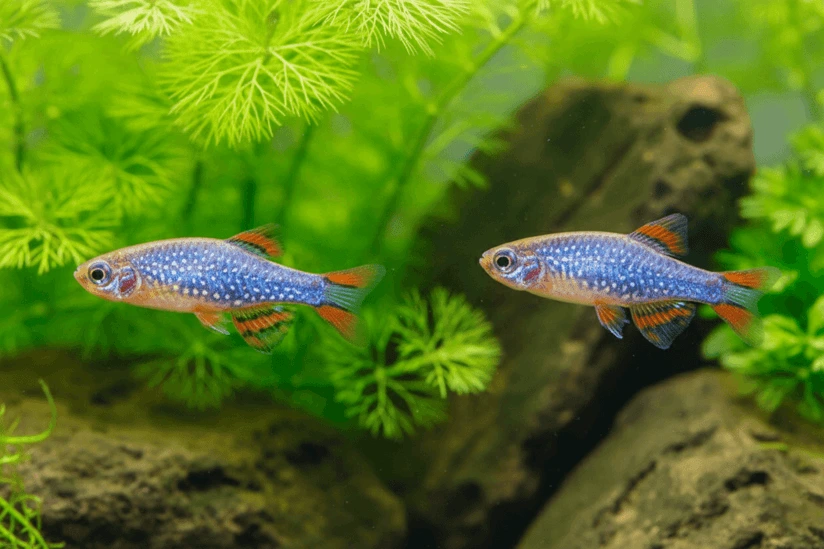
Celestial Pearl Danios (Danio margaritatus), discovered in 2006 in Myanmar’s highland ponds, are miniaturized continuous spawners that breed readily in captivity once you understand their biology. Unlike many Asian nano fish, they inhabit clear, slightly alkaline spring-fed waters (pH 7.3, not blackwater). The key to breeding success: protect eggs from voracious adult predation, provide microscopic food from day one of free-swimming, and keep temperatures cooler (72-76°F, not 80°F+). With proper technique, expect 80-100% fry survival from free-swimming stage.
Quick Stats:
- 72-76°F Optimal Breeding Temperature
- 10-30 Eggs Per Spawn
- 2-4 Days to Hatch
- 80%+ Fry Survival Rate
Introduction: The galaxy rasbora revolution
The celestial pearl danio represents one of aquarium keeping’s most remarkable discoveries this century. Found in 2006 in Myanmar’s Hopong region, these tiny jewels sent shockwaves through the hobby with their stunning coloration—deep blue bodies spangled with pearl-white spots like a galaxy, offset by brilliant orange-red fins.
The Critical Insight Nobody Tells You:
Here’s the secret about breeding CPDs: they’re actually easy. The hard part isn’t getting them to spawn—it’s stopping them from eating every single egg. Well-conditioned adults in a planted tank spawn almost daily. The challenge is protecting those tiny eggs from voracious parents and feeding microscopic fry properly through the critical first two weeks.
This guide synthesizes research from the original species description, phylogenetic studies, commercial breeding operations, and dozens of experienced breeders to create the most comprehensive CPD breeding resource available.
Sexual dimorphism: How to tell males from females
Visual identification guide
Males – The Show-Offs
- Body color: Deep midnight blue to blue-purple (intensely saturated)
- Belly: Bright vivid red to deep orange (especially when courting)
- Pearl spots: Bright white to yellow, highly visible in galaxy-like pattern
- Body shape: Slimmer, torpedo-shaped, almost “emaciated” looking with concave belly
- Size: Slightly smaller (0.75-1 inch adult)
Fin characteristics:
- Dorsal: Red stripe with bold black stripes, nearly translucent background
- Anal: Bright red-orange with black striping
- Caudal: Red-orange with black stripes
- Pelvics: Solid red/orange or filled with red spots
Breeding Display: Colors intensify dramatically during courtship—flanks brighten/darken alternately, belly turns deeper red, bright red stripe appears from head to dorsal fin during head-down posture. Males constantly spar with rivals and actively chase females.
Females – The Egg Machines
- Body color: Washed out blue-green to golden-blue sheen (less intense than males)
- Belly: Golden or yellowish-white (faint orange when gravid)
- Pearl spots: Duller, less bright than males
- Body shape: Rounder, fuller body especially when carrying eggs
- Size: Slightly larger and fatter
Fin characteristics:
- All fins: Faded orange to pale orange (not bright red)
- Pelvics/ventrals: Clear or translucent
- Pectorals: Colorless
The Definitive Female Marker: Black anal spot develops just in front of anal fin when sexually mature and ready to spawn. This is THE definitive female identification marker. When gravid, the entire area around this spot swells noticeably.
Sexing by Age
- Under 3-4 months: Difficult—all appear pale and similar
- 3-4 months: Sexual maturity begins, reliable sexing possible. Males show brighter colors, females develop black anal spot
- 4+ months: Sex differences obvious, full coloration display evident
Pro Tip: Look for the black anal spot on females—it’s the easiest identifier. Males have that vivid “look at me!” coloration while females are deliberately subdued.
Breeding tank setup: The foundation for success
Tank size options
- Bare Minimum: 2.5 gallons—breeding trio for 1-week cycles. Tight space but functional for dedicated breeding.
- Small Dedicated: 5-10 gallons—optimal for controlled breeding with best results. Professional breeder preference.
- Community Breeding: 10-20+ gallons—natural population growth with minimal intervention. Some fry survive in dense planting.
- Fry Grow-Out: Start 2.5 gallons → 5.5 gallons → 10 gallons as they grow. Progressive sizing prevents food-hunting exhaustion.
Critical Insight: Start fry in SMALL volumes so they don’t burn calories hunting food in oversized tanks. This is a major beginner mistake that causes massive starvation losses.
Essential equipment
- Filtration: Sponge filters ONLY—HOB filters suck up eggs and fry
- Heating: Optional—CPDs prefer cooler 72-76°F (can go unheated in many homes)
- Lighting: Low to moderate
- Air pump: For sponge filter or gentle aeration
- Turkey baster: For egg collection (professional breeder method)
Game Changer: Natural Sunlight: Natural sunlight significantly increases spawning success. Tanks near windows with dawn/dusk light produce more spawns than artificial lighting alone. You cannot replicate true dawn with timers—place breeding tanks near east-facing windows.
Plants & hiding spots
You cannot overplant a CPD breeding tank. Dense vegetation = more visible fish, more spawning, better fry survival.
Essential plants:
- Java moss—#1 spawning choice, eggs fall through easily
- Christmas moss—Alternative to Java moss
- Dense stem plants: Ludwigia repens, Hygrophila polysperma, hornwort, water wisteria
- Floating plants: Water lettuce, water hyacinth (outdoor ponds)
- Anubias: Fry use leaves as resting spots
- Spawning mops: Acrylic yarn mops (professional favorite)
Water parameters: The science behind the numbers
Natural habitat context
Critical Misunderstanding to Correct: CPDs do NOT come from blackwater environments. Their natural habitat in Myanmar’s Hopong region consists of:
- Clear, transparent spring-fed ponds (not tannin-stained)
- Shallow waters (maximum 30cm deep)
- Elevation: 1,040+ meters (mountainous plateau)
- Dense aquatic vegetation (Elodea, Anacharis, Blyxa species)
- Slightly alkaline pH: 7.3 measured at type locality
- Temperature: 22-24°C (January measurements—cooler season)
Optimal breeding parameters
- Temperature: 72-76°F (23-24°C): Higher temps speed metabolism, can starve fry faster. Cooler promotes better spawning. Avoid 80°F+ common in tropical fish care.
- pH: 7.0-7.3: Matches natural habitat. Affects ammonia toxicity and enzyme function. Slightly alkaline optimal despite common belief they need acidic water.
- GH: 5-7 dGH (90-125 ppm): Minerals for egg production, skeletal development, osmoregulation. Adequate calcium essential for strong egg membranes.
- KH: 5-7 dKH (90-125 ppm): Buffering prevents pH crashes during breeding. Carbonate ions stabilize pH fluctuations from biological processes.
The biological “why” behind water chemistry
pH – The enzyme dance
Fish physiology runs on enzymes optimized for specific pH ranges. More critically, pH affects ammonia speciation:
- At pH 7.0, 25°C: ~0.5% toxic NH3 (free ammonia)
- At pH 8.0, 25°C: ~5% toxic NH3 (10x increase!)
This is why slightly alkaline (7.0-7.3) matching natural habitat is ideal—high enough for healthy microbial communities but not so high that ammonia becomes deadly.
GH – Building blocks of life
General hardness measures calcium and magnesium—essential minerals for:
- Egg production: Females need calcium reserves for eggshell formation. Low GH = weak egg membranes, reduced hatch rates, deformed fry
- Skeletal development: Calcium is primary bone component
- Osmoregulation: Correct GH reduces osmotic stress
- Enzyme cofactors: Magnesium cofactor for 300+ enzyme systems including DNA/RNA synthesis
Conditioning: Feeding them into breeding mode
The micropredator factor
CPDs are micropredators—they actively hunt live prey smaller than themselves. Natural diet includes tiny crustaceans (copepods, ostracods), zooplankton, insect larvae, and worms. They have conical teeth for capturing prey and prefer moving food.
Implication for breeding: Live high-protein foods condition fish far better than dry foods alone. This is the secret to consistent spawning.
Best conditioning foods
Live Foods – The Champions
- Baby brine shrimp (BBS): Primary conditioning food, fed daily or 2x daily
- Grindal worms: High protein, 2-3 worms make them “VERY fat”
- Blackworms: Extremely exciting for CPDs, excellent conditioning
- White worms: High fat and protein
- Microworms: Good supplementary food
- Daphnia: Promotes spawning, excellent conditioner
- Cyclops: Small crustacean, readily accepted
- Tubifex: Feed 2 days before spawning to maximize egg viability
Frozen Foods – Solid Alternatives
- Frozen baby brine shrimp
- Frozen cyclops
- Frozen daphnia
- Frozen bloodworms (crushed, use sparingly—can cause obesity)
Conditioning protocol
Timeline: Minimum 1 week, 2 weeks optimal
Feeding schedule: 2-4 times daily
Diet rotation example:
- Morning: Baby brine shrimp (live or frozen)
- Midday: Grindal worms or microworms
- Evening: High-quality micro pellets
- 2 days before spawn: Add tubifex
Signs they’re ready
Females
- Plump, rounded belly visibly full of eggs
- Dark coloration in belly area
- Black spot near anal fin prominent
- More subdued colors overall
Males
- Intense, vibrant breeding colors (deepest red-orange with brightest blue bars)
- Spectacular orange band from dorsal to head when displaying
- Aggressive chasing of females begins
- Constant sparring with rival males
Spawning behavior: The nature documentary
Pre-spawning rituals
Morning routine: CPDs spawn almost exclusively in early morning, typically within the first hour after lights come on. Natural dawn light is a powerful trigger—this is why windows near breeding tanks increase success.
The courtship dance
- The Hover: Male positions himself head-down over spawning site at 30-45 degree angle.
- The Shimmy: When female approaches, male shakes his entire body vigorously—an unmistakable signal.
- The Display: Male flares all fins, showing bright red/orange colors and black stripes in full glory.
- The Head-Down: Male adopts pronounced head-down posture, revealing bright red stripe running from head to dorsal fin—the key visual signal.
- The Chase: Male aggressively follows female with head down, nudging her flanks with his snout.
- The Initiation: Receptive female “headbutts” male near his anal fin region—this is her signal of acceptance.
The spawning act
- The Dive: Pair dives together into spawning medium (moss, plants, mop)
- Side-by-Side Quiver: Male and female position side-by-side and shake/quiver together
- Release: Female releases eggs while male simultaneously releases milt (sperm)
- Separation: Pair breaks apart immediately—quick, rapid movements
- Disperse: Each fish goes separate way, may repeat with same or different partner
Physical details: Looks like they’re “flipping around” or tumbling. The act itself takes only seconds. No pair bond forms—fish spawn with multiple partners throughout the morning.
The eggs
- Size: Tiny (1.0-1.3 mm diameter—about the size of the fish’s eye)
- Appearance: Clear, slightly translucent, difficult to see
- Adhesion: Only mildly adhesive (not sticky like killifish eggs)
- Behavior: Fall quickly through spawning medium, settle at bottom
- Quantity: 10-30 eggs per spawning session
- Fertilization: After 24-48 hours, black dots (eyes) visible in fertilized eggs
Post-spawning behavior
The Egg Predation Problem:
Immediate: Both sexes become ravenous egg predators. Adults actively search spawning site and dive headfirst into moss seeking eggs. This is natural behavior—egg protection is ESSENTIAL for any fry survival.
Breeding methods: Choosing your approach
Method 1: Community Tank Natural Breeding
Setup: 10-20 gallon heavily planted display tank, 10+ CPDs
Process: Let nature take its course
- Pros: Zero maintenance, Natural behavior, Some fry survive in dense moss, Documented: 7 fish became 28 in several months
- Cons: Low fry survival (5-10%), Unpredictable yields
- Best for: Hobbyists wanting natural approach, don’t need many fry
Method 2: Egg Trap Container Method
Setup: Plastic container with mesh bottom, Java moss on top, placed in main tank
Process: Eggs fall through mesh into container, safe from adults; Check daily; Remove eggs to hatching cups
- Pros: Adults stay in main tank (less stress), Good egg collection rate (20-30 fry per period), Easy for beginners
- Cons: Daily maintenance required
- Best for: Beginners wanting better yields without complexity
Method 3: Rotating Breeding Tank
Setup: Bare bottom 10-gallon with Java moss on slate
Process: Move trio (1M:2F) to breeding tank; Leave 5-7 days; Remove adults, collect eggs; Rotate to another tank while first batch hatches
- Pros: Better yields (40-50 fry per cycle), Controlled environment, Can run multiple tanks
- Cons: Requires multiple tanks, Moving fish causes stress
- Best for: Intermediate breeders wanting consistent production
Method 4: Permanent Breeding Factory (Expert Choice)
Setup: Dedicated tank with trio (1M:2F), sponge filter, acrylic yarn spawning mop
Process: Trio lives permanently in breeding tank; Daily egg collection with turkey baster (Stop filter, wait 5 minutes for eggs to settle, lift mop by attached long yarn, shake gently over light area, turkey baster eggs from bottom, transfer to hatching container)
Production: Average 20 eggs daily consistently
- Pros: HIGHEST sustained production, No stress from moving fish, Predictable daily yields, Most efficient method
- Cons: Requires dedicated tank space, Daily collection commitment, Need constant fry food supply
- Best for: Serious breeders, those selling fry
Method 5: Moss Rock Rotation
Setup: Flat rocks (3″x5″) with thick moss layer
Process: Place moss rock in display tank for 1 week; Remove carefully to fry tank; Typically yields 20 fry per rock; Alternate with spawning mops in clay pots (12-15 fry)
- Pros: Very low stress on breeders, Good yields without moving fish, Simple technique
- Cons: Need multiple moss rocks/mops, Weekly harvest cycle
- Best for: Those wanting good yields with minimal intervention
Method 6: Outdoor Pond Method (Summer Secret Weapon)
Setup: 25-55 gallon containers/barrels, floating plants (water lettuce, hyacinth), anacharis
Process: Transfer fry or add spawning media from indoor tank; Natural food (infusoria, microorganisms) sustains fry; Minimal feeding needed; Can achieve multiple generations in one season
- Pros: Fry essentially raise themselves, Natural food abundant, Healthy, fast-growing fry, Low maintenance
- Cons: Seasonal only, Predator protection needed (raccoons, birds), Weather dependent
Expert insight: Pond-raised CPDs are notably healthier, bolder, and more colorful than tank-raised. Breeders report significantly faster growth rates and less skittish behavior in pond-raised fish.
Eggs and hatching: The critical window
Egg care and protection
Protecting from parents (Non-negotiable):
Options in order of effectiveness:
- Spawning mop/cup method (eggs fall out of adult reach)
- 3-4mm mesh barrier 2-3cm above bottom
- Daily egg collection and removal to separate container
- Spawning boxes checked every 1-2 days
- Remove adults after 2-3 days spawning
Fungus prevention
Causes: Unfertilized eggs (most common), poor water quality, lack of circulation
Prevention methods:
- Methylene blue: 1 drop per egg container (most popular)
- Gentle aeration: Low-flow airstone over eggs
- Cleanup crew: Ramshorn or mystery snails eat fungus/dead eggs but leave viable eggs alone
- Ich-X: Alternative antifungal
- Remove dead eggs promptly
Hatching timeline
At 73-75°F (23-24°C)
- Day 0-1: Eggs appear clear/white; fertilized become transparent
- Day 1-2: Black dots (eyes) visible in fertilized eggs
- Day 2-4: Eggs hatch into “wrigglers”
- Day 3-7: Wriggler stage—absorbing yolk sac, mostly stationary
- Day 6-9: Fry become free-swimming, begin actively hunting food
At 76-78°F: Can hatch in 2-3 days (faster but less reliable)
At cooler temps (72-74°F): Better hatch rates reported despite slower development
First visual of fry
Newly hatched fry are described as “eyelash-sized,” “slivers of glass,” “hair-thin”—extremely small, mostly transparent, look like tiny tadpoles with yolk sac. They cannot swim initially but will wiggle away when disturbed.
Fry care: The ultimate survival guide
The #1 Killer: Starvation
Most losses occur in Week 1-2 from insufficient food. This is where breeding attempts succeed or fail.
Week 1 (Days 1-7): Critical survival period
Days 1-3:
- Size: Microscopic, transparent, barely visible
- Behavior: Swimming near surfaces, in moss, seeking microorganisms
- Food: Infusoria ESSENTIAL (Infusoria from established moss, Green water, Paramecium cultures, Liquid fry food: Sera Micron, JBL NobilFluid)
- Feeding frequency: Continuous access preferred; 6-7 feedings daily minimum with prepared foods
- Temperature: 74-75°F (NOT 80°F+ which speeds metabolism, starves fry faster)
Days 4-7:
- Continue infusoria as base
- Vinegar eels (Days 4-5)—can be too large initially
- Sera Micron or similar powder
- Feeding: 6-7 times daily
Critical insight: Start infusoria cultures when eggs are laid, so they’re ready when fry free-swim. Green water method provides continuous food without multiple daily feedings.
Week 2 (Days 8-14): Second critical period
The 50% die-off: This is when most losses occur if underfeeding. “First two weeks are the hardest.”
- Food transition: Microworms introduced (Day 10+)—perfect size; Continue vinegar eels; Baby brine shrimp (BBS) can START around Day 10-14
- Feeding: 4-6 times daily minimum
- Water changes: Can begin VERY small (<10%) with temperature-matched water from parent tank
Week 3 (Days 15-21): The BBS transition
The Game Changer: Baby brine shrimp becomes primary food. Signs BBS ready: fry go “mad” for BBS, orange bellies visible after feeding. This transition marks the beginning of rapid growth.
Week 4+ (Days 22-28): Early juvenile stage
- Size: Approximately “guppy fry” sized (3-6mm)
- Appearance: Beginning to show CPD patterns
- Food: Larger BBS, crushed flakes accepted, small pellets
- Feeding: 2-3 times daily
- Milestone: Past highest mortality risk
Color development timeline
- Weeks 1-3: Transparent/silvery
- Weeks 4-6: Faint blue tinge, hints of spotting
- Weeks 6-8: Blue background visible, pearl spots emerging
- Weeks 8-10: Distinct patterns, males showing brighter colors
- Weeks 10-12: Full color approaching, sexually mature
First foods: The make-or-break factor
Initial free-swimming (Days 1-7)
Option A: Infusoria (Best Survival Rates)
- Sources: Java moss from established tanks (simplest), Green water cultures (started when eggs laid), Aufwuchs from leaf litter, Commercial liquid fry food (Sera Micron, JBL NobilFluid)
- Preparation: Start cultures 3-5 days before eggs hatch
- Why it works: Mimics natural pond environment, continuous food availability, correct size for microscopic fry
Option B: Powdered Foods (Convenient)
- Foods: Sera Micron (most recommended), Hikari First Bites, Golden Pearls (5-50 micron), JBL NobilFluid
- Method: Mix with water to create suspension before adding
- Frequency: 6-7 times daily in small amounts
- Limitation: Fry prefer moving food, may not accept powdered foods as readily
Option C: Green Water (Expert Secret)
- Raise fry in pure green water (thick algae suspension):
- Outdoor/windowed container of old tank water
- Add grass clippings or hay
- Develop thick green algae (3-5 days in sun)
- Add newly hatched fry
- Continuous food supply
- 80-100% survival rates
- Minimal hands-on care first 2 weeks
Week 2-3 transition: The BBS introduction
Baby Brine Shrimp – The Critical Transition
- Timing: Start offering Day 10-14, becomes primary food Week 2-3
- Readiness indicator: Fry go “mad” for BBS when ready—clear sign
- Visual confirmation: Orange bellies visible after successful BBS feeding
- Growth response: Rapid growth once on BBS
- Frequency: 2-3 times daily
Common problems and solutions
Problem 1: Eggs Fungusing (High Percentage)
Causes:
- Unfertilized eggs—Most common
- Exhausted males from constant breeding
- Poor male:female ratio
- Confined spawning space
- Solution: Rest males, use 1M:2-3F ratio, larger breeding tank
- Poor water quality: Clean setup, gentle aeration
- Lack of circulation: Low-flow airstone over eggs
Prevention:
- Methylene blue: 1 drop per container
- Ramshorn/mystery snails: Eat fungus, leave viable eggs
- Remove dead eggs promptly
Problem 2: Fry Dying Week 1-2 (The #1 Issue)
Cause: Insufficient food/starvation
Signs: Fry swimming but bellies not rounded, gradual losses daily
Solutions:
- Start infusoria cultures when eggs are laid
- Feed 6-7 times daily minimum
- Provide continuous food source (green water best)
- Add live foods immediately (vinegar eels, microworms)
- Never rely on prepared foods alone first 2 weeks
- Check bellies—rounded = good, concave = starving
Temperature factor: At 80°F+, fry have rapid metabolism, require MORE food. Keep at 72-76°F for better survival.
Problem 3: Adults Eating Eggs
Why: Natural behavior—egg scatterers with no parental care, opportunistic feeders
Prevention (in order of effectiveness):
- Physical Separation—Most effective: Spawning mop/cup method, Mesh barriers, Daily egg collection, Adult removal after spawning
- Dense Planting—Moderate: Very heavy moss coverage, Natural recruitment (lower yields but some survive)
Problem 4: Low Spawn Rates
Causes & Solutions:
- Poor Conditioning: Signs: Thin females, infrequent spawning, low egg counts. Solution: Feed live foods 2x daily (BBS, grindal worms, blackworms) for 1-2 weeks
- Wrong Temperature: Too warm (78°F+): Stress, reduced breeding. Solution: Maintain 73-76°F; slight cooling (2°C) before breeding can trigger spawning
- Poor Male:Female Ratio: Too many males: Females harassed, stressed. Solution: 1 male: 2-3 females ideal
- Exhausted Males: Fertilization drops to 10-20%. Solution: Rest breeding pairs weekly, separate 3-5 days, condition with live foods
Advanced techniques and pro secrets
Expert Secret #1: Natural Light is King
Tanks with natural dawn/dusk light produce MORE spawns than artificial lighting alone. You cannot replicate true dawn with timers. Place breeding tank near east-facing window for morning light.
Expert Secret #2: Temperature Manipulation
Large water change with COOLER water (several degrees) just before lights out mimics rainy season, triggers spawning next morning.
Expert Secret #3: The Turkey Baster Method
Professional breeders’ preferred egg collection:
- Stop sponge filter
- Wait 5 minutes for eggs to settle
- Lift mop using attached long yarn
- Shake gently over light-colored area
- Turkey baster eggs from bottom
- Transfer to hatching container
Production: ~20 eggs daily consistently with permanent breeding trio
Expert Secret #4: Water Source for Fry
Do water changes with water FROM THE ADULTS’ TANK. Young cyprinids very sensitive to “new” water. This single tip prevents massive fry losses.
Expert Secret #5: Tank Size Progression
Start fry in SMALL volume (easier to find food, less energy burned):
- Week 1 = 1 gallon
- Week 2 = 2 gallons
- Week 3 = 3 gallons
- Scale up weekly
Expert Secret #6: The Green Water Method
Raise fry in pure green water (thick algae suspension):
- Outdoor/windowed container of old tank water
- Add grass clippings or hay
- Develop thick green algae (3-5 days in sun)
- Add newly hatched fry
- Continuous food supply, 80-100% survival rates
- Minimal hands-on care first 2 weeks
Conclusion: Keys to CPD breeding success
The celestial pearl danio is actually an EASY fish to breed once you understand three critical factors:
- They’re continuous spawners with voracious egg-eating behavior—You must protect eggs immediately
- Fry are microscopic and starve easily—Feed 6-7 times daily Week 1-2 with infusoria
- They prefer cooler temperatures than most tropical fish—Keep at 72-76°F, not 80°F+
Master these three factors, and you’ll have more CPD fry than you know what to do with. The species’ high reproductive rate, year-round breeding, and adaptability make them ideal for both beginners wanting a few fry and commercial breeders running breeding factories.
The challenge isn’t getting them to spawn—well-conditioned adults in a planted tank spawn almost daily. The challenge is protecting those tiny eggs from voracious parents and feeding microscopic fry properly through the critical first two weeks.
Critical Success Checklist:
- 1. Proper sexing: Look for black anal spot on females, vivid colors on males
- 2. Condition heavily: 1-2 weeks of live foods 2-3x daily before breeding
- 3. Natural light: Place breeding tank near east-facing window
- 4. Protect eggs: Use spawning mop, mesh barrier, or daily collection
- 5. Start cultures early: Infusoria ready when eggs hatch
- 6. Feed frequently: 6-7 times daily Week 1-2
- 7. Small containers: Start fry in 1-2 gallons, scale up weekly
- 8. Use parent water: For all fry water changes
- 9. Temperature control: Keep 72-76°F, not warmer
- 10. BBS transition: Around Day 10-14, marks rapid growth phase
Final Thoughts
With this comprehensive guide, you now have everything needed to successfully breed celestial pearl danios. From understanding their natural habitat and biology to mastering the critical first two weeks of fry care, you’re equipped with professional-level knowledge compiled from the world’s most experienced CPD breeders. Remember: protect those eggs, feed those fry, keep it cool, and you’ll have more of these stunning galaxy rasboras than you ever imagined possible.