Celestial pearl danios (CPDs), also sold as galaxy rasboras, breed in a planted tank with fine moss or a spawning mop. Condition a male and a female on small live foods, give them moss to spawn in, and protect the eggs from the adults. At 24 to 25°C the eggs hatch in 3 to 4 days. The larvae then hang motionless on surfaces for about 3 more days, so a tank that looks empty can still hold live fry. Galaxy rasbora breeding follows the same steps, since the two names describe one fish.
The adults eat eggs and give no parental care. A dense community tank may still produce a few fry. A removable moss clump or mop raises the number that reach the fry stage.
These timings come from the first captive breeding report, published in Roberts (2007). Results vary with temperature and conditions.
Celestial Pearl Danio Breeding: Quick Facts
| Item | Answer |
|---|---|
| Scientific name | Danio margaritatus (formerly Celestichthys margaritatus) |
| Also called | Galaxy rasbora, CPD |
| Adult size | About 2 cm (21 mm standard length) |
| Breeding temperature | 22 to 25°C (72 to 77°F), a practical range, not a proven optimum |
| Aquarium temperature | 20 to 26°C (68 to 79°F) |
| pH and hardness | pH 6.5 to 7.5, 5 to 15 dGH |
| Group tank | 45 × 30 cm base, about 41 L (11 gallons) |
| Spawning container | 10 to 20 L (2.6 to 5 gallons), temporary |
| Spawning site | Fine moss, fine-leaved plants, or a spawning mop |
| Eggs per spawn | Up to about 30 from one female |
| Egg size | Ripe ovarian eggs 1.0 to 1.3 mm |
| Egg hatching time | 3 to 4 days at 24 to 25°C |
| Larval stage | Dark, attached, and still for about 3 days |
| First food | Paramecium or 5 to 50 micron fry food |
| Parental care | None. Adults eat the eggs |
| Sexual maturity | Reported at 11 to 12 weeks, sometimes 3 to 4 months |
Galaxy Rasbora Breeding: How to Breed Celestial Pearl Danios
- Prepare the adults. Keep a healthy group in a mature, planted aquarium. Select at least one male and one female. Feed small foods the fish accept for 1 to 2 weeks.
- Prepare a spawning area. Use a small, stable container filled with fine moss or a spawning mop. A single pair is the easiest to control.
- Wait for courtship. The male displays head down beside a patch of vegetation. A ready female joins him and the pair enters the moss.
- Protect the eggs. Remove the adults after a confirmed spawn, or move the moss or mop to a prepared tank.
- Hold conditions steady. Eggs hatch in 3 to 4 days near 24 to 25°C, and the timing shifts with temperature.
- Leave the larvae alone. They are dark and still for about 3 days. Do not scrape glass or shake the moss.
- Feed when the fry swim free. Offer Paramecium or another food small enough to swallow.
- Grow the fry out. Add microworms and baby brine shrimp once the fry can catch them. Cover the filter intake.
Are Celestial Pearl Danios Easy to Breed
Moderately easy. Spawning is simple once healthy adults of both sexes are fed well. Rearing is the harder step, since the fry need microscopic first food for longer than most small fish.
CPDs breed in a community tank too. A mature, thickly planted aquarium produces occasional juveniles without any intervention. Egg predation is harder to control in that setup, so yield is unpredictable.
Galaxy Rasbora or Celestial Pearl Danio: One Fish, Several Names
The fish entered the aquarium trade in 2006. Tyson Roberts described it in 2007 as Celestichthys margaritatus. The Catalog of Fishes and FishBase now list it as Danio margaritatus. Some aquarium sources still use the older name. The common pearl danio is a different fish, Danio albolineatus.
“Galaxy rasbora” is a trade name for the celestial pearl danio, a species of Danio.
The type locality lies near Hopong in Shan State, Myanmar, in the Salween (Thanlwin) basin. Roberts recorded small, shallow ponds fed by springs or seepage. Depth reached about 30 cm at most. The water was clear unless disturbed, and submerged plants resembling Elodea filled the ponds. Temperature measured 22 to 24°C in January 2007. One visit does not set a year-round value.
The ponds were clear and densely planted, so copy that plant cover and sheltered swimming space. No acidic blackwater setup is needed.
Celestial Pearl Danio Male vs Female
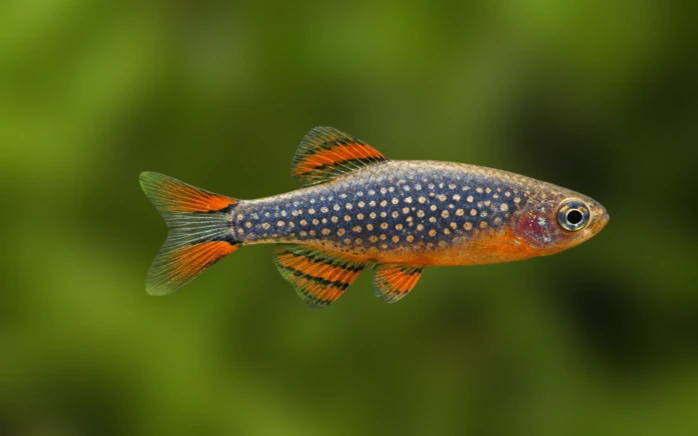
Males have a slim, deep blue body with bold pearl spots and strongly colored red and black fins. The belly can redden during spawning, and displaying males extend their fins.
Females have a fuller body and a paler blue-green or golden cast. Fin color is less intense. Seriously Fish notes that females tend to grow a little larger and look rounder when carrying eggs.
Both sexes carry spots and some red on the fins, so one feature alone does not sex a fish. Judge body shape together with color, fin pattern and behavior. Juveniles are hard to sex with confidence.
The Dark Spot on a Female CPD
The original breeders described a small dark spot around the vent of ripe females, sometimes with slight swelling. They used it to pick females ready to spawn. Mike Hellweg also wrote of a dark mark near the anal fin.
The spot is one breeding clue. Its accuracy has not been tested, and it does not sex every juvenile. Judge it together with a full belly, normal appetite, and males displaying nearby. Observe the female without handling her.
Are Pregnant CPDs a Thing
No. CPDs are egg layers, so a female with a rounded belly carries eggs. Abnormal swelling is not proof of eggs. Persistent bloating, raised scales, lethargy, or poor buoyancy point to illness.
Male to Female Ratio
A single pair is easiest to watch and limits egg predators. Breeders also use one male with several females, or small groups. More fish in a small container raise egg predation and male competition. No fixed ratio, such as one male to two females, is documented.
Long-term groups need space, plants and sight-line breaks. Separate a fish that shows constant chasing or fin damage.
Celestial Pearl Danio Breeding Tank Setup
Tank Size
Seriously Fish lists a 45 × 30 cm base (about 41 L, 11 gallons) for permanent housing. Footprint and plant structure matter more than the gallon figure. The same source recommends a large group, ideally 20 or more. To plan stocking, use the aquarium fish stock calculator.
A 10 gallon tank sits just under that base. A 5 gallon tank suits a short, monitored spawning session only. Spawning containers described by specialists hold 10 to 20 L (2.6 to 5 gallons) and are mostly filled with fine moss. Do not house a permanent group in 2.5 gallons.
A separate fry tank helps. Size it to the number and stage of the fry and to the filtration.
Plants, Moss and Spawning Mops
Provide dense, fine-leaved cover. Java moss works well, since it forms a thick spawning mat and moves as a clump. Other mosses and prepared spawning mops also work.
CPDs spawn inside vegetation or a mop, and some eggs fall out when the moss is disturbed. Use a removable mop or a compact moss clump to collect eggs.
Males choose a spot beside the vegetation and display there. Two or three separate patches of fine moss, placed so that they break line of sight, give several males room to display without constant challenges. This layout is an inference from the courtship record and has not been tested. Keep retreat routes open for females. If chasing, fin damage, or feeding exclusion increases, reduce the number of males.
Filtration, Flow and Light
CPDs do not need high flow. Use gentle current from an established biological filter, since an air-driven sponge filter is adequate and keeps fry out of the intake. Any filter works when the intake is covered.
An experienced keeper can run a small temporary spawning container without a filter. Oxygen and ammonia still need watching.
Keep a normal, steady light cycle. Spawning has been reported in the morning. No evidence shows that sunlight or an east-facing window raises egg numbers. Direct sun overheats small tanks and feeds algae.
Tank Mates
Seriously Fish lists other small cyprinids from Myanmar, such as Danio choprae and Microdevario species. It advises against Danio erythromicron, which could hybridize with CPDs. Large or predatory fish put eggs and fry at risk. For spawning, keep the group alone.
Celestial Pearl Danio Breeding Temperature and Water Parameters
A stable 22 to 25°C (72 to 77°F) suits breeding. The first breeding report recorded egg development at 24 to 25°C. The type locality measured 22 to 24°C in January 2007. Seriously Fish gives 20 to 26°C for general care.
These figures give a practical range. No source proves an optimum. A cool room that falls below 20°C needs a heater, since that is outside the listed range. A heater is not needed in a room that holds 22°C or more.
| Parameter | Value |
|---|---|
| Aquarium temperature | 20 to 26°C (68 to 79°F) |
| Breeding starting point | 22 to 25°C (72 to 77°F) |
| pH | 6.5 to 7.5 |
| GH | 5 to 15 dGH |
| KH and TDS | No spawning target established |
| Ammonia and nitrite | Undetectable in an established tank |
Test the source water before breeding. Match the temperature and chemistry of replacement water. Avoid changing several parameters at once in a stable tank.
Temperature and pH Myths
Three claims appear in breeding advice and none is documented. Raising the tank to 28°C or higher is not a requirement. A pH of exactly 7.3 is not an established trigger. Daily egg output from a group does not show that one female spawns every day.
Cold Water Changes as a Spawning Trigger
A cold water change is not required. The first breeding report describes courtship and spawning with no rain simulation and no temperature drop. Large cold changes stress fish in small tanks. Fix the sexes, the condition of the fish and the spawning medium first.
Conditioning Celestial Pearl Danios for Breeding
Feed a varied diet of small foods. Prepared foods work alongside live and frozen foods such as Daphnia and newly hatched Artemia. Seriously Fish credits daily small live and frozen meals with better color and breeding condition. Check that shy fish get their share.
Ready fish feed well. Females look full and males display near the moss. No minimum conditioning period is documented, and no specific worm or feeding day is proven to raise fertility. Females need time to rebuild eggs after spawning.
Celestial Pearl Danio Breeding Behavior: Courtship and Spawning
Peter Liptrot and Paul Dixon recorded the sequence of galaxy rasbora breeding behavior, and Roberts reproduced it in the 2007 description.
- Site selection. A male chooses a sheltered spot near dense plants, moss, or a mop.
- Display. He hangs head down about 2 to 3 cm from the vegetation, curves his body, spreads his fins, and quivers.
- Approach. A female comes close. A short chase may follow. Long pursuits by one or more males do not always end in spawning.
- Spawning. The pair enters the spawning material, and eggs and sperm are released in a short event.
- Separation. No parental care follows. More males may enter the moss, and the observers could not tell whether they were fertilizing or eating eggs.
Later breeders describe a brief nudge or headbutt by the female near the male’s anal fin. Individuals do not repeat every move in the same way. Male-male bouts and long chases are common and are not spawning by themselves.
How Often Do CPDs Breed
A mature group can spawn often, but a female does not lay a full clutch every day. Roberts dissected wild females about 18 to 19 mm long and found eggs at several stages, with only around half a dozen in the largest size class. That points to small batches released repeatedly, with different females contributing.
Roberts reports up to about 30 eggs in one episode and gives no recovery interval. Seriously Fish states that females cannot produce eggs daily. Some breeders report frequent small batches. The spawn interval for one female is unknown.
Celestial Pearl Danio Eggs (Galaxy Rasbora Eggs): Appearance, Number and Predators
What CPD Eggs Look Like
The eggs are small, translucent, and lightly adhesive, and they are hard to spot in moss. Dissected females held ripe eggs of 1.0 to 1.3 mm, which gives the rough scale. Freshly laid eggs were not measured. Eggs stick to moss or mop strands, and some drop to the bottom when the moss is disturbed. No single color change shows fertility. Eggs that turn white and cottony are dead.
To find them, move the mop into a shallow dish of water from the breeding tank, shine a light from the side, and place a dark surface behind the dish.
How Many Eggs Do Galaxy Rasboras Lay
Up to about 30 eggs per female in one reproductive episode. Seriously Fish gives around 30 mildly adhesive eggs for a typical event. That count is a documented observation. Other spawns may be smaller. One 2015 keeper account reported a high daily yield from a trio, but a single account is not a normal output.
Do the Parents Eat the Eggs
Yes. Adults eat eggs and give no care. Egg loss matters when the goal is more fry, but a thickly planted tank still produces occasional juveniles.
Pick one approach before spawning:
- Natural recruitment. Leave an established, heavily planted group together and watch for juveniles. This is simple and unpredictable.
- Controlled breeding. After a confirmed spawn, remove the adults from the container, or move the moss or mop to a prepared tank. Match the water and handle the eggs gently. An egg grid helps only if it blocks the adults and cannot trap them.
Since the eggs are only lightly sticky, a removable mop allows gentle collection. Lift it into water matched to the breeding tank, then move eggs with a smooth pipette or baster. Avoid shaking, strong jets, and rearranging the whole tank.
No reliable source gives survival percentages for either method. Record egg counts and fry outcomes to build usable numbers.
How Long Do CPD Eggs Take to Hatch
At 24 to 25°C (75 to 77°F) the first captive report recorded 3 to 4 days of incubation. Seriously Fish gives about 72 hours. The larvae then stayed still for about 3 more days.
| Stage | Observation at 24 to 25°C | Action |
|---|---|---|
| Egg | 3 to 4 days to hatch | Protect from adults. Keep conditions steady |
| Newly hatched larva | Dark, attached to surfaces, nearly motionless | Do not feed yet. Do not disturb |
| Transition | About 3 days after hatching | Watch for active swimming |
| Free-swimming fry | Searching for food | Offer Paramecium or fine fry food |
Where the Fry Go After Hatching
The larvae are dark and hard to find for the first days. They attach to glass, mops, and moss with structures on the head, then lose the dark color and start to swim. The function of those structures is unconfirmed, but camouflage and resistance to being swept away are both plausible.
A tank with no visible fry after hatching has not necessarily failed. Check surfaces with side lighting before any cleaning. Skip gravel vacuuming and glass scraping during this stage. Newly hatched larvae need no food on hatch day.
A slow hatch is not a failure. Eggs that rot should still come out, since dead eggs spread fungus.
Egg Fungus
Remove eggs that are dead or cottony without touching healthy neighbors. Keep circulation gentle. Watch for Saprolegnia spreading from dead eggs.
Do not dose methylene blue or Ich-X by guesswork. Doses differ among species, and no CPD protocol exists. If fungus persists, find the cause and ask an aquatic vet.
Celestial Pearl Danio Fry: First Foods and Feeding
Have microscopic food ready before the fry swim free. The first breeders saw larvae feed on cultured microorganisms after the hidden stage. Seriously Fish recommends Paramecium or a proprietary dry food in the 5 to 50 micron grade, then Artemia and microworms.
Paramecium, Infusoria and Fine Prepared Food
“Infusoria” is a loose term for small microorganisms with no set size or nutrition, so a kept Paramecium culture gives more control. Moss with microfauna adds supplementary food but cannot feed every fry.
Fine fry foods work when the particles are small enough to swallow. Add small amounts and watch the fry eat them. Green water supports food-web organisms, but algae do not replace Paramecium. Culture food in a separate container.
When Can CPD Fry Eat Microworms or Baby Brine Shrimp
Move up when the fry can catch and swallow the larger food. Some earlier reports describe a quicker switch to Artemia. One later breeder kept very small live food available for 10 to 15 days after free swimming before most fry took newly hatched Artemia. The reports may differ because of nauplius size, fry development, or what each keeper counted as accepting food. No controlled CPD feeding trial settles it.
Test a small portion of microworms or newly hatched Artemia. An orange-pink belly shows that a fry has swallowed brine shrimp. If the fry ignore the food, go back to finer food and try again after growth. Keep small foods available until the smallest fry feed on the next size. Do not switch by calendar.
Rinse and sieve Artemia nauplii before feeding. Unhatched cysts and shell debris do not belong in the fry tank. For a transitional food, see the microworm culture guide.
How Often to Feed CPD Fry
No CPD-specific schedule exists. Offer small portions often enough that edible food is always present. Remove uneaten food so it does not foul the water. Judge by feeding behavior, activity and water tests.
Fry Tank Water Changes and Growth
Use an established, fry-safe tank with a covered intake. Ammonia and nitrite must test at zero. Lift uneaten food with a pipette or narrow airline tubing, and check the collected water for fry before discarding it.
Change water when tests call for it, since no fixed week-one rule exists. Use dechlorinated water at the same temperature and a close chemistry match. Adult tank water is no safer than prepared replacement water.
Add space as the fry grow and density or waste rises. No evidence supports a fixed weekly tank-size ladder.
When Do CPD Fry Get Adult Colors
The original breeder account reports adult body shape at about 8 to 10 weeks. Adult color begins at about 12 weeks. Hellweg reported breeding at 11 to 12 weeks, including fry in a grow-out tank that held no older adults. Another breeder saw maturity at 3 to 4 months. Age varies with food, temperature, and the individual fish.
A grow-out group can therefore spawn earlier than expected. Watch competing males as they color up. Spread out cover and separate any fish that harasses others. Use unrelated, correctly sexed stock where possible, and label each generation if a line matters.
Celestial Pearl Danios Not Breeding: Troubleshooting
| Problem | Check first | Next step |
|---|---|---|
| No courtship | Sexes, maturity, condition, visible spawning sites | Confirm sex from several features. Add sheltered moss |
| Male chases female constantly | Cover, space, competition | Add visual barriers or separate a stressed fish |
| Courtship but no visible eggs | Hidden eggs, incomplete spawn, predation | Watch the site. Try a removable mop or a short spawning session |
| Eggs vanish | Adults eating eggs, disturbed moss | Remove adults after spawning or move the eggs |
| White or fuzzy eggs | Dead eggs, water-mold growth | Check water quality. Remove affected eggs gently |
| Fry disappear after hatching | Hidden larval stage, intake, predation | Check surfaces with side light. Cover the intake |
| Fry die after swimming free | Food too large or too scarce, water quality | Confirm the fry eat. Test the water |
| Fry reject Artemia | Nauplii too large | Offer finer food and retry after growth |
| Low output | Female recovery, stress, egg loss | Rotate breeders. Drop daily yield expectations |
Cold water changes, sunlight and exact sex ratios are not proven triggers. Adult losses are covered in Why My Galaxy Rasboras Died.
FAQ: Celestial Pearl Danio Breeding
How to Breed Celestial Pearl Danios
Condition healthy males and females on small foods, offer fine moss or a spawning mop in a stable tank, and let them spawn. Protect the eggs from the adults. After hatching, wait for free swimming, then feed Paramecium or fine fry food.
How Many Eggs Do Galaxy Rasboras Lay
Up to about 30 per female per spawning episode. The number varies, and no source guarantees a daily count.
How Long Do Celestial Pearl Danio Eggs Take to Hatch
About 3 to 4 days at 24 to 25°C, and the larvae stay still for about 3 more days. Timing shifts with temperature.
What Do CPD Eggs Look Like
Small, translucent, and lightly adhesive, and hard to see. They sit in moss or on mop strands, and some fall to the bottom.
Do Celestial Pearl Danios Eat Their Eggs
Yes. Adults eat eggs and do not guard them, so dense planting lets only a few fry survive. Removing the adults or moving the moss gives more control.
What Is the Best Temperature for Celestial Pearl Danio Breeding
A stable 22 to 25°C (72 to 77°F). Seriously Fish gives 20 to 26°C for general care, and the habitat measured 22 to 24°C in January 2007.
How to Tell a Male From a Female Galaxy Rasbora
Males are slimmer, with deeper blue bodies, bold spots and strong red and black fins. Females are fuller with a paler blue-green or golden cast, and ripe females may show a dark spot at the vent. Judge several features together.
What Is the Right Male to Female Ratio
One pair works for controlled spawning. Groups with more females also work when space and cover are enough. No fixed ratio is proven.
How Many CPDs Fit in a 5 or 10 Gallon Tank
Seriously Fish lists 11 gallons as the base for a group, ideally 20 or more fish, so a 10 gallon sits just under that. A 5 gallon suits a temporary spawning container only.
When Do Celestial Pearl Danio Fry Swim Free
About 3 to 4 days after hatching at 24 to 25°C. Look for active swimming and food seeking.
What Should CPD Fry Eat
Paramecium or a fine fry food of 5 to 50 microns at first. Add microworms and newly hatched Artemia when the fry can swallow them, which may take 10 to 15 days after free swimming.
Can CPDs Breed in a Planted Community Tank
Yes. A mature, dense tank may produce some juveniles, but a separate spawning setup raises the yield.
Are CPDs Rasboras or Danios
Danios. The accepted name is Danio margaritatus, and “galaxy rasbora” is a trade name.
Final Breeding Checklist
- Healthy adults, with at least one male and one female.
- A mature tank or container with dense fine moss or a spawning mop.
- Varied, small foods without fouling the water.
- Steady temperature and chemistry. No sudden trigger changes.
- A plan for natural recruitment or egg protection, made before spawning.
- A prepared fry tank and microscopic first food on hand.
- No feeding until the larvae swim free, and no cleaning of surfaces during the still stage.
- Bigger prey only when the fry eat it.
- Regular tests for ammonia and nitrite, plus a covered intake.
- Written records of egg counts, dates, and fry outcomes.
Sources and Evidence Notes
- Roberts, T. R. (2007). The “celestial pearl danio”, a new genus and species of colourful minute cyprinid fish from Myanmar. Raffles Bulletin of Zoology, 55(1), 131 to 140. Source of size, habitat, ovarian egg measurements, and the Liptrot and Dixon breeding observations.
- Eschmeyer’s Catalog of Fishes: Danio margaritatus. Accepted name.
- FishBase: Danio margaritatus. Name, size, and habitat.
- Seriously Fish: Danio margaritatus. Husbandry ranges, tank size, group size, tank mates, first foods, and egg protection.
- Hellweg, M. The Celestial Pearl Danio: A Cautionary Tale. Tropical Fish Hobbyist. Vent spot, courtship, maturity, and fry feeding.
- Breeding Celestial Pearl Danios (2015). SKF Aquatics keeper account on egg collection and fry feeding. Not peer reviewed.
- Practical Fishkeeping: Celestial pearl danio history and breeding.
- Swedish National Veterinary Institute (SVA): Saprolegniosis.
- Chambel et al. (2014). Ornamental fish egg disinfection. Aquaculture International, 22, 1743 to 1751.
The breeding accounts in Roberts (2007) were contributed by aquarists, so a later article repeating them is not independent confirmation. Still unknown: an experimental breeding optimum for temperature, pH, GH, KH, or TDS; a universal interval between spawns; egg and fry survival rates; a best first-food species; a daily feeding frequency; the function of the larval attachment structures; and a CPD-specific egg medication dose.
Related guides: Scarlet Badis Breeding Guide, Chili Rasbora Breeding, How to Breed Nano Fish, and 14 Best Nano Fish.