Short answer
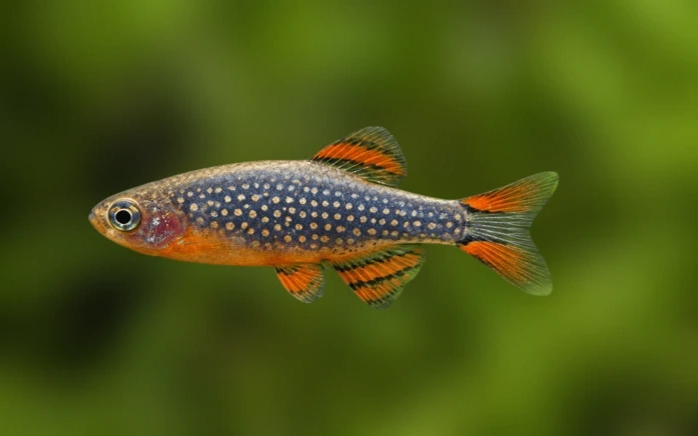
Celestial pearl danios (Danio margaritatus), sold as galaxy rasboras, reach only 2 to 2.5 cm. Keep 10 to 15 in a heavily planted tank of 60 L or more, at 22 to 24°C. Feed foods small enough for a 2 cm fish. Males spar, so cover and sightlines matter more than an exact pH.
The fish belongs to the genus Danio, and galaxy rasbora is a trade name. Roberts described it in 2007 as Celestichthys margaritatus, and Conway and colleagues moved it into Danio in 2008 on molecular and anatomical evidence. Both names remain in shops.
Celestial pearl danio care: quick facts
| Fact | Figure |
|---|---|
| Scientific name | Danio margaritatus (Roberts, 2007), formerly Celestichthys margaritatus |
| Other names | Galaxy rasbora, CPD |
| Origin | Spring-fed wetlands near Hopong, Shan State, Myanmar |
| Adult size | 2 to 2.5 cm including the tail |
| Temperature | 22 to 24°C preferred, 20 to 26°C tolerated |
| pH and hardness | pH 6.8 to 7.5, 5 to 12 °dGH |
| Minimum tank | 40 to 45 L, base of 45 x 30 cm |
| Better tank | 60 to 100 L, 60 to 80 cm long |
| Group | 10 to 15, with 6 to 8 as the floor |
| Diet | Microgranules plus live or frozen micro-prey |
| Breeding | Egg scatterer in fine plants, no parental care |
| Lifespan | Several years, no verified average |
| Conservation | Data Deficient (IUCN assessment of 2010) |
How firm are these numbers
No controlled study sets an optimum temperature, tank volume, group size or sex ratio for this species. The 22 to 24°C band matches water Roberts measured at the type locality in January 2007, and specialists agree with it. Ammonia, nitrite and oxygen limits come from aquatic veterinary references.
Treat every other figure as a starting point, and judge it by the fish.
Celestial pearl danio tank size and footprint
The minimum for a permanent group is 40 to 45 L with a 45 x 30 cm base. A 20 to 30 L tank suits a short breeding or isolation setup. It is too small for a mixed-sex display.
A tank of 80 x 35 x 35 cm (about 98 L) works better. Males defend small display sites, and a subordinate male needs a route away from a dominant one. Length supplies that route, and height does not.
No experiment links tank volume to stress, survival or spawning. The figures come from keeper and breeder experience, including Mike Hellweg’s account, and all of it stresses room for escape. Check total stocking with the aquarium fish stock calculator.
How many celestial pearl danios to keep together
Keep 10 to 15. Six to eight is the practical floor. Twenty or more can work, but only with more space and cover.
Pairs and trios concentrate aggression, since one male may pursue the same few fish all day. A larger group spreads that attention across more targets.
These fish shoal, which means they keep company without swimming in step. A settled group scatters through the plants, and each fish holds a favorite position. Tight synchronized swimming is rare in a settled tank.
Aim for more females than males, such as 4 or 5 males in 12 to 15 fish. No study shows an ideal ratio. Males are darker blue with red and black fin bands, and females are rounder with paler fins.
Water parameters: temperature, pH and hardness
| Parameter | Target | Basis |
|---|---|---|
| Temperature | 22 to 24°C | Measured at the habitat in January 2007, plus specialist advice |
| Tolerated range | 20 to 26°C | Published maintenance range |
| pH | 6.8 to 7.5 | Aquarium consensus, no species trial |
| GH | 5 to 12 °dGH | Husbandry guidance |
| KH | Stable, about 3 to 7 °dKH | General biofilter advice, not a species figure |
| Ammonia and nitrite | 0 | Veterinary standard |
| Nitrate | Under 20 mg/L | Precaution, no species threshold |
| Dissolved oxygen | Above 5 mg/L | Veterinary reference |
The fish suits cooler water than most tropicals. A stable 23°C is a sound default, and 20 to 26°C is the published range. Routine 28°C is hard to defend, since warm water holds less oxygen and raises metabolic demand. Do not heat the tank to suit warmer tank mates. Where a heater is needed, see the best aquarium heaters by tank size.
The claim that pH must be exactly 7.3 is weak. It traces to a collector’s secondhand estimate of pH 7.3, 7 °dGH and about 235 µS/cm. The species description does not contain it. Stable water at pH 7.0 and GH 6 serves as well as pH 7.4 and GH 9.
Skip pH additives. Check the source water and the tank buffering first, since a stable reading is better supported than a corrected one. Dim blackwater is not supported either. Roberts found clear water, dense submerged plants and pools less than 30 cm deep.
Tank setup: substrate, plants, cover, filtration and flow
Use dark inert sand or fine gravel, or a planted substrate. Color is a display choice, and texture only needs to be safe and easy to clean. For planted setups, see the best aquarium lights for planted tanks.
Java moss, hornwort, Cryptocoryne, Rotala and one floating plant supply shelter, spawning sites and shade. Java moss matters most, since CPDs have been seen spawning in it. Hornwort grows fast and needs regular thinning.
Plant the rear, the sides and several middle patches, and leave one open feeding area at the front. Dense patches break eye contact between males. A figure of 60 to 70% planted space is an aquascaping rule of thumb with no measurement behind it.
A sponge filter or a low-flow filter with an intake guard suits the tank. The surface should ripple gently. A rated turnover of 3 to 5 tank volumes per hour is a starting point, but check the current that actually reaches the fish.
Start with moderate light for 6 to 8 hours and adjust to plant growth. Floating plants add shade, but thin them so gas exchange continues. Fit a ventilated lid as a precaution, since no one has quantified jumping in this species.
What celestial pearl danios eat and how to feed them
No one has measured the wild diet. The tiny, upward-angled mouth points to zooplankton and small invertebrates.
| Food | Role |
|---|---|
| Microgranules, slow-sinking | Complete base diet |
| Flakes, crushed just before feeding | Alternate base diet |
| Newly hatched Artemia nauplii | Best regular live food, also for conditioning |
| Cyclops, small Daphnia, Moina | Variety, live or frozen |
| Microworms | Supplement only |
| Bloodworms | Too large whole, avoid as a staple |
Rotate the live foods several times per week. See how to culture Daphnia and microworms at home. Feed one or two small portions daily, sized so the fish finish within 1 to 2 minutes.
Bold fish chase every particle, while timid ones get little. Feed in two or three sheltered spots, and watch the shy fish swallow. A hollow belly that lasts for days is the warning sign.
Safe tank mates for celestial pearl danios
| Tank mate | Verdict | Reason |
|---|---|---|
| Other CPDs | Best | A structured group is the best-supported choice |
| Adult Neocaridina shrimp | Reasonable | Shrimplets get eaten |
| Adult Amano shrimp | Often fine | Too large to swallow, but watch food competition |
| Nerite and other small snails | Fine | Count them in the bioload |
| Pygmy corydoras | Conditional | Temperature overlaps, but they need their own group, see pygmy corydoras |
| Boraras rasboras | Conditional | Some species need softer, more acidic water, see chili rasboras |
| Danio erythromicron | Keep apart | Close relative, hybrid risk |
| Large barbs and danios | Avoid | They take the food and intimidate the group |
| Bettas | Uncertain | Aggression and warmer water conflict |
| Angelfish, large gouramis, predators | Avoid | Predation and temperature mismatch |
The main risk is quiet starvation. A fast feeder takes everything, and the CPDs look fine until they thin out. Use feeding speed as the first test for any tank mate.
Normal behavior, stress signs and health
Midwater hovering and display are normal
A settled CPD hovers at a station among the plants, in the middle or lower part of the vegetation, and darts out to take food. Males circle rivals with erect fins, flare and make short chases. Roberts recorded this display in the 2007 description.
Strong color in a male reflects maturity and rank, and says little about welfare. A dominant male can be bright red while harassing the rest. For fading color, see why nano fish lose color.
Signs of stress or illness
- Rapid gill movement or gasping at the surface, which suggests low oxygen or poor water quality
- A hollow belly that lasts for days, meaning the fish are missing food
- Clamped fins and inactivity
- White spots or visible growths
- Torn fins, a fish pinned in a corner, or a fish kept from food, all signs of harassment
- Bloating with raised scales, which is not a sign of eggs
Many causes share these signs, so test ammonia, nitrite and oxygen first, then check recent changes, feeding access and aggression. For causes behind sudden losses, see why galaxy rasboras die.
Quarantine, medication and lifespan
Quarantine new fish for about 30 days in a cycled tank. Avoid blind medication, routine antibiotics and salt dosing. Consult an aquatic veterinarian before treating.
Popular guides quote 3 to 5 years. A 2013 review put small danios at 1.0 to 3.5 years. Neither figure comes from a CPD survival study, so plan for several years.
Breeding celestial pearl danios: spawning triggers, eggs and fry
No hormonal or seasonal trigger is documented. Spawning follows good condition, fine plants to spawn in and a male with a display site. Breeders condition the fish for 1 to 2 weeks on live foods. Some breeders report near-daily spawning in groups, but the interval for a single female is unknown.
- Set up a matured 10 to 20 L tank with a covered sponge filter, thick Java moss or spawning mops, and egg-separation mesh.
- Add one male and one or two conditioned females. Match temperature and chemistry to the parent tank.
- Remove the adults after spawning, or move the moss to a rearing tank. Adults eat the eggs and give no care.
- Hold 23 to 25°C with gentle flow. Eggs hatch in 3 to 4 days, and a female may lay up to about 30 per episode.
- Leave the dark, motionless larvae alone. They become free swimming at about 6 to 8 days.
- Start with foods under about 50 µm, such as Paramecium or infusoria, then add newly hatched Artemia as the fry grow.
Juveniles take on an adult body shape at 8 to 10 weeks and show full color at 10 to 12 weeks. Breeders report spawning near 11 to 12 weeks. The usual losses are eaten eggs, missed larvae and first foods that are too large. More on method is in breeding nano fish.
Hidden discoveries most care sheets miss
The pearls are reflective cells
The pale spots come from iridophores, cells that reflect light. Their brightness shifts with viewing angle and lighting, so the same fish can look dull from one angle and bright from another.
Roberts also described a pale dorsal blaze in displaying males. The contrast may intensify because the flanks darken.
The face is built for tiny prey
Electron micrographs in the 2007 description show a mouth angled about 45° upward. They also show taste buds on the lower jaw and hair-like olfactory structures near the nostrils. The finding supports small, drifting food and a feeding spot with low flow. No trial has tested an ideal particle size.
The wild habitat has predators and neighbors
Roberts collected the snakehead Channa harcourtbutleri from the same pools. No predation was recorded, but dense cover suits a fish that lives beside one. A 2022 survey by Kano and colleagues found CPDs and Danio erythromicron in shallow backwater at Hopong. It also recorded urbanization and introduced tilapia and mosquitofish.
Hybrids are possible in the lab
A 2024 study produced CPD and zebrafish hybrids by in-vitro fertilization. Some reached adulthood, but the males were sterile. This does not show that CPDs and D. erythromicron hybridize in tanks, but separate breeding lines remain the cautious choice.
Genes and the unconfirmed longspot
An October 2025 preprint by Lu and colleagues names the genes igsf11 and gja5b in pigment-cell interaction. They may explain how striped danios gave rise to spotted ones. The result is preliminary.
Hellweg once described orange fish with elongated spots, which he called longspots. No taxon was ever confirmed. Record the origin of any unusual fish before breeding it.
What to do with this
Build three zones: fine-leaved cover for display and spawning, plant barriers that break sightlines, and a small open area for feeding. Change only the layout for 3 weeks. Log display events, torn fins and whether shy fish swallow food.
Celestial pearl danio myths checked
| Claim | Verdict | Evidence |
|---|---|---|
| Needs soft, acidic water | Not supported | Habitat reports and captive breeding point to near-neutral pH |
| Needs exactly pH 7.3 | Not supported | Secondhand collector estimate, not a replicated measurement |
| Needs 28°C | Avoid | Habitat measured 22 to 24°C in January |
| Needs dim blackwater | Not supported | Habitat is clear and vegetated |
| Is a true schooling fish | Wrong term | Settled groups spread out, and males defend sites |
| Lives 3 to 5 years | Unverified | No longitudinal CPD study exists |
Celestial pearl danio FAQ
Are celestial pearl danios and galaxy rasboras the same fish?
Yes. Galaxy rasbora is a trade name for Danio margaritatus. The fish is a danio.
Are celestial pearl danios schooling fish?
No, they shoal. They keep company but spread through the plants, and males defend small sites.
Are celestial pearl danios aggressive?
Males display and chase each other, which is normal in moderation. They are generally peaceful toward other species.
Can celestial pearl danios live in a 5 gallon tank?
Not as a permanent mixed group. The defensible minimum is 40 to 45 L (10 to 12 gallons) with a base of 45 x 30 cm.
Do celestial pearl danios need a heater?
Only if the room falls below the target of 22 to 24°C. An unheated tank works where room temperature stays in range.
Can celestial pearl danios live with shrimp?
Adult shrimp usually coexist with them. Shrimplets small enough to swallow are at risk.
Can celestial pearl danios live with bettas?
The pairing is uncertain. Betta aggression and a preference for warmer water both conflict with CPD needs.
Do celestial pearl danios jump?
Jumping is not quantified. A ventilated lid is a low-cost precaution.
What is the difference between a celestial pearl danio and an emerald dwarf rasbora?
Danio erythromicron is a close relative that shares the Hopong wetlands. Keep the two in separate tanks, especially when breeding.
Sources
- Roberts (2007), original species description, The Raffles Bulletin of Zoology
- Conway, Chen and Mayden (2008), placement in Danio, Zootaxa
- Kano et al. (2022), fish diversity of the Hopong spring field, Biodiversity Data Journal
- Trevena et al. (2024), danionin hybrids, Evolution & Development
- Lu et al. (2025), pigment-pattern genomics, bioRxiv preprint
- Merck Veterinary Manual, management of aquarium fish
- Merck Veterinary Manual, water quality reference ranges
- Hellweg, Tropical Fish Hobbyist, breeding and behavior account