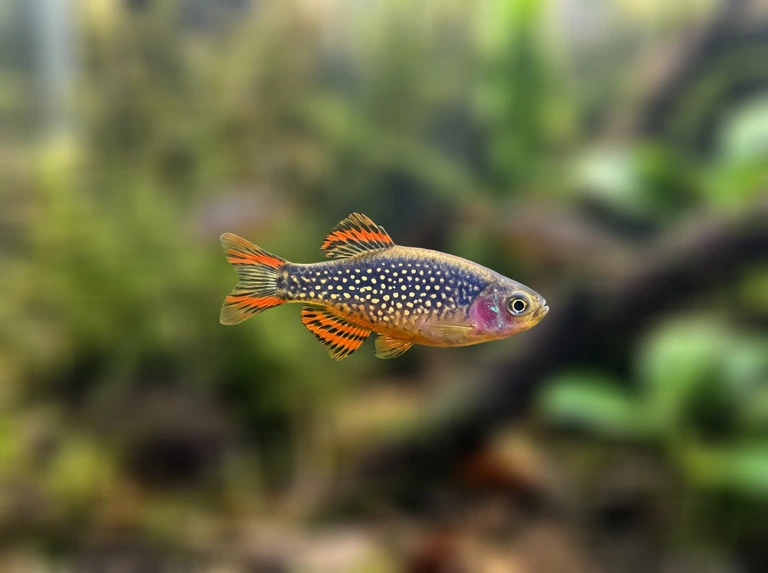
A celestial pearl danio is more likely to be killed by another celestial pearl danio than by any tank mate. Males spar every day. One keeper’s group of 8 was down to a single fish within days. Groups of 20 or more are advised, since aggression spreads across more fish.
The fish is 21 mm long, about the width of a nickel, with a tiny upturned mouth. It hovers in the plants and rarely rises to the surface. Almost anything faster wins its meals. Good celestial pearl danio tank mates pass five tests, which are shared temperature, mouth size, meal speed, flow and water chemistry. Temperament decides little, since most of the fish that fail are sold as peaceful.
Verdicts assume 10 or more danios in a planted tank of at least 41 L, with a base of 45 × 30 cm or larger, held at 22-24 °C. Setup and feeding are in the celestial pearl danio care guide, and spawning is in the breeding guide.
Celestial pearl danio tank mates compared
Pale blue is the danio’s tolerated 20-26 °C. The darker core is its 22-24 °C sweet spot. Each bar is the companion’s own range.
| Tank mate | Verdict | Temperature | What decides it |
|---|---|---|---|
1 Pygmy coryGastrodermus pygmaeus · 30 mm | Top pick | 22-26 °C | Tiny mouth, easily outcompeted, so it takes nothing from the danios. Feed sinking micro-pellets after lights out. |
2 Hastatus and salt-and-pepper corysG. hastatus, Hoplisoma habrosum · 32-35 mm | Top pick | 20-26 °C | The temperature window matches the danio’s exactly. Keep 6 or more and feed after lights out. |
3 Glowlight danioDanio choprae · 30 mm | Top pick | 16-26 °C | A Myanmar danio that needs similar water. Needs a base of 80 × 30 cm and a tight lid. |
4 Kubotai rasboraMicrodevario kubotai · 20 mm | Top pick | 20-27 °C | A Myanmar genus of the same size and shyness. Wants a mature tank with stable water. |
5 Amano shrimpCaridina multidentata · 50 mm | Top pick | 18-28 °C | Hardness of 5-15 dGH matches the danio’s. Larvae need brackish water, so there are no shrimplets to lose. |
6 Nerite, ramshorn and trumpet snailsSnails | Top pick | Wide range | The danios cannot harm adult snails. Shells erode in soft water, so hold pH near 7 or add a calcium source. |
7 Ember tetraHyphessobrycon amandae · 20 mm | Good | 20-28 °C | The standard dither fish. Danios grew bolder in most keeper tanks and shyer in a few. Feed live food in two spots. |
8 Chili rasboraBoraras brigittae · 20 mm | Good | 20-28 °C | Same size and shrimp-safe. Two timid species can leave a tank of hiders. Skip B. merah and B. maculatus, which top out at pH 6.5. |
9 Lambchop and Hengel’s rasborasTrigonostigma espei, T. hengeli · 30 mm | Good | 23-28 °C | Very peaceful. The overlap starts at 23 °C, so run the tank at 23-24 °C. |
10 Kuhli loachPangio semicincta · 100 mm | Good | 21-26 °C | Nocturnal and harmless to adults. Eats eggs and fry, and clears corpses fast. Guard the filter intake. |
11 OtocinclusOtocinclus macrospilus · 35 mm | Good | 21-26 °C | The danios ignore it. The risk is starvation, so add it only to a mature tank with algae. |
12 Pygmy sparkling gouramiTrichopsis pumila · 40 mm | Good | 22-28 °C | Small and slow. It preys on small shrimp, so skip it in a shrimp tank. |
13 Red cherry shrimpNeocaridina davidi · 30 mm | Good | 15-30 °C | Adults are safe in most tanks. Shrimplets and egg saddles are not. |
14 BettaBetta splendens · 70 mm | Conditional | 24-27 °C | Works in about 9 keeper reports, but one keeper lost 2 of 10 danios. Needs 10 gallons or more, danios first, betta last and a spare tank ready. |
15 Neon tetraParacheirodon innesi · 30 mm | Conditional | 21-25 °C | The water fits, but neons reach food first. Feed in two spots so the danios get their share. |
16 Honey gouramiTrichogaster chuna · 55 mm | Conditional | 22-27 °C | Calm, and as slow at feeding as the danio. Needs a group of 4 to 6 and dense plants. Target-feed the danios. |
17 Harlequin rasboraTrigonostigma heteromorpha · 45 mm | Conditional | 21-28 °C | Fine in keeper reports. Twice the danio’s length and a jerky swimmer. Use a 60 cm tank. |
18 White Cloud Mountain minnowTanichthys albonubes · 40 mm | Conditional | 14-22 °C | Overlaps only at 20-22 °C, the cool edge of the danio’s range. Two keepers ran them together for years. |
19 Scarlet badisDario dario · 20 mm | Conditional | 18-26 °C | Same size and shyness as the danio. Needs live food, and males hunt shrimplets. |
The five tests behind every verdict
Temperature
The tolerated range is 20-26 °C, and the fish thrives at 22-24 °C. The pond where it was collected measured 22-24 °C in January 2007. A tank at 24 °C suits the danio and most cooler tropicals. Any fish that needs 26 °C or more fails the test. That rules out cardinal tetras at 23-29 °C and chocolate gouramis at 26-31 °C. Keepers disagree on the ceiling, with some running tanks at 76-82 °F without loss and others losing whole groups above 78 °F.
Mouth and size
Roberts described the species in 2007 and records a very small, upturned mouth. No study has measured its gape, so keeper reports settle the shrimp and fry questions. The table treats about 30 mm, 1.5 times the danio’s length, as the comfortable ceiling. A fish at twice that length needs a specific reason to be listed. Anything that can swallow 2 cm of prey will try. Adult angelfish reach 150 mm and eat fish this size.
Meal speed
The danio sits in the plants and seldom takes food at the surface. It is likely to be intimidated or outcompeted for food by larger or more boisterous tank mates. Keepers add that neon tetras reach food much faster. Barbs finish a meal before the danios notice it, and even cherry shrimp chase danios off. Feed live or frozen Daphnia and Artemia in two spots. Check that the danios’ bellies are round.
Flow and water
The species wants an air-driven sponge filter, which rules out hillstream loaches, since they want 15-20 turnovers of the tank volume an hour. It wants pH 6.5-7.5 and 5-15 dGH. Avoid driftwood and leaf litter. Blackwater fish meet the danio at one corner of its range. Boraras merah tops out at pH 6.5 and 5 dGH, and Sundadanio needs strictly acidic water. Hard-water fish miss from the other side, since Endler’s livebearers want up to 35 dGH.
Celestial pearl danios with shrimp and snails
Adult shrimp are safe in most tanks. Shrimplets are not. Roughly 15 keeper reports describe adult red cherry shrimp left alone, and roughly 7 describe attacks. The attacks cluster on molting shrimp and in bare tanks. About 25 reports describe lost shrimplets. One keeper wrote that danios and shrimp coexisted for six weeks, then the danios went hunting and the shrimp disappeared.
A colony that is thriving before the danios arrive usually survives them. A colony started beside danios usually does not. Dense moss helps but does not guarantee it, since two recent keepers lost colonies in heavily planted tanks. One keeper watched danios strip the egg saddle from a berried female. A forum moderator advises a pile of river rock, because danios avoid dark caves and shrimplets can hide in the gaps. Dense flame moss serves the same purpose. More species are rated in the shrimp-safe fish guide.
Amano shrimp remove the problem. Their larvae need brackish water, so no shrimplets are born. One keeper reported an Amano killing a newly added danio in 2018, against three reports of trouble-free tanks. Crystal Red and bee shrimp have almost no evidence. A 2026 post describes 5 danios and 25 Caridina in 14 gallons with no surviving baby in two years. Nerite, ramshorn and Malaysian trumpet snails are safe. The danios eat a few of their eggs.
Celestial pearl danios with a betta
Of 19 tank mate lists compared for this guide, none recommends a betta and 11 say to avoid it. About 9 keepers report it working. One lost 2 of 10 danios to bettas. A betta is a poor fit for a standard community tank.
The keepers who succeeded put the danios in first and the betta last. The tank was planted and held 10 gallons or more, the betta was calm or female, and a spare tank stood ready. They also settled on 75-76 °F, above the danio’s sweet spot and below the usual betta setting. Even then, the individual betta decides the outcome. Size limits for any betta community are in betta tank mates for 5 and 10 gallons.
Group size and sourcing matter more than tank mates
Keep 10 to 15 danios with more females than males, and 20 in a larger tank. The minimum base is 45 × 30 cm because dominant males fight. No tank mate fixes a group that is too small. Keepers report males killing males in small groups.
Most keeper reports of dead danios involve no tank mate at all. About a dozen describe batches dying within weeks of purchase. The causes are shipping stress, parasites, inbreeding and heat. New imports are often in poor condition. Commercial breeding has also made spotted fins and deformities common. Buy from a local breeder, hold new fish apart for a few weeks and feed live or frozen food from the first day. For sudden deaths, see the guide to why galaxy rasboras die.
Fish to skip, and the real reason
| Species | Real problem |
|---|---|
Emerald dwarf danioDanio erythromicron, sold as emerald dwarf rasbora | Probably capable of hybridizing with the danio. Wants pH 7-8 and 12-20 dGH, above the danio’s range. |
Tiger barbPuntigrus tetrazona | A fin biter at 60 mm. A poor companion for timid, slow-moving species. |
Cherry barbPuntius titteya | Listed as peaceful, yet three danio keepers report it finishing the food first and making the danios hide. |
Zebra and giant daniosDanio rerio, Devario aequipinnatus | Zebras reach 50 mm and eat greedily. The giant danio’s vigorous feeding upsets timid fish. |
Cardinal tetraParacheirodon axelrodi | Needs 23-29 °C and acidic water. One keeper reported that the danios did not thrive beside cardinals. |
Dwarf and three-spot gouramisTrichogaster lalius, Trichopodus trichopterus | The dwarf gourami is shy and territorial, and some three-spots are spiteful with age. |
Guppy, Endler, molly, platy, swordtailLivebearers | Hard water, with Endlers wanting up to 35 dGH. Swordtail fry ate danio fry in one keeper’s tank. |
Angelfish and large cichlidsPterophyllum scalare | Adults reach 150 mm and eat fish this size. |
Congo tetra and large rainbowfishPhenacogrammus interruptus, Melanotaenia boesemani | Too big and boisterous. Keepers who had danios say they vanish into the plants beside Congo tetras. |
Hillstream loachesSewellia spp. | Need 15-20 turnovers of the tank volume an hour. The danio wants a gentle sponge filter. |
Pea pufferCarinotetraodon travancoricus | Nips the fins of slow-moving fish and is easily eaten by larger companions. |
The emerald dwarf danio is the most tempting wrong answer, since several popular lists recommend it. A 2022 survey by Kano and colleagues found it and the celestial pearl danio in the same shallow backwater at Hopong. Hybridizing in aquaria is still a risk, and wild neighbors do not guarantee safe tank mates.
Five stocking plans for celestial pearl danios
| Plan | Tank | Stock | Water |
|---|---|---|---|
1Species tank | 38 L (10 gallon), 51 × 25 × 30 cm | 10-12 danios with 2 females per male, 3 Amano shrimp, 2 nerites | 22-24 °C pH 6.5-7.5 GH 5-10 |
2Cory community | 57 L, 61 × 30 × 30 cm | 12 danios, 5 pygmy or salt-and-pepper corys, 4 adult red cherry shrimp, 2 nerites | 22-24 °C pH 6.5-7.5 GH 5-10 |
3Showcase | 76 L (20 long), 76 × 30 × 30 cm | 20 danios, 5 hastatus corys, 3 Amano shrimp, 3 nerites | 22-24 °C pH 6.5-7.5 GH 5-10 |
4Myanmar mix | 76 L (20 long), 76 × 30 × 30 cm | 10 danios, 8 kubotai rasboras, 5 salt-and-pepper corys, 3 Amano shrimp | 22-25 °C pH 6.5-7.0 GH 5-10 |
5Shrimp first | 57 L, 61 × 30 × 30 cm | A red cherry shrimp colony in dense moss and river rock. Add 10 danios once shrimplets are common. | 22-24 °C pH 6.5-7.5 GH 5-8 |
Volumes are gross. A 10 gallon sits just under the advised 45 × 30 cm base, so keep the group to 10-12 there. Check any mix against the stock calculator.
What the wild pond shares with the danio
The species was collected from spring-fed ponds near Hopong in Shan State, Myanmar. The water was about 30 cm deep and thick with Elodea-type plants. Four fish are listed from the type locality. They are the fireline danio (Devario sondhii), a Microrasbora, a rosy loach and a snakehead, Channa harcourtbutleri. Kano and colleagues counted 25 species in the Hopong springs, including introduced tilapia, mosquitofish and guppies. The area is being built over, and IUCN lists the danio as Data Deficient.
The closest aquarium stand-ins for the native community are Myanmar danios, Microdevario and small loaches. That is why the glowlight danio and the kubotai rasbora sit among the top picks.
Celestial pearl danio claims the evidence does not support
| Claim | What the evidence shows |
|---|---|
Fine with other community fish | It is peaceful, but its size and shyness make most community tanks a poor fit. Keeper reports agree. |
Shrimp safe | True for adults. Shrimplets are lost in about 25 keeper reports, and egg saddles in at least one. |
A cold-water fish | It tolerates 20-26 °C and thrives at 22-24 °C. Tropical community temperatures of 78-82 °F are the mistake. |
Murder minnows | Males fight males. The fin nipping does not normally extend to tankmates. The nickname comes from a thread about danios killing each other. |
They hide forever | Reports split by group size. Twelve in a 90 gallon stayed front and center. Ten in a 10 gallon were rarely seen. Floating plants brought them out. |
A galaxy rasbora is a rasbora | It is a Danio. The chili rasbora, Boraras brigittae, is a different fish. |
A 5 gallon is enough | The minimum base is 45 × 30 cm, about 41 L, because dominant males fight. |
An easy beginner fish | It is easy, but new imports are often in poor condition. About a dozen keeper threads describe batches dying within weeks. |
Sources
- Kano et al. 2022, fish diversity of a spring field in Hopong, Biodiversity Data Journal
- IUCN Red List: Danio margaritatus
- Hellweg, the celestial pearl danio: a cautionary tale
- Roberts 2007, original description, Raffles Bulletin of Zoology 55(1): 131-140
- Keeper counts come from about 75 Reddit and forum threads.