
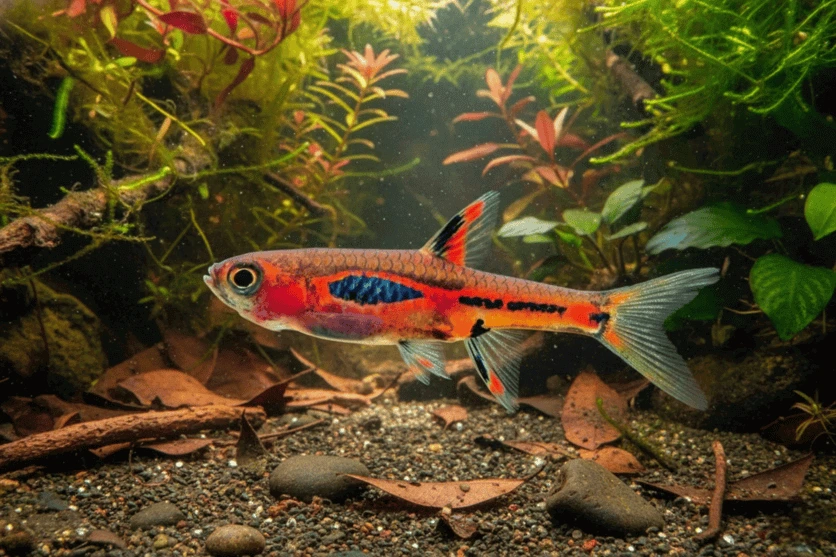
Breeding chili rasboras at home is easy once you understand one critical truth: these tiny jewels of Borneo’s ancient peat swamps require you to recreate their blackwater origins. Success hinges on soft, acidic water chemistry combined with microscopic first foods and patience during the delicate fry stage. This comprehensive guide synthesizes decades of expert breeding experience, scientific research, and community wisdom into actionable protocols that work.
Quick Stats:
- 26-28°C Optimal Breeding Range
- 5.5-6.0 Target pH
- 24-36hrs Hatching Time
- 20mm Maximum Adult Size
- 2-5 Eggs per Day
- 1-5°dH Target GH
Scientific foundation: understanding what you’re breeding
The chili rasbora belongs to a remarkable group of miniaturized cyprinids that have captivated ichthyologists since Dieter Vogt first described the species in 1978 from collections near Bandjarmasin in South Kalimantan. Originally classified as Rasbora urophthalma brigittae (named for Vogt’s wife Brigitte), the fish was later reclassified to the genus Boraras—an anagram of Rasbora reflecting the group’s reversed vertebrae ratios compared to their larger cousins. This taxonomic placement within family Danionidae (subfamily Rasborinae) groups them with five other miniature species, all exhibiting true proportional dwarfism where sexually mature adults remain under 20mm standard length.
Natural Habitat
B. brigittae restricts itself to southwestern Borneo’s peat swamp forests in Kalimantan Selatan and western Kalimantan Tengah. These ancient ecosystems feature peat deposits exceeding 20 meters deep accumulated over millennia, creating unique water chemistry that defines the species’ physiology. The blackwater streams measure pH 4.0-5.0 in pristine conditions, with negligible hardness (under 1°dH) and dark tannin-stained water filtering through forest canopies.
Sharing this habitat with chocolate gouramis (Sphaerichthys osphromenoides), various endemic Betta species, and even the world’s smallest vertebrate (Paedocypris progenetica), B. brigittae has evolved specific adaptations for soft, acidic conditions. The fish swim among submerged leaf litter, fallen branches, and the stilt roots of dominant trees including Gonystylus bancanus and multiple Shorea species.
Conservation Status
This habitat faces existential threats. Only 36% of historical peat swamp forest remains, with merely 9% protected within reserves. Palm oil plantation conversion represents the primary driver of destruction, supplemented by drainage projects (the catastrophic Mega Rice Project alone destroyed over one million hectares), peat fires during El Niño dry periods, and artisanal diamond mining. The IUCN currently lists B. brigittae as Data Deficient as of 2019.
Reproductive Biology
Understanding the reproductive biology illuminates why certain breeding protocols succeed. Like all teleost fish, chili rasboras rely on the Brain-Pituitary-Gonadal (BPG) axis to regulate reproduction. Environmental cues—particularly changes in water chemistry, temperature, and photoperiod associated with rainy seasons—trigger the hypothalamus to produce Gonadotropin-Releasing Hormone (GnRH). This stimulates the pituitary gland to release Follicle-Stimulating Hormone (FSH) and Luteinizing Hormone (LH), which in turn drive gamete production in the gonads.
Continuous Spawning Strategy
The species employs a continuous spawning strategy with zero parental care—females scatter small batches of adhesive eggs (typically 2-5 per day) on the undersides of broad leaves and among fine-leaved vegetation. This strategy maximizes reproductive output over time rather than through single mass spawning events.
Sexual Dimorphism
Females: Noticeably rounder, fuller abdomens when gravid; Plumper appearance from above; Slightly muted coloration; Continuous lateral stripe patterns.
Males: Most intense red coloration when breeding-ready; Bright red extending into fin membranes; Slender, streamlined bodies; Broken or irregular lateral stripes; Dark pigmentation on dorsal, anal, caudal fins.
Blackwater chemistry: the non-negotiable foundation
Water chemistry represents the single most critical variable separating breeding success from frustration with Boraras brigittae. While the species demonstrates remarkable adaptability in display aquariums, breeding success rates correlate strongly with water parameters approaching their natural habitat conditions.
Target Water Parameters
- pH Level: 5.0-6.5 (optimal 5.5-6.0). Research shows pH 5.5-6.0 yields hatching rates of 70-82%, while pH below 4.5 causes severe mortality and pH above 7.0 dramatically increases fungal susceptibility.
- General Hardness (GH): 1-5°dH (18-90 ppm). Soft water reduces osmotic stress during egg development and maintains optimal membrane permeability for gas exchange.
- Carbonate Hardness (KH): 0-2°dH for minimal buffering. Despite targeting soft conditions, maintain at least 2-3°dH to prevent dangerous pH crashes.
- TDS: 80-150 ppm. This range balances soft water requirements with maintaining stable parameters.
- Temperature: 26-28°C (79-82°F). Upper range stimulates spawning behavior through hormonal triggers in the BPG axis.
- Tannins: Essential. Dark tea coloration from Indian almond leaves, alder cones, or commercial blackwater extracts provides antibacterial/antifungal protection.
Why Tannins Matter: Tannins provide multi-layered benefits beyond their aesthetic tea-colored appearance. These polyphenolic macromolecules possess proven antibacterial and antifungal properties by binding to pathogen proteins, disrupting cell wall synthesis, and chelating iron that bacteria require. This protection proves critical because B. brigittae eggs and newly hatched fry lack fully developed immune systems.
Creating Blackwater Conditions
- Indian Almond Leaves (Catappa): The gold standard for most breeders—effective, safe, affordable, and provide biofilm surfaces for fry grazing. Critical Insight: The decomposing leaves should remain in the tank as they colonize with beneficial biofilm—experienced breeder Mike Hellweg identifies this aged leaf and driftwood biofilm as potentially critical for early fry survival.
- Alder Cones: Deliver the highest tannin concentration of common botanicals, making them ideal for targeting very dark water. Dosage: One cone per 5-10 gallons for breeding strength. Warning: Potency requires careful monitoring to avoid dramatic pH drops in unbuffered water.
- RO Water Protocol: For maximum control over parameters, RO (reverse osmosis) water provides the blank slate necessary for precision. Start with RO water; Remineralize to GH 3-5°dH using calcium and magnesium sulfates; Add minimal carbonate buffering to KH 1-2°dH using potassium bicarbonate; Mix 24-48 hours in advance with gentle aeration; Incorporate tannin sources to achieve target pH naturally; Match temperature within 1-2°F before use.
Water Change Protocols
- Adult Conditioning Tanks: 20-30% weekly changes using pre-mixed, temperature-matched RO water with tannins.
- Breeding Tanks: Days 0-10: NO water changes for 7-10 days after spawning unless ammonia becomes detectable. Top off evaporation only with pre-mixed water matching tank parameters.
- Days 10-14: Begin small 5-10% changes every 2-3 days, gradually increasing volume as fry grow.
- After Day 14: Increase to 10-15% twice weekly, eventually ramping to 25-30% every 2-3 days during heavy feeding (days 20-40).
Critical Rules: Temperature must match within 1°F; Water parameters within 0.2 pH units; Water must be aged 24+ hours with gentle aeration; Replacement water must contain appropriate tannin levels.
Breeding setup: Creating the optimal environment
The physical breeding setup determines whether your carefully prepared water chemistry translates into spawning success and fry survival. Two fundamentally different approaches dominate the breeding community.
Separate Breeding Tank Method
Provides maximum control and typically achieves the highest fry survival rates.
- Tank Specifications: 10-20 liter (2.5-5 gallon) container; Bare bottom or fine mesh substrate; Minimum 45cm x 30cm (18″ x 12″) base.
- Lighting: Dim or heavily diffused; 50% surface coverage with floating plants; Water sprite, duckweed, or Pistia.
- Spawning Substrate: Java moss – overwhelming first choice; Fill ~half the container; Alternative: Ceratopteris, Cryptocoryne, Anubias.
- Filtration: Air-powered sponge filter ONLY; Rated for up to 20 gallons; Adjustable air valve for gentle bubbling; Water movement should barely ripple surface.
- Temperature: 27-28°C (80-82°F); Upper range stimulates spawning; Quality adjustable heater; Avoid dramatic swings.
- Location: Away from direct sunlight; No drafts or HVAC vents; Low-traffic area; Stable ambient temperature.
Continuous Spawning Colony Method
Favored by experienced breeders like Mike Hellweg who maintain self-sustaining populations.
- Setup Requirements: 10-15 gallon species tank with 8-12 adult B. brigittae ONLY; No other fish, no snails, no shrimp; Extremely heavily planted with multiple microhabitat types; Dense Cryptocoryne thickets, Anubias on driftwood; Java moss carpets covering substantial bottom areas; Floating plants obscuring 50% of surface; Multiple large pieces of well-aged driftwood; Substantial Indian almond leaf litter on substrate.
- How It Works: This naturalistic setup works through biology rather than intervention. Conditioned adults spawn continuously among vegetation, scattering small numbers of eggs daily. Most eggs face predation by adults, but sufficient plant density means some eggs in protected locations escape detection. Fry graze on infusoria naturally present, feed on biofilm coating aged driftwood and decomposing leaves, and consume leftover microworms when adults are fed live foods. Breakthrough Insight: The biofilm on well-aged driftwood may be more critical than traditional infusoria cultures, with fry actively congregating around aged wood even before accepting free-swimming foods.
- Expected Results: 5-20 fry surviving to visible size per month when conditions prove optimal. This lower absolute number is offset by zero labor investment and rolling generations that maintain themselves indefinitely.
Conditioning adults and triggering spawning
The conditioning phase separates casual spawning attempts from consistent breeding success. This preparation period should run minimum 2 weeks, preferably 3-4 weeks before introducing fish to breeding setups.
Conditioning Diet
- Baby Brine Shrimp (Artemia nauplii): Gold standard – stimulates natural hunting, matches nutritional profile, simple to hatch.
- Live Daphnia: Triggers spawning readiness through natural hormonal compounds.
- Grindal Worms & Microworms: High protein, easy to culture at home.
- Frozen Foods (Bloodworms, Cyclops): Practical alternatives when live foods unavailable.
Feeding Schedule: 2-3 times daily minimum during conditioning, with best results from varied menus rotating between food types. Some breeders supplement with quality crushed krill flakes to intensify red coloration in males.
Visual Breeding Indicators
- Females Ready to Breed: Noticeably plumper, rounder abdomens; Fullness visible from above; Indicates egg development under FSH influence.
- Males Ready to Breed: Most intense red coloration; Bright red extending into fin membranes; Dark black and red highlights pronounced; Actively chase females around tank; Perform courtship displays.
Spawning Triggers
- Day 1: Large Water Change: Perform 50-75% change using RO-based water 1-2°C cooler than tank temperature. This mimics rainfall diluting and cooling swamp waters, triggering neurohormonal cascades that drive final egg maturation.
- Days 2-4: Temperature Elevation: Gradually raise breeding tank temperature to 27-28°C (80-82°F) over several days. This thermal cue combined with soft, acidic blackwater creates ideal breeding conditions.
- Evening: Transfer Fish: Transfer 2-3 conditioned pairs into prepared breeding container in late afternoon or early evening. Allow fish to acclimate overnight.
- Next Morning: Spawning: Spawning typically occurs the following morning shortly after first light. Males approach females with maximally intensified coloration, performing vibrating body movements.
- 48 Hours: Remove Adults: Adults should be removed after 48 hours (allowing 2-3 spawning cycles) to prevent egg predation. By day 2, earliest eggs are already beginning to hatch.
Continuous Spawning Behavior: B. brigittae demonstrates continuous spawning behavior—well-conditioned pairs spawn daily for weeks when maintained in optimal conditions, laying small batches (2-5 eggs) repeatedly rather than depositing all eggs in a single mass spawning event.
From egg to free-swimming fry
The period from spawning through free-swimming represents the first critical bottleneck in breeding chili rasboras. Success during these vulnerable 48-96 hours determines whether your breeding attempt yields zero fry or hundreds.
Timeline:
- Hours 0-24: Egg Stage: Eggs are microscopic, barely visible, either adhering to leaf surfaces or falling through vegetation. Keep conditions stable—no water changes, maintain constant temperature.
- Hours 24-36: Hatching: Eggs hatch in 24-36 hours at optimal temperature (26-28°C), emerging as extremely tiny, nearly transparent larvae. Remove adults by 48 hours post-spawning.
- Hours 24-48 Post-Hatch: Yolk Sac: Newly hatched larvae appear as minute thread-like creatures mostly attached to surfaces, living off yolk sac reserves for 24 hours post-hatch. They remain relatively stationary and require no feeding.
- Days 2-4 Post-Hatch: Free-Swimming! The transition to free-swimming marks the second critical bottleneck. Fry begin horizontal swimming and actively search for food, measuring barely 2-3mm. Fry must begin feeding immediately—they will starve within days if appropriate food is unavailable.
Preventing Egg Fungus:
Unfertilized eggs develop white fuzzy Saprolegnia fungus within hours that rapidly spreads. Prevention strategies:
- Methylene Blue: 1 teaspoon (2.303% solution) per 10 gallons (≈3 ppm)
- Alder Cones: 2-3 per 5 gallons preventatively
- Extra Indian Almond Leaves: Enhanced tannin protection
- Soft, Acidic Water: Natural antifungal baseline
The Microscopic Challenge: Free-swimming fry can only consume food particles measuring 50-300 microns initially, which excludes most commercial fry foods and even newly hatched baby brine shrimp (450 microns). This is why specialized first foods are essential.
Mastering first foods and fry development
First foods represent the single most challenging aspect of Boraras brigittae breeding and the primary cause of seemingly successful spawns producing zero surviving fry.
The Breakthrough Insight: Fry require both free-swimming microscopic organisms and biofilm grazing surfaces, with the biofilm component potentially more critical than previously recognized. Every fry tank should include multiple pieces of well-aged driftwood and several Indian almond or oak leaves in various stages of decomposition.
Paramecium Cultures (Days 0-10)
Paramecium provides the gold standard first food for days 0-10 post-free-swimming. These single-celled protozoans measure 150-225 microns—perfectly sized for tiny fry mouths—swim freely in the water column where fry can see and hunt them, reproduce rapidly ensuring sustainable populations, and thrive with minimal maintenance.
- How to Culture: Plan 10-14 days before anticipated spawning; Use 1-2 liter glass jar with loose paper towel cover (gas exchange); Fill with aged aquarium water or 50/50 dechlorinated tap water; Add food source: boiled wheat berries (10-15), brewer’s yeast (½ tablet), or dog food pellets; Wait 2-4 days for cloudy white bacterial bloom; Add paramecium starter culture; Over 6-10 days, water clears as paramecia consume bacteria; Maintain with small amounts of food source weekly.
- Harvesting: Harvest from the upper water surface where paramecia congregate, using a turkey baster or eyedropper to collect and dose directly into the fry tank. Paramecia survive and reproduce in freshwater for extended periods, so generous dosing cannot harm fry.
The Biofilm Discovery
Critical Discovery from Mike Hellweg: Well-aged driftwood and decomposing leaves as essential fry feeding sites. Chili rasbora fry actively graze on biofilm coating aged driftwood surfaces, potentially before they accept free-swimming foods. This biofilm consists of bacteria, fungi, microscopic algae, and organisms that feed on decomposing wood and leaves—creating a rich, continuously available food source. Fry will visibly congregate around these surfaces, rasping at the biofilm layer with their tiny mouths.
Complete Feeding Timeline
- Days 0-5: Paramecium + Biofilm. Heavy paramecium dosing multiple times daily, continuous biofilm grazing on driftwood and aged leaves.
- Days 5-10: Add Microworms/Vinegar Eels. Continue paramecium with added larger food particles. Introduce slightly larger live foods.
- Days 10-14: Introduce Baby Brine Shrimp. Fry reach 3-4mm and can tackle BBS (450 microns). Gradually incorporate while maintaining smaller foods.
- Days 14-21: BBS Primary Staple. Transition primarily to BBS, continuing microworms as supplement. Fry bellies become visibly orange!
- Days 21-30: Add Crushed Flakes. Maintain BBS multiple times daily, begin finely crushed quality flake food (grind to powder).
- 1.5-2 Months+: Adult Foods. Fry resemble miniature adults and accept adult microworms, grindal worms, larger crushed flakes, small pellets.
Baby Brine Shrimp Hatching
- Equipment: Cone-shaped container (inverted 2-liter bottle), saltwater at 25 ppt (1⅔ tablespoons salt per quart), vigorous aeration, 77-82°F temperature, illuminated.
- Dosage: 1 tablespoon eggs per quart yields hundreds of thousands of nauplii in 18-24 hours.
- Visual Confirmation: Fry bellies become visibly round and distinctly pinkish-orange when they’ve consumed brine shrimp!
Water quality and fry tank maintenance
Water quality management during fry rearing requires vigilance exceeding typical aquarium maintenance. The combination of heavy feeding, minimal nitrogen cycle establishment, extremely delicate inhabitants, and initial avoidance of water changes creates unique challenges.
Primary Killers: Ammonia & Nitrite: Target levels must remain at zero ppm constantly. Ammonia above 0.25 ppm causes stress; above 1.0 ppm causes chemical burns to gill tissue and significant mortality. Breeding tanks often cannot wait for the 3-6 week nitrogen cycle establishment.
Pre-Cycling Strategy
- Run breeding container with filter for 2-4 weeks before adding adults or eggs
- Seed with mature filter media squeezed from established tank
- Transfer 25% of biological media from cycled filter OR use seeded mature sponge filter
- Test ammonia and nitrite daily for first 2 weeks
- Any detectable level requires immediate 50% water change
- Keep Seachem Prime on hand for emergency detoxification
Water Change Schedule
- Days 0-10: NO Water Changes: Perform NO water changes unless ammonia becomes detectable. The shock risk from parameter fluctuations outweighs water quality benefits. Top off evaporation only with pre-mixed water matching tank parameters.
- Days 10-14: Small Changes Begin: Begin small 5-10% water changes every 2-3 days, gradually increasing volume as fry grow.
- After Day 14: Increase Frequency: Increase to 10-15% water changes twice weekly, eventually ramping to 25-30% every 2-3 days during heavy feeding (days 20-40).
Absolute Rules for Water Changes: Temperature must match within 1°F; Water parameters within 0.2 pH units; Water aged 24+ hours with gentle aeration; Replacement water contains appropriate tannin levels.
Sponge Filter Maintenance: When rinsing the sponge, use only aged tank water removed during water changes—never tap water. Squeeze gently in bucket of old tank water, then replace. Do this every 2-4 weeks during heavy feeding. The biofilm on the sponge provides both biological filtration and grazing surfaces for fry.
Growth timeline and batch management
Chili rasbora fry growth proceeds slowly compared to larger cyprinids, requiring patience and extended care before fry reach sizes safe for grow-out tanks or potential sale.
- Week 1 (Days 1-7): Size: 2-3mm. Almost entirely transparent with visible dark eyes. Hide extensively in moss, demonstrate weak swimming, require infusoria/paramecium plus biofilm grazing. Starvation represents primary cause of loss at this stage.
- Week 2 (Days 8-14): Size: 3-4mm. Slight pigmentation where lateral stripe will develop. Stronger swimming, venture from cover more frequently, can begin microworms/vinegar eels, largest may accept BBS by week’s end.
- Weeks 3-4 (Days 15-28): Size: 5-7mm. Distinct black lateral stripe emerges—recognizable as chili rasboras! Body depth increases, most readily consume BBS creating visible orange bellies. At 1 month, healthy fry should measure ~6-7mm.
- Weeks 5-8 (Days 29-56): Size: 7-12mm. Red pigmentation begins showing. Body proportions increasingly resemble adults, can take crushed adult foods. At 2 months, properly fed fry measure 10-12mm.
- Months 3-4: Size: 12-15mm. Red coloration intensifies, sexual dimorphism becomes apparent. Can safely join community tanks at 15mm minimum (only with peaceful nano species, no fish over 1 inch).
- Months 5-10: Size: 15-20mm (adult size). Males develop full intense red breeding coloration by 8-10 months. Sexual maturity arrives at 8-10 months when breeding becomes possible.
- Year 1+: Peak Development: Full adult coloration reaches peak, particularly in dominant males with most intense red pigmentation and well-defined fin highlights. Interesting: In heavily planted optimal conditions, fry reaching 10 weeks may begin breeding themselves, creating self-sustaining multi-generational colonies!
Batch Management: Growth rate variability within batches commonly occurs. When size disparities become significant, separate fry by size groups to prevent larger individuals from outcompeting smaller siblings for food. Tank Space: A 10-liter container can rear ~30-50 fry through first month. Plan multiple grow-out tanks at 4-6 weeks, targeting densities of 30-40 fry per 10 gallons for optimal growth.
Advanced breeding techniques and optimization
Moving beyond basic breeding success into consistent production and genetic management requires implementing advanced protocols that separate casual spawns from sustainable breeding programs.
Genetic Diversity Management
- Building Genetic Diversity: Acquire initial breeding stock from multiple sources rather than single suppliers; Different wholesalers, breeders in different regions; Known captive-bred lines from other breeders if possible; Maintain 2-3 separate breeding lines that are outcrossed every 3-5 generations.
- Inbreeding Depression Risks: Research shows growth reductions of 6-62% after just one generation of sibling mating, plus increased deformity rates, compromised immune function, and reduced reproductive success over time. The solution: maintain 2-3 separate breeding lines outcrossed every 3-5 generations.
Record Keeping Essentials
- Document spawning dates for each batch
- Track parental pairs or groups
- Record water parameters during successful spawns
- Log fry survival rates from each spawn
- Note any deformities and their nature
- Track growth rate data (size at fixed intervals)
- Document source/lineage of new breeding stock
- Maintain photographic documentation of wild-type coloration
Culling Ethics
- Ethical Culling Criteria (Welfare-Based): Severe spine deformities preventing normal swimming; Fin deformities affecting function (severely deformed tails, missing/fused fins); Inability to feed or swim properly (neurological/muscular dysfunction); Obvious disease unresponsive to treatment. Controversial: Broken lateral stripes—some consider hybrid indication, others view as natural variation.
- Humane Method: Clove Oil Overdose: Prepare bucket with 0.4ml clove oil per liter pre-mixed with warm water; Slowly add fish to solution; Allow loss of consciousness (typically within 5 minutes); Continue exposure 30+ minutes to ensure death. Inhumane methods to NEVER use: Ice water (extreme suffering), freezing, flushing live fish, suffocation, physical methods without veterinary training.
- Alternatives to Culling: Healthy fish that don’t meet breeding standards should be: Offered for rehoming to other hobbyists; Traded to local stores; Kept as display fish in community tanks; Considered as feeder fish for appropriate predator-keepers (as last resort). The ethical middle ground: Cull severe genetic issues while rehoming fish with minor aesthetic deviations.
Small-Scale Commercial Reality
- Economic Reality Check: Local fish store wholesale rates: 25-35% of retail prices, often paid in store credit. Example: 50 juvenile chili rasboras at $1 wholesale = $50 revenue – $20 costs = $30 profit (before labor). Reality: View breeding as hobby support rather than income. You’re competing against Florida pond-raised operations and Asian aquaculture with drastically lower costs.
- Success Strategies: Build relationship with one consistent local store; Prove quality through initial free samples (10-20 fish); Breed multiple complementary species simultaneously; Supplement with cultured Java moss or easy-to-breed shrimp; Keep overhead minimal (DIY setups, used equipment); Direct sales to hobbyists via clubs/forums yield better margins.
Troubleshooting the most common breeding problems
Even experienced breeders encounter problems requiring systematic diagnosis and correction. Understanding the most frequent failure modes accelerates the learning curve.
Problem: Eggs Fungusing
- Primary Causes: Unfertilized eggs creating fungal starting points (poor conditioning, wrong sex ratios, male fertility issues); Poor water quality providing ideal fungal growth conditions; Inadequate tannin levels removing natural antifungal protection; Temperature fluctuations stressing developing embryos.
- Solutions: Prophylactic methylene blue at 3 ppm before/after spawning; Increase alder cone density to 2-3 per 5 gallons; Ensure pH 5.5-6.0 with high tannin levels (dark tea coloration); Promptly remove obviously unfertilized eggs (opaque white within hours); Alternative: hydrogen peroxide method (5-10 ppm).
Problem: Fish Won’t Spawn
- Check Water Parameters: pH needs 6.5 or lower (preferably 5.5-6.0); GH should be under 5°dH; Temperature must be 26-28°C.
- Verify Conditioning: Females should appear noticeably plump with eggs visible from above; Males should display most intense red coloration; Duration may need 3+ weeks of high-quality feeding.
- Environmental Factors: Bright lighting—add floating plants; Excessive water flow—baffle output or reduce; Insufficient spawning substrate—add more Java moss; Excessive disturbance—move tank or add visual barriers.
- Spawning Trigger: Most reliable: Execute 50-75% water change using RO water 1-2°C cooler than tank temperature. Alternatively, raise temperature gradually to 28°C over 3-4 days, or add fresh spawning material.
Problem: Fry Dying
- Starvation (Most Common): Fry mouths too small for food offered—establish paramecium cultures; Ensure aged driftwood biofilm surfaces available; Feeding frequency insufficient—increase to 3-4 times daily; Fry cannot find food—distribute throughout tank, include both free-swimming and surface-attached.
- Water Quality Issues: Test ammonia/nitrite immediately—any level requires immediate large water change; Check for chlorine/chloramine—always use dechlorinator; Verify temperature stability—fluctuations severely stress fry.
- Shock from Water Changes: Temperature mismatch—match within 1°F; pH swing—new water must match within 0.2 units; Volume too large—keep under 10-15% first 3 weeks.
- Disease & Predation: Fungal infections from dead eggs—increase tannins, consider methylene blue; Bacterial blooms from overfeeding—remove excess food carefully; Verify all adults removed from breeding tank; Check for hitchhiker predators (dragonfly nymphs, large copepods).
Problem: Poor Growth Rates
- Nutritional Deficiency: Feeding only dry foods—add live foods especially BBS; Protein levels insufficient—increase feeding frequency and variety; Vitamin deficiencies—store foods properly, replace old cultures.
- Water Quality & Environment: Chronic low-level ammonia/nitrite stunts growth—increase water changes; pH/hardness outside optimal range—verify parameters; Overcrowding—reduce stocking density, distribute across multiple tanks.
- Competition & Genetics: Separate by size groups every 2-3 weeks; Genetic limitations from inbreeding—outcross to new bloodline if persistent.
Problem: Male Aggression
- Normal vs. Serious: Normal: Territorial defense, posturing, chasing—this is natural breeding behavior. Serious: Torn fins, visible injuries, one fish hiding constantly unable to feed, stress-related illness.
- Solutions: Increase female ratio (add more females to spread attention); Increase tank size and visual barriers; Remove most aggressive male if one individual causes problems; Increase school size (spreading aggression); Check water parameters—serious aggression usually indicates other stressors.
Ethics, conservation, and responsible breeding
Breeding Boraras brigittae carries responsibilities extending beyond producing healthy fish to encompass conservation ethics, genetic stewardship, and animal welfare throughout the breeding process.
Wild-Caught vs. Captive-Bred
- Wild-Caught Fish: Typically more stressed upon arrival; May carry parasites or disease; Variable quality and condition; Often display more intense wild-type coloration; Provide genetic diversity for captive populations; Usually lower initial pricing.
- Captive-Bred Specimens: Better acclimation to aquarium conditions; Healthier baseline from known care history; Reduced collection pressure on wild populations; May exhibit less intense coloration if poorly bred; Can suffer from inbreeding in closed populations; CB/CBB labeling, F1/F2/F3+ designations; Typically higher pricing from quality breeders.
Conservation Implications: B. brigittae’s limited endemic range in threatened peat swamp habitat makes any collection pressure concerning. Only 36% of historical peat swamp forest remains, with just 9% in protected areas. The species’ Data Deficient IUCN status reflects lack of survey data rather than confirmed security. Counter-argument: Project Piaba’s “buy a fish, save a tree” model suggests providing income to indigenous collectors incentivizes habitat protection over destructive alternatives. Sustainable harvest can theoretically coexist with conservation when properly regulated.
Responsible Breeding Standards: Breed only healthiest, most vigorous adults showing natural coloration and body forms; Avoid breeding individuals with deformities or inbreeding signs; Maintain accurate species identification (not suspected hybrids); Actively manage genetic diversity through record-keeping; Maintain multiple breeding lines with periodic outcrossing; Refuse to create intentional hybrids between Boraras species; Have pre-planned homes for offspring before breeding; Accurately represent fish source when selling/trading.
Supporting Conservation: Purchase captive-bred when available (even at premium prices); Request stores source captive-bred specimens; Document and share breeding success to encourage others; Join breeder cooperatives or species maintenance programs; Support conservation organizations working in Borneo peat swamp habitats; Maintain genetic reservoirs through responsible breeding; Develop husbandry knowledge for potential future reintroduction.
The Bigger Picture: Captive populations cannot substitute for habitat protection—the peat swamp ecosystem harbors hundreds of species impossible to maintain ex-situ. The most responsible approach combines purchasing captive-bred when available, breeding responsibly with genetic management, and supporting organizations working on habitat protection in Borneo.
Conclusion: Mastering Breeding Chili Rasboras
Breeding Boraras brigittae successfully synthesizes water chemistry precision, nutritional planning, environmental engineering, and patience through extended fry development periods. Success pivots on several non-negotiable foundations that, when properly executed, shift breeding from frustrating attempts to reliable yields.
Non-Negotiable Foundations
- Soft, acidic, tannin-rich water: pH 5.5-6.0, GH 3-5°dH, comprehensive tannin supplementation
- Microscopic first foods plus biofilm: Established paramecium cultures, vinegar eel backups, well-aged driftwood covered in biofilm
- Sponge-filtered, heavily planted environments: Java moss, dim lighting, minimal flow
- Genetic management: Record-keeping, multiple breeding lines, periodic outcrossing
The conservation context adds meaning beyond personal satisfaction. As Borneo’s ancient peat swamps face conversion to palm plantations at alarming rates, maintaining vigorous captive populations with strong genetics preserves these jewel-like fish for future generations while demonstrating successful husbandry potentially applicable to threatened relatives.
Your Path Forward
The path from first spawning attempts to consistent production typically spans months of experimentation and learning. Expect initial challenges—not every spawn succeeds, not every fry batch survives. Persistence builds the observational skills and intuition that characterize master breeders.
Start by: Choosing your method: continuous colony or controlled separate breeding tank; Culturing live foods weeks before breeding attempts; Sourcing aged driftwood from established tanks; Preparing more grow-out space than seemingly necessary; Maintaining meticulous water chemistry through RO remineralization; Providing microscopic first foods from day one; Exercising patience as growth proceeds slowly.
The reward—watching generations of captive-bred chili rasboras displaying their incandescent red breeding colors in your aquariums—justifies the effort invested in mastering their care. Your breeding success, when achieved through responsible practices emphasizing wild-type characteristics and genetic health, contributes to a broader conservation ethos valuing both living animals and their imperiled ecosystems.