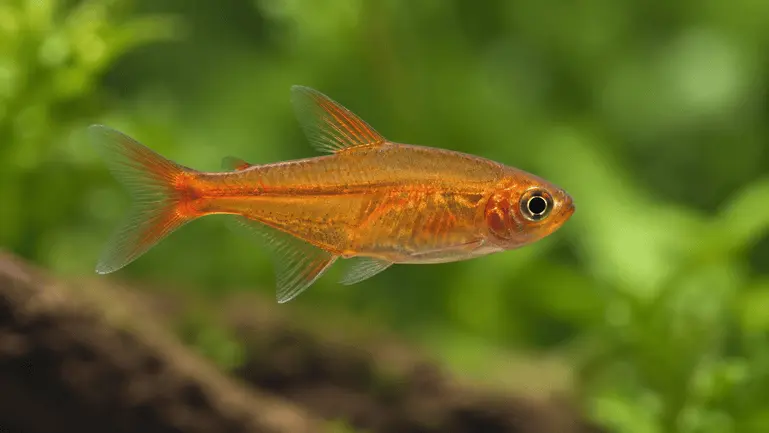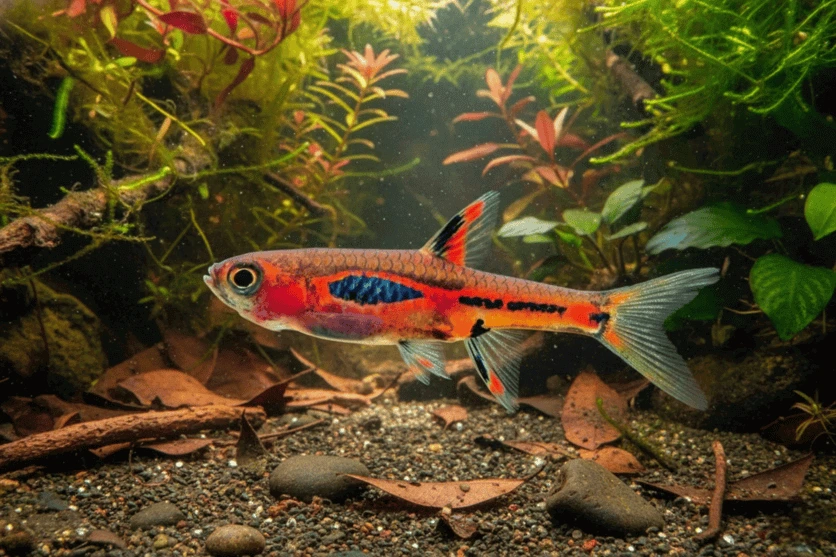
Chili rasboras (also spelled chilli rasbora) will spawn in a planted tank with very little help from you. Boraras brigittae breeding is easy to start and hard to finish. The eggs are specks, the fry hatch too small for baby brine shrimp, and a few days without the right food can wipe out a batch.
For other small species, see the list of best nano fish.
Are chili rasboras easy to breed? Spawning is easy, raising fry is not. Give adults soft, acidic, tannin-stained water and dense moss and they will scatter 2-5 eggs a day. They give no parental care. Fry survive only if microscopic food (paramecium or infusoria) and aged biofilm are in the tank by the time they become free-swimming, 2-4 days after hatching. If you can’t supply that, don’t start.
- Temperature
- 26-28°C (79-82°F)
- pH
- 5.5-6.0 (works from 5.0 to 6.5)
- GH / KH
- 2-5°dH / 1-2°dH
- Adult size
- about 20 mm (under 1 inch)
- Eggs
- 2-5 per day, scattered, no parental care
- Hatch time
- about 24-36 hours at 26-28°C
- Free-swimming fry
- day 2-4 after hatching, 2-3 mm
- Group size for breeding
- 8-12 adults (colony) or 2-3 pairs (separate tank)
- Tank setup
- Water parameters
- Male vs female
- Conditioning and spawning
- Eggs
- Fry food
- Growth timeline
- Fry tank care
- Troubleshooting
- Genetics and ethics
- FAQ
Chili rasbora tank setup: colony or separate breeding tank
There are two workable ways to breed chili rasboras. Pick one before you buy equipment, because the fry-feeding plan differs. Looking for everyday keeping rather than breeding? Read the chili rasbora care guide.
- Container: 10-20 L (2.5-5 gallons), at least 45 x 30 cm (18 x 12 in) on the base. Bare bottom or fine mesh so you can see and siphon eggs.
- Spawning material: Java moss filling about half the tank. Ceratopteris, Cryptocoryne or Anubias also work as backups.
- Light: dim. Floating plants (water sprite, duckweed) over about half the surface.
- Filter: an air-driven sponge filter only, turned down until the surface barely ripples. A dual-sponge model lets you clean one side without wiping out all the bacteria. One example is the hygger dual sponge filter (affiliate link). More options in our best sponge filter for nano tanks guide.
- Heater: a small adjustable heater holding 27-28°C, such as the hygger digital mini heater (affiliate link). Avoid swings of more than 1-2°C.
- Location: no direct sun, no drafts, low foot traffic.
Use a 10-15 gallon (38-57 L) species tank with 8-12 chili rasboras and nothing else. No shrimp, no snails, no other fish. Plant it heavily with Cryptocoryne, Java moss carpets and Anubias on driftwood. Cover about half the surface with floating plants, and leave aged driftwood and a layer of Indian almond leaves on the bottom.
Adults eat most eggs they find, but dense cover hides enough that a few survive. The fry graze on biofilm from the wood and leaves and on infusoria that develop naturally. Expect roughly 5-20 fry reaching visible size per month in a mature, well-run tank. That figure is a hobbyist estimate and not a measured rate. Your results will vary with plant density and how much live food the adults get.
Keepers report that other Boraras, such as the phoenix rasbora (Boraras merah), strawberry rasbora (Boraras naevus) and Boraras maculatus, respond to similar methods. Species details differ and this guide is based on chili rasboras. Thinking of mixing them? Read chili rasbora vs phoenix rasbora first. Mixing close relatives risks hybrids and muddies your line.
Water parameters for breeding chili rasboras
In the wild, the chili rasbora (Boraras brigittae) lives in blackwater peat swamp streams in southwestern Borneo (South Kalimantan and parts of Central Kalimantan). The water there is very soft, acidic and stained dark by tannins. Aquarium chili rasbora parameters can be looser, and adults tolerate harder water in a display tank, but egg survival and fungus resistance are better when you get close to wild conditions.
| Parameter | Target for breeding | Why it matters |
|---|---|---|
| Chili rasbora pH level | 5.5-6.0 (acceptable 5.0-6.5) | Higher pH favors fungus on eggs |
| GH | 2-5°dH | Soft water suits egg development |
| KH | 1-2°dH | Below 1, pH can crash overnight |
| TDS | 80-150 ppm | Soft but stable |
| Chili rasbora temperature range | 26-28°C | Upper end encourages spawning |
| Tannins | Tea-colored water | Mild antibacterial and antifungal effect |
Hobbyist sources agree on the direction (soft and acidic works better), but no controlled hatch-rate study for this species is widely cited. Treat any article that quotes exact hatch percentages by pH with suspicion.
You can create blackwater conditions in three ways:
- Indian almond leaves (catappa): the default choice. They tint the water, and as they break down they grow the biofilm fry graze on. Leave them in.
- Alder cones: stronger tannins. Start with one cone per 5-10 gallons (19-38 L) and watch the pH, especially in unbuffered water. Fungus-prone tanks sometimes use up to 2-3 per 5 gallons.
- RO water, step by step: start with RO, add calcium and magnesium salts to reach GH 3-5, add potassium bicarbonate to reach KH 1-2, aerate and mix for 24-48 hours, add tannin sources, then match temperature before use.
Male vs female chili rasbora
Chili rasbora male vs female differences are subtle. Adult chili rasbora size tops out around 20 mm (under an inch) and size differences between the sexes are small, so sexing relies on body shape and color. Look from above and from the side once the fish are conditioned.
Some sources describe differences in the lateral stripe pattern. Reports conflict, so don’t pick breeders on stripe shape alone.
A “pregnant chili rasbora” is really a gravid female. Chili rasboras scatter eggs and don’t carry live young, so a fat female is just full of eggs.
How to breed chili rasboras: conditioning and triggering spawning
Condition adults for at least 2 weeks and ideally 3-4 before you move them. Feed 2-3 times a day and rotate foods:
- Baby brine shrimp: the standard conditioner.
- Live daphnia (how to culture daphnia at home).
- Microworms and grindal worms (microworm culture).
- Frozen cyclops or bloodworms when live food runs out.
Move the fish when females look visibly rounder from above and males show their strongest red and start chasing and displaying near the plants.
How do chili rasboras breed? Chili rasbora breeding behavior is subtle, so a spawn is easy to miss. Males color up, chase females and vibrate beside them near moss and floating plants. Females release a few eggs among the plants while males fertilize them, and the eggs are then left alone. Well-conditioned fish keep spawning most days for weeks. That is why a colony produces fry continuously and why you don’t need one big spawning event. Watch in the first hour of light, when activity is often highest.
This trigger sequence works for many keepers:
What do chili rasbora eggs look like, and how do they hatch?
Chili rasbora eggs are very small, roughly a millimeter or less, and pale or nearly clear, so you will rarely see more than a few. Look at moss tips and the underside of leaves with a flashlight held at an angle. Fertile eggs stay clear. Unfertilized ones turn opaque white within hours and grow fuzzy Saprolegnia fungus that can spread to good eggs.
- Hours 0-24: eggs sit on plants or drop into moss. No water changes, constant temperature.
- Hours 24-36: hatching at 26-28°C. Larvae look like transparent threads, mostly stuck to surfaces.
- Next 24 hours: larvae live off the yolk sac and stay put. No food needed yet.
- Days 2-4 after hatch: fry become free-swimming at about 2-3 mm and must find food quickly or starve.
To prevent egg fungus:
- Keep pH at 5.5-6.0 with plenty of tannins. This is the main protection.
- Pick out white eggs promptly with a pipette.
- Methylene blue at about 3 ppm is a common extra. It can stain, harm plants and affect the biofilter, so treat it as optional.
Chili rasbora fry: first foods that work
First food is the main reason a spawn that looked successful ends with zero fry. Free-swimming chili rasbora fry take particles of roughly 50-300 microns. Baby brine shrimp nauplii are about 450 microns, so they are usually too large in the first week. Fry need two things at once. They need microscopic live food in the water column and aged biofilm to graze.
For days 0-10, paramecium (150-225 microns) is the usual first food. It swims where fry can see it and multiplies quickly. Start the culture 10-14 days before you expect fry:
Biofilm is the second half of the plan. Many breeders report chili rasbora fry rasping at biofilm on aged driftwood and decomposing leaves before they accept free-swimming food. There is no formal study behind this, but the observation is consistent enough to act on. Put several pieces of well-aged driftwood and a few almond or oak leaves in every fry tank. Rinse the sponge filter only in old tank water so its biofilm stays alive.
Feed by the age of the fry:
| Age of fry | What to feed |
|---|---|
| Days 0-5 | Paramecium several times a day plus biofilm grazing |
| Days 5-10 | Add microworms or vinegar eels and keep the paramecium going |
| Days 10-14 | Start baby brine shrimp as fry reach 3-4 mm |
| Days 14-21 | Baby brine shrimp as the staple (orange bellies show they are eating) |
| Days 21-30 | Add finely powdered quality flake |
| After 6-8 weeks | Small adult foods: microworms, grindal worms, crushed flake, small pellets |
To hatch baby brine shrimp, use a cone-shaped container (an inverted 2-liter bottle), saltwater at about 25 ppt (roughly 1 and 2/3 tablespoons of salt per quart), strong aeration, 25-28°C and a light. Nauplii hatch in 18-24 hours. Rinse them before feeding so brine doesn’t foul the fry tank.
Baby chili rasbora growth timeline
Growth rate varies between batches and with feeding, so treat these as typical ranges.
| Age | Size | What you will see |
|---|---|---|
| Week 1 | 2-3 mm | Nearly transparent, dark eyes, hiding in moss. Starvation is the main cause of loss. |
| Week 2 | 3-4 mm | First pigment, stronger swimming, moving out of cover. |
| Weeks 3-4 | 5-7 mm | Black lateral stripe appears. They look like chili rasboras now. |
| Weeks 5-8 | 7-12 mm | Red begins to show. They can take crushed adult food. |
| Months 3-4 | 12-15 mm | Color deepens. Males and females become distinguishable. |
| Months 5-10 | 15-20 mm | Adult size. Reports of first breeding vary widely, from roughly 4 to 10 months. |
Separate fry by size every 2-3 weeks so larger ones don’t outcompete the smallest. A 10-liter container can hold roughly 30-50 fry for the first month. Plan extra grow-out tanks by weeks 4-6.
Water quality and fry tank care
Heavy feeding in a small tank with no established nitrogen cycle is the second-biggest killer after starvation. Keep ammonia and nitrite at zero. Ammonia above about 0.25 ppm stresses fry, and levels near 1 ppm can burn gills.
Pre-cycle the breeding container before you add fish:
Follow this water change schedule:
Always: match temperature within 1°F (about 0.5°C), keep pH within 0.2 units of the tank, age and dechlorinate replacement water for 24 hours and include tannins.
Chili rasbora breeding problems and fixes
Usual causes are unfertilized eggs (poor conditioning or too few males), pH creeping up, too little tannin, or temperature swings. The fixes are in the egg fungus list above.
Work through these checks:
- Check pH (6.5 or lower), GH (under 5) and temperature (26-28°C).
- Extend conditioning to 3+ weeks of varied live food.
- Dim the light with floating plants, reduce flow and add more Java moss.
- Repeat the cool water change from the trigger sequence, or raise the temperature slowly to 28°C over 3-4 days and add fresh Java moss.
The usual causes, in rough order of likelihood:
- Starvation: by far the most common. Feed 3-4 times a day, dose the food in several spots so fry can find it, and set up the first foods described above.
- Ammonia or nitrite: test immediately and do a water change if any is present. Remove uneaten food, since overfeeding causes bacterial blooms.
- Water-change shock: mismatched temperature or pH, or changes larger than 10-15% before day 20.
- Predators: adults left in, or hitchhikers such as dragonfly nymphs and large copepods.
Add live food (baby brine shrimp especially), reduce density, separate by size and check for chronic low-level ammonia. If growth stays poor across batches, suspect inbreeding and bring in unrelated fish.
Chasing and posturing are normal. Torn fins or a male hiding and unable to feed are not. Add females, add visual barriers, enlarge the tank or remove the worst male.
Genetics, culling and conservation
Keep lines healthy. Buy breeding stock from more than one source, keep records of dates, parents, water values and survival, and outcross periodically. Inbreeding reduces growth and fertility in many small fish, but there are no reliable numbers for chili rasboras.
Culling. Cull only for welfare: severe spinal or fin deformities, inability to swim or feed, or untreatable disease. Rehome healthy fish with minor color differences instead. A common humane method is a clove oil overdose. Dissolve clove oil in a little warm water and mix it into a container of tank water at about 0.4 ml per liter. Leave the fish in it for at least 30 minutes after all gill movement stops. Never use ice water, freezing or flushing.
Selling. Local stores pay a fraction of retail and often in credit, so don’t count on income from breeding chili rasboras. Line up buyers or a club before you spawn.
Conservation. Chili rasboras come from peat swamp forests in Borneo that are being lost to drainage, fire and plantation conversion. The IUCN lists B. brigittae as Data Deficient. That reflects a lack of survey data. It does not mean the species is safe. Buying captive-bred fish when you can reduces collection pressure. Captive populations can’t replace habitat protection.
Chili rasbora breeding FAQ
Do chili rasboras breed easily?
The adults do, if the water is soft and acidic and the tank has dense moss. Raising the fry is the hard part because they need microscopic live food and biofilm as soon as they become free-swimming.
Are chili rasboras livebearers?
No. They are egg scatterers that lay a few eggs at a time among plants. They don’t give birth to live fry.
When are chili rasboras in season to breed?
In aquariums there is no fixed chili rasbora season. A cool, soft water change plus a slight temperature rise acts as the cue. In the wild, spawning is thought to follow rainy-season changes in water chemistry, though detailed field data are scarce.
How many chili rasboras should I keep for breeding?
The right chili rasbora group size for a species colony is 8-12 fish. A separate tank needs 2-3 pairs. Day-to-day care and schooling needs are in the chili rasbora care guide.
How long does it take chili rasbora eggs to hatch?
About 24-36 hours at 26-28°C.
What is the best pH for chili rasboras to breed?
Aim for pH 5.5-6.0. The chili rasbora water parameters that matter most are that pH and a temperature of 26-28°C, with tannins in the water. See the water parameters table above for GH and KH.
When can juvenile chili rasboras go into the main tank?
Around 15 mm (about 3-4 months), and only into a tank with peaceful nano species. Larger or fast fish will outcompete or eat them.
Will chili rasboras breed in a community tank?
You can get eggs, but fry rarely survive with other fish. Use a species-only colony or a separate tank.
Do rasboras lay eggs, and how do rasboras breed?
Yes. Most rasboras are egg scatterers that lay eggs among plants and give no parental care. Are rasboras easy to breed? It depends on the species. For chili rasboras, spawning is easy and raising the fry is the hard part, as covered above.
Is it chili rasbora or chilli rasbora?
Both spellings name the same fish, Boraras brigittae. Advice on chili rasbora breeding and chilli rasbora breeding is the same.
What other nano fish are bred the same way?
Small scatter spawners use similar methods. See our guides to celestial pearl danio breeding, ember tetra breeding and kubotai rasbora breeding, or the general overview of breeding nano fish.
Your plan, in order
Affiliate disclosure: links to hygger products earn us a commission at no cost to you. We only list gear that suits the setup above.