
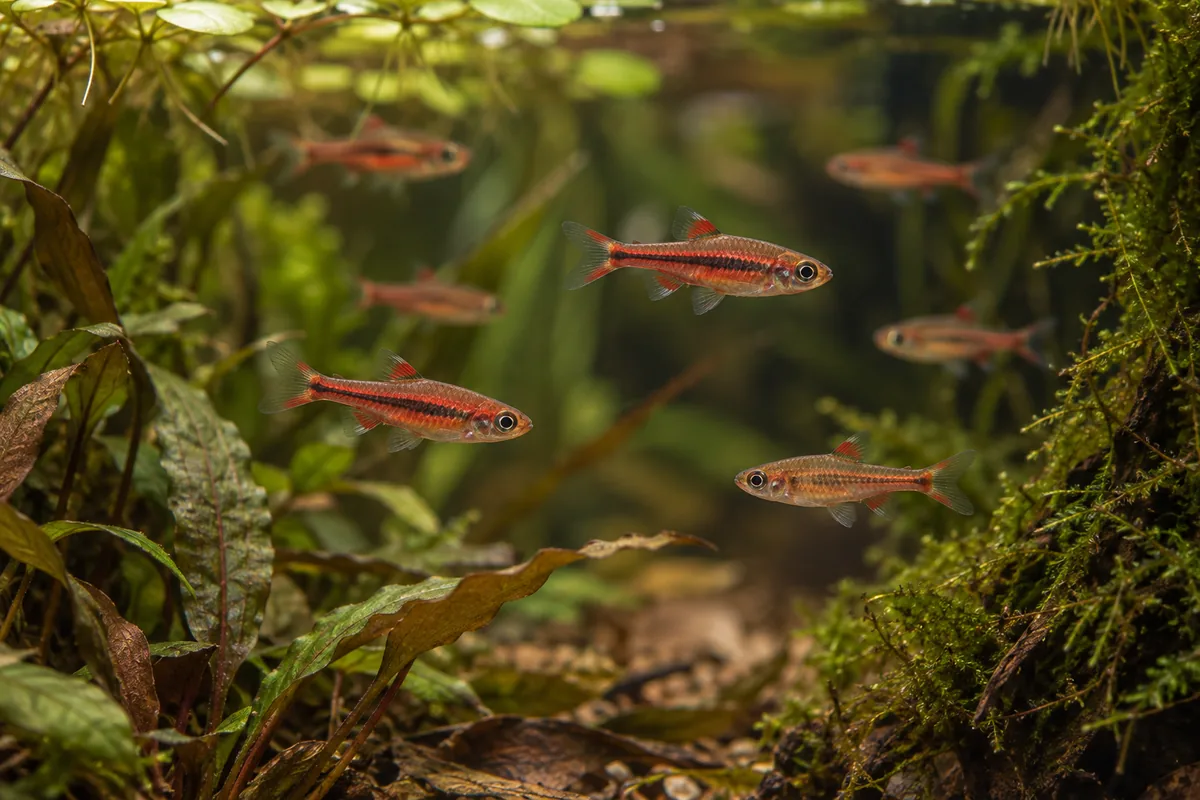
Chili rasboras need a mature tank with soft water. Give them plants, gentle flow and a proper group. And check that their food is small enough to eat.
For your first setup, I recommend at least 45 litres and a swimming length of 45 cm or more. Start with 10–12 fish. Keep the temperature stable at 25–26°C. Give them shaded areas and leave open space for swimming.
It’s tempting to put them in a very small tank because they’re tiny. But they still need room, steady water and enough companions. Their size doesn’t remove those needs.
The main care reference for this guide is the Boraras brigittae entry in Baensch and Riehl’s Aquarium Atlas, Volume 3. Current species guidance and aquarium welfare references supply the practical details that entry leaves out.
Jump to: Tank size · Water parameters · Food · Tank mates · Troubleshooting
Chili rasbora care at a glance
| Care point | Practical starting point |
|---|---|
| Scientific name | Boraras brigittae |
| Other names | Chilli rasbora and mosquito rasbora |
| Adult size | About 1.5–2 cm, roughly 0.6–0.8 inches |
| Tank size | At least 45 litres, about 12 US gallons, with a generous footprint |
| Tank dimensions | Aim for a base of at least 45 × 30 cm |
| Group size | At least 8–10, with 10–12 a sensible starting group |
| Temperature | Atlas range: 25–28°C. Start around 25–26°C, or 77–79°F |
| pH | Aim around 6–6.8 for routine care if your water can hold it steadily |
| General hardness | Soft water. Around 1–6 dGH is a practical target |
| Ammonia and nitrite | Both 0 mg/L |
| Flow and light | Gentle flow with shaded areas |
| Diet | Tiny live or frozen foods plus suitably small prepared foods |
| Temperament | Peaceful and easily outcompeted |
| Breeding | Egg scatterer with no parental care |
Use these recommendations when planning your setup. Check the seller’s water parameters before bringing fish home and avoid changing the water chemistry overnight.
What is a chili rasbora?
Boraras brigittae is a tiny freshwater fish from southern Borneo. The Aquarium Atlas places it around Banjarmasin and describes slow creeks with plants.
It records both black and white waters. Current species accounts give more detail about shaded blackwater streams and peat swamp pools.
So the useful takeaway is soft water, plant cover and slow flow. Your tank does not need to look like dark tea to provide those conditions.
Adults usually reach about 1.5–2 cm. They spend much of their time around the middle and upper parts of the aquarium.
Look for a slender red body with a dark marking along the side. Fish sold under the same common name can include other Boraras species. Our chili rasbora vs phoenix rasbora guide explains the differences.
Are chili rasboras good for beginners?
They suit a beginner who understands cycling and can keep water stable. I would not use them as the first fish in a newly filled aquarium.
The Atlas gives them a difficulty rating covering keepers with some basic knowledge through more experienced hobbyists. Their small mouths and sensitivity during handling need some attention.
If you want to compare other small species, see our nano fish guide. Choose fish around your water and tank size before choosing them by colour.
Chili rasbora tank size and group size
Tank length matters. These fish need horizontal space to move between plants and other members of the group.
The Atlas recommends 40 cm of aquarium length. Its symbol refers specifically to tank length. For a new setup, I would use the larger 45 × 30 cm footprint described in current species guidance.
A tank holding 45–60 litres gives you more room to arrange cover and manage water quality. Check the actual dimensions. Two tanks with the same volume can offer very different swimming space.
Can you keep chili rasboras in a 5-gallon tank?
I would choose a larger tank for permanent care. A 5 US gallon aquarium holds only about 19 litres before substrate and equipment.
It gives you little margin for a full group, feeding mistakes or changing water chemistry. Adding fewer fish also removes the social group they need.
Is a 10-gallon tank enough?
A standard 10 US gallon tank is about 38 litres. Its length can be useful, but the volume falls below the 45-litre starting recommendation here.
If you are buying a tank, move up to 45–60 litres. Keep the first setup focused on chili rasboras.
How many chili rasboras should you keep together?
Keep at least 8–10. A group of 10–12 is a sensible start in a suitable species tank.
They may spread out once they feel safe. A loose shoal does not mean something is wrong. Males can also hold small temporary territories while displaying or spawning.
Watch the whole group at feeding time. One confident fish eating well does not tell you whether the smaller fish are getting food.
Chili rasbora water parameters
Soft, stable water is the goal. Avoid chasing the lowest number listed in a species profile.
Temperature
The Aquarium Atlas lists 25–28°C. I would start at 25–26°C for routine care, which stays within that range.
Use a thermometer to check the water itself. A heater setting is not a measurement. Keep the aquarium away from direct sun and places with large temperature swings.
pH and GH
The Atlas says soft water but gives no numeric pH or hardness range. Those numbers need another source.
For a practical home setup, aim around pH 6–6.8 with roughly 1–6 dGH. These targets sit within the broader ranges in current species guidance. They are not a prescription for every fish already settled in different water.
Wild habitat values can be much more acidic. Reproducing those extremes is unnecessary for routine care and harder to manage.
KH and water stability
KH helps you understand how strongly the water resists pH changes. Very low KH can let pH fall as acids build up.
Test your tap water before buying fish. If it is hard, plan a consistent water supply. Repeated doses of a pH-lowering product can make conditions harder to manage.
Reverse osmosis water can help you make softer water. But do not use pure RO water without a suitable mineral plan. Measure the finished water and prepare changes the same way each time.
Do chili rasboras need blackwater?
They can live in a clear planted tank with suitable water. Tannins and leaves are optional parts of the setup.
The Atlas reports deeper red colour in peat-filtered water. That observation does not make peat a requirement or guarantee brighter fish.
Leaves also break down. Add them gradually and keep checking water quality. Brown water alone tells you nothing about ammonia, nitrite or hardness.
How to set up the tank
Build shelter around the back and sides. Leave an open lane through the middle so the group can move without staying hidden.
Cryptocoryne, Java fern and moss can provide cover under modest lighting. Floating plants help shade the surface. Keep some surface open for gas exchange and feeding.
A darker substrate can make the fish easier to see. Choose aquarium-safe materials and leave enough access to remove food and waste.
Use gentle filtration
A mature sponge filter is a useful option. Another filter can work if its intake is protected and its flow is gentle.
The fish should be able to hold position without constantly fighting the current. Redirect the outlet or reduce flow if the group stays trapped in one sheltered corner.
Our sponge filter guide for nano tanks covers sizing and setup. Choose filtration for the actual tank and stock.
Cycle the tank before adding fish
Use a fishless cycle and confirm it with water tests. A tank that has been running for a few days is not automatically ready.
Ammonia and nitrite should both read 0 mg/L before fish are added and during normal care. Established plants and surfaces give these tiny fish a more settled environment.
Keep a lid on the aquarium. Leave equipment openings covered where practical.
Chili rasbora food and feeding
Food size is one of the easiest details to get wrong. Chili rasboras are small predators with tiny mouths.
The Atlas lists small live foods and Artemia. In a home aquarium, use tiny live or frozen foods alongside suitably small prepared food.
| Food | What to check |
|---|---|
| Baby brine shrimp | Small enough for adult fish to swallow |
| Cyclops or other tiny frozen prey | Break up clumps before feeding |
| Small daphnia | Choose the smallest animals rather than large adults |
| Microgranules | Watch fish swallow them instead of repeatedly spitting them out |
| Finely crushed flakes | Use small portions that stay accessible to the group |
Start with 1–2 small feeds a day and adjust to what the fish actually eat.
Distribute food across a quiet area. Watch the shy fish as well as the first fish at the surface. Remove leftovers before they collect under plants.
For live food preparation, our daphnia culture guide explains how to maintain a culture. Size-sort the food for these tiny mouths.
What if your chili rasboras are not eating?
First check ammonia, nitrite, temperature and flow. Then check whether the food is small enough.
New fish may also hide or lose access to food around faster tank mates. Try a small portion of familiar food in a calm spot and watch from farther away.
Ongoing refusal to eat, weight loss or abnormal breathing needs investigation. Do not keep adding food to compensate.
Chili rasbora tank mates
A species tank is the simplest starting point. The Atlas also favours keeping them alone while allowing other tiny Boraras as possible companions.
Community stocking needs enough room and overlapping water needs. Peaceful behaviour alone does not make two species a good match.
| Possible companion | Main concern |
|---|---|
| Other tiny Boraras | Match water requirements and allow room for both groups |
| Adult dwarf shrimp | Match mineral needs. Very small shrimplets may be eaten |
| Small peaceful bottom dwellers | Check temperature, water chemistry and their own space needs |
| Faster small schooling fish | They may take food before the chili rasboras reach it |
| Bettas | Individual behaviour varies. Harassment and predation are possible |
| Larger fish or fin nippers | Avoid fish that can swallow or repeatedly chase them |
Can chili rasboras live with shrimp?
Adult dwarf shrimp can work in a planted tank with compatible water. But shrimp species do not all need the same mineral levels.
Do not force Neocaridina into extremely soft acidic water just to copy a blackwater habitat. And do not describe chili rasboras as completely shrimplet-safe. A tiny animal can still be food.
Can they live with a betta?
I would not make that the default setup. A betta may ignore them, chase them or eat them.
The problem is harder to manage in a small aquarium. If you try a community, have enough cover and a separate established tank ready. Persistent hiding is not a successful pairing.
Bringing new chili rasboras home
Ask the seller about temperature, pH, hardness and the food they currently eat. Also check that the fish are actually Boraras brigittae.
Choose alert fish with intact fins and normal breathing. Avoid buying from a tank with unexplained deaths or visibly sick fish.
Quarantine newcomers in a separate established tank. Veterinary guidance recommends at least 30 days, with separate equipment where possible.
Keep lighting low during transfer. Match temperature and follow acclimation advice suitable for the journey and bag conditions. Long-shipped fish should not automatically sit in opened shipping water for a prolonged drip acclimation.
Avoid adding shop water to the aquarium. Handle these small fish gently and never squeeze them through a net or against the glass.
Weekly maintenance
Start with a weekly water change of about 25%. Adjust the routine using tests, stocking and what is happening in the tank.
Dechlorinate replacement water and match its temperature and chemistry. Prepare it before disturbing the fish.
Use a small siphon and protect its opening so tiny fish or fry cannot disappear down the tube. Remove visible waste without tearing through every planted area.
Rinse filter media gently in removed aquarium water when needed. Avoid replacing all biological media at once.
Keep nitrate low and stable. A rising trend tells you to review feeding, maintenance and stocking even if the water looks clear.
Why are your chili rasboras pale, hiding or dying?
Colour is useful to watch, but it is not a diagnosis. Female fish can be paler than displaying males.
Start with water tests before assuming disease or buying medication.
| What you see | What to check first |
|---|---|
| Pale colour or hiding | Recent move, strong light, small group, chasing and water quality |
| Fish not eating | Food size, competition, stress and abnormal breathing |
| Gasping near the surface | Ammonia, nitrite, temperature, oxygen and filter function |
| Deaths after a water change | Dechlorination, temperature differences and sudden chemistry changes |
| Fish getting thin | Whether each fish eats, food suitability and signs of illness |
| Eggs appear but no fry survive | Adult access to eggs, filter intake and first-food size |
For gasping fish, increase gentle aeration while checking the cause. If ammonia or nitrite is detectable, use appropriately prepared partial water changes and investigate the filter.
Do not assume every pale fish needs warmer water. And do not raise temperature or add medication without a reason.
Our guide to why nano fish lose colour covers the common environmental causes. Persistent illness or repeated unexplained deaths need qualified fish-health advice.
Male vs female chili rasboras
Males usually show stronger red colour. Mature females tend to be fuller through the belly and may be slightly larger.
The Atlas also describes red markings at male caudal fin tips and red edges on the dorsal and anal fins. Females are described as paler without those red caudal marks.
Use several features together. Age, stress and social position can change how strongly a fish shows its colours.
Breeding chili rasboras and feeding fry
Chili rasboras scatter small numbers of eggs when conditions suit them. They do not guard the eggs or care for the young.
A mature planted tank may produce a few surviving fry. Dense moss gives eggs and young fish places to escape adult attention.
For more control, use a separate established breeding setup with fine plants or mesh protecting the eggs. Prepare microscopic first foods before spawning starts.
The Atlas describes an older continuous breeding method with peat substrate and moving parents between tanks every 2–3 weeks. Your display tank can work without copying that historical method.
In a separate short spawning setup, remove adults before they can eat the first young. Fry are too small to depend on ordinary crushed flakes or newly hatched brine shrimp immediately.
Start with suitable infusoria or Paramecium. Offer larger foods only when the fry can swallow them. Protect filter intakes and keep changes small and carefully matched.
For the full spawning setup, see our chili rasbora breeding guide. Get the display tank stable before adding a breeding project.
Chili rasbora care FAQ
Are chili rasboras easy to care for?
They suit a keeper who understands cycling and stable water. Use a mature planted tank, a proper group and food small enough for their mouths.
How many chili rasboras should be kept together?
Keep at least 8–10. A group of 10–12 is a sensible start in a suitable planted species tank with enough swimming space.
Can chili rasboras live in a 5-gallon tank?
I recommend a larger permanent setup. A 5 US gallon tank holds only about 19 litres and offers little margin for a proper group and stable water. Start with at least 45 litres and a suitable footprint.
What temperature do chili rasboras need?
The Aquarium Atlas lists 25–28°C. A stable 25–26°C, about 77–79°F, is a practical starting point for routine care.
What do chili rasboras eat?
Offer tiny live or frozen foods such as baby brine shrimp, cyclops and small daphnia. Suitable microgranules and finely crushed flakes can form part of a varied diet. Watch the fish swallow the food.
Can chili rasboras live with shrimp?
Adult dwarf shrimp can be suitable when their water requirements overlap. Check mineral needs and provide cover. Very small shrimplets may be eaten.
How long do chili rasboras live?
Plan for several years of care. A precise species-specific lifespan is not established by the main reference used here, so I would not promise an exact number of years.
Why are my chili rasboras losing colour?
Check water quality, lighting, group size and chasing first. New fish can be pale after a move, and females are often less red than displaying males. Colour alone does not diagnose disease.
Care references
The main reference is Hans A. Baensch and Rüdiger Riehl’s Aquarium Atlas, Volume 3, the Boraras brigittae entry on printed page 262 and the care-symbol legend on page 73.
The Atlas supports the size, warm temperature range, soft water, plant cover, diet and handling guidance above. Numeric pH and hardness targets, group size and modern tank recommendations come from the supplementary care research.
Further reading: Boraras brigittae species account, OATA’s rasbora care guidance and Merck Veterinary Manual’s aquarium fish management guidance.