Want a dependable supply of live food for your aquarium? Start with a clean container, suitable freshwater, a healthy live starter and just enough suspended food to sustain it. The difficult part of daphnia culture at home is not buying equipment. It is keeping food, oxygen and water quality in balance as the population grows.
You can culture Daphnia or the related, generally smaller Moina for many freshwater fish. They are useful supplementary live foods, not a cure for every feeding problem, a guaranteed breeding trigger or the right first food for every newly free-swimming fry. If your fish are pale, losing weight or refusing food, check their water quality, health, species-specific diet and social conditions rather than assuming flakes are killing them.
Quick answer
Set up a separate, fish-free container with conditioned, appropriately mineralized freshwater; add a reputable live starter; provide gentle circulation or aeration as needed; feed small quantities of suitable microalgae or a carefully dispersed prepared food; observe the animals and water each day; and harvest only after the population is reproducing well. Keep a second culture in case the first fails. The steps below explain exactly what to watch for and what to change.
Affiliate disclosure: Some equipment links in this guide may be affiliate links. If you buy through one, I may earn a small commission at no extra cost to you; it does not change what I recommend.
Daphnia vs. Moina: which live culture should you choose?
Both are freshwater cladocerans—small, swimming crustaceans often called water fleas. Moina is not a species of the genus Daphnia. Sellers sometimes use “daphnia” loosely for both, so ask for the scientific name when possible. Exact size, temperature response and yield depend on the species, strain, food and culture conditions. [1, 2]
| Culture | Practical advantage | Important limitation |
|---|---|---|
| Daphnia magna | Larger live food for fish that can swallow it; widely used in laboratory culture | Many adults are too large for tiny nano fish or newly feeding fry. An EPA laboratory protocol maintains this species around 20°C, which is not a universal maximum or optimum for every Daphnia. [3] |
| Other Daphnia species | Some remain smaller than D. magna | A shop label saying only “daphnia” does not establish adult size or temperature requirements. |
| Moina spp., including M. macrocopa when correctly identified | Smaller animals and fast population growth can suit many tropical-fish setups | Not every fry can swallow even a young Moina. Young animals are often under about 0.4 mm and adults commonly around 0.7–1.0 mm in a University of Florida overview, but size varies. [1] |
For a small tropical fish room, a correctly identified Moina starter is a sensible option to investigate. University of Florida guidance describes good production at about 24–31°C for Moina, whereas an EPA D. magna protocol maintains its test culture at roughly 20°C. These are documented conditions for different organisms, not proof that Moina always wins or that Daphnia dies above 22°C. [1, 3]
Can chili rasboras, scarlet badis and other nano fish eat daphnia?
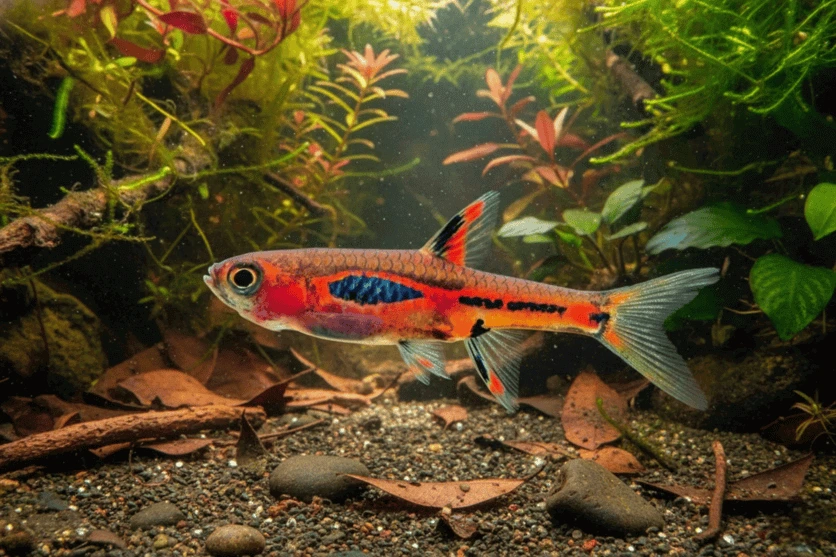
Match the individual prey to the fish’s mouth and feeding behavior. A chili rasbora may take suitably small Moina while ignoring larger adults; a scarlet badis may accept moving prey of a size it can capture. Do not assume that all adults, all fry or all wild bettas accept the same grade. Offer a few, watch actual swallowing, and remove an excess of prey the fish cannot eat.
Very small first-feeding fry may need paramecia, other appropriately sized infusoria or suitable cultured foods before they can take young Moina. Avoid a rigid “day 7, then day 14” feeding schedule: mouth size and development differ among fish. For another small live-food option once fry can take it, see our microworm culture guide. [1]
How to culture daphnia at home: the starter setup
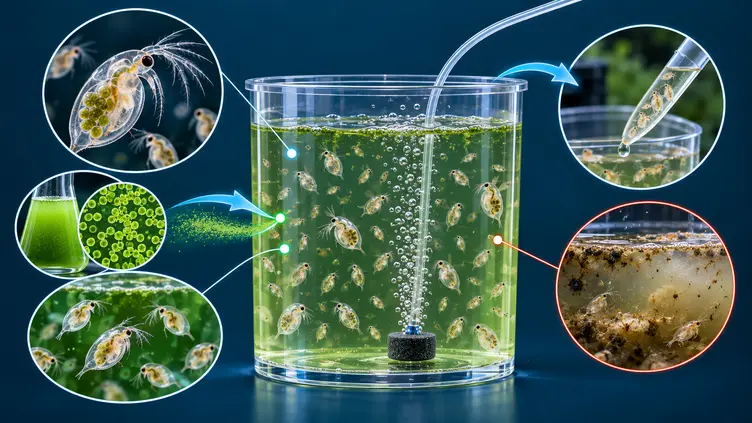
A simple daphnia culture setup does not require a complicated wet-dry filter, automated harvester or snails. Begin with equipment you can clean and control. This is a home-culture starting method informed by aquaculture guidance, not a guaranteed formula. [1, 2]
What you need
- Container: A clean, dedicated food-safe bucket or aquarium. About 10–20 L (roughly 2.5–5 gallons) is a convenient hobby starting volume, not a biological minimum. Avoid copper-bearing or uncoated metal vessels and containers previously exposed to cleaners or pesticides.
- Water: Freshwater free of chlorine/chloramine and other contaminants, with minerals appropriate for your starter species. Use known-good, treated tap water or prepared culture water. Do not assume untreated rainwater, pond water or old aquarium water is automatically safe.
- Live starter: Daphnia or Moina from a reliable culture, ideally identified and free of obvious predators. Keep its original water separate until you know what came with it.
- Food: Cultured green water containing suitable microalgae, a reputable microalgal feed, or carefully measured small amounts of a dispersed yeast/algae mixture.
- Air and light: A gentle air source if the culture needs circulation, plus diffuse daylight or moderate artificial light. Avoid baking a small bucket in direct midday sun.
- Backup: A second, physically separate culture with separate or cleaned tools.
Step 1: Prepare the water, not just the bucket
Rinse the container thoroughly without leaving detergent residue. Fill it with conditioned freshwater and allow the temperature to approach that of the starter before transferring the animals. Avoid dramatic changes in temperature or water chemistry.
If your tap water contains chloramine, leaving it in an open bucket for 48 hours is not reliable treatment. Use a conditioner specifically rated for chlorine and chloramine according to its label, or a verified filtration method, and check residual disinfectant when uncertain. A municipal water authority notes that chloramine may persist for weeks in standing water. [4]
Do not add crushed coral or other minerals blindly. A Daphnia culture usually needs adequate calcium and other dissolved minerals, but the correct adjustment depends on your water and species. Record source-water hardness and pH when repeated failures suggest a water-chemistry problem. FAO describes pH 7–8 as a practical starting range in one Daphnia mass-culture protocol; it is not an all-species law. [2]
About water conditioners: No sound evidence establishes that a particular aquarium conditioner universally kills daphnia. Products and doses differ, and overdosing or contaminants can cause problems. Select a suitable product, follow the label and prepare replacement water separately. Do not assume any additive is risk-free.
Step 2: Add the live starter
Transfer the animals gently, preferably below the water surface so they are not trapped against an air film. Avoid adding large quantities of unknown supplier water or debris. Start with a reasonable number rather than expecting one animal to produce a harvest immediately. University of Florida lists around 25 Moina per litre as a mass-culture inoculation example; you do not need to hit that number exactly for a small hobby culture. Feed more cautiously when the starter is sparse. [1, 3]
Watch the first day for normal swimming, animals carrying developing young and obvious intruders. A healthy-looking jar is not proof that it is pathogen-free.
Step 3: Provide mild aeration and moderate light
Air exchange helps support oxygen and can keep small food particles suspended. Start with a gentle open-ended airline or other low-turbulence circulation; adjust by observing the animals. Avoid blasting them around the container. UF/IFAS warns that extremely fine bubbles can collect beneath the Moina carapace and cause flotation problems; that does not mean every air stone invariably kills all daphnia. Indeed, an experienced Daphnia culturist reports using air stones successfully. [1, 5]
Moderate diffuse light is enough for a culture fed prepared algae. A separate green-water culture needs suitable light for the algae to grow, but a pale green suspension is not automatically a crisis. Heat, excessive organic feeding, very dense blooms and overnight oxygen demand are more important warning signs than greenness alone. [2]
Step 4: Feed lightly, then respond to the culture
Add a small amount of suspended food, mix it through the water and inspect again the next day. Start with less food than you think a new, sparse culture needs. Only increase feeding after the population grows. Uneaten yeast, flour or other organics can fuel bacteria, reduce oxygen and spoil the water. The precise dose depends on culture volume, animal density, food concentration and filtration; a universal “teaspoons per gallon per day” formula is not defensible. [1, 5]
Doug Sweet’s practical hobby guide suggests adjusting prepared feed so the culture becomes only slightly cloudy and clears by approximately the next day. That is an observation-based starting cue, not a laboratory water-quality test. If it remains heavily cloudy or smells unpleasant, stop adding food and check the culture rather than assuming the animals will catch up. [5]
Step 5: Observe reproduction before harvesting
Under suitable conditions, Moina may mature in about 4–7 days and produce repeated broods, according to University of Florida guidance. That describes the animals’ biology—not a promise that your bucket will supply fish food on day seven. Cold water, poor feeding, an undersized starter or contamination can delay production. [1]
Check the animals daily. Growing numbers of small juveniles and females with brood pouches are more useful signs than a fixed calendar deadline. Leave enough breeders and juveniles to keep the colony growing.
What should you feed a daphnia culture?
Green water and other suitable microalgae are a useful basis for culture. Daphnids filter suspended particles; Moina can also use bacteria, yeast and detritus. Food quality matters: FAO reports that the fatty-acid composition of the algae affects daphnid nutritional value. A culture raised on one feed is not automatically nutritionally equivalent to a culture raised on another. [1, 2]
| Food | How to use it | Watch out for |
|---|---|---|
| Cultured green water / suitable microalgae | Feed in small portions and track whether animals clear the suspension | Unknown algal composition, contamination and blooms that change oxygen/pH |
| Chlorella or other properly dispersed algal feed | A convenient alternative when fresh green water is unavailable | Powder quality, particle dispersion and dose vary; the word “chlorella” does not guarantee specific EPA/DHA levels |
| Baker’s yeast | Can support cultures, particularly as part of a mixed diet | Easy to overfeed; yeast alone performed relatively poorly in one specific Daphnia feeding trial [5] |
| Yeast + algae mixture | Reasonable option to test against green water in separate containers | No single universally optimal ratio or monthly cost is established |
What did Doug Sweet’s feeding trial actually find?
In a 1992 practical trial reported by Doug Sweet and reproduced by the American Killifish Association, a mixture of baker’s yeast, spirulina and chlorella produced 9,650 harvested daphnia over 44 days, versus 2,676 with yeast alone. These are results from that trial, not expected yields for a five-gallon bucket today. Importantly, Sweet’s six-ingredient “Doug’s mix” was not the top-performing diet in the reported comparison: the yeast–spirulina–chlorella diet was. His quoted production costs used 1992 ingredient prices. [5]
This comparison does not establish one best diet across species and setups. It also does not justify a universal 3:2:2 ratio, a fixed monthly culture budget or the claim that every chlorella product supplies EPA and DHA.
Beginner recommendation: Start with suitable green water or a simple, dilute food that you can dose consistently. Introduce a mixed feed only if you can keep waste under control. For meaningful comparisons, use separate containers with matched water, starter density and observation periods; measure surviving animals and harvests rather than judging by water color alone.
Water temperature, pH, oxygen and filtration
| Parameter | Sensible starting approach | Why it is not an absolute rule |
|---|---|---|
| Temperature | For known D. magna, about 20°C is a documented laboratory culture condition. For identified Moina, UF/IFAS describes productive conditions around 24–31°C. | Other species and strains differ; overheating a small container can be dangerous. [1, 3] |
| pH and minerals | Use stable, appropriately mineralized water. The FAO Daphnia tank example emphasizes pH around 7–8 and sufficient hardness. | Copying an exact pH or conductivity from an unrelated study does not establish a universal optimum. [2] |
| Oxygen | Keep adequate gas exchange; provide gentle aeration if necessary. Check especially during dense blooms or heavy feeding. | Some Moina tolerate low oxygen, but deliberately creating hypoxia is not a safe color- or nutrition-enhancement method. [1, 2] |
| Filtration | No powered filter is required for a small, manageable culture. If you use one, protect animals from suction and excessive turbulence. | A 200-µm intake mesh cannot be assumed to exclude juveniles smaller than 400 µm. Filter performance depends on design and fouling. [1] |
| Water changes | Replace some water when waste accumulates or tests/observations indicate deterioration, using chemistry- and temperature-matched treated water. | A mandatory 75% emergency change or a blanket prohibition on changes may shock the culture. [1, 5] |
Never cover the entire water surface to suppress oxygen just to make the animals red. Hemoglobin production can respond to low dissolved oxygen, heat and crowding, but red coloration is not proof of superior food value. Keeping cultures oxygenated and fish-safe matters more. [1]
How to harvest daphnia without destroying the starter
- Wait for a visibly expanding population with both adults and juveniles. Do not harvest heavily from a newly arrived or declining culture.
- Use a dedicated, clean net or sieve appropriate to the actual animal size. Coarser mesh can retain larger animals while allowing some juveniles through, but no one mesh size works for every species. UF/IFAS notes that attempting to grade Moina through 500-µm mesh can injure them. [1]
- Collect a modest partial harvest, leaving plentiful reproductive adults and juveniles. Observe recovery before increasing the harvest fraction.
- Rinse the catch gently with appropriate clean water where practical, minimizing transfer of culture debris into the aquarium. Feed a small portion and watch the fish swallow it.
- Keep harvesting nets, hoses and water transfers separate from aquarium equipment. Never put an unknown outdoor culture directly into a fry tank.
Live prey can remain in freshwater for a while, but it still contributes biomass and waste. Do not pour in unlimited daphnia on the theory that live food cannot foul the water. A colony of large uneaten Moina can also disturb small fry. [1]
Why did my daphnia die? A practical troubleshooting guide
| Symptom | Plausible causes to check | What to do |
|---|---|---|
| Numbers fall; food remains cloudy | Overfeeding, inadequate oxygen, high temperature or harmful water chemistry | Stop extra feeding, improve gas exchange, test relevant water parameters, and make a cautious matched-water change if needed. Start a fresh backup from healthy survivors. |
| Animals cluster near the surface or move abnormally | Low oxygen, heat, sudden chemistry change, air trapping or contaminants | Check temperature, gas exchange and source water. Do not diagnose “microbubble damage” from swimming position alone. |
| Culture smells strongly or accumulates sludge | Decomposing organic feed and poor maintenance | Remove rotten material; improve water quality cautiously. Restart if most animals are dead or the vessel is badly fouled. |
| Large green bloom followed by a crash | Possible day–night oxygen/pH swings, overheating or excessive nutrient inputs | Shade from harsh sun, check conditions and reduce nutrient additions. Green color alone is not the diagnosis. |
| Population produces few young | Insufficient food, overcrowding, temperature mismatch, stress or aging stock | Assess species, food and water. Split or renew the culture instead of forcing reproduction with starvation. |
| Hydra, insect larvae or other unwanted animals appear | Contaminated starter or outdoor entry | Isolate the culture; do not transfer its water or unidentified animals to fry tanks. Obtain a clean starter when risks cannot be controlled. |
| White growth is visible on animals | Could involve fungal, bacterial, epibiotic or other processes | Appearance alone cannot identify the cause. Isolate; avoid medicating blindly. Discard and restart from verified clean stock if compromise is suspected. |
For a lost daphnia colony overnight, inspect water source and recent changes first: newly added conditioner, detergent residue, pesticides, heat, feed changes and oxygen depletion can all matter. No single symptom proves one cause. UF/IFAS and FAO both emphasize contamination and water-quality control. [1, 2]
Can resting eggs revive a crashed culture?
Some cladocerans produce dormant eggs enclosed in protective structures called ephippia, but not every culture has them. Production and hatching depend on species, population history and environmental cues. No single drying, storage or hatching recipe applies to every species or egg bank. Research on Daphnia biology documents variable cues such as light, temperature and rewetting. [6]
For home reliability, maintain two independent live cultures rather than deliberately starving a backup to produce resting eggs. If you have identified ephippia and species-specific hatching instructions from a credible supplier, follow those separately. Otherwise, obtaining a new clean starter is the predictable recovery route.
Can you maintain a daphnia culture all year round?
Yes, it can be possible indoors if you can keep temperature, food supply and water quality appropriate for the species and maintain backups. That is more reliable than imposing a fixed seasonal calendar on a fish room. Outdoor cultures may slow down, overheat, attract predators or shift toward resting eggs as conditions change; weather and species matter more than the name of the month. [1, 2, 6]
If you want to expand production, first make a single bucket reliable. Then duplicate it, record feed additions and population changes, and add more culture volume only when demand justifies it. A complex biofilter or vertical substrate may work in a particular setup, but neither is a documented crash-proof shortcut. The University of Florida report notes an experimental surface-area effect while explicitly saying its mechanism is unknown; do not turn that into a universal fourfold-yield promise. [1]
Feeding daphnia to aquarium fish: nutrition and biosecurity
Daphnia and Moina are valuable live prey that encourage hunting and can diversify an appropriate fish diet. Their nutritional composition is variable, affected by species, age and the food used in culture. University of Florida gives a typical Moina protein figure of approximately 50% of dry weight, not 50% of the wet animal. FAO cautions that freshwater daphnids may be deficient in essential long-chain fatty acids for some marine larvae. Neither point proves that daphnia is a complete food for every freshwater fish. [1, 2]
Feed appropriately sized live food alongside a suitable, varied species-specific diet. An established aquarium fish that eats a nutritionally adequate prepared food does not automatically require live daphnia to survive. Equally, a fish that depends strongly on moving prey may need an adapted live-food feeding plan. The correct answer comes from the fish’s actual feeding needs, not a rule that all flakes are deadly.
Biosecurity: Use reputable indoor cultures where possible. Wild pond collections can carry unwanted organisms, pollutants or predators. Isolate questionable stock, avoid adding culture sediment and unknown water to display or fry tanks, and never release cultivated animals or culture water into natural waterways. [1, 2]
Frequently asked questions
How do you start a daphnia live culture?
Use a clean dedicated container, treated and suitable freshwater, a reliable live starter, moderate light, gentle gas exchange and small portions of appropriate suspended food. Watch for reproduction before taking a substantial harvest. Keep a separate backup. [1, 2]
Can I culture daphnia without a starter?
You need a source of the animals: an established live culture, accurately identified resting eggs with suitable hatching instructions, or another verified stock. Water, yeast and algae alone do not spontaneously produce Daphnia.
How do you grow daphnia faster?
First establish suitable species-specific temperature, enough food without a persistent bacterial bloom, adequate oxygen and enough reproducing adults. Moina can reproduce rapidly under favorable conditions, but neither doubling time nor harvest yield is guaranteed for an individual bucket. [1]
What type of net should I use for daphnia?
Choose mesh after confirming the animals’ size and whether you need to retain adults or juveniles. A coarse net may leave the smallest behind; a fine net can catch more of them but may foul and make sorting harder. Handle Moina gently: UF/IFAS reports that 500-µm grading damaged them in one laboratory setting. [1]
Will a filter kill off daphnia?
Not inevitably. An unprotected pump intake can capture animals, and unsuitable flow can injure them. A small home culture often does not need mechanical filtration; if you add it, verify that all size classes are protected. [1]
Can daphnia colonize a nano aquarium?
They may survive or reproduce in some fish-free or lightly predated freshwater systems, but many aquarium fish eat them faster than they reproduce. An aquarium population is not a dependable substitute for a separate culture, and you should not introduce unknown starter water simply to try.
Can chili rasboras eat live Moina?
They may eat prey small enough to capture and swallow. Start with a tiny portion, observe individual fish and offer smaller foods if they ignore adult Moina. For breeding-specific context, see our chili rasbora breeding guide.
Why is my daphnia culture cloudy?
Cloudiness after adding finely suspended food can be normal briefly. Persistent milkiness, odor or declining animals suggest you should check overfeeding, bacterial growth, oxygen and water quality. Green water is not inherently bad; identify what is changing rather than diagnosing by color alone. [2, 5]
How often should I harvest daphnia?
Harvest according to population recovery, not a fixed daily quota. Take modest amounts from an established culture and leave plenty of breeders. If numbers are falling, stop harvesting and investigate first. [1, 5]
The bottom line
For a reliable home daphnia culture, begin with the right organism, treated mineralized freshwater, restrained feeding and a backup. Moina can be particularly useful when you need smaller freshwater live food, but it is not universally superior to Daphnia magna. Feed what the animals can actually filter, harvest only what the population can replace and judge success by healthy reproduction—not marketing promises about color, survival or savings.
Sources and further reading
- Rottmann RW, Graves JS, Watson C, Yanong RPE. Culture Techniques of Moina: The Ideal Daphnia for Feeding Freshwater Fish Fry. University of Florida IFAS Extension. Practical aquaculture guidance; some numerical examples concern specified culture methods, not all home systems.
- FAO. Manual on the Production and Use of Live Food for Aquaculture, §6.1: Daphnia and Moina. Culture methods, food quality, water chemistry and contamination.
- US EPA. Procedures for Conducting Daphnia magna Toxicity Bioassays: User’s Guide. A documented laboratory culture protocol, not an aquarium-wide temperature prescription.
- Pinellas County Utilities. Frequently Asked Questions About Chloramines. Guidance on chloramine persistence and aquarium water treatment.
- Doug Sweet. Daphnia Culture Made Simple. American Killifish Association. Experienced culturist’s methods and a 1992 feeding comparison; not presented here as a peer-reviewed trial or current price survey.
- Ebert D. Introduction to Daphnia Biology. In Ecology, Epidemiology, and Evolution of Parasitism in Daphnia, NCBI Bookshelf; background on reproductive cycles and resting-egg variability.