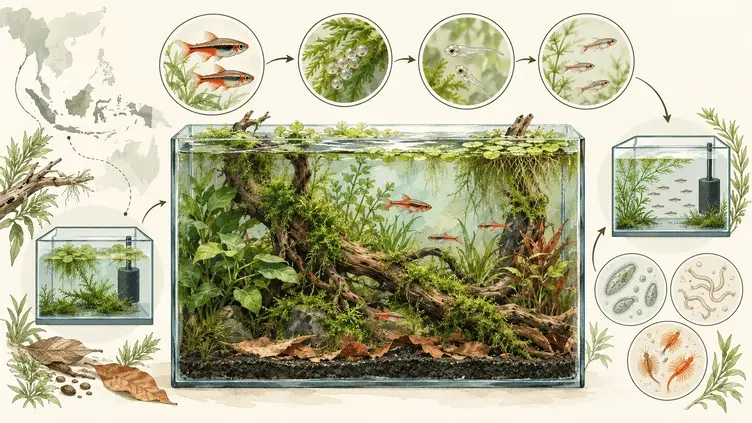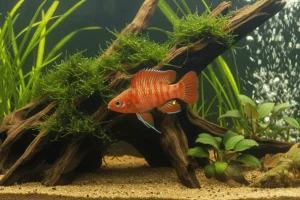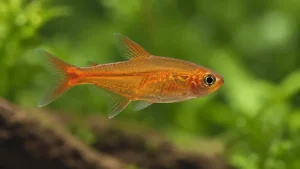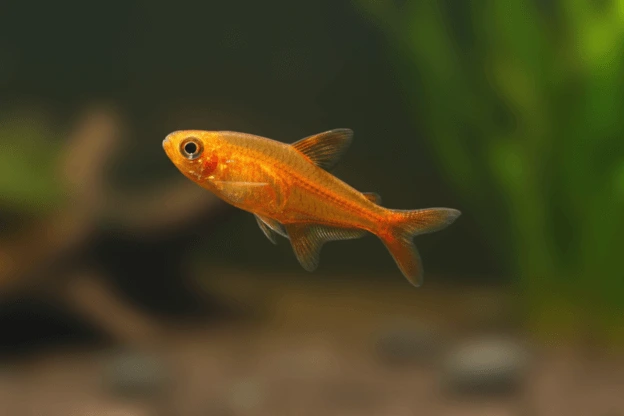
To breed ember tetras (Hyphessobrycon amandae), prepare a mature planted spawning tank, condition healthy adults, protect their eggs, and have microscopic fry food ready. Getting them to spawn is only the first challenge; raising their almost invisible fry takes more care.
Compare ember tetras with other small species in the nano fish guide.
These tiny orange tetras scatter their eggs among plants and other aquarium structures. They provide no parental care, and the adults may eat eggs and newly hatched offspring.
Even after a successful spawn, you can lose the fry if they cannot find microscopic food small enough to swallow.
Fortunately, you can prepare for these problems.
The key is to have a mature breeding aquarium, effective egg protection, suitable water, and established microscopic-food cultures before the adults spawn.
This guide explains the complete process, including:
- Choosing and conditioning breeding adults.
- Preparing a suitable spawning aquarium.
- Finding and protecting nearly invisible eggs.
- Collecting eggs without moving the adults.
- Building a simple egg-protection trap.
- Caring for eggs and newly hatched larvae.
- Feeding tiny fry before they can eat baby brine shrimp.
- Maintaining water quality without damaging fry.
- Raising juveniles and troubleshooting unsuccessful attempts.
The recommendations combine species-specific aquarium references, documented ember tetra breeding observations, and established techniques for breeding other egg-scattering tetras.
Because controlled research on ember tetra reproduction remains limited, exact breeding-success percentages, survival rates, and supposedly perfect parameters should be treated cautiously.
Ember Tetra Breeding: Quick Facts
Spawning Egg scatterer Parental care None Spawning tank 20–30 L Temperature 25–27 °C
| Breeding factor | Practical guidance |
|---|---|
| Scientific name | Hyphessobrycon amandae |
| Breeding behavior | Egg scatterer |
| Parental care | None |
| Breeding difficulty | Spawning can be manageable; raising tiny fry takes more preparation |
| Dedicated spawning aquarium | Approximately 20–30 liters is a practical starting point |
| Temperature | Around 77–81°F (25–27°C) |
| Water | Soft, slightly acidic, and stable |
| Filtration | Mature, gentle, and fry-safe |
| Egg protection | Fine plants, spawning mops, or a suitable egg trap |
| Hatching | Commonly reported around 24–36 hours |
| First foods | Appropriately sized microscopic foods |
| Baby brine shrimp | Introduce when fry can demonstrably swallow them |
Most important tip: Have microscopic food cultures established before breeding begins. Do not assume newly free-swimming ember tetra fry can immediately eat baby brine shrimp.
How Do Ember Tetras Breed?
Ember tetras originate from Brazil’s Araguaia River basin and are associated with slow-moving, vegetated waters.
Adults reach approximately 0.8 inches (2 cm) in length.
Are Ember Tetras Livebearers or Egg Layers?
Ember tetras lay eggs; they are not livebearers. They scatter their eggs among fine plants or spawning mops rather than giving birth to live young.
During spawning, females release eggs among plants or other structures while males fertilize them.
The eggs receive no parental protection.
In an ordinary aquarium, adults and other inhabitants may find and consume exposed eggs. Newly hatched larvae and free-swimming fry are also vulnerable.
Successful breeding therefore involves three separate tasks:
- Encourage healthy adults to spawn.
- Protect the eggs and newly hatched larvae.
- Provide suitable food and water conditions until the fry are strong enough to grow normally.
A breeding attempt can succeed at one stage and fail at the next.
For example, finding eggs proves that spawning occurred, but it does not establish whether the eggs were fertilized or whether the fry will survive.
Male vs Female Ember Tetra: How to Tell Them Apart
Sexing ember tetras is easier when the fish are mature and in good condition.
Females are generally fuller-bodied, particularly when carrying eggs.
Males are usually slimmer and may display stronger coloration.
However, coloration varies with age, condition, lighting, and individual differences. Color alone is not a completely reliable method of sexing every fish.
Observe your group from above as well as from the side.
Gravid or Pregnant Ember Tetra: What Does a Rounded Belly Mean?
A gravid ember tetra is a female carrying developing eggs. Her abdomen may look noticeably rounder, which is why keepers sometimes describe her as a pregnant ember tetra. A rounded belly alone does not confirm eggs; abnormal swelling or changes in appetite and behavior need closer attention.
Important
Ember tetras lay eggs. They do not become pregnant in the same way as livebearing aquarium fish.
Young fish may not show obvious sexual differences, so avoid assuming that a newly purchased group contains confirmed males and females.
How Many Breeding Fish Should You Use?
You can attempt breeding with a compatible pair or a small group.
A small group can allow more natural interactions, although no scientifically established male-to-female ratio has been identified as optimal for this species.
One documented ember tetra breeder used three males and three females in a 26-liter breeding aquarium.
That demonstrates one workable arrangement rather than a universal stocking rule.
Choose the number of fish according to their condition, behavior, and the space available.
Outside temporary breeding attempts, ember tetras should be maintained as social fish in appropriately sized groups.
Quarantine New Ember Tetras Before Breeding
If you purchase new fish specifically for breeding, do not immediately introduce them into an established breeding group.
New arrivals may carry parasites or infectious diseases even when they initially look healthy.
A separate quarantine aquarium lets you observe their health, confirm that they are eating, and acclimate them to your water without exposing an established group.
A Practical Quarantine Procedure
Prepare a biologically established quarantine aquarium with suitable temperature, filtration, and hiding places.
Use water conditions appropriate for the incoming fish.
Monitor their behavior, appetite, breathing, coloration, and physical appearance.
Look for signs such as:
- Clamped fins.
- Unusual lethargy.
- Rapid breathing.
- Abnormal swimming.
- White spots or patches.
- Deteriorating fins.
- Unexplained swelling or weight loss.
- Refusal to eat.
Maintain separate nets, siphons, and other equipment wherever possible.
If equipment must be shared, clean and disinfect it using an appropriate aquarium-safe procedure, then rinse or neutralize residues as required before reuse.
A quarantine period should be long enough to assess the fish and deal with any emerging problems. There is no single duration that guarantees freedom from every disease.
Do not move visibly unhealthy fish into a spawning aquarium.
Once the new fish are healthy, settled, and feeding consistently, they can begin conditioning for breeding.
How to Condition Ember Tetras for Spawning
Conditioning means providing the fish with suitable nutrition and low-stress conditions so they can develop eggs and become ready to spawn.
Start with healthy, mature adults.
Offer a varied diet of appropriately sized foods.
Useful choices include:
- Newly hatched Artemia.
- Small Daphnia or Moina.
- Cyclops.
- Suitable frozen foods.
- High-quality complete aquarium foods.
Feed modest portions and remove uneaten food.
The goal is to improve body condition without allowing waste to accumulate.
There is no established requirement that all ember tetras must receive exactly ten or fourteen days of conditioning.
However, allowing a reasonable conditioning period is preferable to moving newly acquired or poorly fed fish directly into a breeding setup.
Optional Advanced Technique: Separate-Sex Conditioning
Experienced tetra breeder Randy Carey describes conditioning male and female fish separately before introducing them for a planned spawning attempt.
This can help the breeder control feeding and select individuals that appear ready to reproduce.
It is an optional general tetra-breeding technique, not a proven requirement for ember tetras.
If you use it, maintain the fish in suitable social groups and properly equipped aquariums. Do not isolate individual ember tetras for extended periods simply to force breeding.
Keep Records of Successful Breeders
If a particular pair or group produces viable eggs, record which fish were involved.
Previously successful breeding combinations may be worth trying again after adequate recovery and conditioning.
However, past success does not guarantee that the same fish will spawn immediately during every subsequent attempt.
Ember Tetra Breeding Tank Setup
A separate spawning aquarium gives you control over the breeding conditions and makes it easier to protect eggs and feed fry.
For a pair or small breeding group, an established aquarium of approximately 20–30 liters is a practical starting point.
This is a temporary spawning setup, not a permanent stocking recommendation for a large adult school.
Choose a tank with enough room for the adults to behave normally.
1. Use Mature, Gentle Filtration
An air-driven sponge filter is a convenient choice.
It provides biological filtration while producing relatively gentle circulation.
A properly configured Hamburg mat filter can also work.
The important requirements are:
- Established biological filtration.
- Low water velocity.
- No exposed intake that can trap fry.
- Adequate oxygenation.
Sponge filters are useful, but they are not the only acceptable solution.
Do not install an uncycled filter and assume the aquarium is mature simply because you filled it with water from an established tank.
Beneficial nitrifying microorganisms are associated largely with surfaces and filter media.
2. Provide Egg-Protecting Plants
Java moss is an excellent option because its fine structure offers cover and creates places where eggs can settle.
Other suitable fine-leaved plants or spawning mops may serve similar functions.
Choose clean, aquarium-safe materials without sharp edges or loose fibers that could entangle fish.
Dense plants can also support populations of microscopic organisms, which may later supplement the fry’s food supply.
However, plant growth alone does not guarantee adequate nutrition for a large number of fry.
3. Consider a Bare Bottom
A bare-bottom spawning aquarium makes it easier to observe eggs and remove accumulated waste.
Alternatively, use an appropriate egg-protection structure, such as clean glass marbles or an elevated mesh trap.
You do not need a thick layer of ordinary gravel.
Substrate choice should support egg protection, visibility, and maintenance.
4. Use Subdued Lighting
Provide gentle lighting and avoid strong direct sunlight.
There is insufficient species-specific evidence to prescribe a precise light intensity for ember tetra eggs.
Total darkness is not an established requirement.
A normal day-night cycle with subdued lighting is a reasonable starting point.
5. Prepare a Safe Cover
Use a suitable aquarium lid or cover that provides ventilation and prevents fish from escaping.
Ensure that cords, airline tubing, and other equipment do not create gaps or entrapment hazards.
Ember Tetra Breeding Conditions: Temperature and Water Parameters
Ember tetras generally prefer soft, acidic water.
However, controlled species-specific breeding research has not established a single perfect temperature, pH, GH, KH, or TDS value.
Use the following conditions as a practical starting point.
| Parameter | Suggested starting point |
|---|---|
| Temperature | Approximately 77–81°F (25–27°C) |
| pH | Approximately 6.0–7.0 |
| GH | Roughly 2–6 dGH |
| KH | Low, but monitored for stability |
| TDS | No validated universal breeding cutoff |
| Ammonia | Undetectable |
| Nitrite | Undetectable |
| Nitrate | Keep low through appropriate maintenance |
Successful breeding may occur outside these ranges.
A detailed ember tetra breeding account documented reproduction after gradual adjustments to approximately GH 2, KH 2, and pH 6.2.
This is useful evidence that soft, slightly acidic water can work.
It does not prove that every breeder needs those exact readings.
Why Water Stability Matters
Avoid abrupt shifts in temperature, mineral composition, or pH.
This is particularly important in small aquariums with low carbonate hardness.
Very low KH reduces buffering capacity, making unexpected pH changes a concern.
Measure your water rather than attempting to reach a particular pH by adding several different chemical or botanical treatments simultaneously.
Do You Need Reverse Osmosis Water?
Not necessarily.
Reverse osmosis water can help when tap water is too hard for the intended breeding conditions.
Test your source water, then prepare a consistent mixture that provides suitable GH and KH.
Do not assume that pure RO water is automatically appropriate without considering mineral content and pH stability.
Avoid Household Water Softeners
Water from a household ion-exchange softener is not equivalent to reverse osmosis water.
These systems may exchange calcium and magnesium for other ions rather than removing dissolved minerals in the way an RO membrane does.
Use measured, appropriately prepared water instead of assuming that household-softened water has the correct breeding chemistry.
Is TDS Below 100 ppm Required?
No species-specific study establishing a universal 100-ppm breeding limit was identified in the research reviewed for this guide.
A TDS meter estimates total dissolved substances indirectly through conductivity.
It cannot identify which minerals are present.
Measure GH and KH separately.
Use TDS readings to monitor consistency between prepared batches of water rather than treating one number as proof of breeding suitability.
Preparing Safe Replacement Water
Every batch of replacement water should be prepared before it enters the breeding aquarium.
This is especially important once eggs and fry are present.
Replacement Water Checklist
- Check the source water for suitability.
- Neutralize chlorine and chloramine when using treated municipal water.
- Match the aquarium temperature closely.
- Check GH and KH when blending RO and tap water.
- Avoid sudden changes in pH.
- Use clean containers reserved for aquarium maintenance.
- Add replacement water slowly.
A conditioner that removes chlorine alone may not address chloramine. Choose a product suitable for your actual water supply and follow its instructions.
Do not assume that leaving tap water standing overnight reliably removes chloramine.
Never pour untreated municipal tap water directly into a delicate fry aquarium.
If fish begin gasping, swimming erratically, or behaving abnormally during a water change, stop adding water immediately and investigate the replacement water.
How to Breed Ember Tetras: Three Methods
Different breeding methods serve different goals.
Method 1: Natural Breeding in a Planted Aquarium
A mature, heavily planted species aquarium may occasionally produce surviving juveniles.
Dense moss and vegetation can provide egg protection, fry refuge, and a natural source of microscopic organisms.
This method requires less intervention.
However, adults may consume eggs and fry, and it can be difficult to know when spawning occurred.
Use this approach if you are happy to observe natural reproduction without expecting predictable yields.
Will Ember Tetras Breed in a Community Tank?
Yes, ember tetras can spawn in a community tank, but eggs and fry are vulnerable to the adults and other tank mates. Dense moss may shelter a few young fish. For more control over egg protection and feeding, use a dedicated spawning tank or collect eggs for a separate rearing aquarium.
Method 2: Dedicated Spawning Aquarium
A dedicated aquarium allows you to condition and introduce selected adults, monitor courtship, and remove the parents after spawning.
This is a practical option for breeders who want to observe the reproductive process and raise the resulting fry.
Prepare the tank and food cultures before introducing the adults.
Method 3: Egg Collection Without Moving the Adults
You can also attempt to collect eggs from an established aquarium.
The goal is to capture a portion of the spawn in a protected, removable container.
This technique is especially useful when you do not want to move every adult or dismantle a planted aquarium.
The next section explains how.
How to Collect Ember Tetra Eggs Without Moving the Adults
One technique described by Randy Carey for egg-scattering aquarium fish involves placing a removable collection device beneath a likely spawning area.
You can adapt the principle for ember tetras, although successful placement depends on where your particular fish spawn and how the eggs settle.
Step 1: Identify a Likely Spawning Area
Observe where the adults court and spend time among fine plants.
Choose a location beneath or immediately adjacent to that area.
Step 2: Prepare the Collection Container
Use a clean, shallow, aquarium-safe container.
Fit an appropriate mesh barrier over it.
The openings need to let eggs pass through while preventing adults from entering.
The mesh must be securely attached without sharp edges, protruding threads, or gaps where fish could become trapped.
Because ember tetra eggs are extremely small, test the setup carefully rather than assuming any ordinary netting will work.
Step 3: Position It Under the Plants
Place the collector where scattered eggs are reasonably likely to fall.
Do not block swimming space or create a trap for adult fish.
Step 4: Inspect Regularly
Check for eggs without disturbing the fish unnecessarily.
A low-intensity flashlight directed from the side may help.
Step 5: Transfer the Eggs
If you identify eggs inside the collector, carefully transfer the container to a prepared rearing aquarium containing closely matched water.
Minimize handling and avoid exposing eggs to unnecessary temperature or chemistry changes.
Limitations: This method only collects eggs that reach the container. Some eggs may remain among plants or settle elsewhere.
It is an optional egg-scatterer technique, not a species-specific method guaranteed to collect every ember tetra egg.
How to Build a Simple Ember Tetra Spawning Trap
A full-bottom spawning trap is another option.
Unlike a small removable egg collector, it protects a larger section of the aquarium floor.
The principle is simple:
Adults remain above the barrier while eggs pass into a protected space below.
Materials
Choose:
- A rigid, aquarium-safe support frame.
- Suitable fine mesh.
- Aquarium-safe supports that raise the barrier slightly above the bottom.
- Secure fastenings that will not loosen or expose sharp edges.
- A small amount of fine vegetation or a spawning mop.
Avoid materials that leach unwanted substances or have unknown coatings.
Assembly
Step 1: Measure the inside footprint of the spawning aquarium.
Step 2: Prepare a support frame that fits securely.
Step 3: Attach the mesh so that it remains flat and cannot sag.
Step 4: Raise the barrier slightly above the bottom using secure supports.
Step 5: Check the perimeter carefully. Adults must not be able to swim underneath or become trapped in a gap.
Step 6: Add spawning vegetation above the barrier.
The eggs should be able to settle into the protected compartment.
Important Safety Checks
The trap must not have:
- Sharp edges.
- Loose fibers.
- Gaps large enough for adults to enter.
- Openings that can trap fins or bodies.
- Inaccessible spaces where food and waste accumulate.
Uneaten food can decay beneath an egg trap.
Remove the adults after spawning and inspect the protected compartment without damaging the eggs.
A spawning trap is useful only if it protects eggs without creating additional water-quality problems.
How to Get Ember Tetras to Breed
There is no need to start with an aggressive environmental change.
Many tetra breeders experiment with changes that resemble aspects of rainy-season conditions, such as softer water, fresher water, and improved food availability.
Randy Carey describes these as general spawning techniques for tetras and barbs.
They should not be treated as proof that ember tetras require a particular artificial rainstorm or cold-water shock.
Step 1: Prepare the Tank
Confirm that the aquarium is mature, stable, and equipped with suitable spawning structures.
Your microscopic food cultures should already be running.
Step 2: Select Healthy Adults
Choose mature fish in good condition.
If you have documented a successful pair or group from previous attempts, you may choose to try those fish again.
Step 3: Acclimate Carefully
Transfer the adults using an appropriate acclimation method.
Avoid abrupt temperature, hardness, or pH changes.
Step 4: Keep Disturbance Low
Provide adequate cover and subdued lighting.
Observe the fish without repeatedly chasing them or dismantling the tank.
Step 5: Monitor Courtship
Watch for increased activity, interaction around vegetation, and possible spawning behavior.
If no spawning occurs, reassess the fish’s condition and the environmental setup.
Step 6: Consider a Modest Water Change
If you want to experiment with a spawning stimulus, consider a normal water change using appropriately prepared water.
You can also evaluate whether gradually softer water is suitable for your particular setup.
Avoid large cold-water changes intended to force spawning; they are not an established requirement for ember tetras.
If fish become stressed, stop the attempt and restore suitable conditions.
Ember Tetra Breeding Behavior: Courtship and Spawning
A useful observation comes from general egg-scatterer breeding literature.
In many tetras, courtship begins when a male approaches and follows a female.
The fish may swim alongside one another, approach vegetation, briefly come together, and separate.
Egg release may occur in small batches during repeated spawning bouts.
This is a general tetra pattern described by experienced breeders. Every individual step has not been independently established as a mandatory ember tetra courtship sequence.
Ember Tetra Mating Behavior: Signs to Watch For
- Males becoming more active around females.
- Repeated approaches near fine vegetation.
- Brief periods of coordinated swimming.
- Sudden movements away from one another.
- Eggs appearing among plants or beneath spawning structures.
Distinguish courtship from persistent harassment.
If one fish cannot escape chasing, is visibly exhausted, or shows other signs of stress, intervene.
Spawning may happen quickly and can be easy to miss.
Once spawning is complete, remove the adults carefully unless the eggs are being collected separately.
How to Find Ember Tetra Eggs
Ember tetra eggs are small and can be difficult to distinguish from tiny air bubbles, debris, or other particles.
Do not assume a spawning attempt failed simply because you cannot immediately see eggs.
The Side-Lighting Method
Experienced tetra breeder Randy Carey recommends a simple inspection technique for transparent egg-scatterer eggs.
You can adapt it as follows:
- Reduce the room lighting.
- Use a small, low-intensity flashlight.
- Direct the beam from the side or behind the suspected eggs.
- Inspect spawning plants and the protected area beneath any mesh.
- Look for tiny, regular, rounded objects with faintly illuminated outlines.
Avoid prolonged, intense direct light.
A magnifier or macro photograph may help if eggs are extremely small.
However, do not remove or discard an object simply because you are uncertain whether it is an egg.
What Do Ember Tetra Eggs Look Like?
Appearance can provide clues, but it is not an infallible diagnostic method.
Ember tetra eggs look like tiny, rounded, translucent beads. Their faint outlines can be hard to spot among plants or against the tank bottom; gentle side lighting helps.
Clearly deteriorating eggs may become opaque, lose their normal shape, or develop visible fungal growth.
An egg that appears pale immediately after spawning should not automatically be discarded before its condition can be assessed.
When in doubt, minimize handling and observe its development.
For a closer look at identification and hatching, see the ember tetra eggs guide.
Ember Tetra Egg Care and Hatching
Once spawning is complete, your priorities change.
Focus on maintaining suitable conditions rather than repeatedly adjusting the aquarium.
The most important tasks are:
- Protecting eggs from predation.
- Maintaining clean, stable water.
- Providing appropriate gentle circulation.
- Avoiding physical damage.
- Monitoring for clearly dead or fungus-covered eggs.
How Long Do Ember Tetra Eggs Take to Hatch?
Species-specific aquarium references commonly report approximately 24–36 hours between spawning and hatching.
This is a useful expectation, not a guaranteed deadline.
Temperature and other conditions can influence development, and the exact time of spawning may be unknown.
Newly hatched larvae remain very small and may spend time resting while consuming their yolk reserves.
They typically become free-swimming a few days later.
Do not start feeding simply because the eggs have hatched.
Wait until the larvae begin external feeding.
Should Eggs Be Kept in Darkness?
Use subdued lighting and avoid strong direct sunlight.
Randy Carey’s book describes light sensitivity in some egg-scatterer hatchlings, but it does not establish a precise lighting requirement for ember tetras.
Similarly, there is insufficient evidence to claim their eggs are completely unaffected by light.
A cautious approach is to provide shade without insisting on total darkness or a complicated artificial lighting schedule.
Preventing Egg Fungus
Egg fungus can become a significant problem during incubation.
Clearly dead eggs and decomposing material should be removed when practical and when doing so will not damage adjacent healthy eggs.
The Swedish National Veterinary Institute describes how Saprolegnia can establish on dead eggs and extend to nearby living eggs.
What to Do
Inspect the eggs discreetly.
Remove clearly dead or fungus-covered eggs using a fine pipette or another gentle method.
Maintain suitable water quality and circulation.
Avoid introducing contaminated tools or unnecessary organic waste.
If large numbers of eggs repeatedly fail, investigate the adults, fertilization, water chemistry, tank hygiene, and spawning conditions.
Should You Use Methylene Blue?
Do not routinely add medication to every batch of healthy eggs.
Research on ornamental fish egg disinfection has found species-dependent responses to treatments.
That research does not establish a validated methylene blue concentration for ember tetra eggs.
Avoid instructions such as adding a fixed number of drops per gallon without specifying the actual product concentration.
If treatment becomes necessary, use an appropriate formulation according to its specific instructions and seek knowledgeable aquatic veterinary guidance when problems persist.
Are Indian Almond Leaves an Equivalent Treatment?
No.
Indian almond leaves may be used as botanical aquarium material, but a whole leaf is not a standardized antifungal treatment.
Experiments involving prepared botanical extracts do not establish that an arbitrary leaf will deliver the same effect.
Do not combine multiple water-altering or medicinal methods without understanding their effects.
Ember Tetra Fry Development Timeline
Baby ember tetras are called fry. Follow their development rather than rigid calendar dates when deciding when to feed or move them.
| Developmental stage | What happens | Your priority |
|---|---|---|
| Spawning | Eggs are scattered | Protect eggs and remove adults |
| Approx. 24–36 hours | Eggs may hatch | Maintain gentle, stable conditions |
| Following days | Larvae use yolk reserves | Avoid unnecessary feeding and disturbance |
| Free-swimming | External feeding begins | Supply tiny live foods |
| Further growth | Fry can capture larger prey | Test-feed baby brine shrimp |
| Juvenile stage | Fish become stronger | Expand diet and grow-out space |
Do not use a generic tetra development schedule as proof that every ember tetra fry becomes free-swimming on a specific day.
The important transition is the onset of external feeding.
That is when you must ensure suitable food is immediately available.
Feeding Tiny Ember Tetra Fry: Keeping Food Within Reach
Randy Carey’s breeding advice highlights a practical challenge: tiny fry need food they can find as well as swallow.
Newly free-swimming tetra fry are tiny.
Many cannot initially consume freshly hatched Artemia, even though Artemia nauplii are relatively small.
The problem is not simply offering food once or twice.
The fry must be able to encounter enough edible prey throughout their feeding period.
A feeding may be ineffective if most microscopic organisms accumulate in one corner while fry remain elsewhere.
Likewise, a tank can contain many microorganisms without necessarily containing the right organisms in the right places.
Your Three Feeding Priorities
1. Suitable prey size
Use organisms small enough for the fry to capture and swallow.
2. Reliable prey availability
Ensure suitable food remains accessible between feedings.
3. Water quality
Do not overload the aquarium with food or culture water in an attempt to maintain prey density.
A successful approach balances all three.
Best First Foods for Ember Tetra Fry
Paramecia and Suitable Infusoria
An established microscopic-food culture is a useful first-food source.
However, infusoria is a broad term rather than one precisely defined organism.
Different cultures may contain different species and densities.
The amount of culture water added to an aquarium does not directly tell you how many edible organisms are being supplied.
Start with healthy, established cultures and observe the fry.
Small Rotifers
Appropriately sized rotifers are another potential first food.
Their suitability depends on the size of the organisms and the fish’s ability to consume them.
Natural Microfauna in a Mature Aquarium
Mature plants, mosses, and aquarium surfaces may harbor microscopic organisms.
This is one reason some fry survive in established, densely planted aquariums without being deliberately fed immediately.
However, a large number of fry may quickly exceed the natural food supply.
Use established aquarium microfauna as a supplement rather than assuming it can sustain an entire spawn.
Should You Transfer Old Filter Debris Into the Fry Tank?
Randy Carey describes obtaining microfoods from established filtration material.
The principle is useful: mature surfaces can contain microscopic organisms.
But transferring dirty filter sludge indiscriminately can also introduce waste, unwanted organisms, and potential pathogens.
A safer approach is to maintain clean, established plants and controlled food cultures before spawning.
Do not destabilize an existing biological filter by aggressively removing its media.
Green Water
Green water may contribute to the microscopic food environment.
However, green coloration does not prove that an adequate population of edible zooplankton is present.
Use it as a supplement, not your only feeding strategy.
Commercial Fry Foods
Some commercial products may be suitable when particle size, composition, and feeding behavior align with the fry’s needs.
Do not assume every powdered food works for newly free-swimming ember tetras.
Observe actual ingestion and avoid leaving uneaten food to decompose.
How Often Should You Feed Ember Tetra Fry?
Offer suitable microscopic foods in modest amounts several times daily when practical.
But frequency alone is not enough.
Check that food remains accessible between meals.
For example, observe whether the fry are spread across the aquarium or concentrated around a particular food-rich area.
Use a magnifier where necessary.
Look for signs of feeding, including a slightly fuller abdomen when visible.
If many fry appear unable to find food, review both food density and distribution.
If the water becomes cloudy or waste accumulates, reduce excess additions and investigate water quality.
Is There a Correct Infusoria Dosage?
No universal milliliter dosage has been validated for ember tetra fry.
A dense culture and a weak culture can contain vastly different numbers of microorganisms.
Therefore, instructions such as adding exactly 40–50 ml to every five-gallon tank are unreliable.
Base feeding on the culture’s quality, the fry’s apparent feeding success, and water conditions.
Should You Leave the Light On 24 Hours?
Randy Carey recommends soft continuous lighting for certain egg-scatterer fry to support extended feeding opportunities.
That is useful breeder experience, but it is not a demonstrated lighting requirement for ember tetras.
Do not make permanent lighting a universal rule.
Instead, provide suitable gentle lighting, observe feeding behavior, maintain accessible microscopic prey, and avoid causing stress or unwanted temperature changes.
How to Culture Infusoria Before Spawning
Never wait until the fry become free-swimming before preparing microscopic food.
By then, you may not have enough time to establish a dependable culture.
Step 1: Prepare a Clean Container
Use a dedicated container and suitable dechlorinated water.
Step 2: Add an Established Culture
A known, healthy starter culture is preferable to relying on an unidentified mixture from decomposing material.
Step 3: Feed the Culture Conservatively
A small quantity of suitable organic material may support microbial growth.
Avoid overfeeding the culture.
Large amounts of decomposing material can create heavily polluted water rather than a useful food source.
Step 4: Inspect the Organisms
A microscope or magnifying tool can help determine whether suitable organisms are present.
Cloudy water alone is not proof of a successful culture.
Step 5: Maintain Backup Cultures
Keep at least two independent cultures if possible.
Stagger their starting dates so every culture does not age or fail at the same time.
Step 6: Harvest Carefully
Collect an appropriate quantity without transferring decomposing plant matter or excessive culture water.
Avoid sharing contaminated tools between culture containers.
A reliable backup culture may be more valuable than an expensive piece of breeding equipment.
When Can Ember Tetra Fry Eat Baby Brine Shrimp?
Freshly hatched Artemia nauplii typically measure approximately 400–500 micrometers in length.
This explains why newly free-swimming fry of very small fish may initially struggle to eat them.
However, no reliable species-specific study establishes that every ember tetra fry must wait exactly 10–14 days.
The correct transition depends on individual development.
The Artemia Readiness Test
Offer a very small quantity of freshly hatched, properly rinsed nauplii.
Watch the fry closely.
Look for:
- Successful capture.
- Apparent swallowing.
- A visibly orange or pinkish abdomen when observable.
If the fry cannot eat Artemia, continue supplying smaller foods.
Test again after further growth.
Once consumption is confirmed, gradually increase the proportion of Artemia.
Do not remove microscopic foods until the smaller or slower-growing fry can also consume the larger prey.
Randy Carey’s book specifically emphasizes that individual fry may become capable of eating Artemia at different times.
That is a better basis for feeding than switching every fish on an arbitrary calendar date.
How to Hatch and Harvest Baby Brine Shrimp
Freshly hatched Artemia are valuable once the fry can consume them.
Use a clean, dedicated hatching container, appropriately prepared saline water, suitable cysts, and aeration.
Follow the cyst manufacturer’s recommendations for salinity, temperature, and incubation.
Step 1: Prepare the Hatching Water
Measure the salt according to the recommended salinity.
Weighing salt is more reproducible than measuring loosely packed tablespoons.
Use appropriate salt without unwanted additives.
Step 2: Keep the Cysts Circulating
Provide sufficient aeration to keep the cysts suspended.
Check for actual hatching rather than relying entirely on a predetermined number of hours.
Step 3: Separate Nauplii From Waste
Turn off aeration briefly.
Empty shells often float, while swimming nauplii and unhatched cysts may collect lower in the container.
Do not simply siphon everything from the bottom.
The FAO’s Artemia manual describes using light to concentrate nauplii, removing settled debris when necessary, and collecting the swimming animals separately from shells and unhatched cysts.
Avoid leaving a dense collection of nauplii without aeration for an extended period.
Step 4: Collect and Rinse
Harvest the nauplii using a suitably fine sieve.
Rinse them gently to reduce the transfer of hatching solution and debris.
Rinsing does not sterilize the organisms, so maintain good culture hygiene.
Step 5: Feed Promptly
Newly hatched Artemia use internal energy reserves.
Feed suitable nauplii promptly, and prepare fresh batches as required.
Staggered hatchers can provide a more consistent supply than relying on one old batch.
Water Changes During Ember Tetra Fry Rearing
Fry need clean water, but they are vulnerable to rough maintenance.
There is no scientifically established universal schedule requiring every ember tetra breeding aquarium to receive a fixed percentage of water changes each day.
The appropriate routine depends on feeding, filtration, fry numbers, and measured conditions.
During Egg Incubation
Avoid unnecessary disturbance.
Maintain suitable temperature and water chemistry.
Remove obvious sources of contamination when practical.
If water quality deteriorates, correct the problem rather than ignoring it because eggs are present.
During the First Feeding Stage
Microscopic food cultures can introduce organic material.
Test ammonia and nitrite and monitor the aquarium closely.
If maintenance is required, use a narrow airline siphon and work carefully.
Protect the intake with suitable fine mesh when necessary.
Inspect removed water before discarding it to ensure fry have not been accidentally siphoned out.
As Fry Grow
The quantity of food and waste generally increases.
Small, frequent water changes may become useful.
Prepare replacement water in advance and match its temperature and chemistry as closely as practical.
Add it gradually.
Why KH Matters
A change from very low-KH breeding water to substantially higher-KH replacement water can alter buffering and pH conditions.
Randy Carey specifically discusses concerns about increasing alkalinity during early development in some barbs.
That observation should not be converted into a universal ember tetra KH threshold.
The useful lesson is to measure the replacement water and avoid sudden changes.
Should You Avoid All Water Changes for Two Weeks?
No.
Some experienced breeders report that early water changes may be unnecessary under low-waste conditions.
But that does not mean avoiding maintenance is safe when food accumulates or ammonia and nitrite become detectable.
Let actual water conditions guide your response.
Raising Ember Tetra Fry Into Juveniles
Once the fry reliably consume larger foods, focus on steady growth and maintaining suitable space.
Offer a varied diet that gradually includes appropriately sized complete prepared foods.
Do not rely indefinitely on a single live food.
Watch for differences in growth.
Smaller fry may need continued access to smaller prey while larger fish are already eating Artemia.
When Should You Move Them Into a Grow-Out Aquarium?
Move them when they are robust enough to tolerate transfer and the original aquarium no longer provides suitable space or water-quality control.
Prepare the grow-out aquarium beforehand.
It should have:
- Established biological filtration.
- Suitable temperature and water chemistry.
- Fry-safe equipment.
- Adequate space.
- Appropriate food.
Avoid moving fragile fry merely because they have reached a particular age.
Should You Separate Fry by Size?
Consider it if larger fish consistently outcompete smaller individuals.
Additional feeding locations may solve the problem without requiring separation.
If separate grow-out groups become necessary, use established tanks with closely matched water.
How Many Fry Can You Raise Per Gallon?
There is no validated universal stocking formula for ember tetra fry.
The safe number changes as the fish grow.
Monitor feeding competition, oxygenation, waste production, growth, and swimming space.
Plan additional capacity before the aquarium becomes overcrowded.
When Can Juveniles Join the Main Aquarium?
Wait until they are large and strong enough to avoid predation and compete for food.
Make sure the destination aquarium contains compatible fish and suitable water.
A community fish that ignores adult ember tetras may still eat much smaller juveniles.
Acclimate the young fish carefully.
Common Ember Tetra Breeding Problems
| Problem | Possible explanation | First action |
|---|---|---|
| Adults do not spawn | Immaturity, poor conditioning, stress, unsuitable conditions | Check health, diet, behavior, and water |
| No eggs visible | Spawning did not occur, eggs were eaten, eggs are difficult to see | Inspect with gentle side lighting |
| Eggs disappear | Adults or tankmates consume them | Improve egg protection |
| Eggs turn opaque | Infertility, death, poor conditions, fungal growth | Investigate and remove clearly dead eggs |
| Eggs fail to hatch | Fertilization, water, or egg-health problems | Review breeding records and conditions |
| Fry disappear after free swimming | Food shortage, predation, filtration, or water-quality problems | Check feeding and water immediately |
| Fry refuse Artemia | Prey may be too large | Continue smaller foods |
| Fry grow unevenly | Feeding competition or individual differences | Improve food distribution and monitor growth |
| Unexpected losses | Environmental or health problem | Test water and inspect equipment |
The Adults Refuse to Spawn
Check maturity, sex identification, diet, and signs of stress.
Confirm water measurements.
If needed, make gradual adjustments rather than dramatically changing several variables at once.
Keep records so you can identify which conditions are associated with successful attempts.
You Cannot Find Any Eggs
Inspect the tank using subdued side lighting.
Check plants, spawning mops, egg traps, and protected areas.
If you use an egg collector, confirm that it is positioned beneath the area where courtship occurs.
Remember that not seeing eggs is not definitive proof that spawning did not happen.
Eggs Develop Fungus
Remove clearly dead eggs when practical.
Review water quality, fertilization, hygiene, and organic waste.
Avoid automatically adding medication or assuming an arbitrary number of botanical leaves will solve the problem.
Fry Disappear Within Days of Free Swimming
Immediately review the microscopic-food supply.
Verify that the culture contains suitable prey.
Check whether food is accessible throughout the areas occupied by the fry.
Also investigate ammonia, nitrite, filtration hazards, and possible predators.
Do not assume starvation is the only explanation.
Fry Eat but Do Not Grow
Check feeding frequency, food variety, competition, and water quality.
Consider whether larger fry are monopolizing food.
Avoid increasing feed so aggressively that pollution creates an additional problem.
Hydra or Planaria Appear
Unwanted organisms can enter through plants, cultures, or shared equipment.
Inspect new materials and maintain clean cultures.
A documented ember tetra breeder observed hydra and planaria during a period of declining larval numbers, but the observation did not establish that they caused those losses.
Identify the organisms and investigate conditions before introducing chemical treatments.
How to Improve Your Next Breeding Attempt
A successful breeder learns from recorded observations.
For every attempt, write down:
- Spawning date.
- Breeding adults used.
- Conditioning foods.
- Temperature.
- pH.
- GH and KH.
- Approximate egg count, if possible.
- Egg-protection method.
- Observed hatching time.
- Date fry became free-swimming.
- First foods and evidence of ingestion.
- Date larger foods were accepted.
- Water changes and test results.
- Number of surviving juveniles.
If you want to calculate a survival rate, define precisely what you counted.
For example, the number of free-swimming fry observed initially compared with the number of juveniles alive at a specific later stage can provide useful personal information.
Avoid describing an undocumented result as a universal success percentage.
Change one major variable at a time whenever possible.
If you simultaneously change water chemistry, conditioning food, lighting, and filtration, it will be difficult to identify what actually helped.
Complete Ember Tetra Breeding Checklist
Before spawning:
- Breeding adults are healthy and mature.
- Newly acquired fish have undergone appropriate quarantine.
- Adults have been conditioned with a varied diet.
- Breeding aquarium is biologically established.
- Temperature, pH, GH, and KH are suitable.
- Filtration is gentle and fry-safe.
- Plants, mops, or an egg-protection trap are installed.
- All trap materials are aquarium-safe and free of dangerous gaps.
- Microscopic-food cultures are established.
- Backup food cultures are available.
- A prepared rearing aquarium is available if collecting eggs.
- A safe method for finding and inspecting eggs is ready.
- Replacement water can be prepared and tested.
- Fine siphons and collection equipment are available.
- An Artemia hatching setup is ready for later use.
- Grow-out space can be provided as fish develop.
The best time to solve a breeding problem is before it occurs.
Ember Tetra Breeding FAQs
Do Ember Tetras Breed Easily?
Ember tetras may spawn readily once healthy adults are settled in suitable conditions. Raising the tiny fry is the harder part: protect the eggs, prepare microscopic first foods, and keep water quality stable. That makes them more demanding than a simple “easy to breed” label suggests.
How do I know if my ember tetras have spawned?
Look for courtship activity and inspect plants or egg traps for tiny eggs. Side lighting can help reveal nearly transparent eggs, but identification may still be difficult.
Can I collect ember tetra eggs without moving the adults?
You can try a removable egg-collection device protected by suitable mesh beneath a likely spawning area. This is a general egg-scatterer technique, and it will only recover eggs that reach the collector.
What is the best ember tetra spawning substrate?
Fine plants and spawning mops are practical options. A properly constructed mesh trap or other safe egg-protection structure can also reduce predation. Java moss is useful but not mandatory.
How long do ember tetra eggs take to hatch?
Approximately 24–36 hours is commonly reported in species-specific aquarium references. Treat this as an estimate rather than an absolute deadline.
Should I keep ember tetra eggs in complete darkness?
Subdued lighting and avoidance of strong direct sunlight are sensible precautions. A precise darkness requirement has not been established for this species.
What should I feed newly free-swimming ember tetra fry?
Appropriately sized microscopic foods, such as suitable paramecia or small rotifers, are useful first choices. Maintain reliable food availability and confirm that the fry are eating.
Can newly free-swimming ember tetra fry eat baby brine shrimp?
Some may initially be too small. Test-feed a small quantity once they have grown and continue smaller foods until ingestion is confirmed.
How many times per day should I feed the fry?
Several small feedings can be useful, but the important goal is consistent access to edible food without overloading the aquarium with waste.
Do I need to change water during the first week?
Monitor water quality and perform gentle, appropriately matched water changes when needed. Do not allow harmful waste to accumulate simply because the fry are young.
Can I use household-softened water for breeding?
Do not assume household-softened water is equivalent to RO water. Test the water and prepare suitable GH, KH, and pH conditions.
Does every spawning attempt need methylene blue?
No. Prioritize good conditions, egg protection, and removal of clearly dead eggs. Do not use an unspecified medication dose.
When should I move fry into a grow-out aquarium?
When they are robust enough to tolerate the transfer and need additional space or more manageable rearing conditions. Development matters more than a fixed age.
Final Thoughts: How to Successfully Breed Ember Tetras
Successful ember tetra breeding requires more than getting adults to scatter eggs.
First, start with healthy, conditioned fish and a mature breeding aquarium.
Second, use suitable spawning structures to protect the eggs. A dedicated spawning tank, removable egg collector, or properly built mesh trap can help.
Third, prepare microscopic food cultures before spawning.
This is particularly important because newly free-swimming fry may need to find small, edible organisms throughout the day.
Once they grow enough to swallow baby brine shrimp, transition gradually without leaving smaller individuals behind.
Finally, maintain clean water through careful observation, testing, and gentle maintenance.
The most reliable approach is not to follow rigid percentages and calendar dates. It is to observe the fish, protect the eggs, verify feeding, and respond to the conditions in your aquarium.
With preparation and consistent care, a successful spawning event can become a healthy group of juvenile ember tetras.
References and Further Reading
The following sources informed this guide. Species-specific information is distinguished from techniques derived from broader egg-scatterer breeding literature.
1. Randy Carey (2009), Tetras and Barbs: The Complete Guide to the Successful Care and Breeding of Two of the Most Popular Groups of Aquarium Fish. TFH Publications.
Relevant sections include the breeding chapter, printed pages 100–119, particularly egg identification, spawning methods, egg traps, conditioning, microscopic first foods, and fry maintenance.
These sections describe general tetra and barb breeding practices and should not be interpreted as controlled ember tetra experiments.
2. Fishkeeper — Ember Tetra
Species-specific care and breeding information, including spawning mops, fine plants, adult removal, approximate hatching time, and tiny first foods.
3. Hyphessobrycon amandae Breeding Report — Aquariumforum
Firsthand breeding observations, including tank setup, soft-water conditions, and fry development. The observations do not establish universal requirements.
4. FAO — Artemia Biology and Ecology
Technical information on Artemia development and the dimensions of newly hatched nauplii.
Evidence note: Practical aquarium techniques may depend on the breeder’s equipment, source water, and fish. The numerical ranges in this guide are starting points, not experimentally established universal optima for Hyphessobrycon amandae.
How to Breed Nano Fish Successfully: Tank Setup, Species Tips & Fry Care