Ask five ember tetra care guides how long these fish live and you get five answers. 2-4 years. 4-5. 5. 8-10. “10 years or more.” Tank size and group size are just as messy.
This guide covers the ember tetra (Hyphessobrycon amandae). It picks a number for each question, shows where the number comes from, and says plainly where nobody knows.
The gaps are wide. Minimum tank size runs 5, 10, 10-20 and 15 gallons. Group size runs 5+, 6, 8-10, 10-12 and 20-25. Most of those figures get copied from page to page with no source.
So every figure here carries an evidence grade. The numbers come from taxonomic records, peer-reviewed papers, veterinary guidance, modern specialist husbandry and Rolf Meyer’s 1993 Lexikon Süßwasser-Aquarienfische, which holds the most species-specific detail.
How to read the evidence grades
A is strong: taxonomy, peer-reviewed work, authoritative databases. B is good. C is moderate, meaning professional husbandry consensus. D is weak or anecdotal. E is unverified, or there is not enough evidence to say.
Meyer’s numbers count as experienced husbandry, not controlled science. Where he agrees with modern sources, confidence goes up. Where he differs, you see both numbers.
Ember tetra care: quick facts
| Fact | Figure |
|---|---|
| Scientific name | Hyphessobrycon amandae Géry & Uj, 1987 |
| Also called | Amanda’s tetra, fire tetra, dwarf red tetra |
| Adult size | About 2 cm (0.8 in) standard length |
| Origin | Rio das Mortes and the Araguaia system, Brazil |
| Group | 8-10 minimum (modern specialist guidance). 10-15 or more is the better target |
| Tank footprint | At least 45 x 30 cm, about 41 L or 11 US gal (modern specialist guidance). A 60 cm tank is the better start |
| Temperature | 20-28°C (68-82°F) is the listed range. 24-26°C (75-79°F) is the everyday target |
| pH | 5.0-7.0 is the listed range. 6.0-7.0 is the everyday target |
| Hardness | 1-10 dGH |
| Typical lifespan | 2-4 years (the most repeated figure, never verified) |
Are ember tetras easy to keep?
Yes, in a cycled, planted tank with a proper group. They are small and peaceful, and most of the care is stable water and tiny food. The catch is that hardiness and diet are still unknown for this species, so nobody has measured how tough they are.
The short version
Keep them in a mature, planted tank about 60 cm long, in a group of 10-15 or more. Aim for 24-26°C and pH 6-7 in soft to moderately soft water. Use a dark substrate, fine-leaved plants and floating cover, and leave open swimming room. Feed tiny food, dry and live. Pick small, peaceful tank mates. Plan on 2-4 years.
Where ember tetra care guides disagree (and what to use)
Published figures split on almost every number. Taxonomic records and specialist books carry the most weight. Keeper anecdotes carry the least.
| Topic | Range seen | What to use | Why |
|---|---|---|---|
| Lifespan | 2-4, 3-5, 4-5, 5, 5-8, 8-10 years, “10 years or more” | Plan for 2-4. Treat anything past 4 as a bonus | No primary dataset exists. The 10-year claim has no traceable source (E) |
| Minimum tank | 5, 10, 10-20 and 15 gallons | 60 cm long, 45-60+ L. The floor is 45 x 30 cm | Specialist guidance gives 41 L. Meyer gives about 40 cm of tank length (C) |
| Group size | 5+, 6, 8-10, 10-12, 20-25 | 10-15 or more. The floor is 8-10 | Specialist guidance says 8-10. Meyer says not fewer than 10 (C) |
| Temperature | 20-28°C (specialist guidance), 24-28°C (reference databases), 24-26°C (Meyer) | 24-26°C | Where the sources overlap. No thermal experiment exists (C) |
| pH | 5.0-7.0 (specialist guidance), 6-7 (Meyer) | 6.0-7.0 | Overlap again. One wild-water report says 5.7-6.2 but was never confirmed (C/D) |
| Hardness | “GH 0” in some care sheets, 1-10 dGH (specialist guidance), 2-25 °dH (Meyer) | 1-10 dGH. Don’t harden the water on purpose | Meyer’s range shows tolerance, not an optimum (C) |
| Heater | “Essential” in some care sheets, “usually no heater” in others | A stability tool. Use one if the room swings | Editorial guidance, not a study result (D) |
| Weekly water change | About 10% (Meyer), 20-30% (modern practice) | Enough to keep waste low and chemistry steady | No ember-specific experiment exists (D) |
| Blackwater and tannins | Stated as fact in several care sheets | Optional | Little is known about the habitat. No physiological need is shown (D) |
| Betta | “Will work in a heavily planted 10” to “tinier than neons, at risk” | Conditions, not a yes or no. See tank mates | Sources split on 10 versus 15 gallons (D) |
| Baby shrimp | “Completely shrimp-safe” to “baby shrimp at risk” | Adults usually fine. Shrimplets are at risk | Any small moving animal can be eaten (D) |
Some care sheets frame tank size around one fish at 2-3 gallons. They school. A lone ember is a stressed ember, so size the tank for the group.
Some care sheets cite “recent behavioral studies” on betta fin-nipping and name none. Skip that claim.
Some care sheets call the fish hardy and very sensitive to fluctuations in the same article. Both are partly true. Stable water matters more than a perfect number.
What is an ember tetra? Name, origin and size
Name and classification
The fish sold as the ember tetra is Hyphessobrycon amandae Géry & Uj, 1987. Current taxonomic records (updated 13 August 2026) list it as a valid species in the order Characiformes, family Acestrorhamphidae, subfamily Hyphessobryconinae. The type locality is the Rio das Mortes in Mato Grosso, Brazil, and the holotype is MZUSP 37367. Evidence: A.
Older books and some current pages file it under Characidae. A 2024 phylogenomic analysis of 494 species and 1,348 ultraconserved-element loci split the old Characidae into four families, Acestrorhamphidae among them (Melo et al., 2024). The genus Hyphessobrycon is itself non-monophyletic in broad analyses, so more reshuffling is possible. Don’t lose sleep over it. The fish itself hasn’t changed.
Géry and Uj described it in Tropical Fish Hobbyist 35(5):58-61, 65. The issue may have appeared in December 1986, although the bibliographic year is 1987. Hemigrammus amandae is listed as an unaccepted combination. It is the same fish under an old name, not a second species.
The original description compared it with other small Hyphessobrycon, including H. georgettae. Several small South American tetras turn orange or red under aquarium lights, so color alone is a weak way to identify one.
Size
The maximum documented length is 2.0 cm standard length, or about 20 mm. Some aquarium sources quote 2.5-3 cm, and most of that gap is probably standard length against total length, or rounding. Evidence: A/B.
Males and females
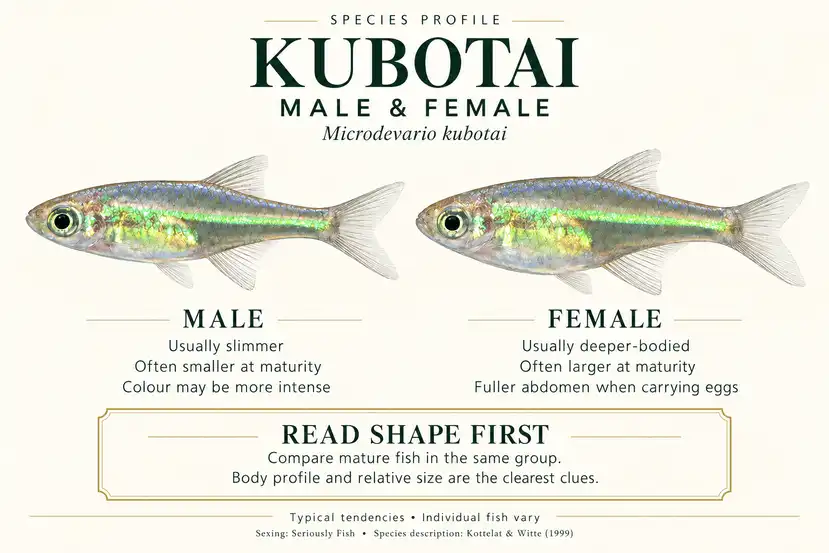
Adult males tend to be more intensely colored. Mature females are rounder-bodied, especially with eggs. Meyer adds that males are smaller, slimmer and only slightly more intense in color, at about 1.5 cm against 1.8 cm for females. Treat those as aquarium observations. The 20 mm maximum is better supported. No controlled study of sexual dimorphism in this species turned up. Evidence: C.
Where they live
The native range is Brazil’s Araguaia River basin. No database reviewed here shows an established introduced population anywhere else. Evidence: A.
The original series came from roughly 100 km upstream of the Rio das Mortes confluence with the Araguaia and held only a small number of fish. The natural ecology has never been documented with anything like the intensity of the husbandry.
Specialist accounts place ember tetras in quieter tributaries, backwaters or similar low-flow water rather than the main channel. Specialist guidance says the fish presumably lives in minor tributaries, backwaters and oxbow lakes. A secondhand field account describes shallow water with sand, submerged roots, floating and aquatic plants, and large aggregations of embers. That account was not verified in a peer-reviewed field paper, so treat it as natural history. Evidence for the exact microhabitat: C/D.
The wider drainage varies a lot. Carvalho and Tejerina-Garro measured 25 Araguaia and Tocantins headwater streams and found differences tied to temperature, depth, turbidity and conductivity. “Araguaia water” is not one pH or one conductivity number. That study covered the region, not an ember tetra population. Evidence for variation across the drainage: A.
Ember tetra tank size and how many to keep
Use a 60 cm tank, about 45-60+ L (12-16 US gal), for 10-15 ember tetras. 45 x 30 cm is the smallest footprint any specialist gives.
Footprint first, volume second
No experiment has found a minimum tank size for this species. You have two specialist benchmarks. Specialist guidance gives a 45 x 30 cm footprint, about 41 L. Meyer gives a species tank from about 40 cm in length. Both come from experienced husbandry, and no welfare trial set either number. Use them as lower benchmarks.
For a shoaling midwater fish, horizontal space matters more than volume. A tall, narrow 50 L tank does not give the same swimming room as a longer 50 L tank. A standard 10 gallon tank has a smaller footprint than 45 x 30 cm, so measure the tank you own before you trust the gallon number. Evidence: C.
What about a 5 gallon tank?
A 5 gallon tank sits below every specialist benchmark above. One keeper’s guide uses a “5 gallon floor”, and that is a single-keeper figure (D).
| Tank | Group | Note |
|---|---|---|
| About 40-45 cm, about 41 L | 8-10 | Lower specialist benchmark (specialist guidance, Meyer) |
| 60 cm, 45-60+ L | 10-15 or more | Preferred starting point |
| Larger, or a mixed community | 10-15 or more, plus companions | Size the ember group first, then add tank mates |
| About 5 US gal | Not advised | Below every specialist benchmark. Single-keeper figures only |
How many ember tetras should you keep?
Ember tetras are peaceful, social, shoaling fish. Specialist guidance recommends at least 8-10. Meyer recommends a school of not fewer than 10, and says the broader Hyphessobrycon group looks and behaves better in larger schools. No group-size experiment on H. amandae exists.
There is a close relative case. Saxby and colleagues tested group size in four ornamental fishes. Neon tetras in larger groups darted less, showed less aggression and shoaled more, and groups of 10 showed the strongest shoaling. The authors stressed that the effect varies by species, so this supports the ember advice without proving it.
- 10 fish is the strongest practical minimum, because Meyer and the modern guidance both land there.
- 10-15 or more is the better target when the tank and filter allow it.
- 8-9 sits inside modern advice but is less conservative than the combined evidence.
- Very large groups often look better, but no experiment shows where welfare stops improving.
- 6 may survive. Specialist guidance says 8-10 and Meyer says 10, so 6 is a weak recommendation.
Aggression is described as very low. Chasing, spacing and display inside the group are not a problem by themselves. Evidence that the fish is social: B/C. Evidence for 10 as a practical minimum: C. Evidence that exactly 10 is a proven threshold: none.
If your group hides all day, count them first. See the pale and hiding section below. For more small species that suit the same tank, read our guide to the best nano fish for small aquariums.
Water parameters, temperature and the heater question
Aim for 24-26°C, pH 6.0-7.0 and soft to moderately soft water, roughly 1-10 dGH. Stable beats perfect.
Tolerance is not the same as optimum
No controlled study measured critical thermal limits, chronic pH tolerance, hardness tolerance or long-term welfare in this species. Four ideas get mixed up, so keep them apart.
| Source | Temperature | pH | Hardness | What it is |
|---|---|---|---|---|
| Modern specialist guidance | 20-28°C | 5.0-7.0 | 1-10 dGH | Professional husbandry range |
| Meyer (1993) | 24-26°C | 6.0-7.0 | 2-25 °dH | Species-specific husbandry range |
| Reference databases | 24-28°C | not listed | not listed | A referenced ecology value, not an experiment. Their maturity, reproduction and longevity fields are essentially empty |
| Wild habitat | Warm | Often acidic | Low-mineral | Pointers only. Quantified data from ember localities are poor |
Specialist guidance and Meyer overlap closely on temperature and pH. That overlap is why 24-26°C and pH 6-7 make the most defensible target. Evidence: C, strengthened by two independent references agreeing.
Meyer’s 2-25 °dH is much wider than modern advice. It shows that he found the species tolerant in captivity. It does not make 25 °dH ideal. Healthy fish outside the 1-10 dGH band in stable water are no cause for panic, but don’t harden the water on purpose.
KH should be high enough to keep the tank chemically stable, unless you deliberately manage very low alkalinity. No species-specific KH optimum exists (E). Don’t push conductivity down to 20 µS/cm because a field report once measured it.
Captive-bred lines may well tolerate chemistry that differs from a wild collection site, and Meyer’s broad range fits that idea. No controlled multigenerational experiment checked it. “Some aquarium populations tolerate harder water” is a different claim from “hard alkaline water maximizes lifelong welfare.” Evidence for an exact physiological optimum: E.
What the wild numbers actually show
| Parameter | What can be supported | Grade |
|---|---|---|
| Temperature | A regional dry-season study found many Araguaia headwater streams at 24.1-27.5°C. Not an ember measurement | B for the region, E for the species |
| pH | A field account reproduced online reports about 5.7-6.2 at ember localities. No independent confirmation | D |
| Conductivity | The same account reports about 19-29 µS/cm. Not a species requirement | D |
| GH and KH | No reliable site measurement located | E |
| Dissolved oxygen | Regional studies measured it. Locality values for embers were not verified | E |
| Tannins and blackwater | Field-oriented accounts report blackwater. How common it is across the range is uncertain | D |
| Seasonal variation | Expected in the drainage. One field account reports cooler winter water. No species-specific series | D/E |
A conductivity reading can’t be turned into GH or KH without knowing the ions in the water. So “wild embers live at GH 0” is not established by the low-conductivity reports. Evidence for the claim: none.
Do ember tetras need a heater?
Think of the heater as a stability tool. If your room swings in temperature, heat the tank. If the room sits steadily inside 24-26°C, a heater is optional. This is editorial guidance. No study backs it. Care sheets do split. Some call a heater essential and others say most tanks go without.
Keepers ask whether the 70s F are too low, and whether heat feeds algae. Nobody has an ember-specific answer. A regional study found dry-season streams at 24.1-27.5°C, and one field account says winter water runs considerably cooler. Neither is a measurement from an ember population.
Cycling, filtration and flow
A biologically mature aquarium is one of the strongest themes in ember husbandry. Meyer states that H. amandae does best in an older, established tank. Veterinary guidance independently backs mature biofiltration, because ammonia and nitrite from an immature system are a major preventable hazard. Evidence: A for general fish husbandry, C for embers specifically.
Use gentle but effective biological filtration. Specialist guidance considers an air-driven sponge filter adequate and says some current is acceptable. Meyer’s broader Hyphessobrycon advice favors clear, well-filtered water with light movement. Keep the flow gentle enough that tiny fish can hold position and eat without being pushed around. Cycle the tank before the fish go in and keep ammonia and nitrite at zero. Our guide to sponge filters for nano tanks covers the options.
Water changes: the part where sources disagree
No controlled study gives an exact weekly percentage for embers.
Meyer was conservative. He considered the fish most comfortable in a mature, established tank, so he recommended weekly maintenance focused on removing detritus and changing no more than about 10%. Modern practice often uses larger routine changes, especially in heavily stocked or heavily fed tanks.
The evidence supports neither “change exactly 20-30% every week” nor “never change more than 10%.” Change enough water to keep nitrogenous waste and organic load low while holding temperature and chemistry steady. In a lightly stocked, mature planted tank that may be a small change. In a busier community tank it may need to be bigger. Base the amount on waste, stocking, feeding, nitrate and the stability of your replacement water. Evidence for keeping water quality high: A/B. Evidence for an exact ember percentage: D.
Planting, substrate and lighting
Use a dark substrate, fine-leaved plants, floating plants for shade, and open midwater room. Meyer reports the strongest coloration over a dark bottom, among fine-leaved plants, with floating plants shading part of the swimming area. Modern specialist advice matches. Evidence: C.
Substrate
A dark, fine substrate or sand is repeatedly recommended, and Meyer ties a dark bottom to stronger color. No evidence shows it is a physiological need. Treat it as a choice for color and looks. Evidence: C/D.
Leaf litter and tannins
Leaf litter adds structure and supports microbial communities, which may help fry. Tannins can mimic parts of some natural habitats. Specialist guidance lists leaf litter as an optional feature.
Blackwater is optional
Ember tetras do not have a scientifically demonstrated requirement for brown, tannin-stained water. Meyer stresses mature water, a dark substrate, plants and shade, and his entry never makes tannins mandatory. No species-specific clinical evidence shows tannins prevent disease either. A clean, stable, planted tank with sensible chemistry is fine without dyeing it brown.
Lighting
Moderate or subdued light, broken up by floating or emergent plants, is a strong practical choice. Floating cover cuts harsh overhead light and adds visual security. Meyer specifically recommends shading the swimming area to bring out color. No controlled lighting study exists. Evidence: C/D. If you need a light for a planted tank, see our comparison of LED lights for planted tanks.
What do ember tetras eat?
Feed very small complete dry food plus small live or frozen food. The mouth is tiny, so particle size is the limit. Food that enters the tank but can’t be swallowed is not nutrition.
The wild diet is a guess
No gut-content, stable-isotope or feeding-ecology paper on this species turned up. Specialist guidance calls the fish probably micropredatory, eating tiny invertebrates and zooplankton. A modeled trophic level near 3.0 exists, but it comes from close relatives. No ember stomach data went into it. Claims that wild embers eat mosquito larvae, copepods, cladocerans or terrestrial insects are not verified. Evidence: D.
What works in the tank
Meyer’s entry adds species-specific detail. He reports that embers readily take Cyclops and Grindal worms, frozen red mosquito larvae in small portions, frozen white mosquito larvae, and small Drosophila offered at the surface. The practical lesson matters more than any one item. Offer very small prey-sized particles and vary the feeding across the water column, including small moving food. Evidence: C.
| Food | Size check | Notes |
|---|---|---|
| Micro pellets, finely crushed flakes | If you can’t picture a 2 cm fish swallowing it whole, crush it more | The complete-food base. Slow-sinking suits a midwater fish |
| Cyclops | Small enough for the mouth | Meyer’s core small food |
| Grindal worms | Offer small ones | Meyer and specialist guidance both name them |
| Artemia nauplii | Newly hatched | Modern specialist guidance. Small-food option |
| Moina | Small | Modern specialist guidance. Small-food option |
| Frozen red mosquito larvae (bloodworm-type) | Small portions | Reported by Meyer |
| Frozen white mosquito larvae | Small portions | Reported by Meyer |
| Drosophila | Small, at the surface | Reported by Meyer. Practical where you have them |
Don’t lean on one food. The claim that embers eat only dry micro-food is poor husbandry, and Meyer’s list shows why. If you want to culture your own, read our microworm culture and daphnia culture guides.
How often?
“Twice a day” is common practice. No test backs it. One or two small feeds a day suits adults as long as the total stays sensible. Watch body condition. Chronic excess food rots, raises the organic load and hurts water quality. Evidence for the exact schedule: D. Evidence for a mixed captive diet: C.
Ember tetra tank mates
Pick small, peaceful, non-predatory fish that don’t dominate feeding time and thrive at about the same temperature and chemistry. Judge each one by adult size, predatory capacity, activity level, food competition and environmental overlap.
Meyer reports his own successful experience with three companions. He states that H. amandae can be kept without problems with Boraras maculatus (as Rasbora maculata), Pethia gelius (as Barbus gelius) and small Corydoras. That is not a controlled trial, but it beats an unsourced list from the internet.
| Tank mate | Verdict | Conditions |
|---|---|---|
| Boraras maculatus | Strong choice | Meyer reports no problems. Similar size, peaceful (C) |
| Pethia gelius | Strong choice with enough space | Meyer reports no problems. Check temperature and water overlap for your stock (C) |
| Small Corydoras | Strong choice | Meyer reports no problems. Modern guidance backs small callichthyids (C) |
| Other small peaceful tetras | Generally fine | Similar temperament. Skip boisterous, fin-nipping or much larger species (C) |
| Other small rasboras | Generally fine | Modern guidance recommends them. Try chili rasbora or kubotai rasbora (C) |
| Otocinclus | Behaviorally fine | Peaceful and in a different feeding niche, but it needs its own mature-tank and food care (C/D) |
| Small gouramis | Conditional | “Gourami” covers very different sizes and temperaments. Some sedate species may work (C/D) |
| Betta | Conditional, individual-dependent | See below (D) |
| Dwarf cichlids | Conditional, often workable | Specialist guidance mentions embers as dither fish for Apistogramma. Breeding pairs get territorial (C) |
| Adult dwarf shrimp | Often coexist | Healthy adults are probably too big to interest an ember. No guarantee (D) |
| Shrimplets | At risk | A small enough moving animal gets investigated or eaten (D, inference) |
| Adult snails | Low risk | Eggs and tiny juveniles can’t be guaranteed safe (D) |
| Large, boisterous or fin-nipping fish | Avoid | Embers are 2 cm. They lose |
The absence of reported attacks isn’t a compatibility study. Treat every pairing as a trial.
Can ember tetras live with a betta?
Sometimes. Embers are tiny and a betta may chase or attack them. Betta temperament varies a lot. Keeper answers range from “will work in a heavily planted 10” to “tinier than neons, at risk with a betta.” Advice also splits on whether you need 10 or 15 gallons.
So set conditions instead of hoping. Use a larger tank, dense planting, a proper group of 10 or more, and a calm betta. Individual bettas vary, so nothing here is a guarantee. Evidence: D.
Do ember tetras eat baby shrimp?
Assume yes. Adults often coexist with adult dwarf shrimp, but some care sheets call embers “completely shrimp-safe, ignoring even baby shrimp” and others warn the opposite. The claim “100% shrimp safe” is misleading. If you want shrimplets to survive, give them dense moss and cover, and expect some losses. Evidence: D.
Normal behavior vs problems: pale, hiding, twitching
Pale and hiding fish drive most post-purchase panic searches. Keepers have asked about this for 15 years, in posts titled “hiding like no other”, “lost color” and “ember tetras pale”. The explanations keepers offer are hypotheses, and they are labeled that way below. Evidence for specific causes: D.
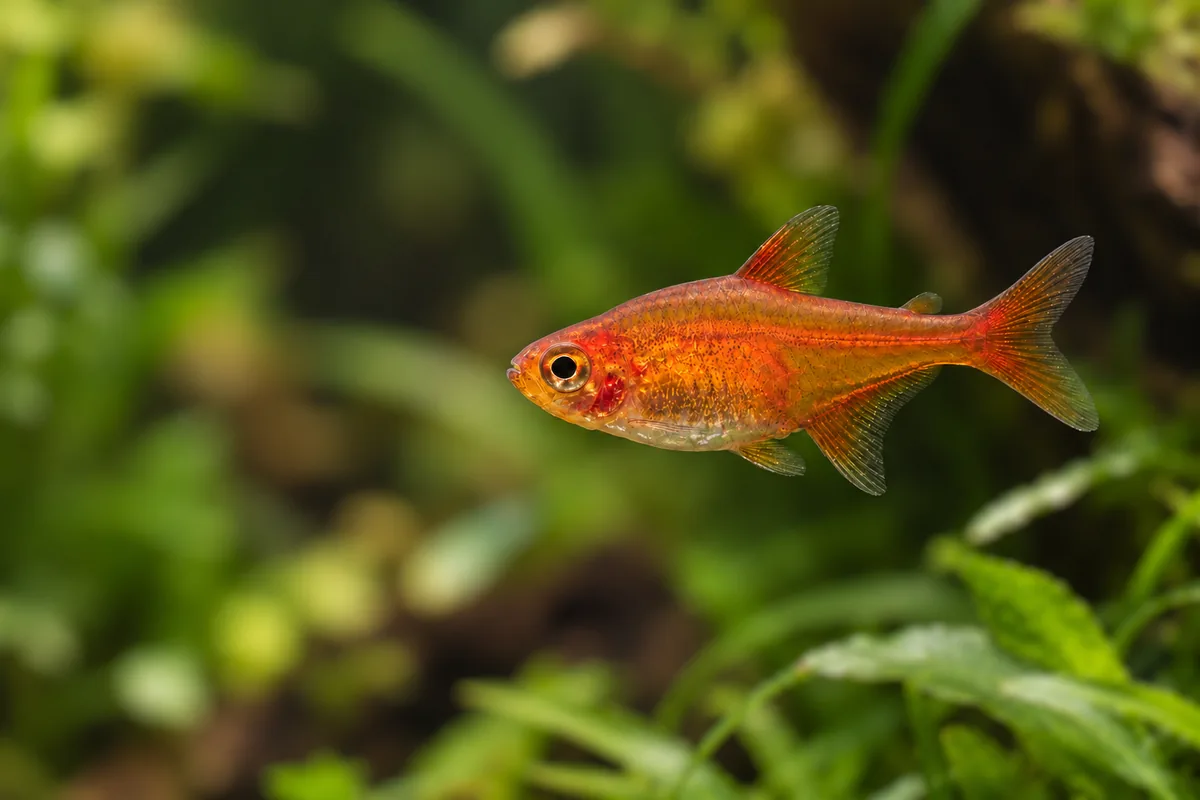
A settled group looks like a glowing orange cloud and moves as a tight ball. Fish can look washed-out in the daytime and different at night. That alone isn’t a diagnosis.
| What you see | Likely causes | What to check | What to change |
|---|---|---|---|
| Pale on arrival | Shipping stress. Some fish color up, some stay pale for weeks | Ammonia and nitrite. Whether the fish are eating | Give it time and keep conditions steady. Don’t medicate on a hunch |
| Hiding all day, bolting when you walk up | Group too small. Bright or open tank. Light too close to the water. Tank too small | How many fish you have. Whether there are floating plants and shade | Build the group to 10 or more. Add floating plants and a dark substrate. Lower the light. Keepers also suggest dither fish and fasting then feeding to train them (unproven) |
| One fish paler than the rest | Low social status, or illness (the keeper “alpha” idea) | Does it eat, swim with the group and breathe normally? | If it acts normal, status is likelier. If it stays apart or stops eating, treat it as a health issue |
| One or two fish hiding for hours and twitching | Stress, parasites, water chemistry | Flashing, rubbing, white spots, ammonia and nitrite | Fix water first. See the health section |
| Pale in the day, fine at night | Normal color change at night (keeper idea, unproven) | Look again after lights out | Nothing, if the fish look healthy |
| Whole group washed-out | Hard or alkaline water. Ammonia or nitrite. Bright, pale surroundings | Test kit readings. The tank background and substrate | Move toward stable, soft to moderately soft water. Add a dark substrate and shade |
| Sudden deaths after adding new fish | A poisoning or water event | Ammonia, nitrite, new stock, shared nets | Test the water before you do anything else. Quarantine new fish |
One keeper lost five embers kept for two years alongside new fish and suspected a poisoning event. That is anecdote, but it fits the same advice: test the water first.
For more causes that hit other nano species, read why nano fish lose color and why my galaxy rasboras died.
How long do ember tetras live?
Plan on 2-4 years. That figure is the most repeated, and nobody has verified it.
Keepers who lose fish around the two-year mark often blame themselves. Check the water first, then consider age.
Online sources variously say 2-4 years, 3-5, 4-5, 5, 5-8 and 8-10, and a few say “10 years or more”. No reliable maximum-age dataset, cohort study or studbook backs any of them. The captive lifespan of Hyphessobrycon amandae is insufficiently verified. Evidence: E.
The long claims look weak. The “10 years or more” claim has no traceable source, which tells you how many citations exist. Other care guides already call it inaccurate.
One keeper with a ten-gallon tank lost embers one by one around 22 months. A reply pointed out that the fish may have been 6 months old at purchase, and that small tetras breed in their first season, so they aren’t built to last. Another keeper asked who has had a first school of 11 all survive past two years.
You can’t know a fish’s age at purchase. So run this check before you blame age:
- Ammonia and nitrite read zero.
- Temperature holds steady.
- No new fish or water event came just before the losses.
- The food is small enough to swallow.
- The group has 10 or more fish, with no bullying.
If the water is clean and the fish fade slowly after about two years, age is a likely cause. Don’t promise yourself a number. Growth rate is also unmeasured. No useful maturity or growth parameters exist, and no controlled growth study turned up. Evidence: E.
Health, quarantine and medication caution
No convincing study of ember-specific disease turned up, so treat the risks as ordinary freshwater ornamental fish risks. Evidence for ember-specific susceptibility: E.
Aquarium fish can develop ectoparasitic disease (including Ichthyophthirius multifiliis), other protozoal or metazoan parasites, bacterial infections, fungal or oomycete lesions, nutritional disorders, and illness caused or worsened by ammonia, nitrite, wrong temperature, low oxygen or unstable chemistry. Veterinary guidance stresses that poor conditions, organic loading, transport and handling often come before bacterial disease, and that fungal disease is usually secondary.
Signs that need investigation
None of these identifies a pathogen on its own.
- Persistent loss of appetite
- Rapid or labored breathing
- Persistent hiding or isolation from the group
- Sustained color loss
- Clamped or damaged fins
- Flashing or rubbing
- Visible spots, ulcers or abnormal coatings
- Loss of balance or persistent abnormal swimming
- Unexplained weight loss
Prevention that holds up
- Establish biological filtration before stocking.
- Keep water chemistry and temperature stable.
- Don’t allow measurable ammonia or nitrite.
- Avoid chronic overcrowding and overfeeding.
- Source fish carefully.
- Quarantine new fish.
- Keep quarantine equipment separate.
- Investigate illness before you medicate.
Veterinary guidance recommends a minimum 30-day quarantine for pet fish in general, and notes that quarantine will not catch every pathogen. That is general veterinary guidance with no ember data behind it. Evidence: A/B for the principle. Our breeding guide has a longer quarantine procedure in its quarantine section.
Keepers report that small tetras can be sensitive to salt and medication, including one keeper treating ich on new embers in quarantine. Read the product label, don’t guess doses, and ask an aquatic vet when you’re unsure. Routine “preventive” antibiotics without a diagnosis aren’t evidence-based care and can cause new problems. This guide gives no treatment protocols.
Buying and acclimating ember tetras
Sellers commonly say most aquarium stock is captive bred. Supplier documentation shows captive-bred embers are in the trade. But no audited dataset gives the share of captive-bred against wild-collected fish worldwide, so “all shop embers are captive bred” can’t be verified. Ask the store where yours came from. Evidence: D.
On the conservation side, the species is listed as IUCN Least Concern, based on an assessment dated 7 November 2018. Evidence: B. The assessment is several years old. The fish is traded commercially, and nothing found shows aquarium collection threatens it. The Tocantins-Araguaia freshwater habitat faces human pressure, and researchers call parts of the region poorly known and seriously threatened. That doesn’t show a decline in this species.
A healthy fish eats and swims with the group. Pale on arrival can be shipping stress, so give it time, but check your water conditions in the same week. Buy 10 or more at once. Use a drip or slow acclimation.
Equipment worth buying
Five items cover it, and all of them serve stable water.
- A sponge filter. Air-driven and gentle is enough. See sponge filters for nano tanks.
- A heater, if your room swings. See the heater section above.
- A light you can dim or shade. See LED lights for planted tanks.
- A test kit for ammonia, nitrite and pH.
- Separate nets and equipment for quarantine.
Ember tetra breeding, in brief
Specialist guidance describes embers as egg-scattering free spawners with no parental care. Well-conditioned adults can spawn regularly. Eggs or fry may occasionally survive in a dense, mature planted tank, but good survival usually means separating the eggs from the adults. Species-specific science on reproduction is very thin. Experienced aquarium literature fills the gap.
Rolf Meyer gives a detailed protocol that worked for him. It is a documented aquarist method. Nobody has optimized it experimentally.
- A breeding pair can go in a tank as small as 5 L.
- Water at 2-5 °dH and pH 6.2-6.5, at about 26°C.
- Fresh water, strongly aerated beforehand.
- Spawning among Myriophyllum or loosely arranged Java moss, with a spawning grid or mesh so adults can’t reach the eggs.
- About 30-70 eggs, clear and only weakly adhesive.
- Hatching at roughly 36 hours at 25°C.
- Fry free-swimming around day 4.
- First foods as small as fine pond plankton or rotifer-sized organisms, then Artemia nauplii about a week later.
Don’t label 5 L, pH 6.2-6.5, 30-70 eggs or 36 hours as proven constants. Other breeder reports give different incubation times and slightly different chemistry. The broader breeder consensus is soft, mildly acidic water, subdued light, fine plants, mops or mesh, well-conditioned adults, egg protection, tiny first foods and then Artemia.
Not securely known: age at maturity, the validated spawning temperature, an experimentally determined pH or GH optimum, fecundity by female size or age, development rate against temperature, larval survival curves and how often adults eat eggs. Evidence: C for the egg-scattering habit and for Meyer’s protocol as successful practice. D/E for his egg count and hatch time as universal biology.
Full steps live in the ember tetra breeding guide. For egg identification and hatching, see ember tetra eggs.
Ember tetra care myths, checked
| Common claim | Verdict | Why |
|---|---|---|
| “Ember tetras need exactly pH 6.0.” | Misleading | No pH optimum has been tested. Modern guidance is broader, and Meyer gives pH 6-7 |
| “They must be kept in blackwater.” | Misleading | Blackwater habitat is reported, but no dependence on tannins is shown. Meyer stresses mature water, dark substrate, plants and shade |
| “Their water must be below 30 µS/cm.” | Misleading | One weakly verified locality reading is not a captive optimum |
| “GH must be zero.” | Contradicted by husbandry evidence | Conductivity isn’t GH. Specialist guidance gives 1-10 dGH, and Meyer reports success across 2-25 °dH |
| “25 dGH is ideal because Meyer lists it.” | Misleading | His range is captive tolerance, not a tested optimum |
| “24-28°C is the proven optimum.” | Misleading | No ember thermal experiment exists. Meyer’s 24-26°C overlaps modern guidance |
| “A 10 gallon (40 L) tank is the biological minimum.” | Uncertain | About 41 L is a credible benchmark, and Meyer gives about 40 cm. Neither is a welfare threshold |
| “Six ember tetras is enough.” | Weak recommendation | Six may survive. Specialist guidance advises 8-10 and Meyer says not fewer than 10 |
| “Ten is the proven minimum school.” | Misleading | It is the strongest practical advice because sources converge. No ember group-size experiment proves it |
| “Larger groups are proven to reduce ember stress.” | Reasonable but indirect | The effect is shown in neon tetras and some other social fishes, not in H. amandae |
| “Change exactly 20-30% every week.” | Too rigid | No species-specific experiment sets a percentage |
| “Never change more than 10%.” | Too rigid | Meyer’s 10% is a method for established tanks, not proof that bigger stable changes harm |
| “Embers are 100% shrimp safe.” | Misleading | Small adults may coexist, but shrimplets are plausible prey |
| “Bettas are always safe tank mates.” | Misleading | It depends on the betta, the tank geometry and the individual |
| “They live 2-4 years.” | Uncertain | Secondary sources disagree and no strong primary longevity dataset exists |
| “Feed exactly twice every day.” | Reasonable convention, not law | Quantity, particle size, food quality, body condition and water quality matter more |
| “They only eat dry micro-food.” | Poor husbandry claim | Meyer reports Cyclops, Grindal, mosquito larvae and Drosophila |
| “Captive-bred embers live best in hard alkaline water.” | Uncertain | Broader tolerance is plausible. No long-term welfare experiment shows hard alkaline water is optimal |
| “Tannins are essential to prevent disease.” | Unverified | No species-specific clinical evidence shows it |
What nobody knows yet
For a fish this common, the gaps are big. A large share of ember care rests on accumulated aquarist experience. Controlled science covers little of it. Hardiness and diet are still labeled “unknown” even in specialist guidance.
- Field ecology: replicated pH, conductivity, GH, alkalinity, dissolved oxygen, depth, current, substrate, canopy and seasonal temperature from confirmed H. amandae populations. This includes natural water chemistry across the range.
- Physiological tolerance: chronic tests of temperature, pH, hardness, conductivity and oxygen, using welfare endpoints and not just survival.
- Social welfare: controlled comparisons of group size, tank dimensions, cover and density with validated stress and behavior measures. That covers the biological minimum group and tank size.
- Natural diet: stomach-content, metabarcoding or stable-isotope work.
- Reproductive biology: maturity, fecundity, spawning periodicity, egg size, developmental rates and larval survival.
- Growth and longevity: cohort growth curves and a documented captive maximum age.
- Disease: how common illness is in embers, and how susceptible they are, instead of generic freshwater lists.
- Trade: wild-caught against captive-bred volume and origin.
Ember tetra care at a glance, with evidence grades
| Care factor | Best-supported recommendation | Evidence | Basis |
|---|---|---|---|
| Identity | Hyphessobrycon amandae Géry & Uj, 1987 | A | Taxonomic records |
| Native range | Araguaia basin, Brazil. Type locality Rio das Mortes, Mato Grosso | A | Taxonomic records, Meyer |
| Adult size | About 20 mm standard length. Meyer lists 1.5 cm males and 1.8 cm females | A/B, plus C | Reference databases, specialist guidance, Meyer |
| Tank footprint | 60 cm long preferred. 45 x 30 cm and about 40 cm are lower benchmarks | C | Specialist guidance, Meyer |
| Group size | At least 10, preferably 10-15 or more | C | Meyer, specialist guidance, neon tetra experiment |
| Temperature | 24-26°C. Broader specialist range 20-28°C | C | Meyer, specialist guidance, reference databases |
| pH | About 6-7 | C | Meyer, specialist guidance |
| GH | Soft to moderately soft, about 1-10 dGH. Meyer reports 2-25 °dH tolerance | C | Specialist guidance, Meyer |
| KH | No species-specific optimum known | E | No adequate primary evidence |
| Blackwater | Optional, not shown to be mandatory | D/C | Natural-history accounts, specialist guidance, Meyer |
| Filtration | Mature biological filtration, gentle flow | A general, C species | Veterinary guidance, specialist guidance, Meyer |
| Plants and cover | Dark substrate, fine plants, floating shade, open swimming room | C | Meyer, specialist guidance |
| Water changes | Keep water quality excellent. Exact percentage unproven. Meyer used about 10% weekly in mature tanks | A/B general, C/D amount | Veterinary guidance, Meyer |
| Captive diet | Tiny complete dry food plus small live or frozen food. Cyclops and Grindal best supported | C | Meyer, specialist guidance |
| Natural diet | Probably micro-invertebrates and zooplankton, not directly shown | D | Specialist guidance, modeled reference data |
| Tank mates | Boraras maculatus, Pethia gelius and small Corydoras are the strongest direct examples | C | Meyer |
| Feeding frequency | 1-2 small feeds a day is reasonable, not a law | D | General husbandry |
| Quarantine | General veterinary advice: at least 30 days | A/B general | Veterinary guidance |
| Breeding method | Soft, mildly acidic water, plant or moss spawning, protect eggs, tiny first foods | C | Meyer, specialist guidance |
| Meyer breeding values | 2-5 °dH, pH 6.2-6.5, about 26°C, 30-70 eggs, about 36 h hatch at 25°C | C as protocol, D/E as universal biology | Meyer |
| Lifespan | Insufficiently verified | E | Conflicting secondary estimates |
| Conservation | IUCN Least Concern, assessed 7 Nov 2018 | B | Conservation assessment |
| Captive-bred share of trade | Captive breeding occurs. Global share unknown | D | Commercial evidence, no audited statistics |
13 facts you can rely on
- The ember tetra is validly identified as Hyphessobrycon amandae Géry & Uj, 1987.
- It is native to Brazil’s Araguaia River basin, with its type locality in the Rio das Mortes system.
- It is tiny, about 20 mm standard length. Meyer describes males around 1.5 cm and females around 1.8 cm.
- It is peaceful and social. Ten or more is the strongest practical group, because Meyer says not fewer than 10 and modern guidance says 8-10.
- A mature, biologically stable tank is strongly supported, and Meyer favors established tanks for this species.
- 24-26°C and pH 6-7 are especially defensible targets, because Meyer and modern professional guidance overlap closely.
- A dark substrate, fine-leaved plants and floating shade with open swimming room are among the best-supported layout choices.
- No science shows blackwater or tannins are mandatory.
- Meyer gives direct aquarium support for Boraras maculatus, Pethia gelius and small Corydoras as compatible tank mates.
- Small food matters most. Meyer reports Cyclops, Grindal worms, mosquito-larva foods and Drosophila, and modern care adds micro-foods, Artemia nauplii and Moina.
- No experiment proves an exact water-change percentage. Meyer’s 10% weekly method belongs to his mature-tank approach.
- General fish-health evidence strongly supports clean water, mature biofiltration and quarantine.
- The reported conservation status is Least Concern, from a 7 November 2018 assessment.
Ember tetra care FAQ
Are ember tetras easy to keep?
Yes, in a cycled, planted tank with a proper group. They are small and peaceful, and most care is stable water and tiny food. Hardiness and diet are still unknown, so easy has limits.
How many ember tetras should I keep together?
Keep at least 10, and 10-15 or more if space allows. Specialist guidance says 8-10 and Meyer says not fewer than 10. No ember experiment proves a threshold, but neon tetras shoaled most strongly in groups of 10.
What size tank do ember tetras need?
A 60 cm tank of about 45-60+ L suits a group of 10-15. The lower specialist benchmarks are 45 x 30 cm (about 41 L) and about 40 cm of tank length. Footprint matters more than gallons.
How long do ember tetras live?
Plan on 2-4 years. That is the most repeated figure, but no primary dataset backs any lifespan claim. Longer numbers such as “10 years or more” are weakly sourced. Rule out water problems before you blame age.
Can ember tetras live with a betta?
Sometimes, under conditions. Use a larger tank, dense planting, a group of 10 or more and a calm betta. Betta temperament varies, and embers are tiny. Advice splits on 10 versus 15 gallons, so watch closely.
Do ember tetras eat baby shrimp?
Assume they can. Adult dwarf shrimp often coexist with embers, but shrimplets are at risk because any small moving animal can be eaten. Dense moss and cover help some survive.
Do ember tetras need a heater?
Treat a heater as a stability tool. Use one if your room temperature swings. If the room stays steady within 24-26°C, a heater is optional. Care sheets split, and no ember study settles it.
What do ember tetras eat?
Tiny complete dry food plus small live or frozen foods. Meyer reports Cyclops, Grindal worms, mosquito larvae and small *Drosophila*. Modern guidance adds Artemia nauplii and Moina. Match particle size to a very small mouth.
Why are my ember tetras pale or hiding?
Common causes are shipping stress, a group under 10, bright or open surroundings, hard or alkaline water, ammonia or nitrite, social status and illness. Test the water first, build the group and add floating plants.
Are ember tetras aggressive or fin nippers?
No. Descriptions of the species report very low aggression, and chasing inside the group is normal spacing or display. The bigger risk is the reverse: being chased by a betta or another boisterous fish.
Bottom line
Keep 10-15 or more embers in a mature, planted 60 cm tank at 24-26°C and pH 6-7. Give them a dark substrate, fine-leaved plants, floating shade and open water. Feed tiny food, dry and live. Plan on 2-4 years.
Meyer’s 2-25 °dH range and about 10% weekly water change are records of what worked for him, not universal optima. They do show the fish is more adaptable in captivity than ultra-soft-water care sheets suggest, while still doing best in stable, non-extreme water. If you plan to breed them, start with the ember tetra breeding guide.
Evidence note: This guide is our own review of the species record. Taxonomy, range and size rest on peer-reviewed work and taxonomic records. Practical husbandry rests on modern specialist guidance and on Rolf Meyer’s long experience with the species, which is experience and not a controlled experiment. Care-sheet consensus is not scientific evidence, and a keeper’s long experience is not worthless just because nobody ran a trial.
References
Peer-reviewed work
- Géry, J. and Uj, A. (1987). The ember tetra: a new pygmy characid tetra from the Rio das Mortes, Brazil, Hyphessobrycon amandae sp. n. (Pisces, Characoidei). Tropical Fish Hobbyist 35(5):58-61, 65.
- Melo et al. (2024). Phylogenomics of Characidae, a hyper-diverse Neotropical freshwater fish lineage, with a phylogenetic classification including four families (Teleostei: Characiformes). Zoological Journal of the Linnean Society 202(1), zlae101.
- Carvalho, R. A. and Tejerina-Garro, F. L. (2015). The influence of environmental variables on the functional structure of headwater stream fish assemblages: a study of two tropical basins in Central Brazil. Neotropical Ichthyology 13(2). DOI 10.1590/1982-0224-20130148. Regional data, not an ember habitat study.
- Saxby, A., Adams, L., Snellgrove, D., Wilson, R. W. and Sloman, K. A. (2010). The effect of group size on the behaviour and welfare of four fish species commonly kept in home aquaria. Applied Animal Behaviour Science 125:195-205. DOI 10.1016/j.applanim.2010.04.008. Neon tetra evidence, not an ember experiment.
Specialist husbandry
- Meyer, Rolf (1993). Lexikon Süßwasser-Aquarienfische: 700 Arten, Haltung, Pflege, Zucht. Bechtermünz/Weltbild Verlag. Entry on Feuersalmler / Funkensalmler, printed p. 146. The author biography says Meyer kept and bred most of the species described.