Museum records from 11 wild ember tetra collections list the penguin tetra in 10 of them and a pencilfish in none. Most tank mate lists still lead with pencilfish, and the pairing works anyway. In a tank, feeding layer, water and mouth size decide compatibility.
An ember is a 20 mm mid-water micropredator from soft, clear floodplain water. Good ember tetra tank mates feed in a different layer and live at 20 to 28 °C in water of 1 to 10 dGH. Their mouths must also be too small to take a 2 cm fish. Breeders add a fourth test, which is who eats whose fry. Tank size, water and diet for the embers themselves are in the ember tetra care guide.
Ember tetra tank mates compared
Verdicts assume a group of at least 10 embers, a planted tank of 60 cm or more for mixed stocking, and soft water. Shared water is the overlap between the companion’s range and the ember’s 20 to 28 °C, pH 5.0 to 7.0 and 1 to 10 dGH.
| Tank mate | Layer | Shared water | Verdict | What decides it |
|---|---|---|---|---|
1 Pygmy coryGastrodermus pygmaeus | Bottom to mid | 22-26 °C pH 6.4-7.0 | Top pick | Very peaceful and easily outcompeted. Keep 10 or more and feed sinking food after lights out. |
2 Hastatus coryGastrodermus hastatus | Open midwater | 20-26 °C pH 6.0-7.0 | Top pick | Schools with small characins in the wild. Run at 24-26 °C and feed live or frozen zooplankton. |
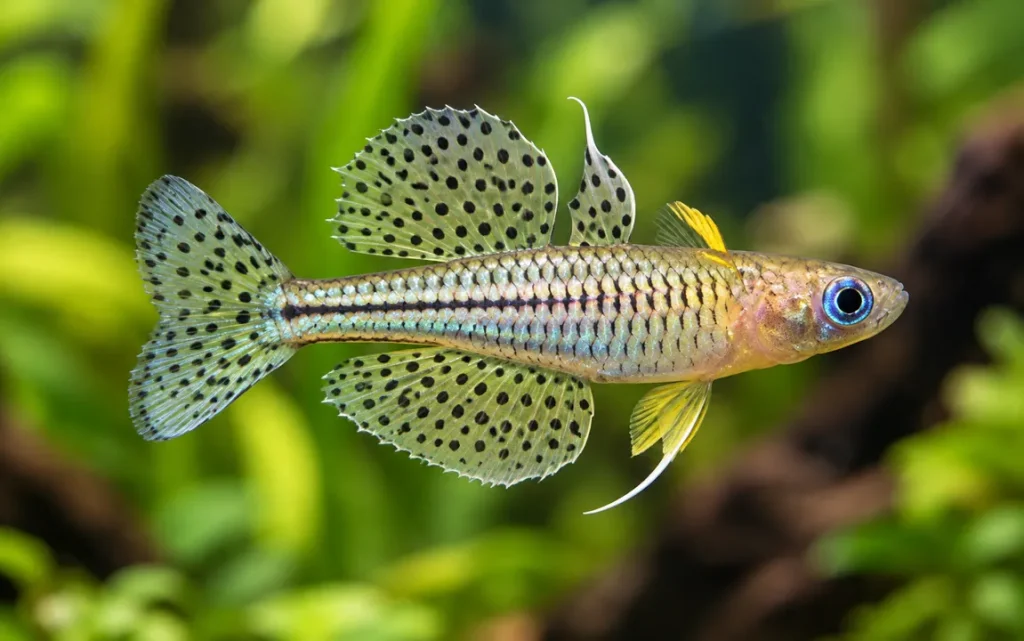
3 Dwarf pencilfishNannostomus marginatus | Mid to upper | 22-28 °C pH 5.0-7.0 | Top pick | 25 mm, and males rarely spar. Skip N. trifasciatus and N. mortenthaleri in small tanks, since they injure each other. |
4 Chili and dwarf rasborasBoraras brigittae, B. maculatus | Mid | 20-28 °C pH 5.0-7.0 | Top pick | Same size, water and temperament. Czech and Polish keepers report the pairing trouble-free with shrimp present. |
5 Hengel’s and lambchop rasborasTrigonostigma hengeli, T. espei | Mid | 23-28 °C pH 5.0-7.0 | Top pick | 30 mm and very peaceful. The larger harlequin (45 mm) needs a 60 cm tank. |
6 Black-winged hatchetfishCarnegiella marthae | Surface | 20-28 °C pH 5.0-7.0 | Top pick | Feeds only at the surface and does not hunt fry. Needs a tight lid and floating micro-foods. |
7 Norman’s lampeyePoropanchax normani | Surface | 22-26 °C pH 6.5-7.0 | Good | Shy lampeyes come forward once embers are added. Weak at feeding time, so feed floating food first. |
8 Clown killifishEpiplatys annulatus | Surface | 20-25 °C pH 5.0-7.0 | Good | Run at 24-25 °C. A jumper, so the tank must be covered. |
9 Spotted blue-eyePseudomugil gertrudae | Top to mid | 21-28 °C pH 5.0-7.0 | Good | Timid and easily outcompeted. Feed at the surface before the embers arrive. |
10 Sparkling gouramiTrichopsis pumila | Top to mid | 22-28 °C pH 5.0-7.0 | Good | A Japanese keeper describes mutual indifference. Some keepers report it hunting small shrimp. |
11 OtocinclusOtocinclus vittatus | Plants and glass | 25-28 °C pH 6.0-7.0 | Good | Mature, algae-rich tanks only. Imports die mostly of starvation, and embers eat their wafers. |
12 Kuhli loachPangio semicincta | Bottom, at night | 21-26 °C pH 5.0-7.0 | Good | Two German keepers call the pairing trouble-free. Kuhlis eat eggs and fry, so ember fry rarely survive. |
13 Red cherry shrimpNeocaridina davidi | Bottom and plants | pH 6.2-7.0, GH 4-8 | Good | Adults are safe. Shrimplets survive where dense moss gives them cover. |
14 Amano shrimpCaridina multidentata | Bottom and plants | 21-27 °C pH 6.5-7.0 | Good | Too large for an ember to eat. Larvae need brackish water, so no colony forms. |
15 Crystal Red and bee shrimpCaridina cantonensis | Bottom | 22-24 °C pH 5.8-7.0 | Conditional | The chemistry fits. The temperature does not, since these shrimp top out near 24.5 °C. |
16 Dwarf cichlidsApistogramma, rams | Bottom | A. borellii 20-26 °C, rams 27-28 °C only | Conditional | Embers are a standard dither fish. Brooding females turn on intruders in small tanks. |
17 BettaBetta splendens | Surface | 22-28 °C pH 6.0-7.0 | Conditional | Depends on the individual. At least 40 L, dense cover, 10 or more embers and a spare tank ready. |
18 Celestial pearl danioDanio margaritatus | Mid to bottom | 20-26 °C pH 6.5-7.0 GH 5-10 | Conditional | Clear water only. No leaf litter, 23-25 °C and groups of 20, since males spar daily. |
19 Scarlet badisDario dario | Bottom | 20-26 °C pH 6.5-7.0 | Conditional | Needs live or frozen food, and embers reach it first. Males herd and hunt shrimplets. |
Ranges come from Seriously Fish species profiles and specialist care sheets.
The four tests behind every verdict
Feeding layer
Embers hold the middle and upper water and take food as it sinks. Companions that feed at the surface or on the substrate meet them only at feeding time. A Japanese keeper reports that lampeyes that had always hidden in the plants came to the front once embers were added, drawn out by a calm shoal in open water.
Two mid-water shoals in a 60 cm tank share one strip of water. A lone ember joined a lambchop rasbora shoal in a German tank, and a French group merged straight into a rasbora school. Both cases mean the ember group was too small.
Shared water
Embers come from clear floodplain lagoons and backwater channels of the Rio Araguaia. The nearest measured lakes run pH 5.2 to 7.9 at 15 to 35 µS/cm. Tannins suit embers, but they are not blackwater specialists. A tank pushed toward pH 5 for blackwater companions runs embers at the acidic edge of their range.
Several small fish only look compatible. Celestial pearl danios want pH 6.5 to 7.5, GH 5 to 15 and no leaf litter. Crystal Red shrimp top out near 24.5 °C, and Endlers want 15 to 35 dGH. All three survive in an ember tank without thriving at its best settings.
Mouth size and feeding speed
An ember is 20 mm long, so any fish that can swallow 2 cm of prey will eventually try. Adult angelfish reach 150 mm and eat small tetras. Speed causes the opposite problem, since embers eat fast. One Japanese keeper watched them clear the otocinclus wafers. Feed slow species first, or after lights out.
Fry
Embers scatter their eggs and eat them unless the eggs are protected. Adults seldom hunt free-swimming fry but take what they find. Guarding parents change the outcome. A German keeper’s 60 embers failed to dent a ram pair’s brood, while Parosphromenus breeders warn that embers will hunt unguarded licorice gourami fry.
Ember tetras with shrimp and snails
Adult shrimp are safe and shrimplets are not. Keepers in Germany, Poland, the Czech Republic, Russia and Korea describe the same pattern, with embers ignoring adults and picking off newborns they can catch. Results run from total loss to colonies that keep growing. Five embers in one Polish tank left “not a single baby” red cherry alive. Five embers in a Bangkok tank lived among cherry shrimp breeding too fast to count. One shrimp-forum keeper has run embers with red cherries for more than five years.
Cover decides most of the difference. Dense flame or Java moss, floating roots and well-fed embers keep losses small. Run tanks with Caridina bee shrimp at 22 to 24 °C, the only band both species share. More species are rated in the shrimp-safe fish guide.
Snails struggle in ember water. Nerites, mystery snails and Malaysian trumpet snails need pH above 7 for long-term shell health. At pH 6 their shells erode slowly unless a calcium source is added. Giant ramshorns (Marisa) eat plants, and assassin snails eat shrimplets. Dwarf crayfish can turn on the fish too. One Korean keeper’s mini orange crayfish grabbed at tetras with its claws.
Fish to skip, and the real reason
| Species | Real problem | Evidence |
|---|---|---|
Serpae tetraMegalamphodus eques | Known fin nipper at 40 mm, twice the ember’s length | Specialist profile |
Tiger barbPuntigrus tetrazona | Fin biter at 60 mm. A group-size study found its aggression less predictable than in neon tetras | Profile and a group-size study |
AngelfishPterophyllum scalare | Adults reach 150 mm and eat small tetras | Specialist profile |
Dwarf gouramiTrichogaster lalius | Territorial males. A 2015 survey found megalocytivirus in 18.7% of 2,086 imported gouramis before quarantine | Peer-reviewed study |
Guppy, Endler, molly, platyLivebearers | Hard water, up to 35 dGH for Endlers. Male Endlers and mollies chased embers in German and Polish tanks | Profiles and keepers |
White Cloud Mountain minnowTanichthys albonubes | A 14-22 °C fish that shares only the ember’s cold edge | Specialist profile |
Emerald dwarf rasboraDanio erythromicron | Needs pH 7-8 and GH 12-20. Three embers in 15 L chased them out of cover | Profile and one keeper |
Green fire tetra in a nanoAphyocharax rathbuni | Embers bullied them off food in 30 cm cubes, and more embers made it worse | Taiwanese keepers |
Pea pufferCarinotetraodon travancoricus | Nips slow fins and eats shrimp and snails | Specialist profile |
Licorice gouramisParosphromenus spp. | Embers eat their unguarded fry, and the species is a conservation priority | Parosphromenus Project |
Three famous “nippers” fail for other reasons. Seriously Fish says silver tip tetras lose their nippiness in a proper group, though they still want harder water. Penguin tetras nip only when kept in small numbers. Odessa barbs are peaceful but want cool, hard water.
The dwarf gourami figure most often quoted is wrong. Seriously Fish states that 22% of dwarf gouramis from Singapore carry iridovirus. The 2006 study behind it found 22% infection among gouramis that were already sick in Sydney shops.
Ember tetras with a betta or dwarf cichlids
Betta reports split cleanly by source. Seriously Fish advises keeping bettas alone. Aquarium Co-op ranks embers among the best betta tank mates. A UKAPS keeper’s embers survived a betta but hid constantly, and a Brazilian author sets 40 L as the floor. The deciding factor is the individual betta, so a spare tank must be ready before the embers go in.
Dwarf cichlids are safer for embers than their reputation suggests. Embers are the standard dither fish for Apistogramma, and a German keeper’s macmasteri grew bolder once 100 embers shared the tank. The risk is a brooding female, and one female A. cacatuoides killed a tetra that kept entering her brood territory. Rams need 27 °C or more, which is the top of the ember range.
Hidden gems from the ember’s own river and beyond
Museum collections hold 11 dated wild samples of embers. Every other fish caught at the same spots in the same years gives the ember’s real neighbours. The penguin tetra appears at 10 sites, Ramirezella pyrophthalma at 8 and Hyphessobrycon moniliger at 5. A 2025 survey of the ember’s headwater streams counted 596 Aspidoras poecilus, more than any other catfish.
Several of these natives are missing from Brazil’s 2012 list of fish permitted for ornamental collection, including the Araguaia cory and Laetacara araguaiae. Buy captive-bred stock of these species.
| Species | Origin | Why it fits | The catch |
|---|---|---|---|
Megalamphodus haraldschultziAraguaia endemic tetra | Araguaia, Ilha do Bananal | Collected alongside embers. Same 20-28 °C, pH 5-7 range, and very peaceful | Uncommon, often filed with rosy tetras |
Araguaia coryHoplisoma araguaiaense | Araguaia | Kept at 25-29 °C, the ember’s own band. Peaceful and shoaling | Not on Brazil’s 2012 collection list |
Aspidoras poecilusC158 | Araguaia, Tocantins | The commonest catfish in the ember’s headwaters. 35 mm and peaceful | No published captive temperature range |
Laetacara araguaiaeAraguaia dwarf acara | Araguaia, Tocantins | Paul Loiselle calls it “exemplary” with small schooling fish. Clear water, pH 6.0-7.2 | Breeding pairs can kill trapped fish, so 90 cm minimum |
Hyphessobrycon moniligerGolden Araguaia tetra | Araguaia, Tocantins | Type locality is the same farm pool as one ember collection | Imported as “Hasemania hansseni”, 31 mm |
Darter tetrasElachocharax spp. | Amazon, Orinoco | Heiko Bleher, who collected the ember type specimens, names embers as mates | Mostly under 15 mm, tiny live food only |
Amazonian dwarf shrimpEuryrhynchus amazoniensis | Amazon | A 3 cm shrimp for soft, low-pH tanks with small characins | Rarely imported |
Barboides gracilisSold as “dwarf ember barb” | West Africa | 18 mm. Seriously Fish names embers as a likely companion | 24-26 °C, groups of 20-30, refuses dry food on import |
Sundadanio spp.Trade “axelrodi” | Borneo, Sumatra | 22 mm peat-swamp cyprinids. Seriously Fish names embers as a likely companion | Strictly acidic, 23-26 °C. Red forms are S. rubellus, green are S. margarition |
Jellybean tetraLepidarchus adonis | Ghana, Côte d’Ivoire | 21 mm soft-water characin, pH 5.8-6.5 | IUCN Vulnerable, so captive-bred only |
Hovering loachMicronemacheilus cruciatus | Vietnam | A loach that hovers in midwater, 22-27 °C | Grows more reclusive with age |
Peat-swamp loachLepidocephalichthys tomaculum | Borneo, Sumatra | 23-29 °C, the closest water match of any bottom fish | Eats eggs and fry, and needs sand |
No keeper report yet pairs embers with the non-Brazilian species in this table. Each fit rests on shared water and specialist suggestion.
Ember tetra claims the evidence does not support
| Claim | What the evidence shows |
|---|---|
Embers nip fins | Keeper forums in 12 languages hold no first-hand report of it. One Brazilian shop blog makes the claim. |
Embers are shrimp-safe | True for adults. Shrimplet losses range from none to total. |
Keep them at 23-29 °C | No water measurement exists from any wild collection site. Seriously Fish gives 20-28 °C. |
Six embers are enough | Seriously Fish recommends 8 to 10. Neon tetras shoal more and fight less in larger groups. |
Pencilfish make a natural biotope | No pencilfish appear in any wild ember sample. The penguin tetra appears in 10 of 11. |
Five stocking plans for ember tetras
| Plan | Tank | Stock | Water |
|---|---|---|---|
1Peaceful South American nano | 60 × 30 × 36 cm, about 65 L | 15 embers, 8 dwarf pencilfish, 8 pygmy corys, 3 otocinclus in a mature tank | 24-26 °C pH 6.0-7.0 GH 2-8 |
2Three-layer blackwater | 60 × 40 × 30 cm, about 72 L | 15 embers, 8 black-winged hatchetfish, 10 hastatus corys | 25-26 °C pH 5.5-6.5 GH 1-4 |
3Shrimp tank | 60 × 30 × 30 cm, about 54 L | 10-12 embers, a Neocaridina colony, dense moss | 23-25 °C pH 6.5-7.0 GH 4-8 |
4Araguaia biotope | 90 × 40 × 40 cm, about 144 L | 25 embers, 10 M. haraldschultzi, 8 Araguaia corys, 1 pair L. araguaiae | 25-27 °C pH 6.0-7.0 GH 2-8 |
5Embers alone | 60 × 30 × 30 cm, about 54 L | 20-25 embers, leaf litter, an air-driven sponge filter | 24-26 °C pH 6.0-6.8 GH 2-6 |
Volumes are gross. Check any mix against the stock calculator.
Leaf litter decides more about ember fry than any tank mate does. One German keeper runs RO water, peat and leaf litter with Apistogramma, neons and shrimp. Embers there breed “as if they were guppies” on the infusoria that grow in the leaf piles. Fry that elsewhere need a breeding setup appear there on their own.
Sources
- Seriously Fish: Hyphessobrycon amandae
- Catalog of Fishes: Hyphessobrycon amandae (Géry & Uj, 1987)
- GBIF: ember tetra museum specimens (MZUSP, MCP, UFRGS)
- Lima et al. 2025, headwater fish of the Araguaia and Mortes basins, Oecologia Australis
- Ferreira et al. 2011, fish of Cantão State Park, Biota Neotropica
- IBAMA Instrução Normativa Interministerial nº 01/2012, Anexo I
- Loiselle 2020, Laetacara araguaiae, AMAZONAS
- Bleher, miniature fishes from South America, Practical Fishkeeping
- PlanetCatfish: Hoplisoma araguaiaense
- Seriously Fish: Barboides gracilis
- Seriously Fish: Danio margaritatus
- Parosphromenus Project forum: Compatibility
- Go et al. 2006, iridovirus in dwarf gourami, Molecular and Cellular Probes
- Rimmer et al. 2015, dwarf gourami iridovirus in imported ornamental fish, Preventive Veterinary Medicine
- Saxby et al. 2010, group size and welfare in four fish species, Applied Animal Behaviour Science
- The Shrimp Farm: Crystal Red shrimp care