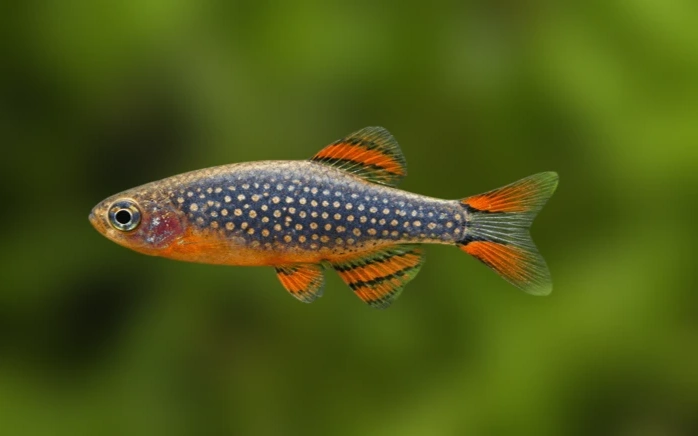
The breeding numbers on most emerald dwarf rasbora care sheets, about 30 eggs and a 72-hour hatch, were recorded on a different fish. They come from the first celestial pearl danio spawnings in Bolton, England, in 2006, and appear word for word in an emerald dwarf profile archived in 2012. The 20 to 24°C ceiling and the 12 to 20 dGH hardness printed beside them cite no measurement.
Measured lake water, a six-generation breeding line and research-lab conditions give wider limits, and most tap water already meets them. The fish is Danio erythromicron, a 2 cm danio from Inle Lake in Myanmar, sold as the emerald dwarf rasbora, the emerald dwarf danio and Celestichthys erythromicron.
| Fact | Detail |
|---|---|
| Scientific name | Danio erythromicron (also sold as Celestichthys or Microrasbora erythromicron) |
| Adult size | About 2 cm (0.8 in) |
| Tank | 45 cm long, 30 to 40 litres, for 8 to 12 fish |
| Temperature | 21 to 25°C (70 to 77°F), up to 26°C (79°F) for breeding |
| Water | pH 6.5 to 8.0, GH 6 to 12 °dH |
| Group | 10 or more, both sexes |
| Diet | Fine dry food plus small live and frozen foods |
| Lifespan | Over 3 years recorded, maximum unknown |
| Difficulty | Easy once settled, shy for the first weeks |
| Origin | Inle Lake and the Hopong springs, Shan State, Myanmar |
| Status | Endangered (IUCN assessment from 2011) |
Six corrections to common emerald dwarf rasbora advice
- The 24°C limit is not a measurement. A 2014 to 2015 survey recorded Inle Lake water between 20.3 and 28.0°C, and a Japanese line started at 26°C has reached six generations.
- Moderately soft water works. The lake measures about 10 dGH, below the usual 12 to 20, and a German breeder spawns the species at GH 6 and pH 6.5.
- Captive-bred fish eat dry food. They take fine flake and crushed granules. Wild imports need live food first.
- The “30 eggs, 72 hours” figures belong to the celestial pearl danio. Emerald dwarf rasboras spawn daily, and one German breeder counts about half again as many eggs.
- Single pairs often fail. A research lab in Germany collected eggs only from groups kept over boxes of Java moss.
- Celestial pearl danios are the wrong tank mates for anyone who breeds either species. The two meet in the wild, and hybrids already reach the trade.
Emerald dwarf rasbora, Danio erythromicron or Celestichthys: one fish
All three names point to the same species. Nelson Annandale described it in 1918 as Microrasbora erythromicron, from fish caught at the edge of Inle Lake. In 2008 a gene study placed it and the celestial pearl danio side by side inside Danio, and the Catalog of Fishes lists Danio erythromicron as the valid name today.
Tyson Roberts created the genus Celestichthys for the celestial pearl danio in 2007 and declined to move this species into it. A 2013 catalogue later grouped both small danios there, which produced the name Celestichthys erythromicron. Most later work keeps both in Danio, but German and Japanese sellers still use the older label.
The fish is not a rasbora. The trade name is a leftover from Microrasbora, a genus that now holds only the red M. rubescens from the same lake. The emerald eye rasbora, Brevibora dorsiocellata, is an unrelated fish from Malaysia and Indonesia.
| Name | Status | Where it appears |
|---|---|---|
| Danio erythromicron | Valid scientific name | Catalog of Fishes, research papers |
| Celestichthys erythromicron | Former genus placement (2013) | Shops, Japanese and German importers |
| Microrasbora erythromicron | Original name (1918) | Older books and import lists |
| Emerald dwarf rasbora, emerald dwarf danio | Common names | Shops and care guides |
| Cross-banded dwarf rasbora, Querstreifen-Zwergbärbling | Trade names | UK and German trade |
| Brevibora dorsiocellata (emerald eye rasbora) | A different fish | Often confused by name |
Wild habitat: lake margins and spring ponds
Annandale found the fish only at the edge of Inle Lake, among the stems of decaying grass beneath floating islands. He called it markedly gregarious, a surface and mid-water fish that hides under floating plants. The bottom there is black fen-peat, and the clear water Inle is known for lies farther out in the open lake.
Inle sits at about 880 m in Shan State. Its water is alkaline and moderately hard, with a conductivity of 236 to 491 µS/cm, a range many tap supplies share. In 2022 Japanese researchers reported 33 specimens from a spring-fed dam backwater at Hopong, in a separate river drainage, living beside celestial pearl danios.
The IUCN lists the species as Endangered. That 2011 assessment counted a single location, and the IUCN itself flags it as needing an update.
Listed threats include fishing, introduced fish such as tilapia and Gambusia, and runoff from farms and villages. Captive-bred fish are sold beside wild ones, so choose captive-bred stock where possible.
Tank size: 30 to 40 litres for 8 to 12 fish
A 45 cm tank of 30 to 40 litres (8 to 10 gallons) holds a group of 8 to 12. A 60 cm tank of about 54 litres suits 20 or more and gives each male room for a small territory.
The common 60 x 30 cm minimum is an opinion. The online care profile that introduced it listed 45 x 30 cm in 2012 and raised the figure later with the same one-line reason. A Japanese breeder has raised six generations in a 36 x 22 x 26 cm tank of about 20 litres.
For breeding or grow-out, a 5 gallon tank of 19 litres holds a group of 6 to 8. A display school of 10 or more needs the larger footprint.
Water: moderate tap water at 21 to 25°C
Plain tap water of moderate hardness suits the species at 21 to 25°C.
| Parameter | Measured in the wild | Kept or bred in captivity | Common advice |
|---|---|---|---|
| Temperature | 20.3 to 28.0°C (Inle, 2014 to 2015); 22 to 24°C (Hopong springs, January) | 26°C breeding, line now at six generations; 28 to 28.5°C in research labs | 20 to 24°C |
| pH | 7.3 to 9.4 in the open lake, under 8.2 in the inflows | 6.5 for breeding; 6.8 to 7.5 in labs | 7.0 to 8.0 |
| GH | About 9.5 to 11.5 °dH | 6 to 8 for breeding | 12 to 20 °dH |
| KH | About 10 °dKH | 1 for breeding | Rarely given |
| Conductivity | 236 to 491 µS/cm | About 295 µS/cm in an Inle biotope tank | Rarely given |
No study has measured a temperature or pH limit for this fish. Research labs kept it at 28°C on zebrafish systems, but those papers report nothing on lifespan or colour.
Keep the target below 27°C, since 27 to 28°C is only known to be tolerated. Avoid pH below 6.5, where nothing has been tested.
Inle fish spawn mainly from February to April, when Annandale measured the lake at about 21 to 22°C. A room at 20 to 21°C stays inside the measured wild range. A small heater set to 23 or 24°C covers colder rooms.
Plants and light: dense cover, dim tank
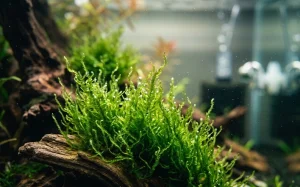
Dense planting, floating plants and leaf litter copy the wild margin. Many guides ban driftwood and leaves for fear of lowering pH, but the species was first caught over decaying vegetation and peat.
One keeper reports no problems from almond leaves in water at pH 8.
Java moss gives spawning cover, and floating plants dim the light enough to bring the fish into the open. Bright, bare tanks keep them hidden. A sponge filter keeps the flow gentle in a small tank. No reliable report of jumping exists, but a lid costs little.
School size: at least 10 fish
Keep at least 10. Wild fish live in loose groups, and keepers report that shyness falls as the group grows and again in captive-bred generations. One German keeper who has kept the species since 2011 recommends 50 in 80 litres over the usual 10.
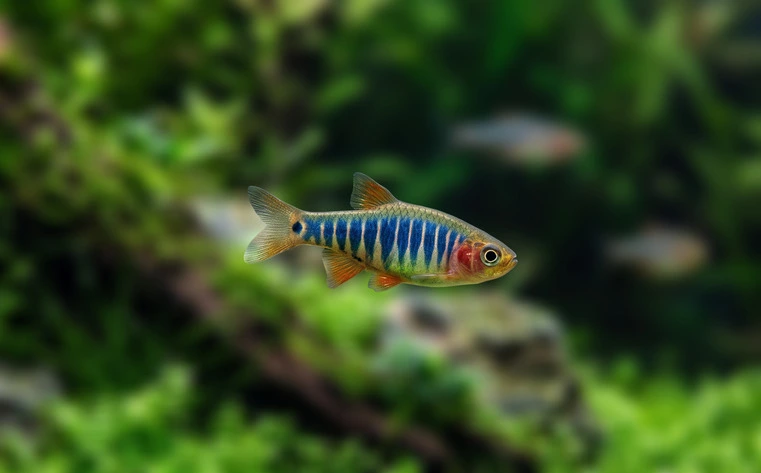
Males show blue vertical bars on a red body, red-based fins and a black tail spot inside a pale ring. Females are paler, with fainter bars and less red. Colour fades during transport and returns within about a month.
Males flare their fins at rivals and hold small, temporary territories before spawning. Reports range from “completely peaceful” in an importer’s tanks to guarded territories in a 150 gallon tank. No deaths from fighting have been reported.
More cover and more females spread the chasing. The warnings about constant sparring and nipped fins in many guides were written for the celestial pearl danio.
Diet: fine dry food plus small live foods
Captive-bred emerald dwarf rasboras eat fine flake, crushed granules, frozen cyclops, daphnia and baby brine shrimp. A German importer reports that they accept any commercial food of a suitable size. Particle size matters more than food type, since the mouth is tiny.
Wild-caught fish often ignore dry food at first. Start them on live daphnia, microworms or baby brine shrimp, then mix in powdered flake over several weeks. Feed small amounts twice a day.
Emerald dwarf rasbora tank mates: small, slow feeders
Small, calm fish that feed slowly make the best company. Fast feeders keep the rasboras hidden and hungry.
| Tank mate | Fit | Reason |
|---|---|---|
| Sawbwa resplendens | Good | Same lake and water, calm |
| Microrasbora rubescens | Good | Same lake, same size |
| Pygmy corydoras | Good | Calm, stays low, small mouth |
| Chili rasbora, ember tetra | Good | Small and slow, accept neutral water |
| Cherry shrimp | Good | Adults are safe, some shrimplets get eaten |
| Celestial pearl danio | Avoid when breeding | The two species hybridise |
| Zebra danio, tiger barb | Avoid | Too fast, they take all the food |
An Inle biotope works with Sawbwa, M. rubescens and the emerald dwarf rasbora together. A Japanese breeder keeps and breeds all three in the same fish room.
Buying: choose captive-bred fish
Wild-caught and captive-bred fish are both sold, often under different stock codes at the wholesaler. Captive-bred fish are bolder, take dry food readily and spare the wild population. Wild imports need live food and a few quiet weeks before they show colour.
Quarantine new fish for 2 to 4 weeks in a planted tank with live food on hand. Check celestial pearl danio stock as well. A fish with pearl spots, plain fins and a dark spot at the base of the tail may be a hybrid of the two species.
Breeding emerald dwarf rasboras in a group
Breeding is easy in a group and unreliable in pairs. The fish spawn continuously, often shortly after the lights come on, and scatter single eggs into moss. Adults eat some eggs but rarely hunt for them.
- Set 2 males and 5 females in a 20 to 30 litre tank with Java moss, a moss mop or a box of moss on the bottom.
- Match one of the two breeding records. The German one used 23 to 25°C at GH 6 and pH 6.5. The Japanese one used 26°C at GH 7 to 8 and pH 7.4.
- Lift the moss or the egg box every 2 to 3 days, or remove the adults after 5 days.
- Incubate the eggs in dim light. One breeder hatched only 2 eggs in 20 under direct light, then got a batch with no fungused eggs after moving them into shade.
- Expect hatching after about 3 days. The larvae hang on the glass for about 3 more days until the yolk is gone.
- Feed infusoria, green water or powdered fry food first, then microworms, and baby brine shrimp after about a week.
Growth is slow, about 5 mm at one month and about 1.8 cm at 3 to 6 months. The Japanese line produced roughly one generation a year, and fish older than three years still spawned.
In dense planted tanks young fish appear without help. One German keeper found 9 juveniles in an 80 litre community tank stocked with 9 adults.
The celestial pearl danio breeding method works with these changes: a group instead of a pair, and dark incubation. More on fry setups is in breeding nano fish.
Emerald dwarf rasbora vs celestial pearl danio
Gene studies pair the two as sister species, but the care numbers do not transfer cleanly.
| Trait | Emerald dwarf rasbora | Celestial pearl danio |
|---|---|---|
| Scientific name | Danio erythromicron | Danio margaritatus |
| Body pattern | Blue vertical bars, black tail spot | Pearl spots on a blue body |
| Wild home | Inle Lake margins and Hopong springs | Hopong spring ponds |
| Size | About 2 cm | About 2 cm |
| Egg output | Daily, about half again as many eggs (one breeder) | Up to about 30 per female per spawning |
| Hatch rate in one breeder’s identical water | About 2 in 20 in direct light | Above 90% |
| Best setup | Species tank or calm Inle biotope | Planted nano community |
Both appear in the best nano fish list, with the emerald dwarf rasbora as the shyer choice and the stronger case for a species tank.
Emerald dwarf rasbora FAQ
Is the emerald dwarf rasbora a rasbora?
No. It is a danio, Danio erythromicron, and its closest relative is the celestial pearl danio. The rasbora name survives from its original genus, Microrasbora.
How big do emerald dwarf rasboras get?
About 2 cm (0.8 in). The largest fish in the 1918 type series measured 20 mm, and smaller ones were already mature. Figures of 3 cm and above have no measured specimen behind them.
Can emerald dwarf rasboras live in a 5 gallon tank?
A 5 gallon (19 litre) tank holds a breeding or grow-out group of 6 to 8. A display school of 10 or more is calmer in a 45 cm tank of 30 to 40 litres.
Do emerald dwarf rasboras need a heater?
Only in rooms that fall below about 21°C. Wild water runs from about 20 to 28°C, and breeding records come from 23 to 26°C, so a heater set to 23 or 24°C is enough.
How long do emerald dwarf rasboras live?
At least 3 years. A Japanese breeder spawned fish older than three years. No study has measured the maximum, so the common 3 to 5 year figure is an estimate.
Do emerald dwarf rasboras school?
They shoal loosely. Annandale described wild fish as markedly gregarious. In the aquarium a group of 10 or more spreads out among the plants, and males hold small territories before spawning.
Can emerald dwarf rasboras live with celestial pearl danios?
They tolerate each other, but the two sister species hybridise, and hybrids already appear in shops. If either species is to be bred, keep them apart.
Are emerald dwarf rasboras endangered?
The IUCN listed the species as Endangered in 2011, based on a single known location. A second population at Hopong was reported in 2022, and the assessment is flagged as needing an update. Captive-bred fish reduce collection from the wild.
Sources
- Annandale, N. (1918). Fish and fisheries of the Inlé Lake. Records of the Indian Museum 14: 33 to 64. archive.org
- Roberts, T. R. (2007). The celestial pearl danio, a new genus and species of colourful minute cyprinid fish from Myanmar. Raffles Bulletin of Zoology 55: 131 to 140.
- Conway, K. W., Chen, W. J. and Mayden, R. L. (2008). The celestial pearl danio is a miniature Danio. Zootaxa 1686: 1 to 28. mapress.com
- Kottelat, M. (2013). The fishes of the inland waters of Southeast Asia. Raffles Bulletin of Zoology Supplement 27. lkcnhm.nus.edu.sg
- Eschmeyer’s Catalog of Fishes. Species of Danio (online version, October 2026). researcharchive.calacademy.org
- Kano, Y. et al. (2022). Fish diversity of a spring field in Hopong Town, Shan State, Myanmar. Biodiversity Data Journal 10: e80101. doi.org
- Mjelde, M. et al. (2017). Assessing ecological status in Inlay Lake. NIVA report 7162-2017. myanmarwaterportal.com
- Thin, M. M., Sacchi, E. and Setti, M. (2016). Hydrological processes at Inle Lake. Isotopes in Environmental and Health Studies 52: 455 to 467. doi.org
- Podobnik, M. et al. (2020). Evolution of the potassium channel gene Kcnj13 underlies colour pattern diversification in Danio fish. Nature Communications 11: 6230. doi.org
- McCluskey, B. M. et al. (2021). Pigment pattern morphospace of Danio fishes. Biology Open 10: bio058814. doi.org
- Conith, A. J. et al. (2022). The evolution of feeding mechanics in the Danioninae. Integrative Organismal Biology 4: obac049. doi.org
- IUCN Red List. Danio erythromicron, Endangered (assessed 2011). www.iucnredlist.org
- Tanganjika Cichliden. Danio erythromicron breeding log, generations 1 to 6 (2018 to 2024). tanganjikacichliden.g2.xrea.com
- Aquaristik-Lexikon. Zuchtbericht Querstreifenbärbling, Danio erythromicron (2025). aquaristik-lexikon.de
- Aquarium Glaser. Celestichthys erythromicron (2026). www.aquariumglaser.de
- Seriously Fish. Danio erythromicron, archived profile (May 2012). web.archive.org
- Seriously Fish. Danio margaritatus, archived profile (May 2012). web.archive.org
- Flowgrow. Nachwuchs, Querstreifen-Zwergbärbling (Danio erythromicron) (2023). www.flowgrow.de
- aquaworld.cz. Microrasbora erythromicron breeding notes. www.aquaworld.cz
- Biotope Aquarium Project. Inle Lake, Shan State, Myanmar (2022). biotopeaquariumproject.com
- r/Boraras. Poor emerald dwarf rasbora hatch rate thread. www.reddit.com
- r/nanotank. Emerald dwarf rasbora versus celestial pearl danio thread. www.reddit.com
- r/Aquariums. Emerald and celestial danio hybrid thread. www.reddit.com