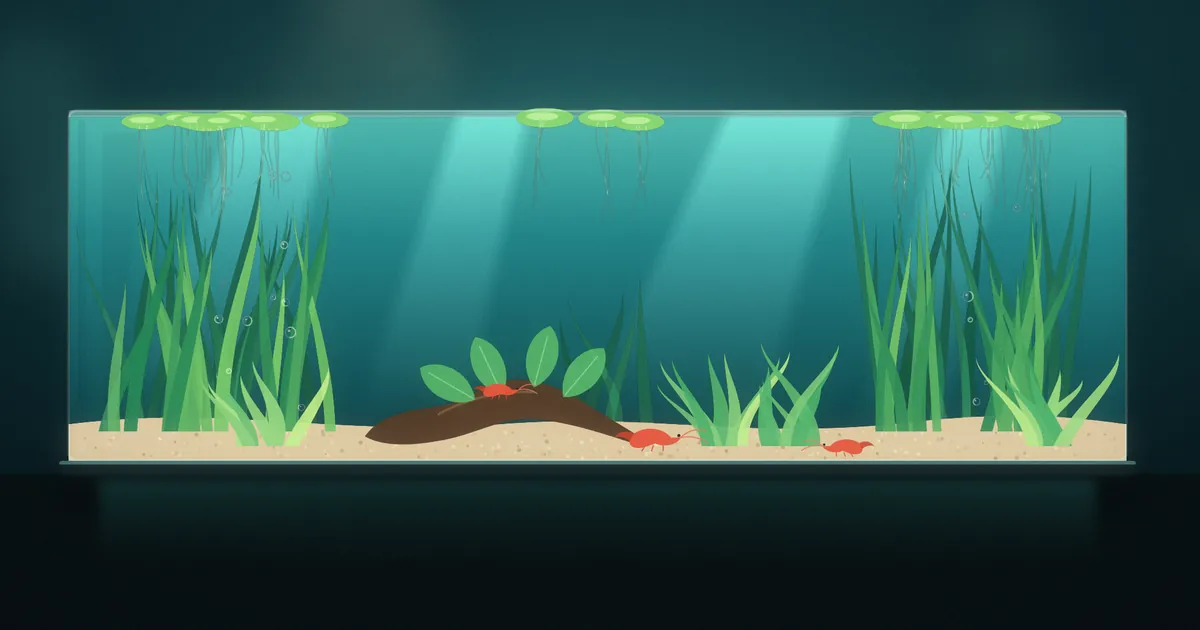
Yes, a filterless nano aquarium can work. It works when the tank is shallow, heavily planted, lightly stocked and mature. Shrimp and snails are the safe bet. Fish are harder, and in some places illegal. Plants do the filtering, so if the plants stall, the tank fails.
Check your setup against the rules below before you spend a cent on animals. A wrong call costs you the whole tank. If a “self-sustaining tank” video brought you here, this guide covers the limits and failures to check before you copy it.
The thresholds in this guide are conservative editorial guidance built from published research. They don’t come from a long build log. Every claim is sourced at the bottom, and where the evidence is thin, the text says so.
What “filterless” actually means
A filterless aquarium has no powered filter. Biological filtration still happens, because bacteria live on every wet surface and plants pull ammonia out of the water.
A filter is a convenient box for those bacteria. The bacteria don’t need the box. They need surface, oxygen and time.
| Setup | Powered filter | What it relies on |
|---|---|---|
| Filterless / no-tech | No | Plants, surfaces, gas exchange, light stocking |
| Filterless with a bubbler | No | Same, plus an oxygen safety margin |
| Low-tech planted | Optional | Plants, modest light, no CO2 injection. May have a filter and heater. |
| Walstad-style | Optional | A soil layer under a cap, plus heavy planting |
Walstad, filterless and natural are not the same thing. Diana Walstad wrote the best-known book on this. She still ran filters in her large deep tanks. In her words: “My point is not to advocate dispensing with filters altogether, but I would urge readers to believe in their plants more than trickle filters.”
Self-sustaining is not maintenance-free
You still feed, trim, top off, test and change water. You do these less often once the tank matures. You never stop doing them.
Filterless is not flowless
Still water isn’t ideal for plants. One plant Walstad cites photosynthesized more at 1 cm per second of flow, and 13 to 29% less at 4 cm per second. Another grew best at 11 cm per second and worse in near-still water.
A single-bubble air pump or a tiny pump on low gives gentle movement. Walstad’s heated 2-gallon tanks used one bubble at a time “to provide gentle water circulation without driving off precious CO2”. That tank is still filterless, because an airstone isn’t a filter.
How do filterless aquariums work?
Four things do the work.
- Plants take up ammonium directly. Walstad’s argument is that aquatic plants prefer ammonium over nitrate, and that this makes nitrifying bacteria less critical in a planted tank. A duckweed study backs the preference. All six species tested used nitrate only after ammonium ran out.
- Bacteria live on surfaces. Leaves, roots, sand, wood and glass all carry biofilm. Researchers now find that comammox Nitrospira, not the archaea older guides name, dominates most surveyed aquarium filters (30 of 38 in one 2024 survey).
- Gas exchange happens at the surface. Oxygen comes in through the top of the water. That’s why shape matters, and it’s the next thing to check.
- The bioload stays tiny. Less food in means less waste to process.
Plants and bacteria compete for the same ammonium. Walstad’s practical test: “If nitrates accumulate, it suggests that plant growth is insufficient to remove the tank’s ammonia.”
So your nitrate test is a plant-growth gauge. Nitrate climbing means the plants are falling behind, and bacteria are handling the overflow. Bacteria are the backup. Plants are the system.
That has a flip side. If plants do most of the work, the bacterial backup may be small. A sudden plant crash (melt, heat wave, a hard trim) can leave nothing to absorb the ammonia. This is a reasoned inference, and nobody has measured it in aquariums. Test ammonia after any big plant loss.
What the research hasn’t done is test any of this in a truly filterless home tank over months. Nearly every nitrification study on aquariums used filtered tanks. The one unfiltered study (2 L betta tanks, 25 days) found plants reduced ammonia but didn’t stop it rising. Plants help, but you still need a test kit on day one.
Next up is the one design choice that decides how much oxygen your tank gets.
Shallow vs cube: why shape beats gallons
Oxygen enters through the surface. In a straight-sided tank, surface area per litre equals one divided by the depth. Volume cancels out.
A 15 cm deep tank gives every litre twice the air contact of a 30 cm deep tank. The RSPCA says it directly: “wide tanks are better than tall tanks as they have a larger surface area for the water volume.” Walstad cites “their shallow depth” as a reason her 2026 expo tanks needed no filters or aerators. A betta welfare study speculated that tanks wider than they are deep are likely more suitable.
Here’s the same 20 litres in five shapes:
| Shape (20 L) | Water depth | Surface | cm² per litre |
|---|---|---|---|
| Tall column, 20 × 20 cm | 50 cm | 400 cm² | 20 |
| Cube | 27 cm | 737 cm² | 37 |
| Rimless, 30 × 30 cm | 22 cm | 900 cm² | 45 |
| 40 × 25 cm | 20 cm | 1,000 cm² | 50 |
| Tray, 50 × 26.7 cm | 15 cm | 1,334 cm² | 67 |
(These are our calculations from the tank dimensions.)
Recovery time matters too. In still, low-wind conditions, oxygen transfer across the surface levels off around 1 to 2 cm per hour. That means an oxygen deficit recovers on a timescale of roughly depth divided by that speed. It’s about 7 to 15 hours at 15 cm, and 15 to 30 hours at 30 cm. This is a calculation, and nobody has measured it in a tank. Walstad also says to avoid tanks taller than about 18 inches (46 cm) unless they get window light.
Can your tank run filterless? Go / Caution / No
Score your tank with this table. The water-quality values are sourced. The shape, age and stocking thresholds are our conservative editorial guidance. Where a value comes from welfare or retail standards for filtered tanks, treat it as a ceiling to stay under.
| Check | Go | Caution | No |
|---|---|---|---|
| Water depth | Shallow and wide | 25 to 46 cm | Over 46 cm without window light |
| Plant coverage | Dense, growing, with a fast grower | Sparse or newly planted | Plants melting or stalled |
| Stocking | Shrimp and snails only | A few small fish in 30 L+ | Fish in a tank under 20 L |
| Tank age | Over 2 to 3 months, stable | 6 to 8 weeks | Under 4 weeks |
| Dissolved oxygen | 6 mg/L or more | 5 to 6 mg/L | Under 5 mg/L |
| Total ammonia | Undetectable | Detectable, fish stable | Rising, or animals stressed |
| Nitrite | 0 | Any detectable | 0.2 mg/L or more |
| Nitrate | Under 20 mg/L (check the unit) | 20 to 50 above tap | Over 50 above tap |
| Alkalinity (KH) | Above 100 mg/L CaCO3 (about 5.6 dKH) | 50 mg/L or less (about 2.8 dKH) | Under 20 mg/L (about 1.1 dKH) |
| Room temperature | Stable, matches your species | Summer swings | Heat waves with no plan |
| Lid | Fitted | Partial | Open top, no mosquito control |
Sources for these values: the Merck Veterinary Manual water quality table, UK Defra seller standards (dissolved oxygen at least 6 mg/L, nitrite 0.2 mg/L maximum), and University of Florida extension guidance on alkalinity. The “No” for alkalinity comes from the line that below 20 mg/L, nitrifying bacteria “do not function effectively.”
Nitrate units. Most test kits read nitrate as nitrogen. To get actual nitrate, multiply by 4.4. A reading of “20” can mean 20 or 88 mg/L.
Ammonia and pH. “In most home aquariums, a TAN reading of 1.0 is not a huge concern unless pH exceeds 8.5.” Toxic ammonia depends on pH and temperature, so judge any reading against your pH.
Filterless nano aquarium setup
Passed the table? Then do these in order.
- Pick the tank. Shallow and wide. The more water, the easier it is. Our safest beginner recipe is 30 to 40 L, not 5.
- Choose a substrate. Inert sand or small gravel is the easy route. A soil underlayer is the classic Walstad method. If you go with soil, keep it to about 1 inch (2.5 cm), unfertilized, under a thin cap. Walstad’s limit for a sand cap is about 0.5 to 0.75 inch (1.3 to 1.9 cm). Sand can seal soil and “suffocate” it. Don’t add fertilizer to soil. Sulfates feed hydrogen sulfide. Nitrate fertilizer gave her 1 to 2 ppm nitrite within a week.
- Plant heavily on day one. Include at least one fast grower, such as stems, hornwort or a floater. Slow plants (Anubias, Java fern, moss) give you structure and surface. They don’t process much nitrogen.
- Fill with conditioned water. Find out if your utility uses chloramine. See the water section below.
- Set your light. This one is disputed. See the next section.
- Wait, test, then add animals. Don’t count days.
The light schedule: two camps
The common aquascaping advice is to start at about 6 hours a day and work up to 7 or 8. Walstad says the opposite. She wants at least 12 hours, run as a “siesta” schedule. Lights go on 7 AM to noon, off noon to 4 PM, and on again 4 to 9 PM. Her 2023 article lists “7-hour photoperiods” among the causes of problems. In floating-plant tanks she runs 13 hours or more with no siesta.
Nobody has run a controlled aquarium trial comparing the two. In a filterless tank, plant growth is your filtration, and a short day limits that. Algae is better managed with light intensity and plant mass than by a short day. Start with a siesta schedule, watch the plants, and adjust.
How to cycle a filterless aquarium
It isn’t a normal cycle. You aren’t waiting for a filter to ripen. You’re waiting for plants and surface bacteria to handle the food you’ll add.
- Weeks 0 to 3: Expect plant melt and cloudiness. With fresh soil, expect a burst of ammonia. Soil bacteria also pull oxygen out of the water. Walstad’s advice for new soil bowls was to wait a couple of weeks before shrimp, “closely monitor ammonia levels, prepare for water changes and possibly add aeration.” In her 2023 bowls she changed about 80% of the water almost daily for 1 to 2 weeks. She blamed overly fertile potting soil.
- Weeks 3 to 8: Test ammonia and nitrite. In filtered home tanks, they cleared by week 3 in two tanks and week 8 in the third. In another study (filtered, 20 to 22 °C), nitrite peaked on days 44 to 58. Your tank may differ. Calendar age doesn’t prove anything.
- Add animals when new plant growth is vigorous, ammonia and nitrite are undetectable, nothing smells bad, and a small dose of food doesn’t cause a spike.
Walstad’s book says soil tanks can take fish within days. Her own recent experience says wait. Follow the conservative path. Plant first, wait six to eight weeks, and test.
Don’t lean on bottled bacteria. In a 14-day test, four of five products failed to reduce ammonia, with one tank per product. The authors said the products “should not be recommended as a sole method.” Live plants may be the better seed. In a 2025 study of three filtered home tanks, the two that cleared fastest had live plants. The slowest had artificial plants and the only bottled product. That’s three tanks, so treat it as a hypothesis.
Best livestock for a filterless nano tank
Start with the volume rule. A fish fitting in a tank says nothing about whether the tank is right for it.
| Tank | What fits (editorial guidance) |
|---|---|
| 2 to 5 L | Plants, microfauna, a few small snails. No fish. Shrimp only for experienced keepers. |
| 10 L | A small shrimp colony and snails. Normally no fish. |
| 20 L | One betta in a heated, planted, wide tank, or a shrimp system |
| 30 L | One betta, shrimp, or a conservative school of tiny rasboras in a long tank, once mature |
| 40 L | Around 10 chili rasboras, or a betta or shrimp system. Add gentle aeration. |
| Animal | Bioload | Verdict |
|---|---|---|
| Neocaridina (cherry shrimp) | Low | Candidate. Best fit. Breeding does best near 28 °C and stops at 32 °C. |
| Ramshorn and bladder snails | Low, but they multiply | Candidate. A population boom means too much food. |
| Nerite snails | Low | Candidate if there’s enough biofilm. A sterile new tank may starve them. |
| Malaysian trumpet snails | Low, but they multiply | Caution. Parthenogenetic, so one snail can found a colony. |
| Betta | Moderate | Candidate at 20 L+, heated and heavily planted. See the welfare section below. |
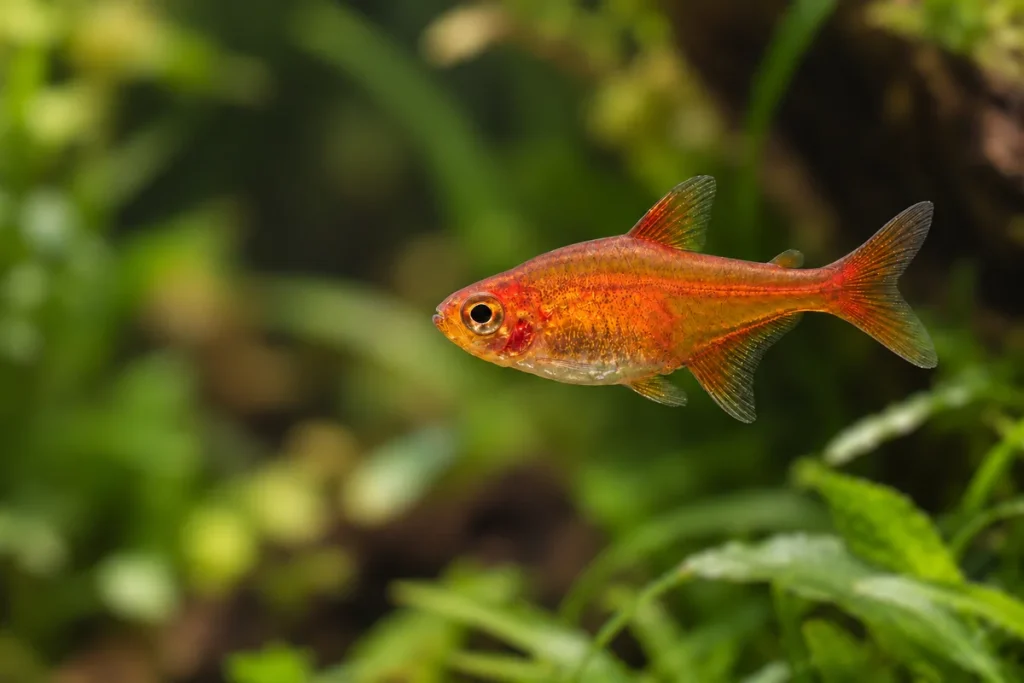
| Chili rasbora, ember tetra | Low each, school needed | Candidate at 30 to 40 L long. Stock at the low end. |
| Medaka | Moderate | Candidate at 40 L+. Cool water. |
| Endler-type livebearers | Grows fast | Caution. Males only, in 30 to 40 L+. |
| Caridina (bee shrimp) | Low | Avoid. They need tightly controlled soft water. |
| Pygmy corydoras (now Gastrodermus pygmaeus) | Moderate | Avoid. Social, active and oxygen-hungry. |
Fish sizes quoted from FishBase are maximums. A chili rasbora’s common length is 1.8 cm, but it reaches 3.5 cm.
What the welfare research says about bettas
One study (Oldfield and Murphy, 2024) found that “at least a 10-L aquarium is required to ensure full expression of swimming behaviour.” They tested 0.5 L, 10 L, 38 L and 208 L, and nothing in between. So 10 L is the smallest size shown to be enough. It isn’t a proven minimum.
Another (Clark-Shen and colleagues, 2024) tested 1.5, 3.3, 5.6 and 19.3 L. Fish were more active in the biggest tank and rested and hovered less. They recommend at least 5.6 L for retail display and more at home. The UK trade body OATA recommends 20 L for a single male. We use 20 L as the practical target.
Bettas also tolerate extreme ammonia in lab tests (a 96-hour LC50 of 7.7 mg/L NH3-N). That says nothing about welfare. Don’t use it as an excuse for bad water.
Check the law before you buy
Some animals in the hobby are regulated. The EU’s 2025 update added the giant ramshorn Marisa cornuarietis, the Chinese mystery snail, the weather loach and the yabby to its invasive species list. Listing bans keeping, breeding, sale and exchange. Pet owners who already had animals may keep them to the end of their lives if breeding and escape are impossible. Plants get no such exemption.
Plants matter here too. In the US, Hygrophila polysperma, Limnophila sessiliflora and all four giant salvinias are federal noxious weeds, and moving them between states needs a permit. The EU list includes Salvinia molesta, water lettuce (Pistia stratiotes, from 2 August 2024), Cabomba caroliniana and Elodea nuttallii. Amazon frogbit isn’t on either list. In Queensland, every Cabomba species except C. caroliniana is prohibited. Name species when you shop, not genera, and check your local rules.
The microfauna bonus
Copepods, seed shrimp and detritus worms show up on their own in a mature tank. They’re usually harmless and feed shrimp and small fish.
Daphnia turn visibly red in low oxygen because they make more hemoglobin. New hemoglobin shows up within 18 hours, and it takes up to 11 days to level off. So it’s a slow hint and not a gauge. Warm water also raises it, and a red-pigmented bacterial pathogen infects some Daphnia. Ramshorn snails are red for another reason. Their family is the one group of snails with hemoglobin.
Maintenance: what you still do
| Task | How often |
|---|---|
| Look at animals and plants | Daily |
| Check dawn breathing | Daily in new tanks, and after any heat wave |
| Top off with the right water | As needed |
| Feed small, remove leftovers | Every feeding |
| Trim plants | Weekly to monthly. Dead plants pollute. |
| Test ammonia and nitrite | 2 to 3 times a week for the first month with animals |
| Test nitrate, pH and KH | Weekly at first, then monthly |
| Water changes | See below |
Water changes: the conflict, resolved
One guide says 20 to 30% every week. Walstad’s established tanks often “go for six months or more without water changes.” Both are right at different tank ages.
| Stage | Approach | Why |
|---|---|---|
| Weeks 0 to 3, fresh soil | Test every 2 to 3 days. Change a large volume if ammonia or nitrite shows. | Soil releases nutrients and pulls oxygen. |
| First 1 to 2 months with animals | 20 to 30% weekly | Plants and surface bacteria are still building. |
| Mature, light stock, plants growing, nitrate near zero | Stretch the gap on data. Go monthly, then up to Walstad’s 3 to 6 months (25 to 50%). | Plants export nitrogen. Humic compounds protect against metals. |
| Any tank kept only by topping off | Test KH and pH monthly | Alkalinity drops over time. |
| Old tank with low pH and high ammonia | Small daily changes. Never one big one. | A big change raises pH and converts harmless ammonium into toxic ammonia. |
The last row matters most. Merck says an old, acidic tank “should be returned to normal by performing daily small water changes to avoid pH shock and ammonia toxicosis that can occur as the pH increases.” Don’t “fix” a neglected tank with one giant change.
Two tap-water traps
Chloramine. Many utilities use it. A thiosulfate dechlorinator breaks it apart and leaves its ammonia in the water. At the legal maximum of 4.0 mg/L, that can release up to about 0.79 mg/L ammonia nitrogen (our calculation). A 50% change adds up to about 0.4 mg/L. Ask your utility. If it uses chloramine, use a conditioner rated for it, and test the next day.
Metals. Walstad’s well water had 0.8 ppm zinc, and that was enough to kill her shrimp. US tap rules allow 1.3 mg/L copper, and regulators sample water that sat in pipes for at least six hours. A freshwater prawn’s copper LC50 is 0.0313 mg/L. Nobody has published a cherry shrimp copper LC50, so that’s an analogy. Run the tap before you collect water, and use a conditioner that binds heavy metals. Walstad also notes that each water change “is, in essence, a fresh dose of metals” if your tap is contaminated.
Why filterless tanks fail
Failures tend to follow tank age, and each stage has its own trap.
- Weeks 0 to 3: Soil releases ammonia and consumes oxygen. Plants melt after transplant. Animals added too early die.
- Months 1 to 3: A plant crash exposes a small bacterial reserve. Heat, a hard trim or a light failure can do it.
- Month 6 and later: Alkalinity wears down. Nitrification uses about 7.14 mg of alkalinity per 1 mg of ammonia nitrified. In a KH 2 tank, that’s roughly 20% of your buffer for every 1 mg/L (our calculation). Below about pH 6.5, nitrification slows sharply. The pH drops, and the rescue trap above kicks in.
- Summer: Warm water holds less oxygen (9.09 mg/L at 20 °C, 7.56 at 30 °C) while animals need more. A fish’s resting oxygen demand rises by more than double for every 10 °C in many species (median Q10 of 2.40). At 32 °C, cherry shrimp females lose their eggs.
| Symptom | Likely cause | Fix |
|---|---|---|
| Milky, cloudy water | Bacterial bloom from too much food or rot | Feed less, remove rot, add gentle aeration |
| Rotten-egg smell | Sulfide or decaying matter | Act now. Remove the source, aerate, change water. |
| Gasping or surface crowding | Low oxygen, or high CO2 | Aerate immediately. Test ammonia and nitrite. |
| Spreading algae | Plants are the problem first | Fix plant growth, then trim light and food |
| Slimy mats | Dead-flow zones with organic buildup | Siphon, improve flow, reduce organics |
Four hidden causes of failure
- The afternoon spike. Photosynthesis raises pH during the day. Each unit of pH multiplies the toxic share of ammonia about ten times. At 25 °C, 0.5 mg/L total ammonia is about 0.003 mg/L toxic ammonia at pH 7.0, and about 0.027 mg/L at pH 8.0 (our calculation). Test pH in the morning and again in the late afternoon at least once. In one low-alkalinity reservoir full of plants, daily pH swung 0.88 units on average, and 2 to 3 units at the extremes.
- The floating-plant blanket. A full mat blocks the oxygen inlet and shades what’s below. In unfiltered 2 L tanks, Wolffia tanks averaged 3.88 mg/L dissolved oxygen, against 6.16 with no plants. In ponds, those with about 95% duckweed cover had far more oxygen-free sediment. Keep open water. Thin floaters often.
- Surface film. A scum can trap plant bubbles under it. Walstad’s fix is to agitate the surface or blot it with newspaper.
- Bottom stratification. In a lake plant bed, oxygen hit 177% saturation at the canopy and often hit zero near the sediment in daylight. Nobody has measured this in an aquarium. But a thick stem forest in still water is a candidate.
Light inhibits some nitrifiers in lab cultures. A comammox species stopped nitrifying completely under continuous dim light, and archaea showed no recovery in the dark phases. These were pure cultures and not tanks. But it’s a reason to give nitrifiers dark space, like the substrate, hardscape, root mats and the area under floaters.
Filterless vs sponge filter
| Filterless | Sponge filter | |
|---|---|---|
| Cost and noise | Cheapest, silent | Cheap, a little noise |
| Oxygen and flow | Depends on shape and plants | Built-in surface movement |
| Bacteria surface | Plants, substrate, hardscape | The sponge, plus all of the above |
| Failure margin | Small | Larger |
| Official guidance for fish | Against | For |
Official guidance mostly says fish tanks need filters. The RSPCA (England and Wales) says: “No fish should be kept in tanks without a well set up and maintained filter.” OATA says a betta needs at least 20 L and “Whatever the size, a filter is always essential.” RSPCA Australia and SPCA New Zealand also call for filtration.
Austria goes further. Its animal-keeping ordinance bans keeping even small fish long-term in tanks under 54 L, lists “Filter, Heizung, Pumpe” as minimum equipment, and requires that ammonia and nitrite be undetectable. It covers vertebrates, so a shrimp-only tank falls outside it. Germany’s 1998 federal guidance also uses 54 L as the minimum for permanent keeping, and it’s being revised. Switzerland sets litres per centimetre of fish in law. The 54 L and filter advice there comes from the federal veterinary office’s guidance page, not the ordinance.
This guide leads with shrimp and snails for that reason. For fish, a hybrid is the better call: an air-driven sponge filter on gentle flow, plus heavy planting. You keep the plant-led system and add a margin.
Gear worth buying
- A thermometer. Not optional. Small tanks track the room within hours, so a hot afternoon can cook a nano before you notice.
- Test kits. Ammonia, nitrite and nitrate, plus KH and GH. KH shows your buffer eroding before the pH crashes.
- A conditioner that handles chloramine and binds heavy metals.
- A lid. It cuts evaporation, stops jumpers and blocks mosquitoes. A mosquito egg takes 7 to 10 days to become an adult, and Culex lay rafts of 100 to 300 eggs on standing water. Walstad uses glass lids on all her tanks.
- A light on a timer. Plants need a steady schedule.
- A small air pump with a single-bubble outlet for fresh soil, heat waves and floater-heavy tanks.
- A heater, only if your species need it. Don’t skip one for ideology.
Filterless aquarium FAQ
Can you have a filterless aquarium?
Yes. It works best as a shallow, heavily planted, lightly stocked shrimp or snail tank. It’s harder with fish, and it’s illegal for fish in some places, so check your local rules.
Do nano tanks need a filter?
Not always. But small tanks are less forgiving. Ten milligrams of pollutant is 2 mg/L in 5 L and 0.25 mg/L in 40 L. The bigger the tank, the easier it is.
How long before fish can go in?
Plant first and test. Six to eight weeks is a sensible planning horizon. Readiness means undetectable ammonia and nitrite, strong plant growth and no foul smell. In the studies we found, ammonia and nitrite cleared between weeks 3 and 8 in filtered tanks.
Do you need water changes?
Yes, at first. Do 20 to 30% weekly in the early months. A mature, lightly stocked tank can stretch to monthly, and in Walstad’s case a few months. Let your test results decide.
Can shrimp live without a filter?
Yes. Walstad kept red cherry shrimp in small planted tanks without a filter or heater, as long as they were protected from heavy metals in tap water. But she also found her 1-gallon bowls “were not big enough to maintain a shrimp population.”
Why is my filterless tank cloudy?
Usually a bacterial bloom from extra food or decaying plants. Feed less, remove rot and add gentle aeration. If the water also smells like rotten eggs, treat it as an emergency.
Do I need an air stone?
Not always. Use one for fresh soil, heat waves, dawn gasping and floater-heavy tanks. Floating plants take CO2 from the air, so aeration doesn’t hurt them. In a submerged-plant tank with healthy fish, a single-bubble trickle is plenty.
Can a betta live in a filterless tank?
Bettas have been kept unfiltered in welfare studies and by experienced keepers. But UK, Australian and New Zealand welfare bodies recommend a filter, and Austria requires one. If you try it, use at least 20 L, a heater, dense plants and weekly tests.
Verdict and next step
Try it if you want shrimp or snails, you can fit a shallow wide tank, you’ll plant heavily, and you’ll test for the first two months.
Don’t try it if you want a fish community in a small tank, you’re away for weeks at a time, your room swings in temperature, or you live where filters are required by law.
In a good filterless tank, the plants can process more waste than the animals produce. Keep the margin big. Fewer animals, more plants, more water.
Next step: run your tank through the Go / Caution / No table today. Any “No” means fix that first. Several “Caution” rows mean wait a week and test again. Write down your ammonia, nitrite, nitrate and KH before you add a single animal, so you have a baseline to compare against.
Sources
Walstad is a practitioner source and not a controlled trial. Papers marked abstract-only were read at abstract level.
- Walstad DL. Ecology of the Planted Aquarium, 3rd ed. (Echinodorus Publishing, 2012) and 4th ed. preview (2023). Articles at dianawalstad.com: “Potted Plants for Fish Breeding Tanks” (2023), “Small Planted Tanks for Pet Shrimp” (2023), “Nitrogen Uptake by Aquatic Plants” (2017), and blog posts of 29 April 2026 and 8 February 2023.
- Xu Y et al. 2026. Effects of aquatic plants on water quality, microbial community, and fish behaviors in newly established betta aquaria. Animals 16(2):247.
- McKnight MM, Neufeld JD. 2024. Comammox Nitrospira among dominant ammonia oxidizers within aquarium biofilter microbial communities. Appl Environ Microbiol 90(7):e00104-24.
- McKnight MM et al. 2025. Microbial community succession of home aquarium biofilters. ISME Communications 5:ycaf212.
- Umbach AK et al. 2026. Fish load impacts biofilter microbial communities (bioRxiv preprint, not peer reviewed).
- Scagnelli AM et al. 2023. Efficacy of quick-start nitrifying products in controlled fresh-water aquaria. J Exot Pet Med 44:22-26 (abstract).
- Merck Veterinary Manual: water quality reference ranges, Environmental Diseases of Aquatic Animals, and Management of Aquarium Fish.
- US EPA. Aquatic Life Ambient Water Quality Criteria for Ammonia, Freshwater (2013).
- University of Florida IFAS EDIS FA16, Ammonia in Aquatic Systems.
- USGS. Dissolved Oxygen, Techniques and Methods 9-A6.2 (2020).
- Oldfield RG, Murphy EK. 2024. Life in a fishbowl. Animal Welfare 33:e1. Clark-Shen N et al. 2024. Life beyond a jar. Animal Welfare 33:e62.
- Tropea C et al. 2015, PLoS ONE 10:e0119468 (cherry shrimp and temperature). Baliña S et al. 2018, Biol Bull 234:139 (abstract).
- Rabaey JS, Cotner JB. 2022. Pond greenhouse gas emissions controlled by duckweed coverage. Front Environ Sci 10:889289. Wylie GD, Jones JR. 1987, J Freshw Ecol (abstract). Martinsen KT et al. 2022, J Geophys Res Biogeosci 127.
- Merbt SN et al. 2012, FEMS Microbiol Lett 327:41-46 (abstract). Gottshall EY et al. 2022, Front Microbiol 13:1022899.
- Csontos D et al. 2024. Removal of nitrate and phosphate by aquatic plants during aquarium-based ornamental fish production. N Am J Aquacult 86:413 (abstract).
- Kajimura M et al. 2023. Acute toxicity of ammonia and nitrite to Siamese fighting fish. BMC Zool 8:25.
- Conway Holroyd S et al. 2026. An ecophysiological approach to improving health outcomes of ornamental shrimp. Conserv Physiol.
- RSPCA (England and Wales), “Choosing an aquarium for pet fish”. RSPCA Australia betta guidance (2024). OATA betta care sheet. SPCA New Zealand. Defra retail guidance (2018), Table L-02.
- Legal texts: 7 CFR 360.200. Regulation (EU) 1143/2014 with Implementing Regulations 2016/1141, 2017/1263, 2019/1262, 2022/1203 and 2025/1422. Austria 2. Tierhaltungsverordnung, Anlage 5. Switzerland Tierschutzverordnung Annex 2 Table 8. German BMLEH 1998 expert opinion. Queensland Biosecurity (Cabomba).