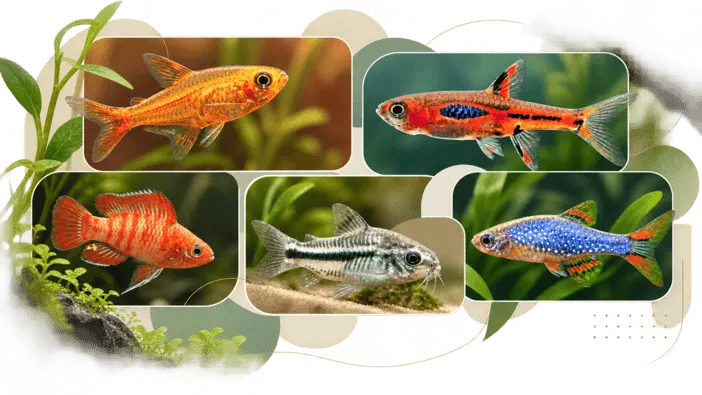
The best fish for a 20 gallon aquarium are small, peaceful freshwater species that fill three slots: one school of 8 to 12 tiny fish, one group of 6 to 8 bottom dwellers, and at most one centerpiece. My default is ember tetras with pygmy corys. This guide covers freshwater only. Saltwater and reef need a different plan, and this site does not cover them.
Every fish below has an adult size, a group minimum, a temperature and pH range, a shrimp flag and a bioload rating. Every stocking plan shows the temperature, pH and hardness its fish share. Fish that appear in this guide do not all belong together, so use the plans instead of mixing and matching.
Pick your plan in 30 seconds
These are the beginner fish for a 20 gallon tank that I would buy first, plus 20 gallon fish tank fish ideas for every common situation. Tap a row to jump to the plan.
20 gallon long vs high vs hex: why shape changes your picks
Both hold 20 gallons. They do not give fish the same space. A standard 20 long measures 30.25 x 12.5 x 12.75 in (76.8 x 31.8 x 32.4 cm). A 20 high measures 24.25 x 12.5 x 16.75 in (61.6 x 31.8 x 42.5 cm). Those are standard glass sizes. Other brands differ a little, so measure your tank before you shop.
The long has about 25% more floor and a 6 inch longer swim lane. Fish swim and forage along the length, not up the height, so every plan in this guide assumes a long unless it says otherwise.
Top-down view, drawn to scale. Floor area is about 378 sq in for the long and 303 sq in for the high.
Best fish for a 20 gallon long
Best for: every schooling fish here, corys, kuhli loaches, one bristlenose, a betta, a ram pair.
Avoid: nothing in this guide, but fast fish still want more than 30 inches.
Fish for a 20 gallon tall tank
Best for: embers, chilis, CPDs, pygmy corys, a betta, a honey gourami, tall stems.
Avoid: kuhli loaches, bristlenose, rams, and active schools like cherry barbs or X-ray tetras.
20 gallon hex
Best for: the smallest fish only, such as embers or chilis, or a single betta.
Avoid: anything that needs a lane. Hex sizes vary by brand, so measure across the flats.
How many fish can you keep in a 20 gallon?
A 20 long holds one school of 8 to 12 tiny fish, one group of 6 to 8 bottom fish, and at most one small centerpiece. The exact species decide the count. Twelve embers and 12 goldfish are not the same load.
The old one inch per gallon rule counts length and ignores body mass, activity and group size. Even tank manufacturers qualify it by pointing to activity, territory and filtration. Here is the method I would use instead. It is my own editorial guideline, tuned on the plans in this guide, and not a published biological number.
- Start with real water. A 20 is 75.7 L on the label. Sand, rock and wood take some of it, so plan on roughly 17 gallons (65 L).
- Fill the group minimums first. Never shrink a group to squeeze in another species. Drop the species instead.
- Add up adult lengths. Slim fish count 1 per inch. Deep-bodied or heavy-waste fish (bettas, gouramis, rams, bristlenose, barbs) count 1.5. Hyperactive livebearers count 1.25. Snails and shrimp count 0.
- Stay under a ceiling of about 30 weighted inches in a 20 long, or about 24 in a 20 high.
- Check that nobody collides. A centerpiece claims territory, so give it its own cave, root or plant clump.
Worked example, Plan 1:
| Fish | Count | Adult length | Weight | Load |
|---|---|---|---|---|
| Harlequin rasbora | 8 | 1.8 in | 1.0 | 14.4 |
| Panda cory | 6 | 2.0 in | 1.0 | 12.0 |
| Honey gourami | 1 | 2.2 in | 1.5 | 3.3 |
| Nerite snail | 2 | 1.0 in | 0 | 0.0 |
| Total | 29.7 of about 30 |
That puts Plan 1 right at the ceiling, which is why I call it the fullest plan in the guide. Drop the gourami and you have real margin. Plants help with nitrate and cover, but they do not add swimming room.
Best schooling fish for a 20 gallon tank
These are the small fish for a 20 gallon tank that earn their space. Pick one school for the middle of the tank. Two full schools plus a bottom group overloads the footprint.
Shrimp flag: each card carries one.
Adults and shrimplets are usually left alone.
Adults are fine and shrimplets get eaten.
The fish can hunt adult shrimp.
Bioload is my editorial rating of waste per fish, not a measured value. Temperature, pH and hardness ranges come from published species profiles.
 Schooling
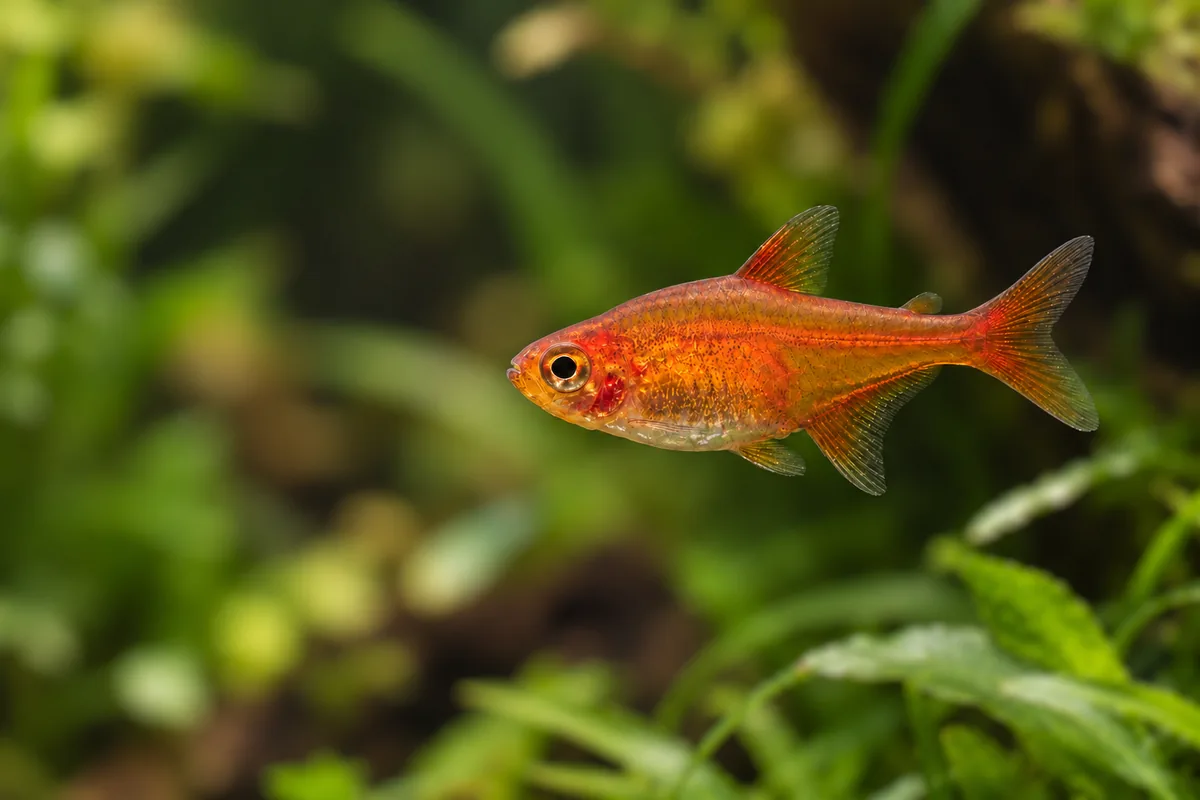
Ember tetra
Hyphessobrycon amandae
The safest first school for a planted 20. Embers stay under 1 inch, ignore each other, and the orange pops against dark soil and green stems. A group of 10 to 12 barely uses any space, which leaves room for a bottom group.
- Adult size
- 0.8 in (2 cm)
- Group size
- 10-12 (min 8)
- Temperature
- 68-82°F (20-28°C)
- pH / GH
- 5.0-7.0 / 1-10 dGH
- Temperament
- Peaceful, mid-water
- Best shape
- Long or high
Watch out: Soft to moderate water only. Anything bigger or boisterous will bully them, and 12 embers still eat newborn shrimp.
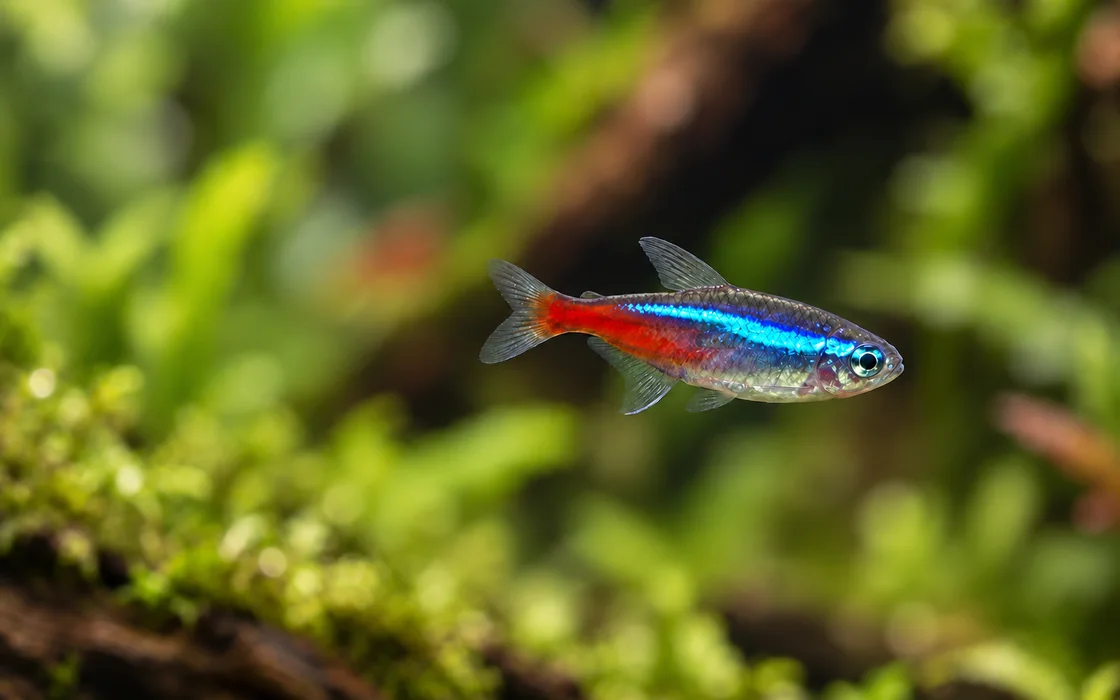 Schooling
Neon tetra
Paracheirodon innesi
The classic for a reason. Ten to 12 neons in a 20 long draw a clean blue line through the middle of the tank. They like it cooler than most tropical fish, so run 73-75°F (23-24°C).
- Adult size
- 1.2 in (3 cm)
- Group size
- 10-12 (min 8)
- Temperature
- 70-77°F (21-25°C)
- pH / GH
- 4.0-7.5 / 1-12 dGH
- Temperament
- Peaceful, mid-water
- Best shape
- Long preferred
Watch out: Hard alkaline water and constant 81°F+ heat shorten their lives. Pick fat, fully colored fish at the shop.
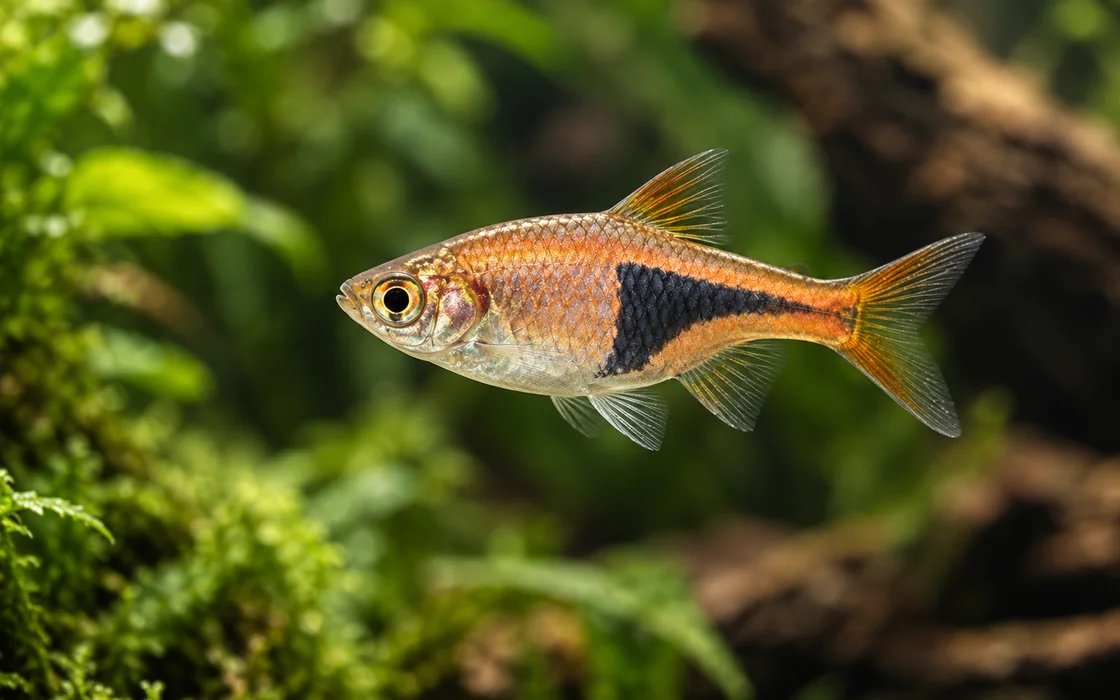 Schooling
Harlequin rasbora
Trigonostigma heteromorpha
The easiest school on this list. Harlequins take almost any peaceful tank, eat whatever you drop in, and the copper body with the black triangle looks sharp against plants. 8 to 10 is the number.
- Adult size
- 1.8 in (4.5 cm)
- Group size
- 8-10
- Temperature
- 70-82°F (21-28°C)
- pH / GH
- 5.0-7.5 / 1-12 dGH
- Temperament
- Very peaceful, mid-water
- Best shape
- Long preferred
Watch out: They are bigger than embers and neons, so count them as 1.8 inch fish. Keep the school at 8 to 10 if you also want a corydoras group.
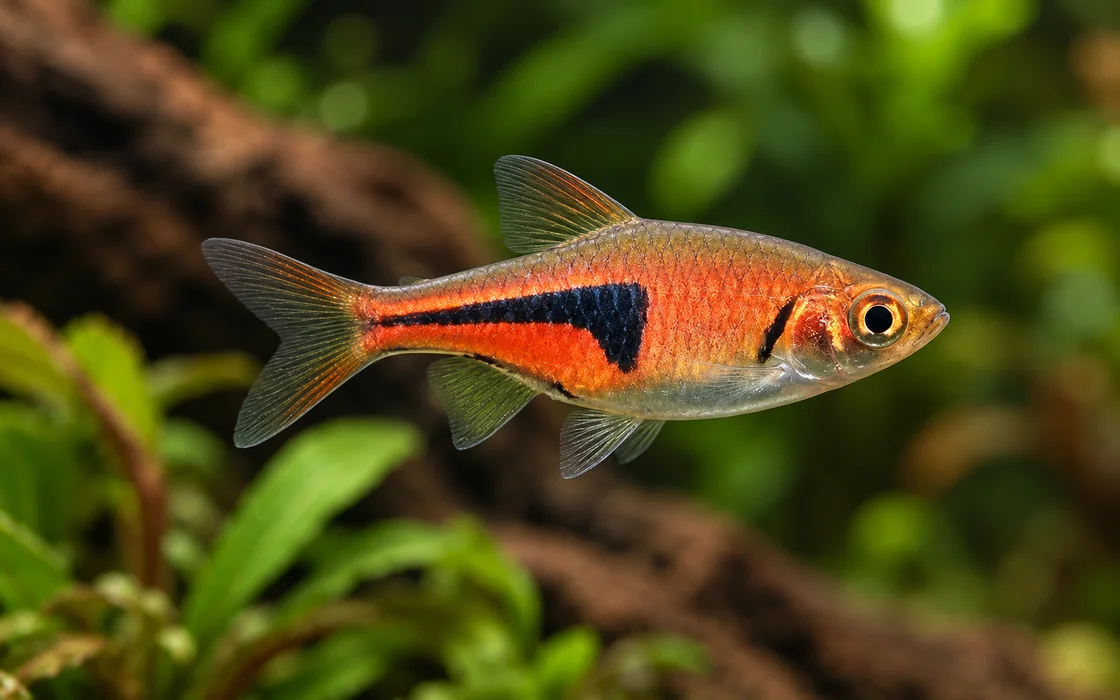 Schooling
Lambchop rasbora
Trigonostigma espei
The harlequin’s smaller, calmer cousin. The copper-orange body stands out under dim light and floating plants, and 8 to 12 fit a 20 long with room to spare. It also suits Cryptocoryne, Java fern and dark wood.
- Adult size
- 1.2 in (3 cm)
- Group size
- 8-12
- Temperature
- 73-82°F (23-28°C)
- pH / GH
- 5.5-7.5 / 1-10 dGH
- Temperament
- Peaceful, mid-water
- Best shape
- Long preferred
Watch out: Not for hard alkaline water or loud tank mates. Give them floating plants for cover or they hide all day.
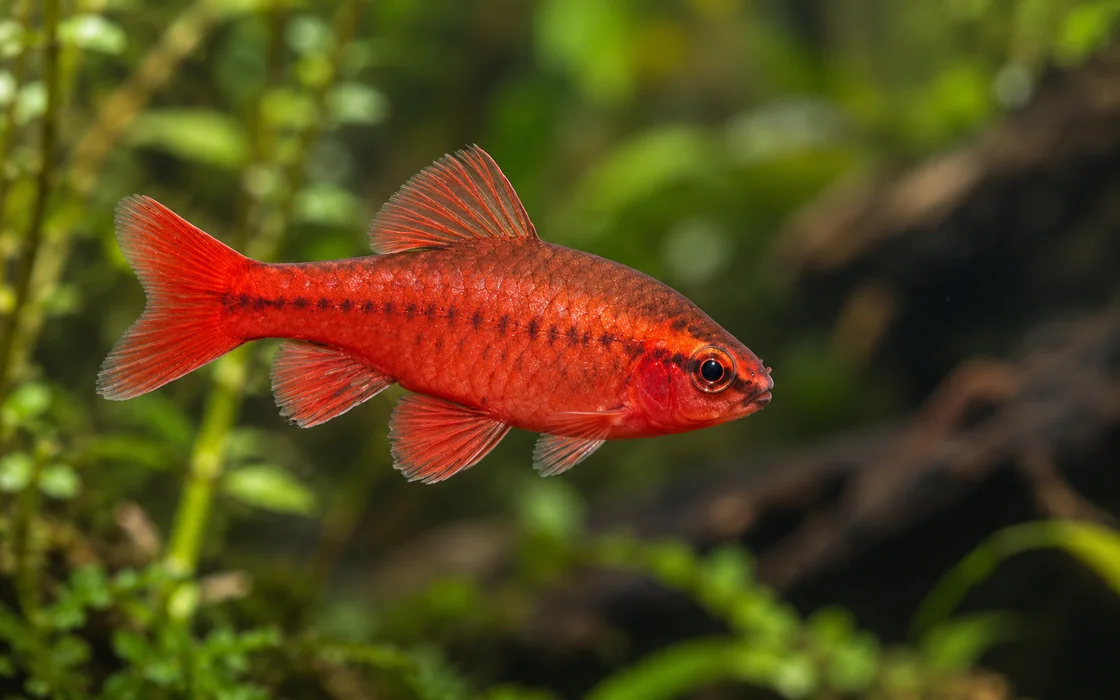 Schooling
Cherry barb
Puntius titteya
The one colorful school here that copes with tap water from soft to fairly hard. Males turn deep red. They are calm, they do not nip like tiger barbs, and they suit a planted 20 long with an open lane in the middle.
- Adult size
- 2 in (5 cm)
- Group size
- 8-10
- Temperature
- 68-81°F (20-27°C)
- pH / GH
- 6.0-8.0 / 2-20 dGH
- Temperament
- Peaceful, mid to low
- Best shape
- Long
Watch out: They carry more body mass than a tetra, so do not stack a second big school on top. Males display at each other, and a group of 8 to 10 spreads that out.
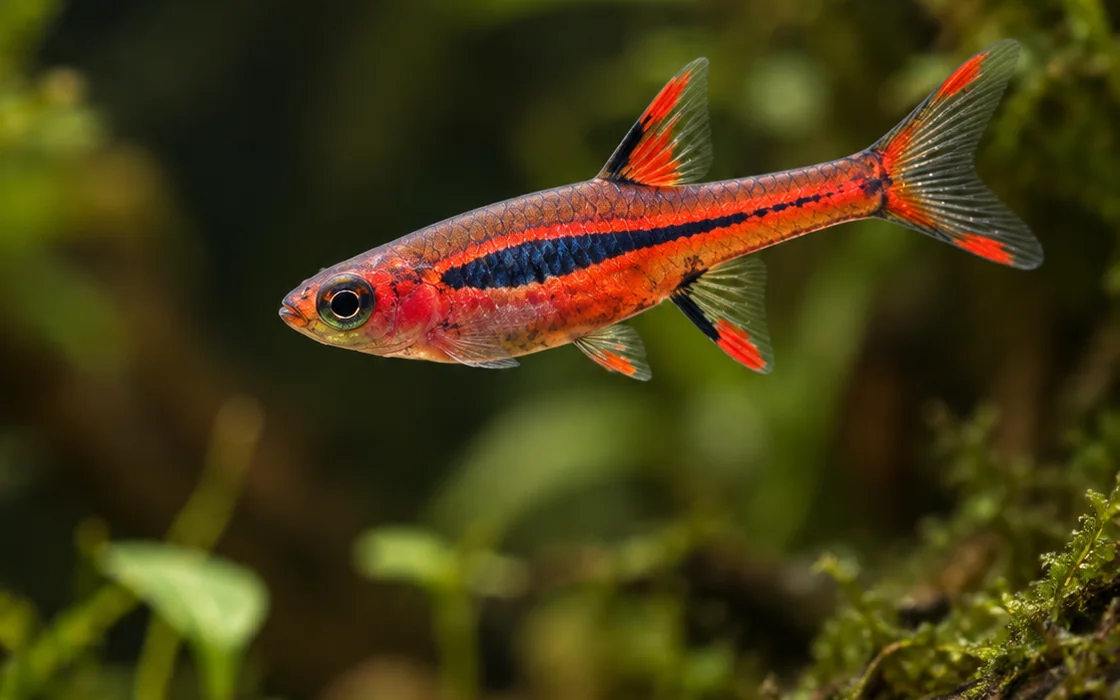 Schooling
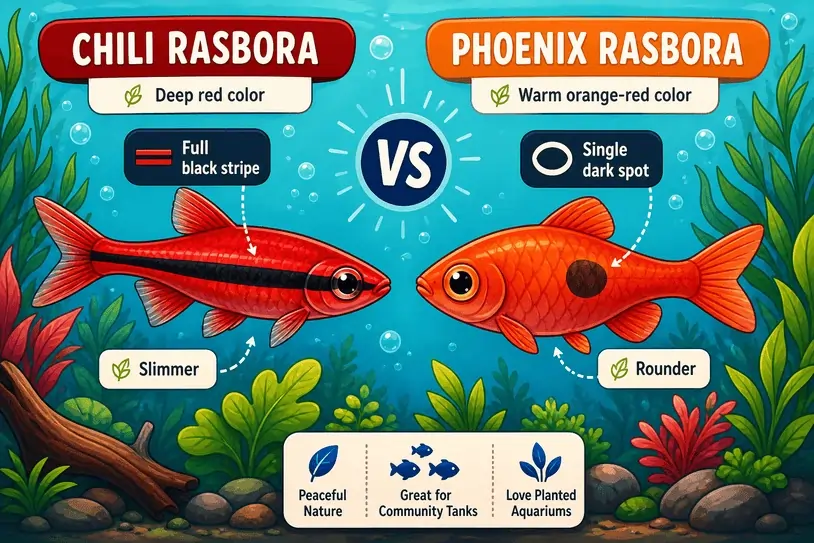
Chili rasbora
Boraras brigittae
The smallest fish in the guide and one of the best for an aquascape. A tight group of 12 to 16 in a mature, shaded, gently filtered tank makes a great show.
- Adult size
- 0.8 in (2 cm)
- Group size
- 12-16 (min 8)
- Temperature
- 68-82°F (20-28°C)
- pH / GH
- 4.0-7.0 / 1-10 dGH
- Temperament
- Timid, mid-water
- Best shape
- Long or high
Watch out: Timid fish that do not belong in a new tank. Add them to a tank that has run for weeks with plants growing. Newborn shrimp are still prey.
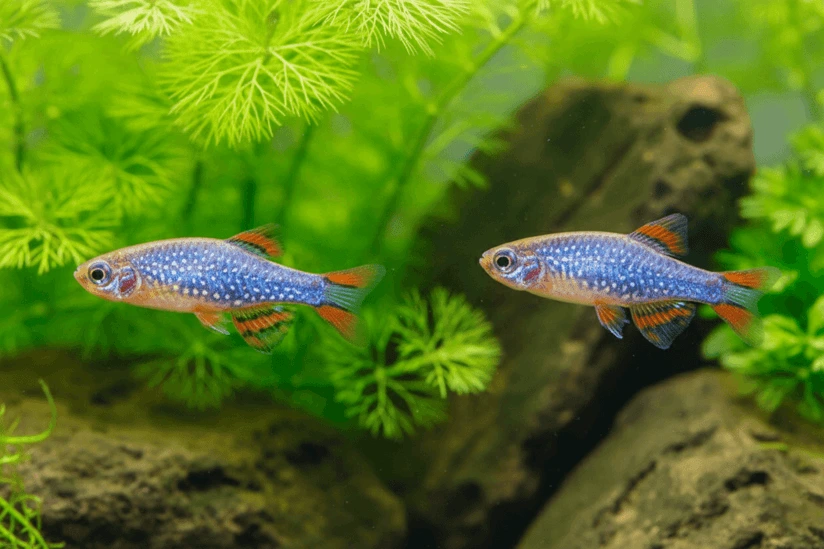 Schooling
Celestial pearl danio
Celestichthys margaritatus
A species-tank fish in a 20. Current specialist guidance says to keep CPDs in large groups, ideally around 20, because males spar and a big group spreads the aggression across everyone.
- Adult size
- 0.8 in (2.1 cm)
- Group size
- 18-20 (as many as you can)
- Temperature
- 68-79°F (20-26°C)
- pH / GH
- 6.5-7.5 / 5-15 dGH
- Temperament
- Shoaling, males spar
- Best shape
- Long or high
Watch out: Six is the old care-sheet number and it is too low. If you cannot buy 15 or more, pick another fish.
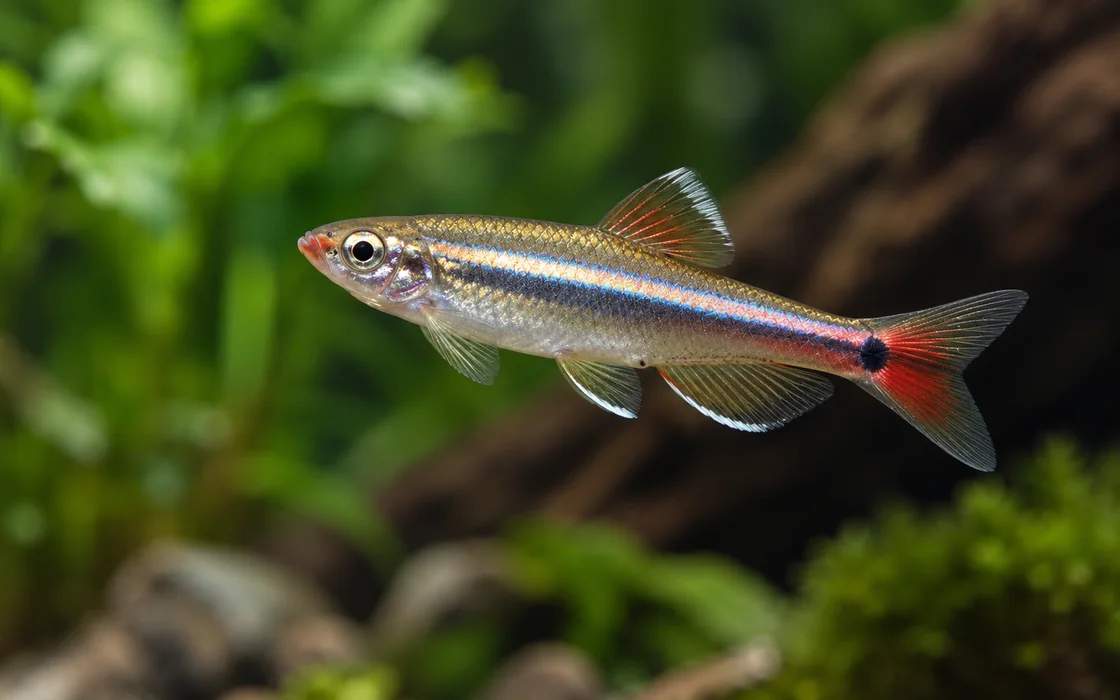 Schooling
White Cloud Mountain minnow
Tanichthys albonubes
The only fish here made for a cool room. Keep 8 to 12 at 61-70°F (16-21°C) with no heater and they stay active and healthy.
- Adult size
- 1.6 in (4 cm)
- Group size
- 8-12
- Temperature
- 57-72°F (14-22°C)
- pH / GH
- 6.0-8.5 / 5-20 dGH
- Temperament
- Peaceful, active, upper to mid
- Best shape
- Long preferred
Watch out: Do not pair them with warm-water fish. Past 72°F (22°C) you are outside their listed range.
Best centerpiece fish for a 20 gallon tank
A centerpiece is the fish people look at first. In 20 gallons it needs a spot to claim and tank mates that tolerate it. Most of these five come with caveats, and each card spells them out.
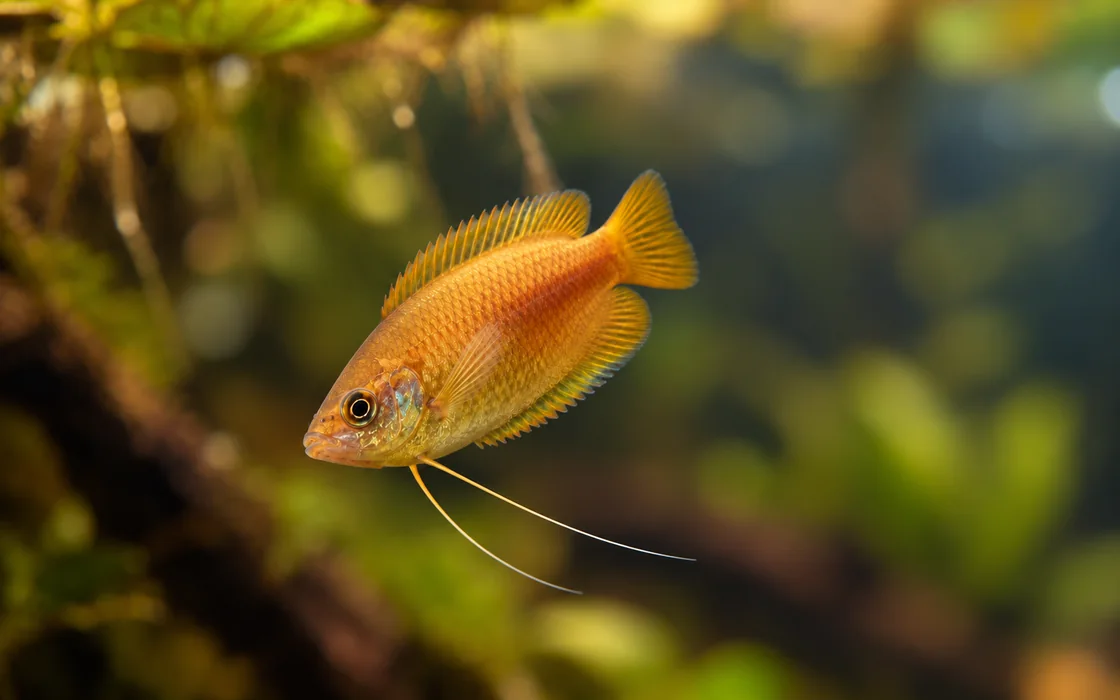 Centerpiece
Honey gourami
Trichogaster chuna
Small, calm and gold. It fits the footprint with room to spare, and a planted tank with floating cover suits it.
- Adult size
- 2.2 in (5.5 cm)
- Group size
- 1 to 6 (see note)
- Temperature
- 72-81°F (22-27°C)
- pH / GH
- 6.0-7.5 / 2-15 dGH
- Temperament
- Peaceful, slow, shy
- Best shape
- Long or high
Watch out: Shops sell it as a single fish. Current specialist guidance says groups of 4 to 6 do best, and other sources say one is fine. I would keep one in a lightly stocked tank, because they lose at feeding time to faster fish.
 Centerpiece
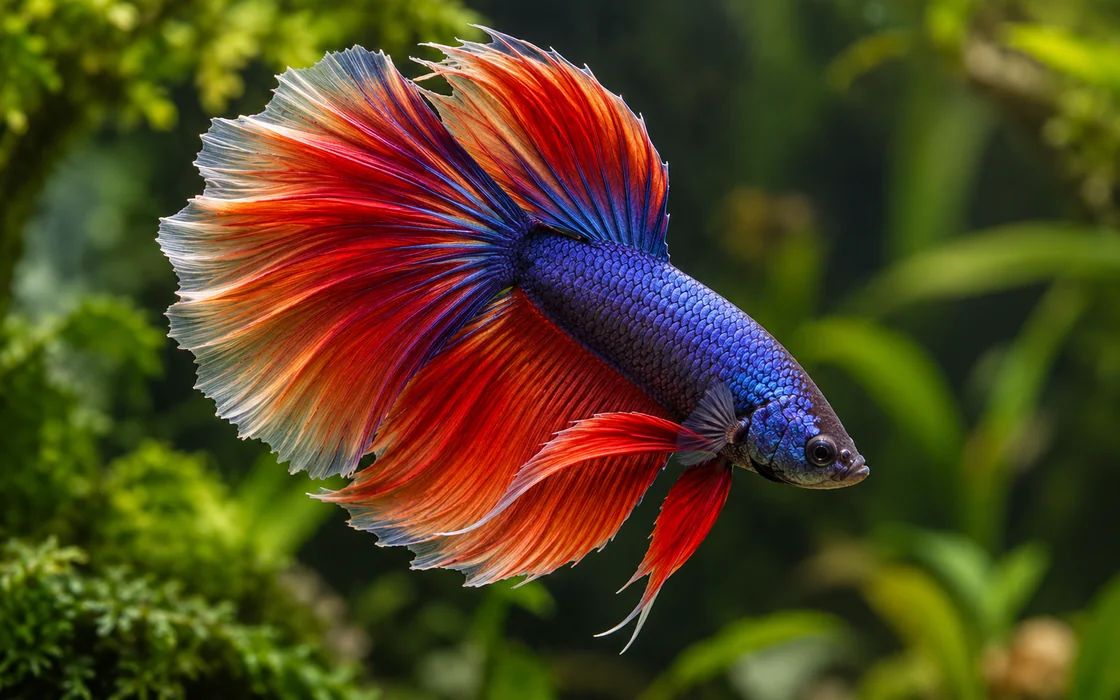
Betta
Betta splendens
A 20 gallon is more than most bettas ever get. With floating plants, roots and a slow filter, he behaves like a betta instead of a tenant in a cup.
- Adult size
- 2.8 in (7 cm)
- Group size
- 1 male
- Temperature
- 72-86°F (22-30°C)
- pH / GH
- 6.0-8.0 / 1-15 dGH
- Temperament
- Territorial, varies by fish
- Best shape
- Long or high
Watch out: Specialist guidance recommends one betta per tank. Many bettas hunt shrimp, and a community works only if your fish is calm, so keep a backup tank. Fast, nippy schoolers will wreck his fins.
 Centerpiece
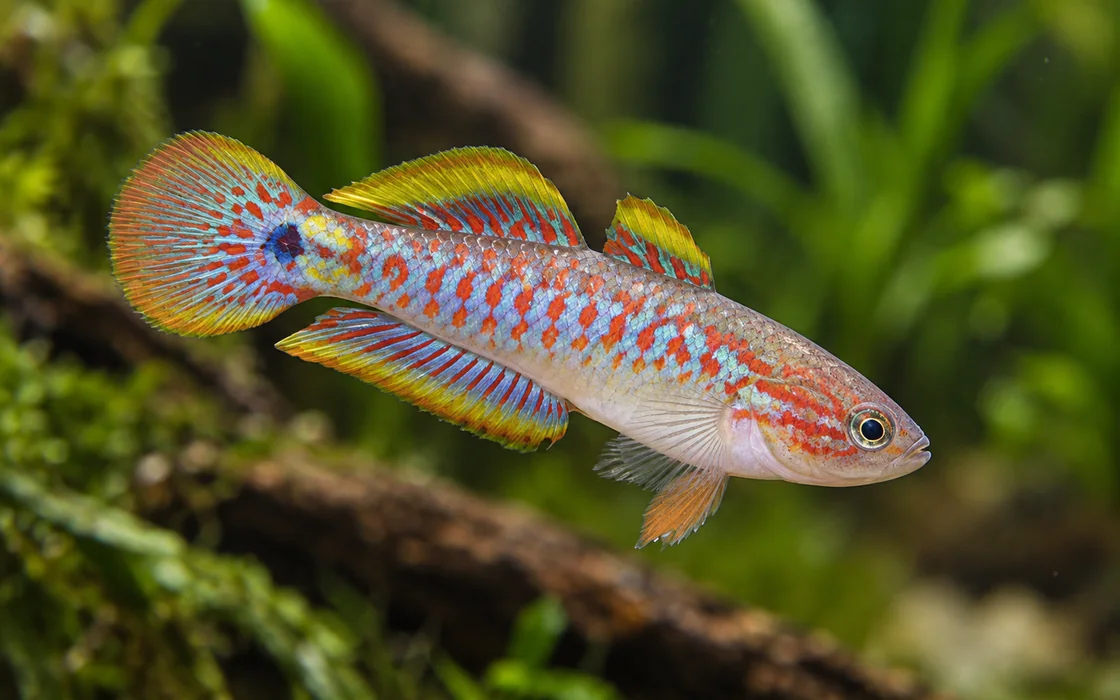
Peacock gudgeon
Tateurndina ocellicauda
A small goby with reef-fish color. It stays low to mid-water, takes prepared and frozen foods, and claims a cave or a log.
- Adult size
- 3 in (7.5 cm)
- Group size
- 1 to 3
- Temperature
- 72-79°F (22-26°C)
- pH / GH
- 6.5-7.5 / 5-10 dGH
- Temperament
- Colorful, a little territorial
- Best shape
- Long or high
Watch out: A micropredator. Larger shrimp like Amanos are usually fine, but expect fish fry and Neocaridina shrimplets to vanish.
 Centerpiece
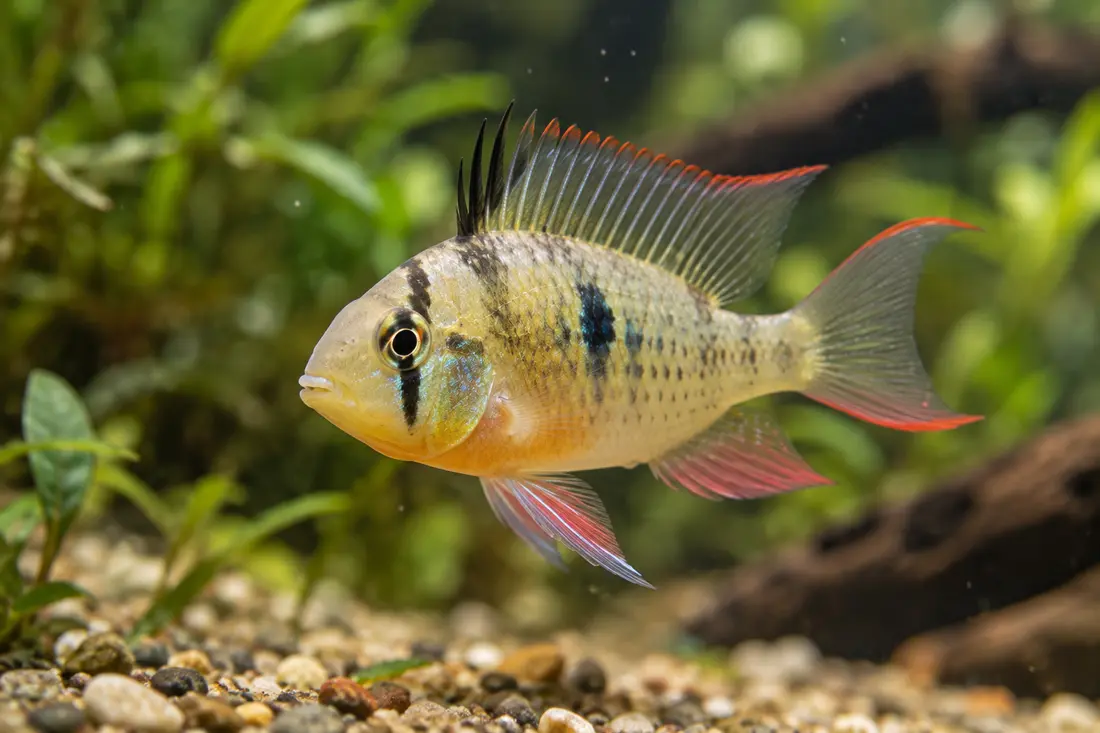
Bolivian ram
Mikrogeophagus altispinosus
Active, curious dwarf cichlids that dig and display. One pair with a small school makes a real centerpiece.
- Adult size
- 3.1 in (8 cm)
- Group size
- 1 pair
- Temperature
- 75-82°F (24-28°C)
- pH / GH
- 6.0-7.5 / 1-10 dGH
- Temperament
- Peaceful but territorial, shy
- Best shape
- Long only
Watch out: Specialist guidance lists a 36 x 18 inch base. A 20 long is 30 x 12. This is a borderline fit: one pair, mature tank, sand, and small weekly water changes (10-15%). If you can upsize, do.
 Centerpiece
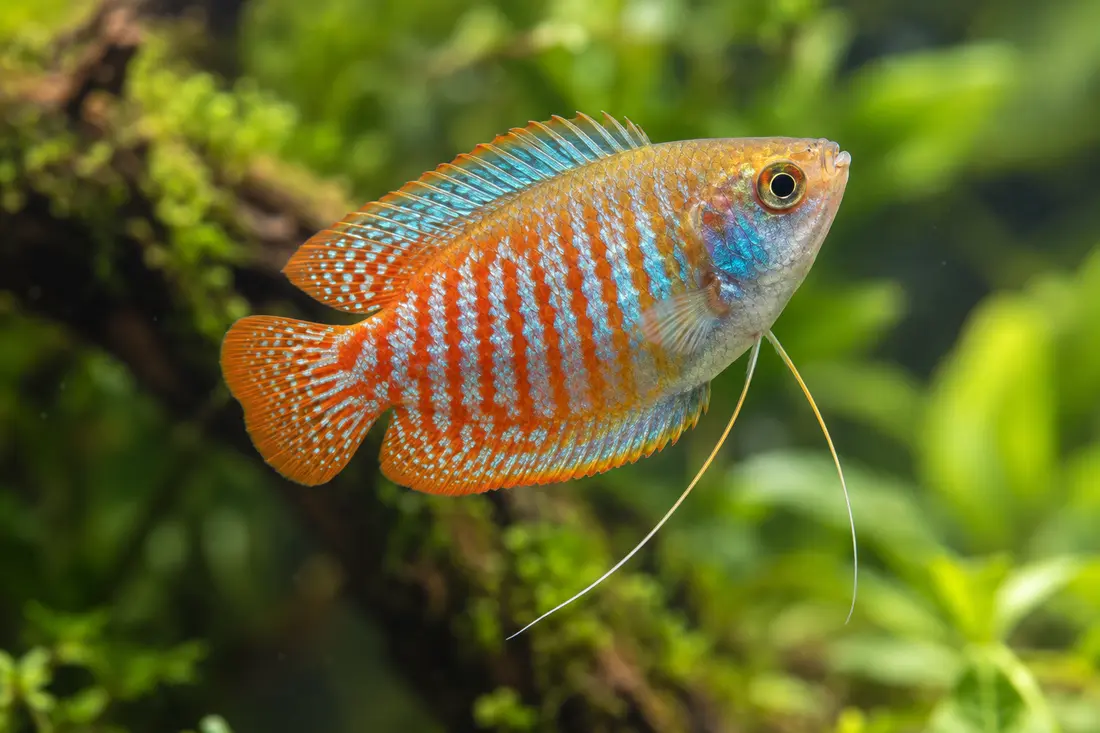
Dwarf gourami
Trichogaster lalius
The brightest centerpiece in this group, at around 3.5 inches.
- Adult size
- 3.5 in (8.8 cm)
- Group size
- 1 male or 1 pair
- Temperature
- 72-81°F (22-27°C)
- pH / GH
- 6.0-7.5 / 2-18 dGH
- Temperament
- Shy, males territorial
- Best shape
- Long or high
Watch out: Dwarf gourami iridovirus is widespread in trade stock, and specialist guidance says stock quality has fallen badly. Buy from a seller who quarantines. Walk away from any dark or lethargic fish. I would pick a honey gourami or a betta first.
Best bottom dwellers and cleanup crew
Corys, loaches and otos have diets and group sizes of their own, so treat them as livestock first. They eat food you put near them and still make waste. Use fine sand for anything with barbels. For a cool tank, swap pandas for salt-and-pepper corys (Hoplisoma habrosum, 1.4 in, 68-79°F). For harder tap water, bronze corys (about 2.75 in, 68-82°F, pH 6.5-7.5, 4-20 dGH) cope better than pandas or pygmies.
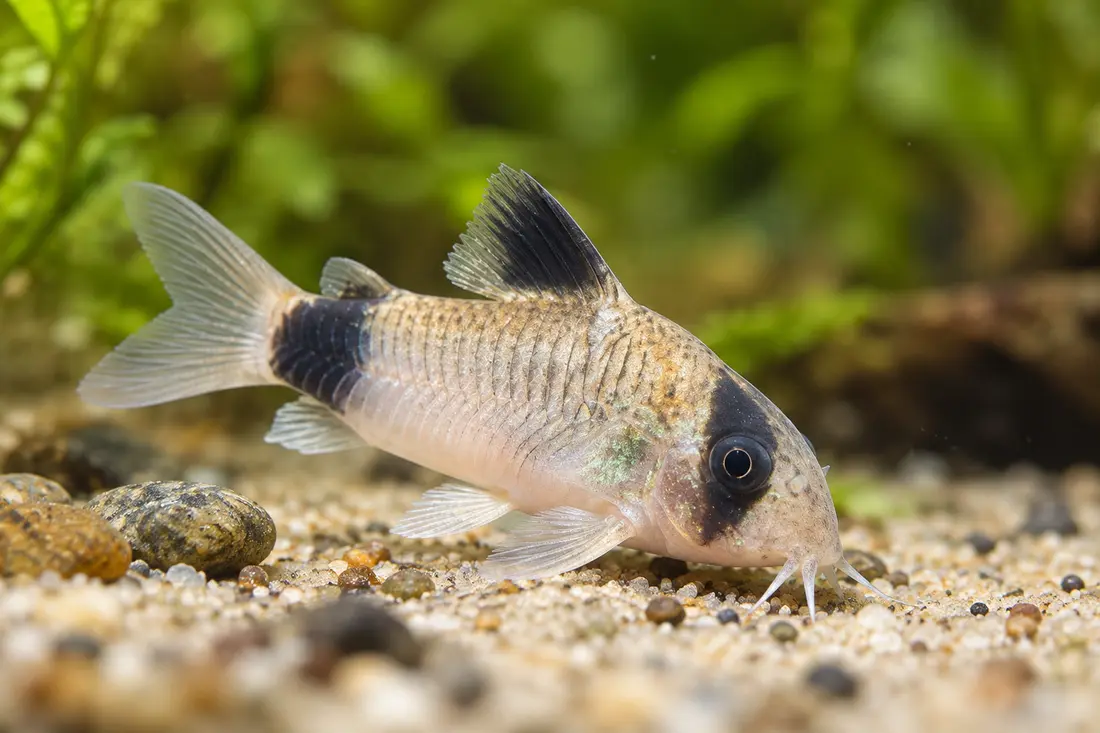 Bottom dweller
Panda cory
Hoplisoma panda
The standard 20 long bottom group. Black patches on white, active, and small enough that 6 do not crowd the floor.
- Adult size
- 2 in (5 cm)
- Group size
- 6
- Temperature
- 72-77°F (22-25°C)
- pH / GH
- 6.0-7.4 / 1-12 dGH
- Temperament
- Peaceful, bottom
- Best shape
- Long preferred
Watch out: Fine sand and a clean substrate. Rough gravel wears down their barbels. Feed sinking food directly to them. They are not cleaners.
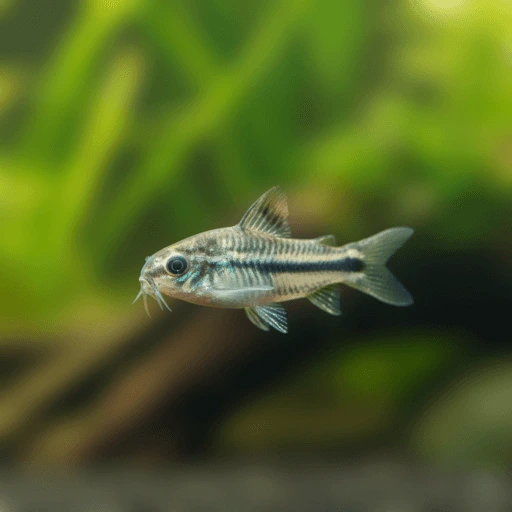 Bottom dweller
Pygmy cory
Corydoras pygmaeus
Only 1.2 inches, and they spend half their time hovering in midwater. A group of 8 to 12 looks like a school of tiny catfish, and it is the best bottom group for a 20 high.
- Adult size
- 1.2 in (3 cm)
- Group size
- 8-12
- Temperature
- 72-79°F (22-26°C)
- pH / GH
- 6.4-7.4 / 0-8 dGH
- Temperament
- Peaceful, bottom and mid-water
- Best shape
- Long or high
Watch out: Faster fish steal their food. Target-feed crushed sinking pellets or live microworms.
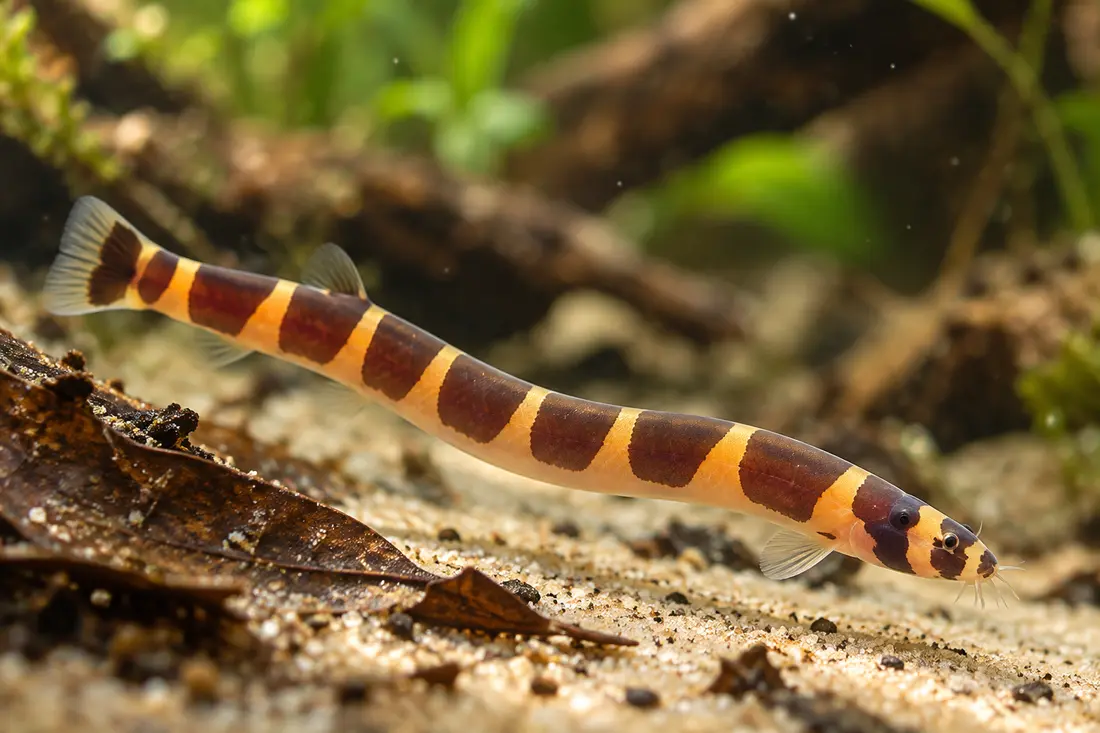 Bottom dweller
Kuhli loach
Pangio semicincta
The strangest fish in the guide, in a good way. They look like small eels, live in leaf litter and show up at feeding time. Most kuhlis in shops are P. semicincta or close relatives, not true P. kuhlii.
- Adult size
- 3.9 in (10 cm)
- Group size
- 5-6 minimum
- Temperature
- 70-79°F (21-26°C)
- pH / GH
- 3.5-7.0 / 0-8 dGH
- Temperament
- Peaceful, shy, bottom
- Best shape
- Long only
Watch out: They need fine sand, hiding spots, a tight lid and a covered filter intake, because they squeeze through gaps. Keep at least 5.
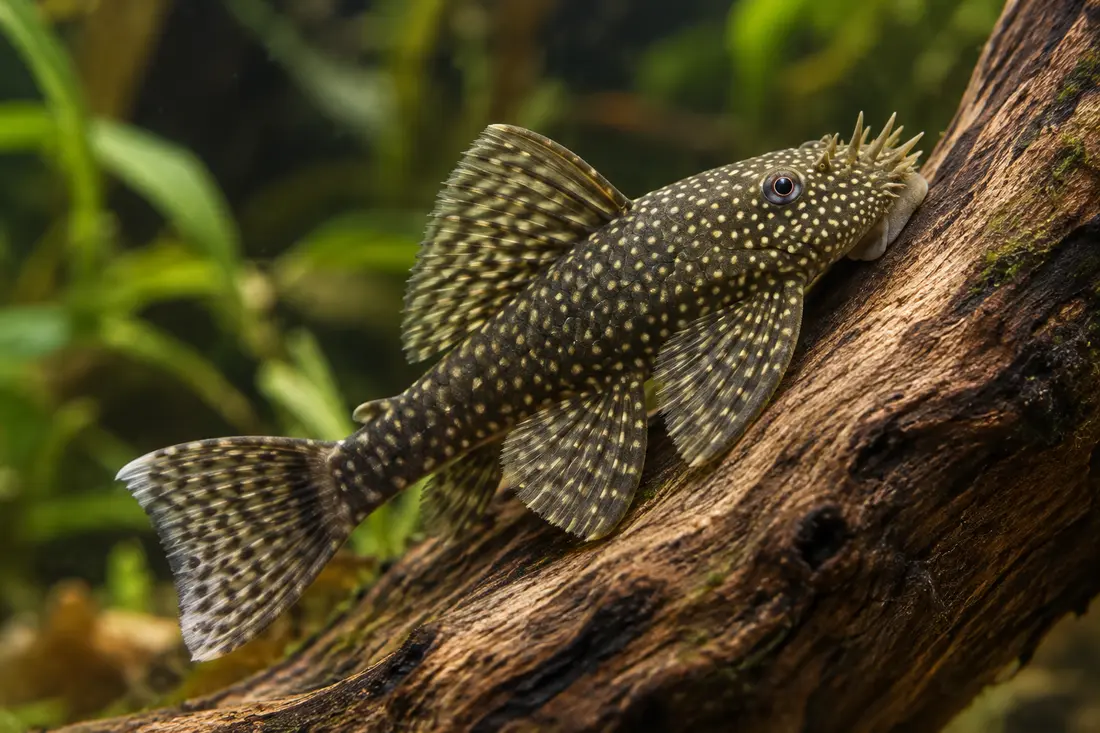 Bottom dweller
Bristlenose pleco
Ancistrus sp.
The only plecostomus-type catfish I would put in a 20 long. It tops out around 4 to 5 inches, rasps algae and biofilm, and needs driftwood in the tank.
- Adult size
- 4.5 in (11 cm)
- Group size
- 1
- Temperature
- 73-81°F (23-27°C)
- pH / GH
- 5.5-8.0 / GH flexible
- Temperament
- Peaceful, territorial with its own kind
- Best shape
- Long only
Watch out: One fish only. It makes a lot of waste for its size, so keep it out of plans already near the ceiling. Some sources want a 3 foot tank, so treat a 20 long as the bare minimum.
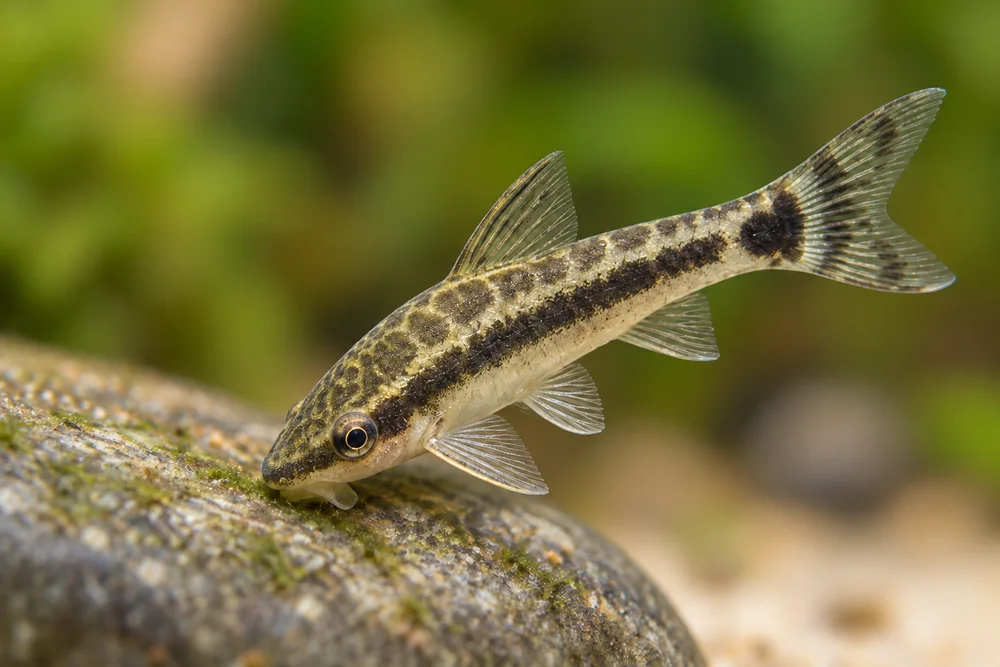 Bottom dweller
Otocinclus
Otocinclus macrospilus and related trade species
Otos graze biofilm and soft algae on plants and glass. In a mature planted 20 with a group of 6, they fit well.
- Adult size
- 1.4 in (3.5 cm)
- Group size
- 6+
- Temperature
- 70-79°F (21-26°C)
- pH / GH
- 5.5-7.5 / 1-12 dGH
- Temperament
- Shy grazer
- Best shape
- Long or high
Watch out: Do not buy them to fix algae in a new tank. New arrivals are often underfed, and a clean tank gives them nothing to eat. Feed algae wafers and blanched zucchini.
Livebearers and shrimp
Livebearers want hard, alkaline water and a single sex. Shrimp want minerals and fish that leave them alone. No fish in this guide is fully shrimp safe, because anything that fits a shrimplet in its mouth will try.
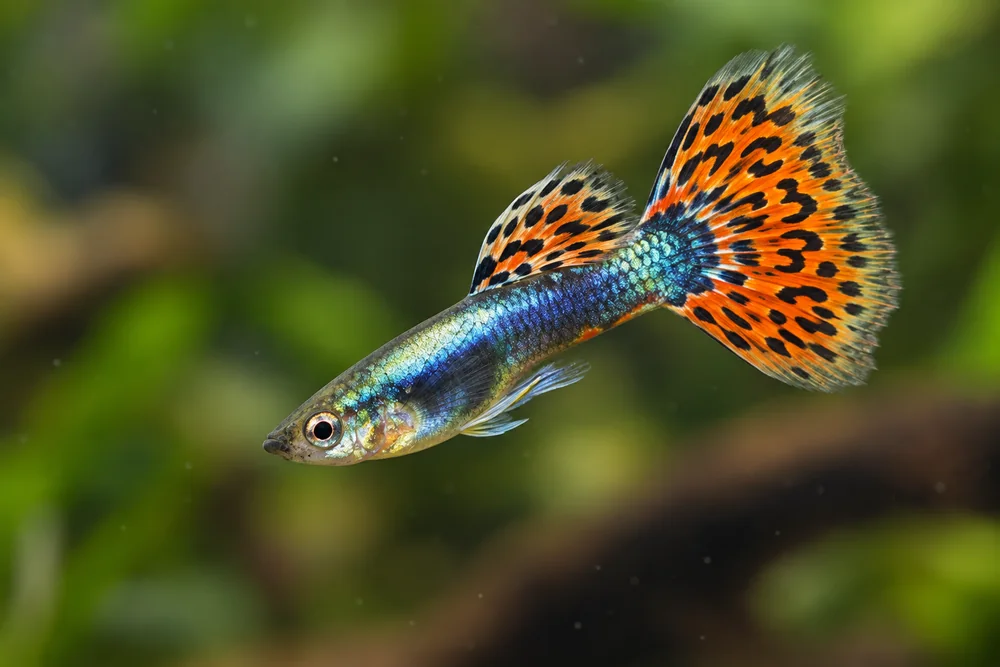 Livebearer
Guppy
Poecilia reticulata
Cheap, bright and easy in hard water. Keep males only and you get color with no fry.
- Adult size
- 2.4 in (6 cm)
- Group size
- 5-8, males only
- Temperature
- 63-82°F (17-28°C)
- pH / GH
- 7.0-8.5 / 8-30 dGH
- Temperament
- Peaceful, active
- Best shape
- Long or high
Watch out: Mixed sexes breed nonstop and the tank fills fast. Keep them away from fin nippers, and keep them apart from Endler’s if you care about hybrids.
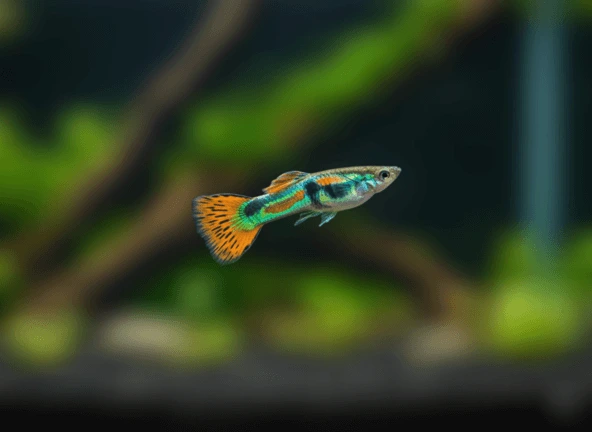 Livebearer
Endler’s livebearer
Poecilia wingei
Males stay around 1 inch, glow in neon patterns and thrive in hard alkaline water. 8 to 10 males give you color from the first week.
- Adult size
- 1 in (2.5 cm)
- Group size
- 8-10 males
- Temperature
- 75-86°F (24-30°C)
- pH / GH
- 7.0-8.5 / 15-35 dGH
- Temperament
- Active, peaceful
- Best shape
- Long or high
Watch out: Males only. Mixed sexes become a colony. They hybridize with guppies.
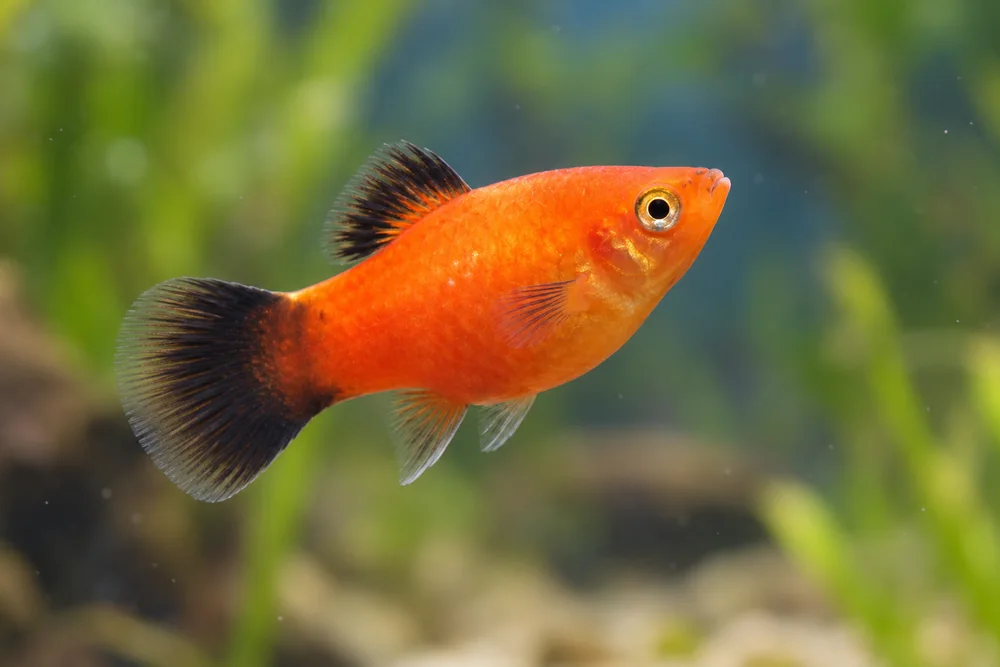 Livebearer
Platy
Xiphophorus maculatus
Sturdy, peaceful and available in a lot of colors. A small same-sex group works in a hard-water 20.
- Adult size
- 2 in (5 cm)
- Group size
- 4-6, same sex
- Temperature
- 68-79°F (20-26°C)
- pH / GH
- 7.0-8.2 / 10-30 dGH
- Temperament
- Very peaceful
- Best shape
- Long preferred
Watch out: They breed readily. Specialist guidance says broods of up to 80 fry are not uncommon, with gestation around 4 to 6 weeks. Keep one sex or have a plan for the fry.
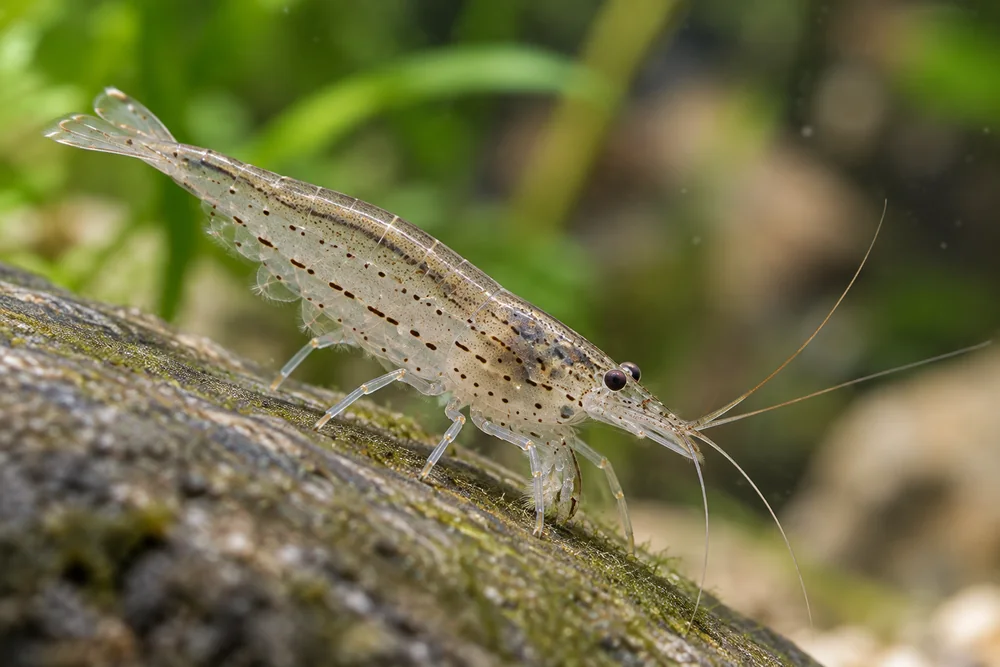 Shrimp
Amano shrimp
Caridina multidentata
The big algae picker of the shrimp world, at 2 to 3 inches. Adults are too large for tiny fish to swallow, which makes Amanos the safer shrimp choice with embers or chilis.
- Adult size
- 2.5 in (6 cm)
- Group
- 6+
- Temperature
- 65-82°F (18-28°C)
- pH / GH
- 6.5-7.5 / 1-15 dGH
- Temperament
- Peaceful algae picker
- Best shape
- Either
Watch out: Larvae need brackish water, so you will not get a colony. They climb out through gaps, so keep the lid tight.
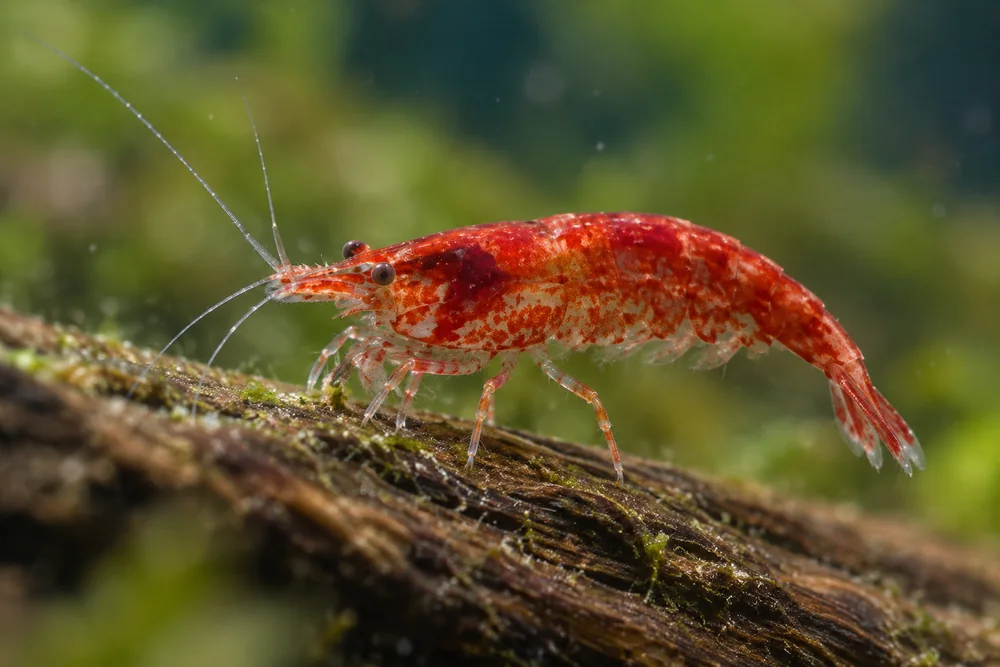 Shrimp
Neocaridina shrimp
Neocaridina davidi (cherry and other color morphs)
Hardy shrimp that breed in the tank. Thick moss and plant cover give shrimplets a chance.
- Adult size
- 1.1 in (2.8 cm)
- Group
- 10 to start
- Temperature
- 61-82°F (16-28°C)
- pH / GH
- 6.5-8.5 / 6+ dGH
- Temperament
- Peaceful, breeds in tank
- Best shape
- Either
Watch out: Most fish here will eat shrimplets. Expect a small colony unless the plants are thick. They need GH 6 or higher, and soft water means failed molts unless you add minerals.
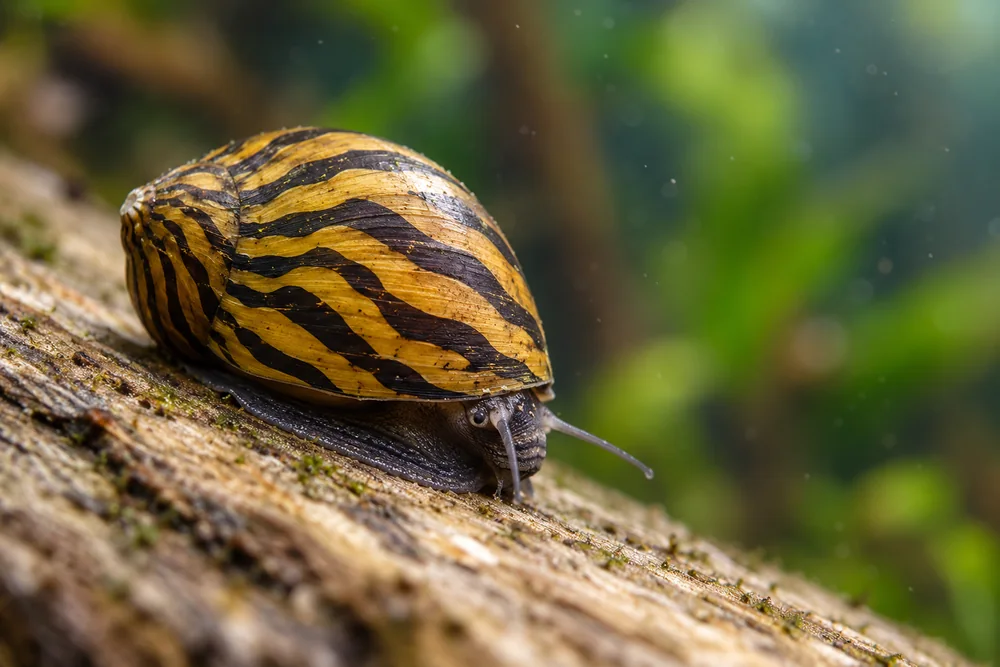 Snail
SnailNerite snail
Neritina natalensis
Nerites clean glass and hardscape, ignore your plants and do not overbreed. Two is plenty for a 20.
- Adult size
- 1 in (2.5 cm)
- Group
- 2
- Temperature
- 72-79°F (22-26°C)
- pH / GH
- 7.0-8.2 / 5-20 dGH
- Temperament
- Peaceful glass and hardscape cleaner
- Best shape
- Either
Watch out: They need hard, alkaline water or the shell pits. Under pH 7.0, skip them. Use a tight lid. White egg dots on decor are normal and will not hatch in freshwater.
The nano-species 20 gallon
If you want nano fish for a 20 gallon aquarium and a dense planted display, this is the plan I would build, using the small species this site profiles. 18 celestial pearl danios, 10 chili rasboras and 6 pygmy corys share a pH of 6.5 to 7.0 and a GH of 5 to 8, so the tank needs moderately soft, near-neutral water.
Nano-species meadow
- 18Celestial pearl danios
- 10Chili rasboras
- 6Pygmy corys
- Temperature
- 72-79°F22-26°C
- pH
- 6.5-7.0
- Hardness
- 5-8 dGH
Dense fine-leaved plants and moss, small open lanes and a tight lid. Load: 29.6 weighted inches against a ceiling of about 30.
Flag: This is the fullest nano plan. Drop the chili rasboras for margin, and never run fewer than 15 CPDs. Test GH before you buy, because the overlap is only 3 dGH wide.
These fish have tiny mouths, and live food gets them eating and into color. Start with microworm cultures for the smallest mouths, and add daphnia for the adults. Feed live food 2 or 3 times a week in amounts they finish in 2 or 3 minutes, and use crushed micropellets the rest of the time.
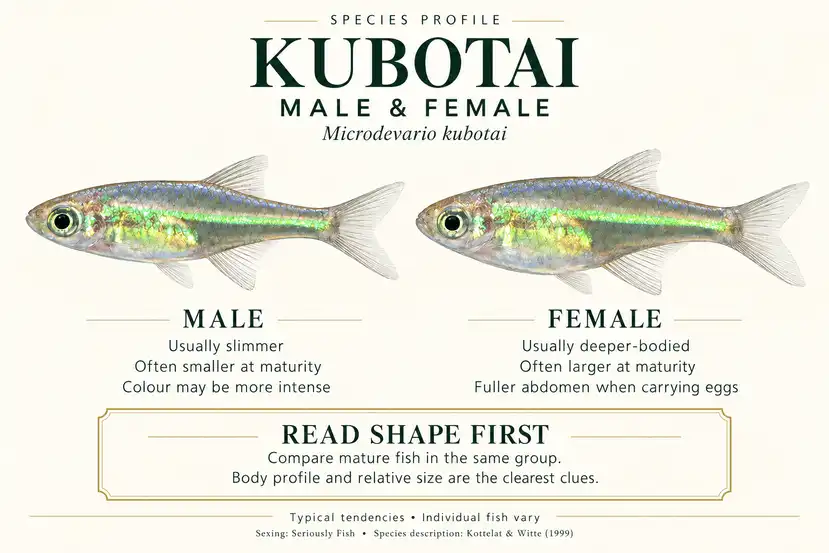
Other nano species do better as their own project. See the profiles for kubotai rasboras and scarlet badis before you try to fit either in here.
6 complete stocking plans
Pick one plan. They are alternative tanks and do not combine. Each plan shows the temperature, pH and hardness its fish share, and flags any narrow overlap. Counts are editorial starting points.
Plan 1: First Tank Classic
- 8Harlequin rasboras
- 6Panda corys
- 1Honey gourami (optional)
- 2Nerite snails
- Temperature
- 72-77°F22-25°C
- pH
- 7.0-7.4
- Hardness
- 5-12 dGH
Harlequin rasboras fill the middle, pandas work the sand, and the gourami takes the surface under floating plants. Load: 29.7 weighted inches against a ceiling of about 30.
Flag: The pH window is narrow, 7.0 to 7.4, because nerites need hard, alkaline water. If your tap pH sits below 7.0, skip the snails and the window opens to 6.0-7.4. The honey gourami is optional. Drop it for real margin.
Plan 2: Dense Nano
- 12Ember tetras
- 8Pygmy corys
- 10Neocaridina shrimp (starter colony)
- Temperature
- 72-79°F22-26°C
- pH
- 6.5-7.0
- Hardness
- 6-8 dGH
The best planted-tank plan here. Moss and fine stems give the shrimp cover, and the corys use the whole tank. Load: 19.2 weighted inches against a ceiling of about 24.
Flag: Hardness is the tight spot. Neocaridina want GH 6 or more, and the pygmy cory range stops near 8, so the window is 6 to 8 dGH. Test GH first. Chili rasboras, 12 to 16 of them, work in place of the embers with the same windows. Embers eat shrimplets, so expect a small shrimp colony.
Plan 3: Unheated Room-Temp
- 10White Cloud Mountain minnows
- 6Salt-and-pepper corys
- Temperature
- 68-72°F20-22°C
- pH
- 6.0-7.5
- Hardness
- 5-10 dGH
No heater, moderate flow and an open middle. White Clouds stay active and the corys use the sand. Load: 24.4 weighted inches against a ceiling of about 30.
Flag: The temperature window is narrow, 68-72°F, and it only works if your room holds that range. Pandas want 72°F or more, so this plan uses salt-and-pepper corys, and nerites are left out for the same reason. Past 72°F the minnows leave their listed range.
Plan 4: Livebearer Garden
- 8Endler’s males
- 6Bronze corys
- 2Nerite snails
- Temperature
- 75-79°F24-26°C
- pH
- 7.0-7.5
- Hardness
- 15-20 dGH
Endlers add color at the top, bronze corys work the sand, and nerites handle algae. Load: 26.5 weighted inches against a ceiling of about 30.
Flag: This is a hard-water plan. The GH window is 15-20 dGH, so if your tap is under 10 dGH, use Plan 1 or Plan 2 instead. Otocinclus are left out because their listed hardness tops out near 12 dGH. Keep the Endler’s all male.
Plan 5: Ram Showpiece (advanced)
- 2Bolivian rams (1 pair)
- 10Ember tetras
- 8Pygmy corys
- Temperature
- 75-79°F24-26°C
- pH
- 6.4-7.0
- Hardness
- 1-8 dGH
Sand, caves, driftwood and plants that break sight lines, so the pair never sees the whole tank. Load: 26.9 weighted inches against a ceiling of about 30.
Flag: Rams are below the specialist base here, 36 x 18 in against the long’s 30 x 12, so treat this plan as a stretch. Embers fill the school slot because rummy-nose tetras, the usual ram partner, want 36 inches of length. Keep it to one pair and make small weekly water changes. The temperature window is narrow, 75-79°F.
Plan 6: Betta Plan
- 1Betta (male)
- 6Panda corys
- 2Nerite snails
- Temperature
- 72-77°F22-25°C
- pH
- 7.0-7.4
- Hardness
- 5-12 dGH
The betta takes the top, the pandas take the sand, and floating plants give him resting spots. Load: 16.2 weighted inches against a ceiling of about 30.
Flag: The pH window is narrow, 7.0 to 7.4, because of the nerites. Bettas often hunt shrimp, so no shrimp here. Fin-nippers like tiger barbs, serpae tetras and zebra danios shred betta fins, so skip fast nippy schoolers. Keep a backup tank ready, since temperament varies by fish.
Fish to avoid in a 20 gallon
These are the common pet-store traps. Shops sell them small, and they grow into a tank you do not own.
| Fish | Adult size | Problem |
|---|---|---|
| Common pleco | 12 in or more | Outgrows a 20 gallon. Fish sold as common pleco vary, and many grow larger. |
| Goldfish | 6 in and up | Heavy waste, long life and a need for a much bigger tank. |
| Zebra danio | 2 in (5 cm) | Hyperactive. Specialist guidance wants a 36 in base, and a 20 long has 30. |
| Tiger barb | 2.8 in (7 cm) | Nips fins and wants about 31 in of base, more than a 20 long gives. |
| Swordtail | 5.5 in (14 cm) | Wants a base around 48 x 12 in. |
| Angelfish | About 6 in, taller with fins | Deep body and height. Specialist guidance starts near 100 x 40 x 50 cm. |
| Bala shark | 14 in (35 cm) | Social, fast and far too big. |
| Oscar | 14 in (35 cm) | Needs a much larger tank and heavy filtration. |
| Rummy-nose tetra | 2 in (5 cm) | Specialist guidance wants a 36 in base and clean, mature water. A 20 long is borderline. |
Looking for an aggressive, predator or biggest fish?
A 20 gallon does not hold one. The honest options are a single betta, a peacock gudgeon, or a bigger tank. Anything sold as a predator for 20 gallons outgrows it.
How to stock it: order and testing
Cycle first, then add fish in stages and test between each step. Veterinary guidance describes new tank syndrome as ammonia or nitrite poisoning in a tank whose filter bacteria are not established. Do not add the whole plan on day one.
- Before day 0
Cycle the tank
Run the filter with an ammonia source until ammonia and nitrite both read 0 within 24 hours of a dose, and nitrate shows up. This often takes 3 to 6 weeks. The readings tell you when you are done.
- Day 0
Add the school
Add the whole school at once, since a split group bullies its smallest members. Condition the water, match the temperature and acclimate slowly.
Test ammonia and nitrite on days 3 and 7. Both should read 0.
- Day 14
Add the bottom group and snails
Go ahead if ammonia and nitrite read 0 and nitrate sits under about 20 ppm. Feed the corys directly.
Test again on days 17 and 21.
- Day 28
Add the centerpiece
Territorial fish go in last, so they claim a spot in a settled tank.
Test on days 31 and 35.
- Day 42
Add shrimp
Only if the tank is mature, with moss and plants established.
Any reading above 0 for ammonia or nitrite means stop. Change 30 to 50% of the water and hold the next addition until two tests in a row read clean.
What a 20 gallon needs
The gear is simple. Match filter flow to the fish you keep.
- Filter
- A sponge filter or a hang-on-back with adjustable flow. Chilis and honey gouramis dislike strong current. Cover the intake for kuhlis, shrimp and tiny fish. Here is the best sponge filter for a nano tank.
- Heater
- An adjustable heater with a guard, around 75 to 100 W (a common hobby rule is 3 to 5 watts per gallon). Skip it only in the cool plan.
- Light
- Match it to your plants. Low light and floating plants suit most plans here. See the best light for a planted aquarium.
- Lid
- A tight lid. Kuhlis, bettas and nerites all leave the tank through gaps.
- Test kit
- A liquid kit for ammonia, nitrite, nitrate and pH. Test strips are fine for a quick check but not for cycling.
Need the gear? Browse Hygger filters, heaters and lights sized for a 20 gallon. This is an affiliate link, so I earn a small commission if you buy through it, at no extra cost to you.
Fish for a 20 gallon aquarium: FAQ
How many fish can you put in a 20 gallon tank?
It depends on the species. A 20 long holds about 30 weighted inches of calm, slim fish, which works out to one school of 8 to 12 tiny fish, one bottom group of 6 to 8 and an optional centerpiece. Count full groups first, then add adult lengths. The method is above.
What are the best fish for a beginner 20 gallon?
Harlequin rasboras, ember tetras, panda corys and a single betta. They take ordinary tap water in a cycled tank and eat standard foods. Plan 1 puts the first three together with nerite snails and an optional honey gourami.
What is the best centerpiece fish for a 20 gallon?
A single betta is the simplest, and a peacock gudgeon is the easiest colorful alternative. A honey gourami works in a lightly stocked tank. Bolivian rams are a stretch in 20 gallons, and dwarf gouramis carry a disease risk, so I would skip both unless you have a reason.
Can you keep a betta with other fish in a 20 gallon?
Sometimes. Specialist guidance recommends one betta per tank, and temperament varies by fish. Corys and snails are the safest company. Skip fin-nippers and brightly colored surface fish like fancy guppies, and keep a backup tank.
Is a 20 long or a 20 high better for fish?
The long. It has about 25% more floor area and a 30 inch swim lane against 24, with the same water volume. Pick a high only for tiny species like embers, chili rasboras, pygmy corys or a single betta.
Can I add all the fish at once?
No. Add the school first, test ammonia and nitrite on days 3 and 7, and add the next group only when both read 0. Adding everything at once overloads a young filter, and the fish pay for it.
What are the best fish for a planted 20 gallon?
Ember tetras, lambchop rasboras, chili rasboras, celestial pearl danios and pygmy corys. Dense plants give them cover and fine leaves suit their size. Plants take up nitrate but do not add swimming room, so stock to the length of the tank.
Can I keep shrimp with these fish?
Adult shrimp, yes. Amano and Neocaridina can live with small peaceful fish. No fish here is fully safe for baby shrimp, and moss only improves the odds. If you want a colony, keep shrimp alone.
Verdict
Buy a 20 long, stock one school and one bottom group at full group sizes, then stop. My default is Plan 2 for a planted tank and Plan 1 for a first tank. Cycle first, add slowly and test between additions.