Flame moss is cloned in sterile lab cups and sold worldwide, yet the main species databases hold no record of it. The plant is unidentified, but its care is well mapped.
Short answer
It is easy to keep alive, grows in low light, and needs no injected CO2. Growth is slow, and Tropica lists an average height of 3 to 10 cm after two months. Water at 20 to 25°C (68 to 77°F) keeps the shoots upright.
Most complaints are about shape. New moss often grows sideways for 2 to 6 weeks, and its owner suspects the shop sent the wrong plant. Judge flame moss at week 6, not week 1.
Flame moss care: quick facts
| Parameter | Best answer | Source of the number |
|---|---|---|
| Scientific name | None. Sold as Taxiphyllum sp. ‘Flame’ | GBIF, GenBank and iNaturalist hold no record (checked October 2026) |
| Difficulty | Easy to keep alive, medium to keep upright | Dennerle rates it easy, Tropica medium |
| Light | 15 to 50 µmol PAR at the moss | 2Hr Aquarist (mosses spread at 10 PAR), Nature Aquariums (20 to 50 PAR) |
| CO2 | Not required. Stable injection speeds growth | Tropica, Dennerle and Garnelio list it as low or optional |
| Temperature | 20 to 25°C (68 to 77°F) for upright form. Survives about 18 to 28°C | Moss physiology and keeper reports. No flame moss trial exists |
| pH | 6.0 to 7.5 best, 5 to 8 tolerated | Dennerle and Flowgrow ranges, untested |
| Hardness | Soft to moderately hard. KH under 8 helps without CO2 | Carbonate chemistry plus vendor ranges |
| Growth rate | Slow. 3 to 10+ cm average height after 2 months | Tropica specification |
| Maximum height | 5 to 15 cm per shoot | Tropica. Dennerle lists up to 10 cm |
| Attachment | Slow, from the base of the shoots | UKAPS keeper reports, Garnelio |
| Propagation | Division and clippings | Dennerle |
| Origin | Unknown. First dated record: Singapore, 2006 | aquamoss.net |
How firm are these numbers
No growth trial on flame moss exists. The temperature, pH and light figures come from vendor sheets, studies of other mosses, and keeper reports.
The common “12 to 30°C, pH 5 to 8” range traces back to one German plant database, Flowgrow. That page lists an “optimum” of 12 to 34°C, wider than its own tolerance range. It also states that no detailed cultivation information exists yet.
Treat every number here as a starting point, and judge the moss by its shape.
What is flame moss?
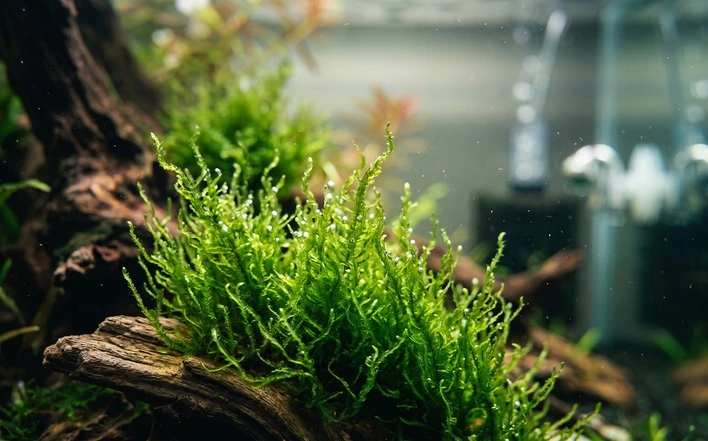
Flame moss is an aquarium moss sold as Taxiphyllum sp. ‘Flame’. Its upright shoots twist as they grow, like small green candle flames. The “sp.” means the species was never named.
No herbarium holds a voucher specimen. GBIF returns 0 records for “Taxiphyllum flame”, and GenBank holds no DNA sequence. iNaturalist has no taxon for it. Dennerle states that the moss “has not yet been definitively classified”.
Where flame moss came from
The earliest dated description sits on aquamoss.net, a Singapore hobby site last updated in October 2006. It opens: “Yet another new Taxiphyllum species available recently in our aquarium shop.” The writer named the moss after its fronds, which “grow straight up” and twist like a candle flame.
The site belongs to Tan Sze Wei, a Singapore hobbyist whose photos appear in Janice Glime’s academic bryology e-book. It is often credited to Loh Kwek Leong by mistake. Loh co-wrote a separate paper on aquarium mosses with the bryologist Benito C. Tan.
No wild locality has ever been recorded. Growers say only “Asia” (Tropica) or “South East Asia” (Dennerle). Flame moss is known only from aquariums.
Why the Taxiphyllum label is a guess
Singapore hobbyists and Dr Benito Tan sorted the trade mosses between 2004 and 2007 by leaf-cell shape. Taxiphyllum has narrow, oblong cells. Vesicularia has short, wide cells. The Taxiphyllum label on flame moss dates from that era, and no DNA test has checked it.
The same test once placed Java moss in Taxiphyllum. A DNA study published in Cladistics then moved it: “The aquarium species T. barbieri is transferred to Ectropothecium” (Wynns et al., 2018). GBIF now lists Taxiphyllum barbieri as a synonym of Ectropothecium barbieri.
The Java moss that was sequenced grew in a Dutch greenhouse. GenBank record KY562819 gives its source as “Netherlands: greenhouse”, collected on 17 April 2012. The botanist who coined the name in 1982 had examined specimens sent from aquaria in Japan and the USA.
A label that reads “flame moss, a relative of Taxiphyllum barbieri” therefore repeats two outdated assumptions. The accurate label is Taxiphyllum sp. ‘Flame’, species undetermined.
This is why flame moss care sheets disagree. Most copy figures for a plant that nobody has tested in a lab.
Moss names have drifted from the start
In 1982, Japanese bryologists noted that Java moss was often sold in shops as “willow moss”. Willow moss is Fontinalis antipyretica, a cold-water stream moss.
A second trade label, Taxiphyllum sp. ‘Long Flame’, appears in some listings today. No source shows whether it is a separate clone.
Flame moss is a moss, not a liverwort
Flame moss is a leafy moss. Its shoots carry stems and tiny leaves, and rhizoids hold the base to wood or stone. Liverworts such as Riccia fluitans and Ricciocarpus natans grow as flat, forked thalli instead.
Older aquarium books file both groups under moss (Kasselmann, 2003, and Hiscock, 2003), and the mix-up survives in shops. The difference matters for care, since Riccia needs intense light and flame moss grows in low light.
The name also collides with unrelated plants. Garden “scarlet flame” phlox and the land moss Ceratodon purpureus, known as fire moss, are different organisms.
Flame moss vs Java moss vs Christmas moss
The three mosses separate by growth habit after 4 to 8 weeks underwater. Before that, emersed or lab-grown stock can resemble any of them.
| Trait | Flame moss | Java moss | Christmas moss |
|---|---|---|---|
| Scientific name | Taxiphyllum sp. ‘Flame’, unidentified | Ectropothecium barbieri, formerly Taxiphyllum barbieri | Vesicularia montagnei |
| Growth form | Upright shoots, few branches, twisting tips | Irregular strands that branch and spread in all directions | Drooping, triangular fronds shaped like a small fir |
| Sideways spread | Slow | Fast, covers whole surfaces | Not measured |
| Leaf cells under a microscope | Never described in print | Narrow and oblong | Short and wide |
| Best use | Branch tips, stone tops, shrimp tanks | Any surface, beginner tanks | Moss trees and walls |
| Evidence base | Trade sheets and keeper reports | Peer-reviewed lab studies | Some lab studies |
A keeper on Reddit sums up the field test: “If pointing upwards then flame moss. If it branches then java moss.” Check three marks after week 8. Shoots rise from the clump, carry few side branches, and twist slightly near the tip.
Shoots that fork into flat triangles point to Christmas moss. A clip-on phone microscope can rule out Vesicularia by its wide cells. No test confirms flame moss itself.
Erect moss (Vesicularia reticulata) also grows upright, but it branches heavily and ends in pointed tips. Flowgrow notes that an upright Taxiphyllum is sometimes sold under the erect moss name, so the labels swap both ways.
Flame moss care requirements
Flame moss survives a wide range of tanks. Its shape is the sensitive part. Light, temperature, carbon and flow decide whether the shoots stand up or sprawl.
Lighting
Low light is enough. Aquatic mosses need very little light to grow, and the 2Hr Aquarist reports mosses spreading at 10 µmol PAR. Aim for 20 to 40 PAR at the moss without CO2, and 40 to 80 PAR with injection. The aquarium light guide explains how to measure PAR at a given depth.
Strong light is unlikely to burn the moss itself. In a 2025 lab study, Java moss, the best-studied aquarium moss, kept or raised its pigments under 600 µmol of light. Damage at high light comes from algae, which settles on slow-growing moss first.
Closer to the light is therefore worse in a low-tech tank. A UKAPS keeper found that the clump “furthest away from the light” grew the most. Another keeper describes moss placed high in full light as “hair algae city”.
Mount moss below the brightest zone, and light it from directly above. Side light makes the shoots lean. Keep the photoperiod at 6 to 8 hours.
Water parameters and temperature
Flame moss tolerates most aquarium water. The upright form is easiest at 20 to 25°C, pH 6.0 to 7.5, in soft to moderately hard water. Keep ammonia and nitrite at 0, and change 30 to 50% of the water weekly.
The advice that mosses “like cool water” comes from a different kind of moss. Lab work on temperate stream mosses found growth optima in the 0 to 20°C range. Stringy moss (Leptodictyum riparium) grows best at 23°C and dies at 33°C (Sanford, 1979).
Tropical aquarium mosses behave differently. Glime notes that Java moss thrives at 28 to 30°C. Java moss also held its pigment at 24°C under strong light in the 2025 study. Keepers still report flame moss failures clustering at 29 to 30°C, and one advises: “if you want nice green moss in SEA you gotta run chiller”.
Heat is therefore a quality risk, not a proven killer. Above about 27°C, expect looser, slower and more branched growth. In stringy moss, heat stress “resulted in a proliferation of branches”, and branching erases the flame shape. That link is untested in flame moss itself.
Set the aquarium heater to 22 to 24°C. In hot weather, a fan across the water surface cools the tank by evaporation.
Hard, alkaline water slows moss in a less obvious way. Most aquatic mosses cannot use bicarbonate, so they depend on dissolved CO2 (Bain and Proctor, 1980, 20 species tested). As pH rises, free CO2 falls toward zero.
Seiryu stone leaches calcium carbonate and raises KH and pH over time. A tank with a large seiryu pile and no CO2 starves moss of carbon, while stem plants that use bicarbonate carry on.
Nitrate of 5 to 20 mg/L is a sensible starting value. No trial has tested an optimum. One keeper with 0 nitrate, pH 8 and very hard water reported “intense yellowing” over five months.
CO2 and fertiliser
Injected CO2 is optional. Tropica, Dennerle and Garnelio all list it as low or unnecessary, and many keepers grow flame moss in low-tech tanks. CO2 does make the moss grow faster and denser, since moss relies on dissolved CO2.
Glime reports better growth with injection at up to 15 to 30 ppm. Stable CO2 matters more than a high level, because swings in CO2 trigger algae.
Feed the water, not the substrate. Mosses take up nutrients “not through rhizoids, but through leaves” (Glime). Root tabs do nothing for moss on wood or stone. One popular care page says flame moss takes nutrients from the soil, which is wrong.
Dose a lean, complete liquid fertiliser weekly in low-tech tanks. Dose daily or twice weekly, at a steady rate, in tanks with injected CO2.
Keep copper out of a moss tank
Copper at 80 µg/L for 12 days damaged chlorophyll in an aquatic moss, and the damage rose with temperature. Excess copper also damaged pigments and membranes in Java moss (Bačkor et al., 2023).
Some snail treatments, medications and fertilisers contain copper. Read the label before dosing any tank with moss in it.
Water flow
Flow is a carbon supply for moss. Stream mosses rarely run short of CO2, because moving water keeps replacing it at the leaf surface. In a low-tech tank, gentle and even flow across the moss can matter more than another hour of light. Flow also lifts debris before it feeds algae.
Strong flow tears loose moss away. One buyer reported a $20 container of flame moss blown around the tank within an hour of planting. Aim outlets across the moss, never straight into fresh portions.
A sponge filter, or a prefilter sponge on the intake, catches stray fragments. Blow debris out of the clumps weekly with a turkey baster.
How to plant and attach flame moss
Flame moss attaches, but slowly and only at the base. The shoots grow up rather than creeping, so a fresh clump touches the surface at few points. Vendors describe “strong adhesive organs”, and a UKAPS veteran says it does not attach “as such”. Both are right about different stages. Fix the moss in place for the first 4 to 8 weeks.
- Rinse tissue-culture moss under dechlorinated water until no gel remains. Leftover gel can cloud the water or trigger algae, and Dennerle’s own instructions say to rinse it off.
- Split the moss into pea- to fingertip-sized portions.
- Leave gaps of 1 to 3 cm between portions. Separate portions grow into distinct flames, while one large wad sprawls and browns at the centre.
- Place the portions on horizontal tops and branch tips. Tropica calls the moss “very suitable for horizontal surfaces”.
- Switch the filter off while working, and net stray pieces before restarting it.
- Wait about a week before adding fish or shrimp, as Glime suggests, so the moss can start to attach.
Gluing flame moss
Use gel-type ethyl cyanoacrylate. Put a thin dot on the hardscape, press a thin layer of moss onto it for 10 to 20 seconds, and return the piece to the tank. Gel glue works best on damp rock (Randall, 2016).
The glued contact points die, and the rest of the portion grows on. A video with over 250,000 views claims that superglue kills moss. It kills only the tissue it touches. A blob soaked through a thick clump kills the clump.
Cured cyanoacrylate is not fully inert. It slowly breaks down into formaldehyde, and ethyl types are more toxic to cells than long-chain types in lab tests. The amount released from a few dots has never been measured in an aquarium.
Tying flame moss with thread or line
Dark cotton thread blends in and rots away once the moss holds (Randall, 2016). It can rot before slow moss anchors, so check it at week 3 and retie if needed.
Fishing line lasts, but it must be cut away later. Randall warns that line can tangle and injure Corydoras and loricariid catfish. Avoid it in a pygmy corydoras tank.
Mounting flame moss on mesh
Stainless steel or plastic needlepoint mesh holds moss flat without glue. Sandwich a thin layer between two sheets and tie the edges. Mesh suits carpets, walls and removable moss tiles for shrimp tanks.
A tile lifts out for trimming. To net shrimp, one keeper shakes the tile and lifts it out.
Flame moss on wood and rock
| Hardscape | How flame moss does on it |
|---|---|
| Driftwood and branch wood | The classic look is flames rising from branch tips. Dennerle says moss on thin root branches creates “an incredibly attractive look” |
| Cholla wood | The open lattice gives many anchor points |
| Lava rock | The porous surface gives rhizoids the best grip. Moss can be wedged into the holes |
| Dragon stone (ohko) | Textured surface, and glue holds well |
| Seiryu stone | Raises KH and pH over time, which cuts dissolved CO2. Use it sparingly in moss tanks without CO2 injection |
How fast does flame moss grow?
No measured growth rate for flame moss exists. Tropica’s specification gives 3 to 10+ cm of average height after two months. Keeper reports range from “about 1-1.5cm in 5 months” (UKAPS, 2009) to trimming every month in a 10 L shrimp tank.
The closest hard number comes from a 2025 study of mosses as biofilters for life support on Mars. Java moss tips grew 50 to 200% in length per month. Flame moss has never been measured that way, and the evidence fits a moss that is slow to establish and moderate once established.
| Time underwater | What to expect |
|---|---|
| Weeks 0 to 4 | Little visible growth. Mild browning is normal after shipping |
| Weeks 2 to 6 | First grip on the surface. Lab-grown moss may still look like Java moss |
| Weeks 4 to 8 | Clear vertical shoots appear |
| Months 3 to 6 | Dense clumps that need thinning |
How to grow a flame moss carpet
A flame moss carpet works, but it grows into a shag carpet about 3 to 8 cm tall. Flame moss grows up, not out. Coverage comes from spreading the moss thinly and evenly at the start.
“Flame carpet” is not a separate plant. Every aquarium use traces back to flame moss grown or sold flat, usually on 3 by 3 inch stainless mesh pads. The shag-carpet comparison dates back at least to 2009, when a PlantedTank thread warned of “quite the long and tall shag carpet”.
- Cut stainless or plastic mesh to the shape of the foreground.
- Chop the moss finely and spread it about 1 cm thick across 80 to 100% of the mesh.
- Lay a second mesh on top, or tie the moss down with thread. Loose moss floats.
- Pin the pads under substrate or hardscape so the edges cannot lift.
- Give the carpet at least 25 PAR at substrate level, since a flat mat sits farthest from the light.
- Trim high spots back to 3 to 4 cm every 4 to 8 weeks.
- Siphon every fragment after trimming.
Expect 3 to 6 months from a full-mesh start, a low-confidence estimate from keeper reports. One shrimp keeper grew a 50 by 40 cm flame moss carpet. Many others abandon the attempt, and one keeper calls a moss carpet “a nightmare for tank maintenance”.
Long growth kills the base, and the mat then lifts off the mesh. One keeper warned that this leaves “moss everywhere forever in your tank”. A flat mat also catches falling mulm, so blow it out weekly.
How to trim and propagate flame moss
Trimming advice splits even inside one supply chain.
Where the experts disagree
Garnelio sells Dennerle’s lab-grown cup and calls pruning “rather counterproductive”, since cut shoots branch and the flame effect is lost. Dennerle, which grows the moss, says that “radical pruning is possible at any time”. Aquarium Plants Factory says each cut thickens the flame effect.
Nobody has published data on it. The method below combines the points that all three sources can accept.
- Thin the clump rather than shearing it. Remove whole shoots at the base from crowded areas with fine scissors or tweezers. The remaining flames stay unbranched, and light reaches the base.
- Shear the tips only to reset a shaggy or algae-covered clump. Expect it to bush out before it flames again.
- Trim outside the tank when the stone or branch can be lifted. Otherwise switch the filter off and siphon fragments at once.
- Check monthly. Thin when the flames pass 5 to 8 cm or when the base starts to brown.
- Re-mount fresh tips every 6 to 12 months on show tanks.
Every clipping can start a new colony. Aquarium Java moss formed no spore capsules in a 2024 culture study, and no capsules have been reported on flame moss. Both spread by fragments. Tie clippings onto new wood or stone, or trade them. Hobby swap listings price a golf-ball-sized portion at about $3.
The same biology explains stray patches, since a missed fragment roots wherever it lands.
Flame moss problems
Flame moss not flaming or growing sideways
This is the most common complaint. In a NanoFishNest review of about 1,650 Reddit comments on flame moss, roughly 85 described sideways growth. Another 11 raised mislabelling outright. One buyer asked, “Did I get scammed?”
Mislabels do happen. Stores often buy unlabelled bulk moss, then “look at what comes closest and name it”, a UKAPS member explains. Often, though, new flame moss is still adapting. Mosses grown above water “become unrecognisable from their submersed” form (Tan et al.).
One Reddit keeper records the usual timeline. The moss pointed up after about six weeks “and a few haircuts”.
Work through these in order:
- Time underwater. Wait until week 6.
- Light angle. Move the moss under overhead light.
- Thickness. Re-mount thick clumps as thin portions.
- Temperature. Bring the tank under 26°C.
- Flow. Shield the shoots from outlets.
If shoots still branch irregularly after week 8 under overhead light, the moss is probably Java moss. Named tissue culture cuts that risk next time.
Flame moss turning brown or yellow
Brown bases under green tips usually mean shade, not disease. New growth blocks light to the old shoots underneath. Clumps taller than about 5 cm brown from the bottom. Thin them from the base.
Whole portions that brown within 1 to 3 weeks of planting are usually in transition. Leave them in place. One keeper had written off glued moss and wrote: “Imagine my shock when 2 months later I see green sprouts!”
Yellowing has several causes. Heat, a spot under very strong light, nutrient poverty, emersed growth and recent liquid carbon can all cause it. Check temperature first, then light position, then the dosing log. Change one variable at a time.
Slimy, translucent tissue that falls apart is rot. Remove it, cool the tank, and change water. Sudden browning across the whole tank points to a toxin. Check recent medications for copper, and any liquid carbon or peroxide dose.
Dry, brown moss can return. One keeper re-submerged driftwood after months out of water, and the moss grew back. Keep firm brown material in place for 6 to 8 weeks before discarding it.
Algae in flame moss
Algae is the main reason moss tanks lose their looks, according to the 2Hr Aquarist. Slow moss sits still while algae grows over it, and moss placed high in the light suffers first.
| Problem | Fix | Avoid |
|---|---|---|
| Hair algae | Twirl it out with a toothbrush, cut off the top layer, lower or shade the moss, add Amano shrimp, cut the light by 1 to 2 hours | Raising the light |
| Black beard algae | Remove the affected moss, replace it with fresh tips, stabilise CO2 | Spot-dosing liquid carbon or peroxide on the moss |
| Cyanobacteria | Raise flow, siphon the sheets, consider a 3-day blackout | Dead-water corners |
| Trapped debris | Turkey baster weekly | Overfeeding |
Spot-dosing is a common way keepers lose established moss. One keeper spot-treated black beard algae with Excel, and “while it killed the BBA it also took out a lot of my moss”. Seachem, which makes Excel, does not market it as an algicide. Whole-tank dosing at the label rate is tolerated in many tanks.
Flame moss floating
Floating moss has too little contact or too much flow. Tie or glue thin portions, use mesh on flat areas, and turn outlets away. Siphon free pieces daily in the first week, since each one can root somewhere else.
Best tank mates for flame moss
Shrimp and flame moss suit each other. Neocaridina and Caridina graze the biofilm on the shoots, and shrimplets hide inside. One keeper calls the moss “the perfect little baby nursery”.
| Animal | Effect on flame moss |
|---|---|
| Neocaridina and Caridina shrimp | Graze biofilm and shelter shrimplets |
| Amano shrimp | Clean algae from moss without eating it, when other food is plentiful (Glime) |
| Celestial pearl danios, killifish | Use moss as spawning and hiding cover |
| Fry of nano fish | Shelter among the shoots |
| Snails | Graze the surface film. A few individuals eat moss |
| Siamese algae eater | Eats moss. One UKAPS keeper lists Java, Christmas and flame moss among its meals |
Celestial pearl danios scatter eggs into fine plants, and dense moss gives the fry cover. Feed fry separately with microworms, since moss alone does not feed a brood.
Where to buy flame moss
Buy tissue culture from a named grower. Tropica’s 1-2-GROW! cup (003HTC) and Dennerle’s In-Vitro cup are lab clones, which cuts the mislabel risk. A Reddit keeper who switched recalls: “my tissue culture flame moss looks amazing.”
Portions from shops and swaps cost less. Hobby listings price a golf-ball-sized portion at $3 to $5, and one buyer paid $20 for a small container. Garnelio sells an XXL in-vitro cup for €12.99.
Signs of healthy moss:
- Bright green, firm tips
- No slime and no rotten smell
- No algae threads or black tufts
- Only a few brown strands, which are normal after shipping
In winter, ask for a heat pack, since cold shipping can melt moss. Rinse off all gel on arrival. The name “flame moss” carries no genetic guarantee, because nobody has compared Tropica, Dennerle and Asian farm stock.
Flame moss myths checked
| Claim seen online | What the evidence shows |
|---|---|
| Flame moss is a variety of Java moss (Taxiphyllum barbieri) | No source supports it. Java moss is now Ectropothecium barbieri |
| It comes from cold river water | No wild habitat has ever been recorded |
| Strong light fries it | Light harms moss through algae. Java moss tolerated 600 µmol in a lab |
| It never exceeds 3 inches | Tropica gives 5 to 15 cm |
| It needs plenty of CO2 | Every grower lists CO2 as optional |
| Superglue kills moss | Glue kills the tissue it touches, not the clump |
| It feeds through its roots | Mosses feed through their leaves |
| 12 to 30°C and pH 5 to 8 are tested limits | The range comes from one database and no trial |
The six-week rule
The moss in the cup has no species name and no wild address. It still responds to four levers: light from above, cool water, thin portions, and time. Photograph the clump on planting day from a fixed angle. Compare the photo at week 6 before changing anything.
Flame moss FAQ
Does flame moss need CO2?
No. Flame moss grows in low-tech tanks, and growers list CO2 as optional. Stable injection at about 15 to 30 ppm makes it denser and faster. Most aquatic mosses use only dissolved CO2, so gentle flow helps in tanks without injection.
Can flame moss grow out of water?
Yes, in high humidity. It grows emersed in terrariums, wabi-kusa and dry starts, but slowly and less upright. Garnelio notes it “does not grow quite as tightly upright” in terrariums. The upright form returns a few weeks after the moss goes back underwater.
Is flame moss slow growing?
Yes, at first. Expect little growth for 2 to 4 weeks, upright shoots by weeks 4 to 8, and clumps that need thinning by months 3 to 6. Tropica lists 3 to 10+ cm after two months.
How tall does flame moss grow?
Shoots reach 5 to 15 cm (Tropica), and Dennerle lists up to 10 cm. Untrimmed clumps grow taller, but the lower parts brown from self-shading.
Does flame moss attach by itself?
Slowly. Rhizoids form at the base of the shoots, but a fresh clump has little contact and floats away. Glue or tie thin portions first. Most hold within 4 to 8 weeks.
Is flame moss good for shrimp?
Yes. Shrimp graze the biofilm on it, and shrimplets hide in it. Siamese algae eaters and some snails may eat it.
What temperature does flame moss need?
About 20 to 25°C (68 to 77°F) gives the most upright form. It survives warmer water, but growth turns loose and slow above about 27°C.
Is flame moss a liverwort?
No. Flame moss is a leafy moss with stems, leaves and rhizoids. Riccia and Ricciocarpus are liverworts with flat thalli, and older books list them as moss.
Sources
- Tan, Loh and Gan, “A Case of Mistaken Identity?”, Singapore Scientist (2004 or 2005)
- Tan Sze Wei, aquamoss.net, Flame Moss (last updated October 2006)
- Glime (2017), Aquaria, Bryophyte Ecology Vol. 5, Ch. 4
- Glime, Nutrient Relations: CO2, Bryophyte Ecology Vol. 1, Ch. 8-2
- Iwatsuki (1982), A new combination of an Asiatic species in Taxiphyllum
- Takaki, Watanabe and Iwatsuki (1982), Bryophytes in aquariums for tropical fish
- Wynns, Munk and Lange (2018), Cladistics 34: 469 to 501
- GenBank KY562819, Ectropothecium barbieri voucher
- GBIF Backbone 2682670, Taxiphyllum barbieri (synonym)
- Anglana et al. (2024), aquatic mosses in axenic culture, Aquatic Botany
- Bain and Proctor (1980), free CO2 in aquatic bryophytes, New Phytologist
- Sanford (1979), temperature and growth in Amblystegium riparium, The Bryologist
- Amitrano et al. (2025), the moss on Mars project, Frontiers in Plant Science
- Bačkor et al. (2023), copper toxicity in Taxiphyllum barbieri, Plants
- Tropica, Taxiphyllum sp. ‘Flame Moss’ (003HTC)
- Dennerle Plants, Taxiphyllum spec. ‘Flame Moss’
- Garnelio, 1-2-Grow Flame Moss
- Flowgrow, Taxiphyllum sp. ‘Flame Moss’
- Buce Plant, Flame Moss on stainless steel mesh
- Nature Aquariums, Flame Moss Portion (20 to 50 PAR)
- The 2Hr Aquarist, How to grow mosses in the aquarium
- UKAPS, I could use a little advice on flame moss (2009)
- UKAPS, Best way to help my moss spread (2019)
- PlantedTank.net, Flame moss carpet (2009)
- Kasselmann, C. (2003). Aquarium Plants. Krieger Publishing
- Hiscock, P. (2003). Encyclopedia of Aquarium Plants. Barron’s
- Randall, K. A. (2016). Sunken Gardens. Timber Press