The harlequin rasbora lays its eggs upside down. The female turns belly-up beneath a broad leaf, the male curls his body over hers, and the eggs stick to the underside of the leaf. Broad-leaved plants belong in every harlequin tank for that reason. Otherwise the species is easy to keep. It needs a school of 8 or more, a tank at least 60 cm (24 in) long, dim light, and soft to moderately hard water. Breeding is harder, since spawning needs very soft, acidic water and a separate tank.
Harlequin rasbora quick facts
| Fact | Figure |
|---|---|
| Scientific name | Trigonostigma heteromorpha (formerly Rasbora heteromorpha) |
| Family | Danionidae (Cyprinidae in older references) |
| Adult size | 3 to 4 cm (1.2 to 1.6 in), rarely 5 cm (2 in) |
| Origin | Peninsular Malaysia, Singapore, and Sumatra |
| Temperature | 23 to 28°C (73 to 82°F) |
| pH | 5.5 to 7.0 |
| Hardness | 2 to 10 dGH |
| Tank | At least 60 cm (24 in) long, about 15 gallons |
| Group | At least 8; 10 or more is better |
| Diet | Micropredator; eats flake, micro-pellets, and small frozen or live foods |
| Temperament | Peaceful |
| Lifespan | 5 to 8 years in classic references; keepers more often report 3 to 5 |
| Care level | Easy to keep, moderately difficult to breed |
Appearance and the black “pork chop” patch
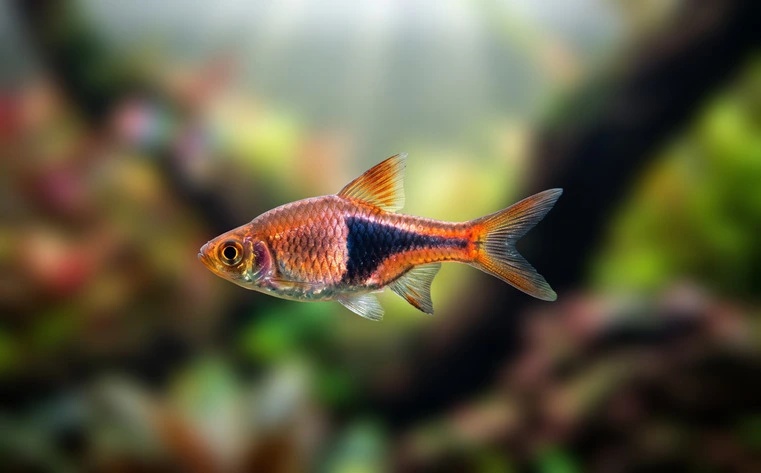
The body is a metallic copper-orange to pinkish red. A large blue-black wedge starts below the dorsal fin and tapers back to the base of the tail. Hobbyists call it the “pork chop” patch. Most adults measure 3 to 4 cm in total length. The largest documented specimen measured 35 mm from snout to tail base, about 5 cm including the tail (Tan, 2020).
Purple, black, and gold harlequins
Purple, black, gold, and blue harlequins are captive color forms or trade names for the same species. Blue and gold strains arose as mutations in breeding stock and were fixed by line breeding (Aquarium Glaser, 2015). The origin of the black and purple forms is undocumented. Well-conditioned standard harlequins also show a purplish sheen, so a “purple” label may describe nothing more than good color. Care is identical for every form.
Harlequin or look-alike
Three relatives are sold under similar names. Check the wedge before buying.
| Species | Wedge | Body | Other clues |
|---|---|---|---|
| Harlequin (T. heteromorpha) | Broad triangle, reaches the tail base | Copper to pinkish red | Steep forehead, clear anal fin |
| T. truncata | Stops 1 to 2 scales short of the tail | Pale, bluish-lilac sheen | Orange-red anal fin |
| Lambchop (T. espei) | Thin, starts further back | Copper to red | Slimmer body |
| T. hengeli | Thin, edged with a bright orange line | Greyish | Often sold as glowlight rasbora |
T. truncata was described in 2020 from fish that had been sold as harlequins. Its describer wrote that the two “were misidentified” because they look so alike (Tan, 2020). Fish labelled as wild harlequins from southern Thailand are very likely T. truncata.
Origin and natural habitat
The species comes from peat swamps and slow forest streams in Peninsular Malaysia, Singapore, and Sumatra. Older references, including classic encyclopedias, also list southern Thailand. Those Thai populations are now classed as T. truncata. The water is shaded by forest canopy and stained brown with tannins from decaying leaves. It is soft and acidic, with a measured pH of 4.6 to 5.5 in Singapore’s Nee Soon swamp forest.
Dense Cryptocoryne, leaf litter, and gentle flow complete the habitat. Shade and cover are the parts to copy in the aquarium. Farm-bred fish do not need pH 5, but they stay pale and nervous without them.
Tank size and setup
A 60 cm (24 in) long tank is the practical minimum, since harlequins swim constantly in open midwater. Classic references accept 10 to 15 gallons for a small school. A standard 10-gallon measures only 50 cm (20 in) long, shorter than the 60 x 30 cm base that specialist sources set as the floor (Seriously Fish). Length counts for more than volume, so a 20-gallon long beats a 20-gallon high.
| Tank | Footprint | Species-only tank | With tank mates |
|---|---|---|---|
| 10 gal | 50 x 25 cm (20 x 10 in) | Not recommended | Not recommended |
| 15 gal or 20 high | 60 x 30 cm (24 x 12 in) | 8 to 10 | 8, plus shrimp or snails |
| 20 long | 76 x 30 cm (30 x 12 in) | 10 to 14 | 8 to 10, plus 6 pygmy corydoras |
| 29 gal | 76 x 30 cm (30 x 12 in), taller | 12 to 15 | 10 to 12, plus a small community |
| 40 breeder or larger | 91 x 46 cm (36 x 18 in) | 15 to 25 | Full community |
For smaller tanks, chili rasboras are the better choice. Run the numbers for a specific tank in the aquarium fish stock calculator.
Furnishing the tank
- Substrate: Dark sand or gravel brings out the red and the black.
- Plants: Dense planting with broad-leaved species such as Cryptocoryne, Anubias, and Java fern. Leave open water in the middle.
- Floating plants: A layer of floating plants dims the light and makes the school less nervous.
- Wood and leaves: Bogwood and dried leaves release tannins. Replace leaves every few weeks, since a heavy organic load fouls the water.
- Lighting: Subdued.
- Filtration: Gentle flow. A sponge filter or a spray bar works well. Harlequins avoid strong currents.
- Cycling: Cycle the tank before adding fish. A new biofilter can take up to 8 weeks to establish (Merck Veterinary Manual).
Water parameters
| Parameter | Keeping | Breeding |
|---|---|---|
| Temperature | 23 to 28°C (73 to 82°F) | 26 to 28°C (79 to 82°F) |
| pH | 5.5 to 7.0 | 5.5 to 6.0 |
| GH | 2 to 10 dGH | 1 to 2 dGH |
| Ammonia and nitrite | 0 | 0 |
| Nitrate | Under 20 mg/L | Under 20 mg/L |
Nearly every harlequin in the trade is farm-bred, and farm-bred fish adapt to neutral or slightly alkaline water. Soft, acidic water matters only for breeding. In very soft water with no carbonate hardness (KH), the pH can crash. A large water change then raises the pH suddenly and turns stored ammonia toxic. Keep KH at about 3 dKH (50 mg/L) or higher, the level below which water buffers pH poorly (Merck Veterinary Manual). Change 25% of the water weekly.
Diet and feeding
Wild harlequins are micropredators that eat small insects, worms, crustaceans, and zooplankton. In the aquarium they accept prepared food readily.
Use quality flake, crushed for small mouths, or micro-pellets as the staple. Add frozen or live Daphnia, brine shrimp, bloodworms, or mosquito larvae several times a week. A home Daphnia culture supplies live food cheaply. Feed once or twice a day, only what the school eats in 2 to 3 minutes.
Live and frozen foods give the best color and condition. Overfeeding shows up as leftover food on the substrate and rising nitrate.
Harlequin rasbora tank mates
Harlequins are peaceful and ignore other fish. Compatibility depends on the tank mate’s temperament, size, and water needs.
| Tank mate | Verdict | Condition or risk |
|---|---|---|
| Small tetras (neon, ember) | Good | Keep neons at 23 to 25°C, the cool end of the harlequin range |
| Pygmy corydoras and other small corydoras | Good | Keep at 26°C or below |
| Kuhli loaches | Good | Need soft sand and hiding places |
| Other small rasboras | Good | Chili rasboras are slower at feeding time |
| Sparkling gourami, honey gourami | Good | Dense planting |
| Dwarf gourami | Conditional | One male only, and quarantine strictly, since iridovirus is reported in the species |
| Betta | Conditional | Depends on the individual betta; needs a tank of 20 gallons or more |
| Cherry shrimp | Adults safe | Shrimplets get eaten, so add dense moss for cover |
| Amano shrimp | Safe | Adults are too large to eat |
| Guppies | Poor match | Guppies prefer harder, more alkaline water |
| Angelfish | Avoid | Adults eat small fish |
| Tiger barbs | Avoid | Known fin biters |
| Large or aggressive fish | Avoid | Harlequins are prey |
Bettas
Harlequins are among the most common betta companions, but the outcome depends on the betta. Many Betta splendens tolerate a school. Others chase it constantly. Use a planted tank of 20 gallons or more, keep a full school, and have a backup tank ready.
Shrimp
Adult cherry and Amano shrimp are safe. Baby shrimp are small enough to eat, so a colony grows more slowly with harlequins present. See shrimp-safe fish for alternatives.
Keeping one or two
A single harlequin, or a pair, stays stressed and hides. Schools of 10 or more show more natural behavior and better color.
Male vs female
| Trait | Male | Female |
|---|---|---|
| Body | Slender | Plumper and deeper, especially when full of eggs |
| Color | Brighter red | Paler, more golden |
| Wedge | Sharper outline; the lower front corner extends slightly down toward the belly | Lower edge straighter or slightly rounded |
Body shape is the most reliable sign in adults. Sources describe the wedge differences in conflicting ways, so treat them as a second clue. Sexing is unreliable before about 6 months of age. A round-bellied female is full of eggs, since harlequins never bear live young.
How to breed harlequin rasboras
Breeding is moderately difficult. A pair needs a broad leaf to spawn under and very soft water, and the parents eat their own eggs.
- Condition the pair. Feed live and frozen foods heavily for one to two weeks. A ready female looks visibly full, and a ready male shows his strongest color.
- Set up a breeding tank. Use a separate small tank with very soft water (1 to 2 dGH), pH 5.5 to 6.0, and a temperature of 26 to 28°C. Keep the light dim. Add broad-leaved plants such as Cryptocoryne or Anubias, and a gentle sponge filter.
- Introduce the fish in the evening. Use a pair, or two males with one female. Spawning usually starts the next morning.
- Watch for the upside-down spawn. The male courts the female with a dancing display. She turns upside down beneath a leaf and presses her belly against it. The male wraps his body over hers, and eggs and sperm are released together.
- Count on 80 to 200 eggs. A female lays about 6 to 12 adhesive eggs per embrace and repeats until she is spent. The eggs are 1.2 to 1.3 mm across and nearly transparent.
- Remove the parents immediately. They show no parental care and eat any eggs they find.
- Keep the tank dark. Eggs hatch in about 24 hours. Remove white, unfertilized eggs.
- Feed the fry. The fry hang from the leaf or glass for 3 to 4 days while they absorb the yolk sac. Feed infusoria or liquid fry food for the first week, then newly hatched brine shrimp or microworms.
Fry reach about 1.5 cm at one month and 2.5 cm at three months. Change small amounts of water often, since fry react badly to sudden changes. One breeder report describes normal egg development at pH 6.8 to 7.4 and 3 to 5 dGH (Elias and Podvesky), so very low hardness may matter more than very low pH. More on the method in the nano fish breeding guide.
Common problems and what causes them
Test the water first. Ammonia, nitrite, and a crashed pH produce the same signs as disease, so rule them out before treating.
| Problem | Likely causes | First step |
|---|---|---|
| Constant hiding | School too small, bright light, bare tank, a bully | Add floating plants and grow the school to 10 or more |
| Losing color | Stress, bright light, pale substrate, poor water | Test the water, then darken the tank and vary the diet. See why nano fish lose color |
| White spots | Ich, or Epistylis in water rich in organic waste | Ich spots look like grains of salt; a microscope confirms it before treating |
| Deaths after purchase | Shipping stress in the first week, an uncycled tank, ich appearing 1 to 3 weeks later | Test ammonia and nitrite, then quarantine new fish for 30 days |
| Clamped fins, lethargy | Poor water, parasites, temperature swings | Full water test and a stable heater |
| Swollen belly | A female carrying eggs (normal), overfeeding, or dropsy if the scales stand out | Check the scales from above |
| Swimming upside down | Spawning behavior beneath a leaf | Normal, unless the fish cannot hold its position |
Ich completes its life cycle in 3 to 6 days at 24 to 26°C, so treat daily for at least 3 to 5 days. Do not use copper sulfate when alkalinity is below 50 mg/L, which is common in soft harlequin tanks (UF/IFAS).
Harlequin vs lambchop vs neon tetra
| Harlequin rasbora | Lambchop rasbora | Neon tetra | |
|---|---|---|---|
| Scientific name | Trigonostigma heteromorpha | Trigonostigma espei | Paracheirodon innesi |
| Family | Danionidae | Danionidae | Characidae |
| Origin | Malaysia, Singapore, Sumatra | Thailand, Cambodia | Amazon basin |
| Adult size | 3 to 4 cm | About 3 cm, slimmer | About 3 cm |
| Marking | Broad black triangle | Thin “lambchop” wedge | Blue stripe over red |
| Temperature | 23 to 28°C | 23 to 28°C | 21 to 25°C |
| pH | 5.5 to 7.0 | 5.5 to 7.5 | 4.0 to 7.5 |
| Swimming level | Middle to upper | Middle | Middle to lower |
| School size | 8 or more | 8 or more | 8 or more |
| Breeding | Eggs stuck under broad leaves | Eggs stuck under broad leaves | Eggs scattered |
Harlequins and lambchops are close relatives with the same care. The neon tetra is an unrelated South American characin that prefers cooler water. Harlequins are danionids, not tetras. Harlequins and neons share a tank well at 23 to 25°C.
Buying healthy harlequins
In October 2026, harlequins cost about $3 to $9 per fish in the United States and £3.50 to £5.50 in the UK. Online sellers discount groups of 6 to 12, and overnight shipping often costs more than the fish.
- Choose active fish that swim with the school, with intact fins, bright eyes, and a crisp black wedge.
- Pass on tanks with clamped fins, white spots, hollow bellies, erratic swimmers, or dead fish.
- Ask how long the fish have been in the store, and ask to see them eat.
- Buy the whole group at once, so the school forms in quarantine.
Small, pale juveniles are normal. Color deepens as the fish mature and settle.
Harlequin rasbora FAQ
How many harlequin rasboras should be kept together?
At least 8, and 10 or more for the most natural behavior and color. Smaller groups hide and fade.
Can harlequin rasboras live alone?
No, a single harlequin hides and loses color. The species lives in schools in the wild.
Are harlequin rasboras good for beginners?
Yes, farm-bred harlequins accept soft to moderately hard water, eat prepared food, and ignore other fish. A cycled tank at least 60 cm (24 in) long is the main requirement.
Can harlequin rasboras live with bettas?
Often, in a planted tank of 20 gallons or more with a full school. The outcome depends on the individual betta, so keep a backup tank ready.
Can harlequin rasboras live with shrimp?
Adult cherry and Amano shrimp are safe. Harlequins eat baby shrimp, so dense moss is needed for a colony to grow.
How long do harlequin rasboras live?
Classic references give 5 to 8 years. No study has measured it, and keepers more often report 3 to 5 years.
Are harlequin rasboras easy to breed?
No, spawning needs very soft, acidic water, broad-leaved plants, and a separate tank. The parents eat the eggs, so they must be removed straight after spawning.
Why are my harlequin rasboras hiding?
Usually a small school, bright light, or too little cover. Test the water, add floating plants, and grow the school to 10 or more.
Why are my harlequin rasboras losing color?
Stress, bright light, pale substrate, and poor water quality are the usual causes. New fish also look pale for their first weeks in a tank.
What is the difference between male and female harlequin rasboras?
Females are plumper and deeper-bodied. Males are slimmer and brighter, and the lower front corner of their wedge extends slightly toward the belly.
Are harlequin rasboras peaceful?
Yes, harlequins do not nip fins or chase other fish.
Is a harlequin rasbora a tetra?
No, the harlequin belongs to the family Danionidae and comes from Southeast Asia. Tetras are characins from South America and Africa.
How big do harlequin rasboras get?
Most adults reach 3 to 4 cm (1.2 to 1.6 in). The largest documented fish measured about 5 cm (2 in) including the tail.
References
Peer-reviewed work and reference books
- Axelrod, H. R., Emmens, C. W., Burgess, W. E. et al. The Encyclopedia of Freshwater Tropical Fishes. TFH Publications.
- Tan, H. H. (2020). Trigonostigma truncata, a new species of harlequin rasbora from Malay Peninsula (Teleostei: Danionidae). Raffles Bulletin of Zoology 68: 421–433.
- Fricke, R., Eschmeyer, W. N. and Van der Laan, R. (eds). Eschmeyer’s Catalog of Fishes. California Academy of Sciences, online version accessed October 2026.
- Permana, A. et al. (2024). Induced spawning of harlequin rasbora (Trigonostigma heteromorpha) using tiger barb stimuli. International Journal of Fisheries and Aquatic Studies 12(4): 140–144.
- Wong, H. F. et al. (2013). Checklist of the Plant Species of Nee Soon Swamp Forest, Singapore. National Parks Board, Singapore.
- Collins, R. A. et al. (2012). Barcoding and border biosecurity: identifying cyprinid fishes in the aquarium trade. PLoS ONE 7(1): e28381.
Specialist husbandry and veterinary sources
- Seriously Fish. Trigonostigma heteromorpha, Trigonostigma espei and Paracheirodon innesi species profiles (revised 2026).
- Elias, J. and Podvesky, F. Harlequin rasbora. Tropical Fish Hobbyist.
- Aquarium Glaser (2015). Trigonostigma heteromorpha Blue and Gold.
- Francis-Floyd, R., Yanong, R. and Pouder, D. Ichthyophthirius multifiliis (White Spot) Infections in Fish. UF/IFAS Extension, FA006.
- Merck Veterinary Manual. Management of Aquarium Fish; Environmental Diseases of Aquatic Animals.