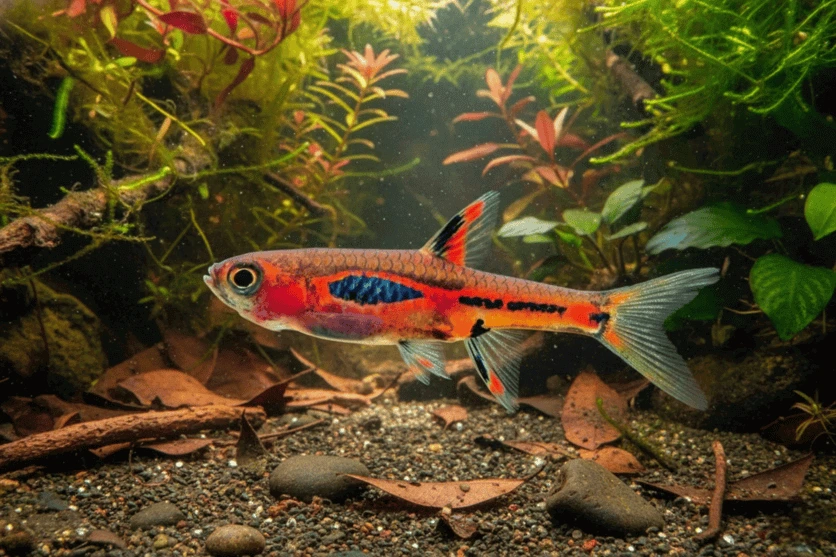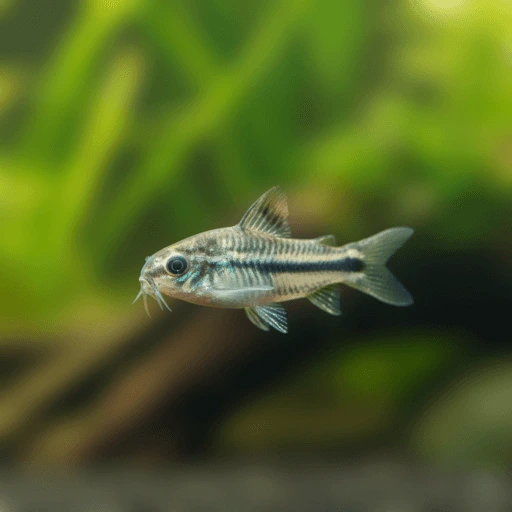
Breeding pygmy corydoras is possible in a well-maintained home aquarium, but finding eggs is only the beginning. To raise healthy juveniles, you need mature breeding fish, safe egg protection, suitable first foods and stable water.
Compare pygmy corydoras with other small species in the nano fish list.
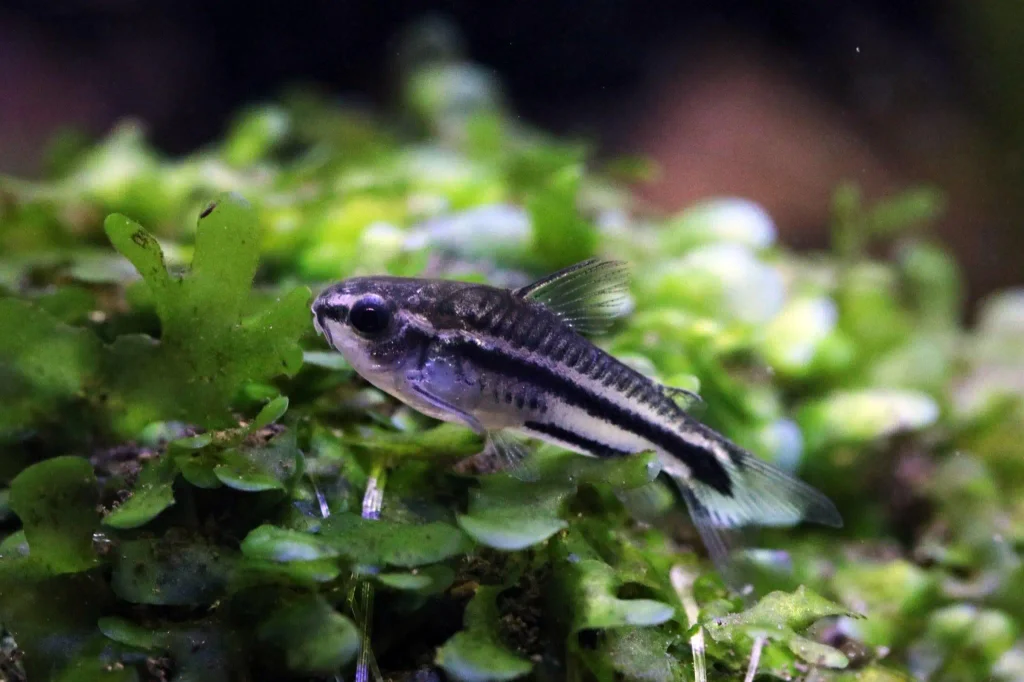
If you are searching for how to breed pygmy corydoras, begin with a useful distinction: these fish do not always need a large, cold-water change to spawn. In his species-specific account, Corydoras specialist Derek Lambourne wrote that a temperature reduction is usually unnecessary for Corydoras pygmaeus. Other aquarium guides recommend cooler water changes as a possible trigger. That makes cooling an option to evaluate carefully—not a compulsory daily procedure.
This guide puts that species-specific observation first, explains where other breeders disagree, and shows how to manage eggs and fry without relying on unsupported survival percentages or medication doses.
Pygmy Corydoras Breeding: Quick Facts
Spawning T-position Temperature 22–26 °C Breeding start About 24 °C Eggs hatch 3–4 days
| Question | Practical answer |
| Scientific name | Gastrodermus pygmaeus; formerly Corydoras pygmaeus |
| Spawning behavior | Characteristic T-position; adhesive eggs deposited individually in Lambourne’s account |
| General temperature guidance | 72–79°F (22–26°C) |
| Initial breeding temperature | Around 75°F (24°C) is a reasonable starting point |
| Water | Clean, stable; slightly acidic to near-neutral and preferably relatively soft |
| Spawning trigger | A cooling change may be tried cautiously, but is not always required |
| Egg size | About 1.75 mm in Lambourne’s species profile; his general chapter gives a conflicting larger figure |
| Hatching | About 3–4 days in Lambourne’s account; some aquarium references report 3–5 days |
| First feeding | After yolk reserves are used and fry begin foraging |
| First foods | Suitable microscopic foods; test microworms and newly hatched Artemia as fry develop |
Best starting strategy: Build a mature, planted, fry-safe aquarium and prepare food cultures before encouraging the adults to spawn. Eggs do not guarantee juveniles; feeding and water quality determine what happens next.
What Are Pygmy Corydoras? Is the Scientific Name Still Corydoras pygmaeus?
The familiar aquarium name is pygmy corydoras or pygmy cory. A 2024 phylogenomic revision recognized the genus Gastrodermus, and the species is now listed by Eschmeyer’s Catalog of Fishes as Gastrodermus pygmaeus (Knaack, 1966). The older combination, Corydoras pygmaeus, remains common in shops and breeding literature. Both names refer to the same fish.
This small South American catfish is unusually comfortable swimming in the middle of the aquarium as well as foraging near the bottom. Lambourne describes its shoaling and midwater swimming and recommends a well-planted aquarium. That matters for breeding: provide open horizontal swimming space, plants and safe surfaces rather than assuming a pygmy cory lives exclusively on the substrate.
Pygmy corydoras are egg layers. They do not guard eggs or raise their young, so other fish—and potentially adult pygmies—can consume exposed eggs or fry.
How to Sex Pygmy Corydoras: Male vs Female
Look at mature fish from above when they are calm and in good condition. Females tend to be larger and broader, especially when carrying eggs; males are usually smaller and more streamlined. Lambourne’s aquarium estimates are roughly 25 mm for males and 30 mm for females, but individuals vary. Do not turn these estimates into strict cutoffs for identifying every fish.
An enlarged belly is not automatically evidence of eggs. Consider the fish’s appetite, behavior and general health, especially if swelling appears suddenly or only one fish looks unwell.
Coloration alone is not a dependable sexing method. The original article also recommended vent examination, but the reviewed material does not establish a safe, reliable vent-based method specifically for pygmy corydoras. Avoid repeatedly catching and handling fish just to inspect them.
When are pygmy corydoras old enough to breed?
Do not wait for a supposed mandatory age of 8–12 months. Lambourne’s general breeding chapter says the species can become sexually mature at about three months; his dedicated species account says breeding can occur by four months. These are breeder observations, not a deadline every fish must meet.
Choose well-grown, visibly mature, healthy fish instead of forcing young or poorly conditioned specimens to spawn. Keep a record of age when known, body condition and actual spawning behavior.
Pygmy Cory Breeding Setup: Tank Size, Filtration and Plants
A mature species-only aquarium offers a useful balance between natural behavior and fry protection. If your goal is to collect most eggs and monitor hatching closely, a separate breeding and rearing setup provides greater control.
Tank size and group size
For a permanent adult group, a tank around 10 US gallons (38 L) or larger, with a useful horizontal footprint, is a practical starting point. Larger tanks provide more space and can make water stability easier. Some specialist references describe much smaller temporary breeding tanks; these are not recommendations for permanently housing an entire school.
Check your tank and a group of six or more with our aquarium fish stock calculator.
Correction to the previous article: A 12 × 8 × 8-inch container is not a 10-gallon aquarium. Do not label those dimensions as ten gallons.
Pygmy corydoras are social. Keep at least six, preferably ten or more, when adequate space and filtration are available. For a breeding attempt, confirm that both sexes are present. Lambourne suggests two males for each female as a general Corydoras method, but there is no controlled evidence that one exact ratio is universally best for this species. Never maintain an oversized group in a tiny tank simply to achieve a target ratio.
Filtration and oxygenation
Use established biological filtration with a fry-safe intake and gentle circulation. Air-driven sponge filters and appropriately configured box filters are convenient. Other filters can work if their intakes are effectively protected and their current does not overwhelm fry.
There is no requirement to install two or more sponge filters in every tank. Do not confuse low flow with stagnant or oxygen-poor water. An air stone can provide additional movement when needed; it is not automatically required in every properly filtered container.
Avoid under-gravel systems in an egg-and-fry tank where newborn fry could be pulled into gravel. Lambourne specifically warns about this hazard in his general breeding chapter.
Sand, bare bottom or gravel?
A thin layer of clean, smooth sand is a useful choice for normal pygmy cory foraging and may provide grazing surfaces. A bare-bottom breeding container makes eggs and leftover food easier to see and remove. Both are used successfully by breeders.
Avoid sharp, abrasive gravel and pockets of trapped waste. Healthy barbels are important for foraging and feature in Corydoras courtship. Barbel damage also has multiple possible causes, so do not attribute every case solely to substrate grain size.
Plants and spawning surfaces
Provide Java moss or another dense aquatic moss, plus plants with accessible leaves. Spawning mops can be useful removable surfaces. Glass, leaves and filter housings may all receive eggs; inspect broadly rather than expecting them exclusively in moss.
Lambourne describes pygmy corydoras as happiest in planted aquariums, but Java moss is not a biological requirement. Choose clean, aquarium-safe plants and leave a clear feeding area.
Are six or more dried leaves necessary?
No. Clean, aquarium-safe leaf litter can offer shelter and may support microscopic organisms in mature setups, but there is no evidence-based six-leaf minimum. Add botanicals conservatively and monitor water quality as they decompose. They are not a substitute for deliberate fry feeding or tested water preparation.
Best Pygmy Corydoras Temperature and Water Parameters
For normal care and initial breeding attempts, use approximately 72–79°F (22–26°C). Around 75°F (24°C) is a practical breeding starting point cited by specialist aquarium references. Maintain good oxygenation and avoid abrupt changes; anecdotal spawning at warmer temperatures does not establish 80–84°F as a superior or universally appropriate breeding range.
The following ranges are guides, not proven reproductive optima:
| Parameter | Practical approach |
| Temperature | 22–26°C / 72–79°F |
| pH | About 6.4–7.4 as a general care reference; stability matters |
| GH | Relatively soft water preferred; many references favor below 8 dGH |
| KH | Measure and avoid sudden changes, especially in low-buffering water |
| Ammonia and nitrite | Undetectable |
| Nitrate | Keep appropriately low through maintenance |
| TDS | Useful for checking consistency, not a species-specific magic threshold |
Do not claim that pH 6.0–6.5 or a TDS reading of 40–50 ppm is a scientifically verified pygmy cory breeding optimum. A recipe using 25% tap water plus 75% RO water cannot produce the same hardness or TDS everywhere: it depends on the original tap water. If RO is needed, prepare and test a consistent mixture rather than using unmixed, unbuffered water by default.
Treat municipal tap water for chlorine and chloramine as appropriate. Letting water stand is not a reliable universal chloramine treatment. Match replacement-water temperature and chemistry closely, especially around eggs and fry.
Do Pygmy Corydoras Need a Cold-Water Change to Breed?
No—not as a universal requirement. This is the most important correction to the old guide.
Lambourne’s Corydoras Catfish: An Aquarist’s Handbook specifically states in the C. pygmaeus species profile that a temperature reduction is usually unnecessary. His general breeding chapter also discusses rainy-season-style cooling as a possible technique for Corydoras broadly. Seriously Fish recommends large, cooler changes for this species. These are different kinds of sources and observations; none establishes that repeatedly changing 50–70% of the water every day is obligatory.
Start with healthy adults, varied food, a mature aquarium, suitable surfaces and normal water maintenance. Watch for courtship before trying extra stimulation. If healthy adults are not spawning and you want to test an environmental cue, make a modest, carefully matched maintenance change and record the result. Stop if the fish show distress; never repeat aggressive cooling simply because a calendar says to.
Claims that low barometric pressure, a particular hemisphere’s winter, or a compulsory 24–48-hour response guarantee spawning are not supported well enough to guide husbandry.
Conditioning Pygmy Corydoras for Breeding
New fish should acclimate and, when appropriate, complete quarantine before joining established stock. Select fish with normal behavior, intact barbels, healthy body condition and good appetites.
Offer varied, appropriately sized food: quality prepared food, newly hatched Artemia, suitable small live foods and suitable frozen foods. Baby brine shrimp are useful for conditioning but not essential as the only food. Give portions the fish will actually eat, observe their condition and remove leftovers.
There is no validated requirement for exactly two or four weeks of conditioning or for heavy feeding four times daily. Lambourne recommends variety and modest repeated feedings in the broader Corydoras chapter. Use your fish’s condition and water measurements, not a rigid countdown, to decide when to attempt spawning.
Pygmy Cory Breeding Behavior: What the T-Position Means
When spawning approaches, males may become more active and follow females. A receptive pair adopts the distinctive T-position, which Lambourne documents specifically for pygmy corydoras. The female holds eggs using her pelvic fins, then attaches them to a chosen surface.
Some reports describe the female carrying two to four eggs at a time in the fin pouch, while Lambourne records that the eggs were deposited individually. These statements need not conflict: the number briefly held is not necessarily the number attached at one spot. Do not assert a fixed number for every mating cycle.
Do pygmy cory females really drink sperm?
The unusual sperm-drinking mechanism was demonstrated in a 1995 research paper on Corydoras aeneus, a different species. That is an intriguing comparison, but the research should not be presented as direct experimental proof of the entire fertilization mechanism in pygmy corydoras. For breeding purposes, identify the visible T-position and egg placement without overclaiming species-specific physiology.
Where Do Pygmy Corydoras Lay Eggs?
Search the aquarium glass, plant leaves, moss, sheltered corners and filter housing. Pygmy cory eggs are adhesive and may be individually placed in several locations. In one enthusiast breeding account, roughly 90% were found on glass; that describes one aquarium, not a universal 90% rule.
Look behind decorations as well as on visible front glass. Inspect gently and avoid repeatedly dismantling the aquarium while fish are still spawning.
What do pygmy corydoras eggs look like?
Expect tiny, rounded, adhesive eggs that may look translucent or lightly colored when fresh. Developing embryos may become visible with close observation. An opaque or fuzzy egg may be deteriorating, but appearance alone does not prove whether an egg was fertilized or justify discarding every pale egg immediately.
How big are the eggs?
Lambourne’s species-specific account reports about 1.75 mm; his general chapter describes eggs exceeding 2 mm. Because the book itself conflicts, neither number should be advertised as an exact diagnostic measurement. They establish that the eggs are tiny enough to need careful inspection, not a precision test for identifying your fish.
How many eggs do pygmy corydoras lay?
FishBase cites a reproductive account in which repeated mating cycles resulted in roughly 100 attached eggs. Other reports count fewer or more eggs, and eggs hidden in plants may never be counted. Do not promise 100 eggs per female or 100 eggs every spawn, and do not publish an unsupported universal hatch or fry-survival percentage.
Do Pygmy Corydoras Eat Their Eggs? Colony vs. Separate Rearing
Pygmy corydoras provide no parental care. Egg predation is possible, but breeders disagree about how frequently adults eat eggs in different setups.
Colony method: Leave healthy adults and eggs in a mature, densely planted, species-only aquarium. Some fry may survive among the plants and natural microfauna. This is relatively low-intervention but makes egg counts and survival difficult to measure. Natural microfauna cannot be assumed sufficient for a large brood.
Separate method: Collect eggs or move adults once spawning finishes. A prepared hatching and rearing aquarium offers better visibility and more direct control over food and maintenance, but introduces transfer and handling risks.
Choose based on your goal, equipment and actual egg losses. There is no validated claim that one method always yields 30–50% survival and the other 60–90%.
How to Collect Pygmy Cory Eggs Without Damaging Them
Prepare the receiving container first: clean equipment, suitable matched water, stable temperature and an appropriate way to maintain oxygenation and quality.
Eggs attached to glass can sometimes be removed by gently rolling them free with a thoroughly rinsed, residue-free fingertip. Alternatively, move a removable plant or spawning mop with eggs attached. If an egg is firmly stuck, do not scrape or force it. Minimize time out of water and unnecessary repeated handling.
There is no verified pygmy cory study showing that eggs moved before exactly two to four hours invariably die. The safest instruction is to handle as little as practical, not to promise that one precise waiting period guarantees success.
Pygmy Cory Egg Hatching: Container, Flow and Lighting
A clean, appropriately prepared small hatching vessel or a mature fry-safe aquarium can work. Use suitably matched water. Provide gentle circulation and enough gas exchange without blasting eggs with a strong current. If using a very small container, monitor temperature and waste particularly carefully.
Subdued light is a sensible way to reduce disturbance, but a fixed total-darkness requirement has not been established specifically for this species.
How long do pygmy cory eggs take to hatch? Lambourne reports three to four days. Some specialist aquarium sources say three to five days, with temperature and individual development affecting the outcome. Do not discard eggs because they missed a precise 72-hour deadline.
What if eggs turn white or grow fungus?
Inspect regularly. Remove clearly dead or fungus-covered eggs when they can be separated without damaging adjacent eggs. Improve cleanliness and investigate stagnant conditions or waste if many eggs fail. An opaque appearance is a warning sign, not an infallible instant fertility test.
Should I use methylene blue or hydrogen peroxide?
Do not copy the original article’s instructions of “seven drops per gallon” for methylene blue or “half a teaspoon per gallon every 24 hours” for hydrogen peroxide. Those instructions do not specify product concentration, and no pygmy cory egg-specific dose was established in the reviewed sources.
Lambourne mentions methylene blue as an option for Corydoras eggs generally. A 2014 experimental study of other ornamental fish found that egg-disinfection responses depended on species and treatment concentration, so its results cannot establish safe dosages for pygmy cory eggs. Prioritize appropriate water, moderate movement and removal of clearly deteriorating eggs; seek product-specific, qualified advice if treatment is genuinely required.
Indian almond leaves, oak leaves and alder cones are not standardized medicines. Nor can ramshorn snails or shrimp be guaranteed to leave every healthy egg untouched. Do not present any of these as a foolproof antifungal treatment.
Pygmy Cory Fry: From Hatching to First Feeding
Immediately after hatching, larvae still have internal yolk reserves and may rest rather than feed. Avoid dumping food into the water just because hatching has occurred.
Start feeding when the fry have substantially used their yolk and are actively searching for food. Lambourne’s general chapter describes a period of around two days after hatching, but follow what the fry actually do rather than insisting that every fish begins eating on the same day.
Very young pygmy cory fry may use the bottom, plant surfaces and other sheltered areas. Deliver food where they can encounter it. Do not assume that a floating cloud of food automatically reaches every fry.
Best first foods for baby pygmy corydoras
Begin with suitably sized microscopic foods from established, clean cultures when the fry are too small to handle larger prey. Options may include appropriate infusoria or paramecia and small rotifers. The word “infusoria” is broad; culture quality and organism size vary.
Microworms are practical for many Corydoras fry and feature in Lambourne’s general recommendations. Newly hatched Artemia nauplii can be introduced once the fry demonstrably capture and swallow them. Some documented pygmy cory breeders have relied on natural microfauna initially and Artemia later, but the transition age is not universal.
Fine prepared food is not automatically useless. Lambourne mentions pre-soaked powdered flake for Corydoras fry. Offer suitable particles when the fry can take them, verify ingestion and promptly address leftovers. Do not dismiss all commercial fry foods categorically or describe live movement as an experimentally proven requirement for every pygmy cory fry.
Avoid routine raw egg yolk or dirty sponge-filter squeezes as default first-food recommendations: either can add substantial pollution or unwanted organisms. A mature tank’s microfauna can supplement deliberate feeding but should not be treated as a guaranteed complete supply.
When can pygmy cory fry eat baby brine shrimp?
Test a small amount of freshly hatched, rinsed Artemia when fry are visibly growing and actively foraging. Observe actual capture and swallowing; a fuller or orange-tinted abdomen may help where visible. Continue smaller foods for individuals that cannot eat Artemia yet.
Do not insist on “day seven,” “day ten,” or another rigid switch date. Reassess the fry rather than the calendar.
How often should I feed the fry?
Several small, well-targeted meals can help keep suitable food accessible, but there is no validated rule requiring precisely four to six feedings—or eight to ten commercial-scale feedings—per day. Adjust frequency to prey availability, fry numbers and water quality. Remove excess food and monitor whether the smallest fry are actually eating.
Water Changes and Fry Survival: What Actually Matters
Newly hatched fry are vulnerable to abrupt water changes, yet uneaten food and decomposing material can make an unmanaged aquarium dangerous.
Measure ammonia and nitrite and keep both undetectable. Check the tank’s actual waste load, filter performance, feeding and fish behavior. There is no evidence-based universal schedule establishing that daily changes are always harmful, that every three or four days is optimal, or that no changes are safe for the first two weeks.
Use narrow airline tubing or another gentle siphon. Shield the intake if needed and inspect discarded water for accidentally collected fry. Match replacement water closely for temperature and chemistry and add it slowly. If harmful waste is detected, correct the problem promptly rather than waiting for the next calendar day.
The original article’s claim that a special growth-inhibiting hormone causes a predictable mortality crisis on days 10–14 was not adequately supported and has been removed. When fry disappear, investigate inadequate feeding, ammonia or nitrite, oxygenation, filter intake, predation, disease and maintenance errors rather than attributing losses to one unverified cause.
Growing Pygmy Cory Fry Into Juveniles
As fry grow, increase food size gradually and offer a varied diet. Continue to feed smaller individuals separately or in several locations if larger siblings take most of the food.
Move juveniles into a mature grow-out aquarium when they need additional room or maintenance is becoming difficult—not automatically at exactly two weeks old. Match conditions before moving them and use fry-safe filtration.
Lambourne observed adult coloration at around six weeks and noted breeding capability by roughly four months in his species profile. These are useful growth milestones, but food, temperature and individual development can change the timeline.
Avoid claiming a universal fry-per-gallon density, fixed market size or guaranteed commercial yield. Watch growth, oxygenation, swimming room, waste and competition, then expand space as necessary.
If breeding across multiple generations, document the origin of your fish and avoid unknowingly relying on a tiny, closely related breeding population indefinitely. Introducing appropriate, healthy, correctly identified unrelated stock can help manage long-term genetic diversity, though all new fish should be quarantined.
Troubleshooting: Why Won’t My Pygmy Corydoras Breed?
| Problem | What to check first | Practical response |
| No eggs appear | Fish maturity, both sexes, condition and hidden spawning sites | Improve diet and stability; inspect glass and plants |
| Adults chase constantly | Courtship versus distress | Provide cover and space; intervene if fish cannot escape |
| Eggs vanish | Adult or tankmate predation, unnoticed locations | Check sheltered surfaces; consider a separate hatching setup |
| Eggs turn opaque or fuzzy | Deterioration, water quality, poor fertilization | Remove clearly bad eggs gently and inspect conditions |
| No hatch after three days | Temperature, unknown spawn time, egg development | Continue observing; do not discard on a rigid deadline |
| Fry disappear after free swimming | Food availability, water, intake, predators | Verify ingestion and test water immediately |
| Fry cannot swallow Artemia | Prey size or developmental variation | Continue microfoods; test again later |
| Fry growth stalls | Food, competition, space and waste | Distribute suitable food and review husbandry |
Avoid making multiple major adjustments at once. Record changes and spawning outcomes so you can identify which conditions work for your group without confusing correlation with proof.
Pygmy Cory Breeding Checklist
☐ Healthy, mature adults of both sexes; newcomers appropriately quarantined.
☐ Social group housed with adequate footprint and cover.
☐ Mature, fry-safe biological filtration and suitable oxygenation.
☐ Temperature and source water measured and stable.
☐ Safe, smooth substrate or deliberately managed bare bottom.
☐ Suitable plants and several egg-deposition surfaces.
☐ Clean hatching/rearing equipment ready if eggs will be moved.
☐ Microscopic first-food source established ahead of time.
☐ Artemia or another larger-food option available for the transition.
☐ Test kits and carefully matched replacement water ready.
☐ Fry-safe siphon and sufficient eventual grow-out space.
☐ Breeding log started for dates, eggs, food, tests and survival.
Frequently Asked Questions
Are pygmy corydoras easy to breed?
Healthy, mature groups can spawn in suitable aquariums, sometimes without a deliberate trigger. Raising tiny fry consistently is a separate task requiring appropriate first foods, egg protection and careful water management. “Easy” depends on whether you mean seeing eggs or raising juveniles.
Will pygmy corydoras breed in a community tank?
They may spawn, but tankmates can consume eggs or fry and compete for food. A mature species-only or separate breeding setup generally gives you greater control over what survives.
How do I know if my pygmy corydoras is pregnant?
Pygmy corydoras lay eggs; they do not become pregnant like livebearing fish. A mature female may look rounder when carrying eggs, but swelling alone is not proof and can signal illness.
How do I tell male and female pygmy corydoras apart?
Compare mature fish from above. Females are generally larger and broader, while males are slimmer. Size and shape work better together than any single fixed measurement.
What temperature encourages pygmy cory breeding?
Start within 22–26°C (72–79°F), around 24°C (75°F) being a reasonable target. A temperature reduction is not always necessary, according to Lambourne’s species account.
Do pygmy corys need a 50–70% cold-water change?
No. Some guides recommend cooler changes as a trigger, but this is not a universal requirement, and repeated large swings can stress fish. First optimize health, feeding, maturity and normal maintenance.
Where can I find pygmy cory eggs?
Check aquarium glass, leaves, moss, sheltered areas and filter housings. Eggs are small and adhesive and may be placed one by one.
How many eggs does a pygmy cory lay?
A FishBase reproductive account describes roughly 100 eggs after repeated mating cycles, but that is not a guaranteed yield per female or every spawning. Actual results and observable counts vary.
How long do pygmy cory eggs take to hatch?
Lambourne reports about three to four days. Other specialist references give approximately three to five days. Use developmental signs and suitable conditions rather than an exact deadline.
Do pygmy corydoras eat their eggs?
They provide no parental care, and predation is possible. Some breeders have raised fry successfully in planted colonies, while others remove eggs or adults. Choose based on actual losses and your goals.
What do baby pygmy corydoras eat first?
After the yolk is absorbed and fry start foraging, use food small enough for them to ingest. Suitable microfoods may be needed before they can eat microworms or newly hatched Artemia. Confirm that the fry are really feeding.
Are ramshorn snails or Indian almond leaves necessary to stop fungus?
No. Neither is a standardized, guaranteed antifungal treatment, and snails should not be assumed to ignore every viable egg. Prioritize clean water, gentle circulation and careful removal of clearly deteriorating eggs.
Can pygmy cory fry survive without water changes?
Only water measurements and the actual tank condition can tell you whether maintenance is needed. Do not impose a blanket no-change period when waste is accumulating or ammonia or nitrite is detectable.
Final Thoughts
Pygmy corydoras breeding becomes easier to understand when you separate three stages: getting adults ready, safeguarding eggs and keeping fry fed in clean water.
The species-specific account in Lambourne’s handbook is particularly useful because it confirms T-position spawning, individually placed eggs, an approximately three-to-four-day hatch period and—most importantly—that cooling is not always needed. But even this specialist book contains inconsistent egg-size and maturity figures, and its older medication advice lacks species-specific dosing evidence.
Prepare a mature aquarium, start with healthy fish and varied feeding, have tiny fry foods ready, then watch the fish instead of forcing a rigid schedule. The goal isn’t a spectacular egg count or an unsupported percentage. It’s a reproducible process that produces healthy juveniles without compromising the adults.
References and Source Notes
1. Derek Lambourne. Corydoras Catfish: An Aquarist’s Handbook. Blandford, first published 1995. Species profile: printed pp. 104–105 (PDF pp. 106–107); general breeding chapter: printed pp. 35–38. Primary source for the historical, species-specific observations used here. The book’s egg-size and maturity figures are internally inconsistent and are presented as observations rather than validated standards.
2. Dias, A. C., et al. (2024). “Phylogenomic analyses in the complex Neotropical subfamily Corydoradinae …” Zoological Journal of the Linnean Society. https://academic.oup.com/zoolinnean/article/203/3/zlae053/7691278
3. Eschmeyer’s Catalog of Fishes. Gastrodermus pygmaeus accepted-name and original-description information. https://researcharchive.calacademy.org/research/ichthyology/catalog/fishcatget.asp?spid=4897
4. Seriously Fish. “Corydoras pygmaeus.” Specialist aquarium care, reproductive observations, temperature and fry guidance; offers a large cool-water-change method that differs from Lambourne’s species-specific account. https://www.seriouslyfish.com/species/corydoras-pygmaeus
5. FishBase. “Gastrodermus pygmaeus.” Distribution, biology and a summarized egg-production account. The approximately 100-egg figure is a referenced observation, not a guaranteed spawning yield. https://www.fishbase.se/summary/12194
6. Kohda, M., et al. (1995). “Sperm drinking by female catfishes: a novel mode of insemination.” Environmental Biology of Fishes, 42:1–6. Study species: Corydoras aeneus, not pygmy corydoras. https://doi.org/10.1007/BF00002344
7. Chambel, J., et al. (2014). “Hydrogen peroxide, iodine solution and methylene solution highly enhance the hatching rate of freshwater ornamental fish species.” Aquaculture International, 22:1743–1751. Study fish do not include pygmy corydoras; treatment results are species- and dose-dependent. https://doi.org/10.1007/s10499-014-9779-1
Evidence policy: Historical species-specific observations take precedence over generic Corydoras advice where they directly disagree. Modern taxonomy and safety evidence take precedence over dated naming or unspecified medication recipes. Precise breeding optima, egg/fry survival rates and guaranteed triggering protocols have not been established for this species in the sources reviewed.