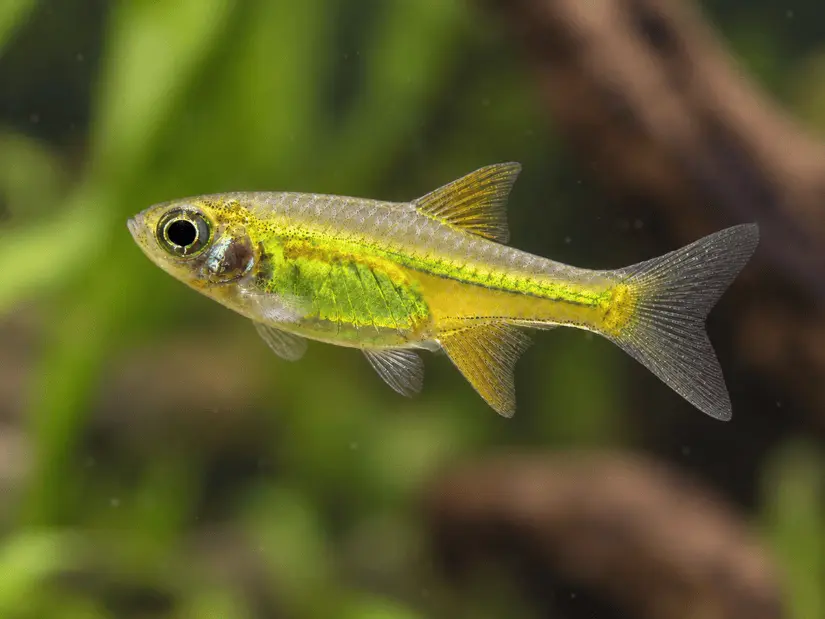

You can’t sex a kubotai rasbora (Microdevario kubotai, the neon green rasbora) with certainty from the outside. You can read tendencies. Mature females tend to be larger and deeper-bodied. Males tend to be more compact and more intensely colored.
That’s the answer in three sentences. The rest of this guide shows how much weight each clue can carry, what the original species description does and doesn’t say, and where the evidence stops.
What the evidence supports
A specialist aquarium profile describes the pattern. Females run larger and fuller. Males run slimmer and brighter. These are comparative tendencies, not a measured diagnostic test. Confidence: moderate.
Nobody has published a test that checks external sexing against fish of confirmed sex. So treat every clue below as a lean.
| Feature | How to read it | Evidence strength |
|---|---|---|
| Adult body profile | A fuller, deeper body leans female. A slimmer body leans male | Moderate |
| Relative adult size | Female often larger | Moderate |
| Color intensity | Supporting clue only | Moderate tendency, depends on condition |
| Fin shape or colored fin borders | No validated shortcut found | Unknown as a sexing method |
| Young or ambiguous fish | Record sex as undetermined | Conservative recommendation |
How to compare your fish
Look at mature fish from the same group, under the same conditions. Compare body profile and relative size together. Don’t judge one fish alone.
This is an editorial recommendation drawn from the available evidence. It is not a validated identification protocol. That matters, because the biggest mistake is turning a vague impression into a certain answer.
Read body shape first. Treat color second.
Why color is only a clue
Color is the first thing most keepers notice, and it’s the weakest clue. It depends on condition and lighting.
A firsthand breeder record from Japan backs this up. The breeder found the sexes difficult to tell apart. The same record documents fish fading temporarily after handling, and it photographs one individual under different lighting. Same fish, different color.
That is direct observation, so confidence in what was reported is high. It’s a small personal record, not a controlled experiment, so confidence in applying it to every tank is moderate.
For more on why colors shift in nano fish, read why nano fish lose color.
What the original description says
Kottelat and Witte described the species in 1999 (Journal of South Asian Natural History 4(1): 49-56). Their description portrays transparent fins. It describes a translucent yellow to greenish-yellow body with golden luminosity in aquarium specimens.
The paper also mentions a slightly pointed pelvic fin. But it describes that as a feature of the species. It doesn’t attribute it to males or to females. So the paper gives you no “pointed male, rounded female” rule. Confidence: high for what the paper contains.
This is a common trap. Species-level fin anatomy gets mistaken for a difference between the sexes. Don’t use fin shape to sex a kubotai.
A full belly doesn’t prove a female
A modestly fuller abdomen fits the female tendency, and a female carrying eggs would look fuller. But that is a biological interpretation. It isn’t a finding that every full-bellied fish is a female. Use the belly together with body depth and size, never alone.
What to do with ambiguous fish
Record young fish and unclear fish as undetermined. That’s the honest label. Don’t convert an ambiguous impression into a certain sex assignment.
For tank size, food and tank mates, see the kubotai rasbora care guide. For eggs to fry, see the kubotai breeding guide.
Bottom line
External appearance can suggest sex in mature kubotai. The evidence doesn’t justify certainty for every individual. Read body shape first, use size as a second clue and treat color as a supporting hint. Compare mature fish from the same group, and write down “undetermined” when you can’t tell.