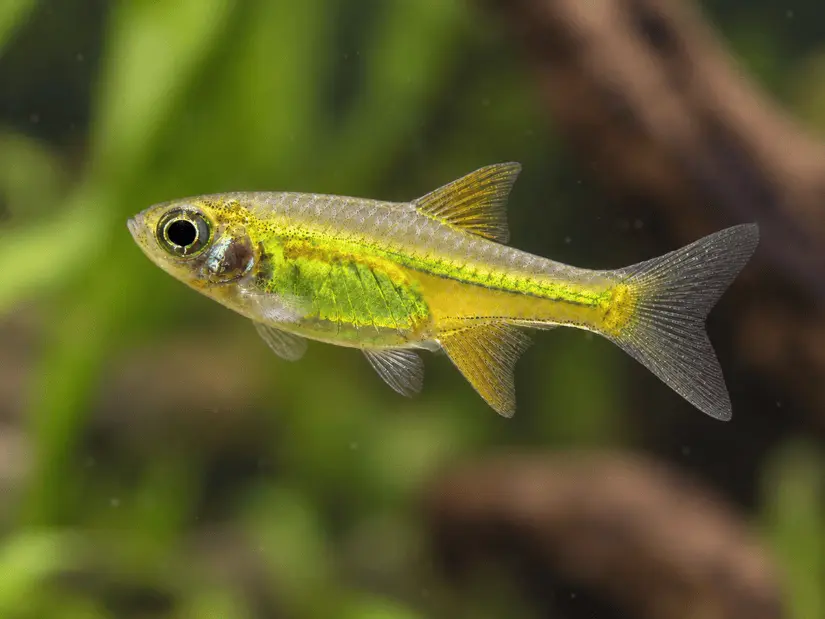
Kubotai rasbora care starts with a mature aquarium and a proper group. Plan for at least 10 fish. Give them a planted tank with a 60 × 30 cm footprint, then choose small companions that suit the same conditions.
The green colour gets your attention, but the tank dimensions deserve it too.
Kubotai rasbora care at a glance
| Care detail | Recommendation |
|---|---|
| Scientific name | Microdevario kubotai |
| Also sold as | Neon green rasbora or green neon rasbora |
| Adult size | About 2 cm (0.8 inch) standard length, excluding the tail fin |
| Tank footprint | At least 60 × 30 cm (about 24 × 12 inches) |
| Group size | 10 or more |
| Temperature | 22–26°C (72–79°F) |
| pH | 6.0–7.0 |
| General hardness | 1–10 dGH |
| Food | Small prepared foods and suitably sized live or frozen foods |
| Tank mates | Small, peaceful fish with compatible requirements |
| Breeding | Egg scatterer. Protect eggs and fry from the adults. |
These are practical care recommendations. They aren’t experimentally proven survival limits.
What is a kubotai rasbora?
The accepted scientific name is Microdevario kubotai. Kottelat and Witte originally described it as Microrasbora kubotai in 1999. Both names refer to the same fish.
So an older listing for microrasbora kubotai doesn’t identify another species. Check the full name when buying kubotai fish.
Appearance and adult size
The original description records greenish-yellow aquarium specimens with a glowing golden stripe along the side. The dorsal and anal fins are transparent.
Standard length leaves out the tail fin, which explains why size figures need some care.
Aquarium Glaser gives approximately 2.5 cm without specifying the measurement convention. For a clear size description, use about 2 cm excluding the tail. Don’t turn a measured specimen into a promise that every fish stops growing at exactly that length.
Minimum tank size and group size
My recommendation is to choose the tank by its footprint first because a volume label alone doesn’t tell you its length or width.
At least 60 × 30 cm and lists approximately 54 litres, or 14 US gallons. A named keeper, Christian Splettstößer, independently recommends that footprint with a minimum height of 30 cm.
If you’re comparing tanks, take the dimensions with you. A tall tank and a longer tank can hold similar amounts of water.
Keep at least 10 together. Fishkeeper recommends 10 or more, while Seriously Fish advises 8–10. Buy the aquarium for the group you intend to keep.
Temperature, pH and hardness
Use 22–26°C as the practical temperature range. Both Fishkeeper and Aquarium Glaser recommend it. Seriously Fish lists a broader 20–27°C range.
The published water guidance is pH 6.0–7.0 and 1–10 dGH. dGH measures general hardness. It isn’t a KH target.
Use those figures when planning your setup. Don’t read either endpoint as a tested boundary between safe and unsafe water.
Setting up the aquarium
Start with a mature tank. Fishkeeper recommends dense planted areas and shaded cover, with moderate water movement. Leave room for the fish to swim. The current should support oxygenation without being severe.
Aquarium Glaser also stresses clean, oxygen-rich water. Regular partial water changes belong in the maintenance routine.
My layout choice would be planted shelter around an open swimming area. Decide where the group will swim before filling every available space with decor.
What do kubotai rasboras eat?
Offer crushed flakes or micropellets that the fish can swallow. Small live or frozen foods can include baby brine shrimp, Cyclops and Daphnia.
Prepared food acceptance has also been documented in a laboratory study. The researchers maintained adult M. kubotai on tropical flakes and/or live Artemia.
But check what your own fish actually eat. Splettstößer reported that his newly acquired wild-caught fish initially struggled with some prepared foods. Live Artemia helped him improve their condition. They accepted more foods after settling in. That was one keeper’s experience with wild fish. It doesn’t establish a live-food requirement for every kubotai.
Watch a few mouthfuls during feeding. Picking food up and swallowing it are different things.
Choosing tank mates
Choose small, peaceful companions with matching care needs. Seriously Fish suggests Boraras naevus, Trigonostigma espei and Pangio species among its options. Treat these as candidates to check against your whole setup.
Each additional species needs its own space and suitable group. The kubotai tank recommendation doesn’t automatically leave room for another shoal.
If the fish you want have incompatible requirements, choose which species the aquarium will serve. A species tank is a straightforward option.
Can kubotai rasboras live with shrimp?
Adult shrimp coexistence has been reported. Splettstößer kept kubotai with Crystal Red shrimp in a mixed aquarium. He also said he couldn’t judge whether baby shrimp were being eaten.
That supports one successful setup. It doesn’t establish safety for every shrimp colony.
My advice is to keep fish separate if preserving shrimp offspring is your priority. Don’t build that plan around a promise of zero predation.
Male versus female
Mature females tend to be fuller-bodied. Seriously Fish describes males as more compact and more intensely coloured.
Use body shape as part of the comparison because colour alone won’t give you a dependable answer for every fish.
How long do kubotai rasboras live?
I couldn’t verify a typical aquarium lifespan from the reliable sources reviewed for this guide.
A precise lifespan number would need documented longevity records. The available care guidance doesn’t provide them. Giving you an unsupported number would add certainty the evidence doesn’t have.
Breeding kubotai rasboras
Kubotai scatter eggs among vegetation and decor. Adults can eat eggs and larvae. Fishkeeper recommends a separate breeding aquarium with fine plants or spawning mops, followed by removal of the adults after spawning.
The fry need very small initial foods. Introduce Artemia nauplii once they can accept them.
Exact hatch times remain insufficiently verified in the research behind this guide. Before setting up a breeding tank, decide how you’ll protect the offspring and feed the smallest fry.
Sources
Research checked on 30 September 2026.
- Kottelat and Witte’s original description, 1999. Identity, appearance and standard-length measurements.
- Eschmeyer’s Catalog of Fishes, updated August 2026. Accepted scientific name.
- Seriously Fish: Microdevario kubotai. Specialist care recommendations.
- Fishkeeper: Neon Green Rasbora. Aquarium setup, food and breeding.
- Frank Schäfer for Aquarium Glaser, October 2018. Specialist importer guidance.
- Conith and colleagues, 2022. Documented captive feeding.
- Christian Splettstößer, updated April 2024. Attributed feeding, shrimp and breeding observations.