The least killifish feeds its young through a placenta for about a month before birth, and it is not a killifish. Heterandria formosa is a livebearer from the guppy family, native to shallow, weedy water in the southeastern United States. Females reach about 3.5 cm and males about 1.7 cm in total length.
Day length, steady food, and room to breed decide how well a colony does. Water chemistry matters much less, since wild populations thrive anywhere from pH 4.6 to 8.4.
Least killifish quick facts
| Trait | Value |
|---|---|
| Scientific name | Heterandria formosa (Girard, 1859) |
| Family | Poeciliidae (livebearers) |
| Adult size | Females to about 30 mm standard length (36 mm total), males about 15 to 19 mm total |
| Lifespan | Wild: weeks to about 4 months. Aquarium: months, some females over 1 year |
| Temperature | 20 to 26°C for keeping, 25 to 28°C for breeding |
| Light | 12 to 14 hours daily for breeding |
| pH | Any stable value from about 5 to 8 |
| Salt | None |
| Tank size | 20 to 40 litres for a starter colony |
| Diet | Finely ground flake, baby brine shrimp, microworms |
| Breeding | Livebearer, 1 to 8 fry every few days to 2 weeks per female |
| Temperament | Peaceful, males spar |
What the least killifish is
The name dates from the 19th century, when scientists grouped killifish and livebearers in a single family called “The Killifishes”. The least killifish gives birth to free-swimming young and belongs to the Poeciliidae with guppies and mosquitofish. Heterandria now has a single species, since its former Central American relatives moved to Pseudoxiphophorus.
The species is often called the smallest fish in the world. A smaller fish took that title in 1902. By maximum length the spring pygmy sunfish (Elassoma alabamae, 25.5 mm) is smaller, and FishBase lists Neoheterandria elegans as a smaller livebearer. H. formosa ranks among the smallest fishes of North America and among the smallest livebearers.
The native range runs along the coastal plain from the Cape Fear River in North Carolina to southeastern Louisiana and the Sabine River in Texas, and through all of peninsular Florida. The IUCN rates the species Least Concern, while North Carolina lists it as a species of Special Concern.
Least killifish size and sexing
Newborns measure about 6 mm. Standard length runs from the snout to the base of the tail and leaves out the tail fin. Females mature at 8 to 10 mm standard length in about 30 to 40 days in warm laboratory tanks. Males mature later, at 10 to 14 mm and 40 to 50 days, and almost stop growing afterward. A large female is roughly twice the length of a male.
Males carry a gonopodium, a long anal fin used to transfer sperm. Mature females show a dark spot near the vent. Both sexes have a dark stripe along the side and a dark spot on the dorsal fin. Females from soft-water lakes grow 35 to 40% larger than females from spring-fed rivers.
Wild habitat and water conditions
Wild least killifish live in water usually less than 30 cm deep, close to shore and inside dense vegetation. In the Everglades they are most numerous in bladderwort beds under floating mats of periphyton, the film of algae and microbes on submerged surfaces. Periphyton is the main source of carbon in their diet, and lake populations also eat small crustaceans.
| Site (Florida unless noted) | Temperature | pH | Conductivity or salinity |
|---|---|---|---|
| Trout Pond, soft lake | 13 to 38°C | 4.6 to 5.3 | 12 to 25 µS/cm |
| Moore Lake, soft lake | 8 to 35°C | 4.9 to 5.8 | 10 to 22 µS/cm |
| Wacissa River, spring run | 17 to 28°C | 7.1 to 8.4 | 150 to 275 µS/cm |
| Louisiana fresh and intermediate marshes | 14 to 34°C | not measured | 0 to 4 ppt salinity |
These measured ranges are much wider than the ones care sheets print. The species lives and breeds in soft acidic water as well as hard alkaline water, but it occurs mainly in fresh water, and few fish were caught in Louisiana marshes at 8 to 13 ppt salinity.
Least killifish tank size and stocking
A planted tank of 20 to 40 litres suits a starter colony of 6 to 10 adults, and 40 to 60 litres keeps temperature and water quality steadier. Long, shallow tanks fit the species, since wild fish live in the top 30 cm.
Crowding limits breeding more than food does. In a Florida State University experiment, cutting the females in a 19-litre tank from 8 to 2 raised the young produced per female more than fourfold. A fourfold change in density had over twice the effect of a fourfold change in food. In a second study, crowded females had about 60% lower reproductive success, and daughters of crowded mothers were even more sensitive to crowding.
Keepers report 25 fish in 38 litres, and one kept 10 fish in about 4 litres for years. Such colonies survive because breeding slows as numbers rise. For steady breeding, keep about 0.2 adults per litre, roughly 4 in 20 litres or 8 in 40 litres, and remove surplus fish every few weeks.
Least killifish water parameters and temperature
| Parameter | Target | Basis |
|---|---|---|
| Temperature, keeping | 20 to 26°C | Lab and keeper practice |
| Temperature, breeding | 25 to 28°C (labs breed at 22 to 31°C) | Laboratory studies |
| Temperature change | 1 to 2°C per day at most | Embryo deaths after a rapid rise, one report |
| Light | 12 to 14 hours for breeding | Photoperiod experiment |
| pH | Stable, anywhere from about 5 to 8 | Field data and lab rearing |
| Hardness | No minimum shown | Field data and lab rearing |
| Salt | None | Field data |
| Ammonia and nitrite | 0 | General fish care |
The care-sheet range of 20 to 26°C and pH 7 to 8 traces back to a 1991 aquarium atlas and a database entry. No husbandry trial produced those figures. Fish reared in natural pond water at pH 4.8 to 5.3 matured about 10 days sooner than fish reared in hard spring water, with no rise in deaths and no loss of fertility. Stable, dechlorinated tap water between pH 5 and 8 needs no adjustment.
Temperature trials at the University of Florida in the late 1960s set the limits. At 5°C all test fish died within 2 to 3 weeks. At 10 to 15°C the fish lay on the bottom and refused food, and only 40% of males survived 40 days at 10°C, against 88% of females. At a constant 35°C about 40% died in the first week.
Sudden heat harms cool-kept fish most. At 38.8°C, fish acclimated to 15°C died in about 45 minutes, while fish acclimated to 35°C lasted 17 to 20 hours. Keep the tank out of direct sun and use a heater with a thermostat.
Heater, light and the winter pause
An unheated tank works in rooms that stay above about 20°C. Breeding depends on day length. In the same University of Florida study, females under 16 hours of light at 30°C carried about 17 embryos each. Under 8 hours of light at the same temperature they carried almost none. No young were born at 15°C under either day length.
Wild populations breed from March to November and pause in winter. Fish collected in December produced few embryos even under long days and warm water, so expect several weeks before output returns. For breeding year-round, hold the tank at 25 to 28°C and set a timer to 12 to 14 hours of light.
Plants, filter and cover
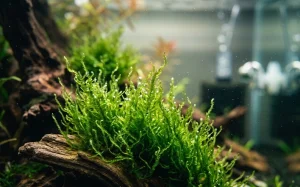
Floating plants should cover about half of the surface, the standard used in Florida State University tanks. Add fine-leaved thickets such as Java moss, hornwort, or guppy grass (Najas guadalupensis). Newborns hide in floating roots and moss, and dense plants reduce sparring between males.
Use an air-driven sponge filter. Power-filter intakes pull in fry and small males, so cover any intake with a sponge. Siphon slowly during water changes and check the bucket for fry. Change 20 to 30% of the water weekly. A light cover prevents losses from jumping, which some keepers report and others never see.
What least killifish eat
Finely ground flake is enough as a staple. Florida State University has raised generations of least killifish on ground TetraMin alone, with growth and breeding comparable to wild fish. The laboratory ration is about 10 mg of flake per adult female per day, given once or twice. Males eat little.
Add live or frozen foods 3 to 4 times a week, such as baby brine shrimp, microworms, Daphnia, or Cyclops. Slow-sinking micro pellets suit adults, which often ignore food floating at the surface. Biofilm on plants and glass feeds the fish between meals.
Feed pregnant females steadily. The egg has little yolk, and each embryo grows about 40 times heavier on nutrients supplied by the mother during gestation. In a feeding trial, low food made this species produce smaller young, while two yolk-feeding livebearers produced larger ones.
Breeding least killifish
Breeding requires no special setup. A female carries 2 to 4 broods at different stages at the same time, a pattern called superfetation, and up to 8 have been counted in one fish. Each brood takes about 25 to 35 days to develop, faster in warm water. The result is a few fry at a time, every few days to two weeks.
| Breeding trait | Value |
|---|---|
| Fry per brood | 1 to 8, usually 2 to 3 |
| Interval between broods | 3 to 8 days in summer, 33 to 41 days in winter |
| Young per female at peak | About 12 to 20 per month |
| First fry after pairing young adults | 38 to 49 days |
| Female maturity | About 30 to 50 days |
| Male maturity | About 40 to 100 days |
The line “as many as 40 fry over 10 to 14 days” appears on many websites. It traces back to aquarium books, and no study supports it.
Keep at least 2 to 3 males with every group of females. In a University of Helsinki study, 37% of females became pregnant with one male over 16 days, compared with 89% with four males. Too many males also cause harm, since harassment cuts the time females spend feeding. A ratio of 1 male to 2 or 3 females works.
Mated females continue to give birth for months. After males were removed on day 30 of the Helsinki study, the last young appeared around day 155. So a female bought without a male can still produce young. The figure of 10 months of sperm storage comes from a single sentence in a 1947 review and carries no data.
Raising least killifish fry
Leave fry in a densely planted colony tank. Parents do eat some young. A 1944 study noted that the young “are frequently eaten by the parent”, and nobody has measured the rate. Mixed-age colonies still grow when cover and food are plentiful. Laboratory colonies grew from 30 founders to about 120 to 180 fish in 120 litres over two breeding seasons.
The first 2 weeks decide fry survival. In one study, 16% of fry died in their first 2 weeks, and on low rations 75% of fry from one strain died before maturity. Feed powdered flake, microworms, or baby brine shrimp 2 to 3 times daily during that period. Avoid breeding traps, since births spread over days and isolated females can decline.
Colonies start slowly. Keepers commonly see the first fry 1 to 3 months after buying a group, and a steady trickle of newborns follows. Outdoor summer tubs, with warm water and long days, can speed the process. One keeper put a single female outdoors in late spring and brought in more than a hundred fish in autumn.
Keeping the colony genetically healthy
Start with 10 or more unrelated fish when possible. One generation of brother and sister mating reduced male mating activity and offspring survival in Helsinki laboratory fish. Lines founded from a single pair had about 7% lower genetic diversity. Exchange fish with another keeper every few generations, using stock of the same wild origin when known, since some crosses between distant wild populations caused high rates of failed pregnancies.
Least killifish lifespan
Wild least killifish live weeks to a few months. Florida otolith data put the maximum near 120 days, and typical wild females live about 7 to 9 weeks. Predators, cold winters, and drought shorten wild lives.
Aquarium fish live longer. In the Helsinki laboratory at 28°C, adult females lived an average of 245 to 319 days after the experiment began, and 4 were still alive when it ended about a year later. A 1969 study found that only laboratory fish lived beyond one year. No published source supports the 2 to 3 year lifespan repeated on care sheets. An adult death at 8 to 12 months is often old age, which no treatment fixes.
Least killifish tank mates
A species tank keeps the most fry alive and makes breeding easy to follow. Snails are safe, and so are adult shrimp. Many keepers report least killifish eating baby shrimp. Others keep both in moss-packed tanks with an established shrimp colony.
| Tank mate | Verdict |
|---|---|
| Eastern mosquitofish (Gambusia) | Never. Mosquitofish prey on least killifish |
| Eastern newts | Never. One keeper lost nearly 60 fish in an hour |
| Swamp darters, sunfish, bettas, gouramis | Avoid. They eat fry |
| Snails | Safe |
| Neocaridina shrimp | Adults safe, shrimplets at risk |
| Pygmy Corydoras, otocinclus | Keepers report them compatible in planted tanks |
Mosquitofish are a common mix-up. In experiments, large Gambusia hunted small least killifish, and 5 years of field records show linked predator and prey cycles at 2 of 3 sites. Gambusia has a blue sheen, while the least killifish has a dark side stripe and a dark spot on the dorsal fin. Check every bag of wild-caught or shipped fish for strays.
Health and common problems
No disease is documented as typical for this species. The parasites on record come from wild fish and include Myxidium fonti, a gallbladder parasite described in 2025, and large body-cavity worms that swell some wild females. Both need other host animals, such as worms or wading birds, to complete their life cycles.
Most losses come from husbandry, usually filter intakes, starved fry, sudden temperature changes, cold rooms, crowding, or exposure to copper or pesticides. Copper at 150 µg/L, the low end of the dose used to treat marine fish, killed every test fish, and 25 µg/L disrupted shoaling within 2 hours. The species was the most sensitive of 4 fish tested with the insecticide endosulfan sulfate. Avoid copper-based medicines and keep outdoor tubs away from garden sprays.
Quarantine new fish for 30 days. Diagnose before treating, test any medicine on a few fish first, and consult a fish veterinarian when losses continue.
Common least killifish myths
| Common claim | Evidence |
|---|---|
| Smallest fish in the world | Title passed to a smaller fish in 1902. Smaller livebearers also exist |
| Needs hard, alkaline water | Wild populations thrive at pH 4.6 to 8.4 and breed in soft or hard water |
| Lives 2 to 3 years | No source. Months, sometimes just over a year |
| Brackish fish | Found mainly at 0 to 4 ppt. The “30 ppt” figure has no measurement behind it |
| Parents never eat fry | Recorded in 1911 and 1944. Cover protects most fry |
| Breeds year-round | Stops under short days and below about 15°C |
| Controls mosquitoes | No larvae found in its stomachs where mosquitofish had them |
| One male is enough | 37% pregnancy with one male, 89% with four |
Buying least killifish
Keepers rarely find least killifish in pet chains. Most fish come from small online breeders, auction sites, aquarium clubs, and keeper swaps. In October 2026, online prices in the United States ran from about $2 per fish in bulk to about $15 for five, and trios sold for about $18 plus shipping. Some sellers ship trios of a single sex, so confirm the sex ratio before ordering. Keepers report the best arrivals from overnight shipping in mild weather, and one keeper saw pale arrivals darken within days.
A gold form exists and is scarce, and keepers report it more often in Europe than in North America. Florida residents can collect wild fish with a dip net under state rules for nongame fish. Check licence rules and local bans before collecting.
Setup checklist
- Choose a planted tank of 20 to 60 litres with a light cover.
- Fit an air-driven sponge filter and sponge over every intake.
- Cover about half of the surface with floating plants and add moss.
- Hold 20 to 26°C, or 25 to 28°C for breeding, with 12 to 14 hours of light on a timer.
- Stock 6 to 10 adults, with at least 2 to 3 males.
- Feed ground flake daily, about 10 mg per female, plus live food 3 to 4 times a week.
- Remove surplus fish every few weeks once fry appear.
Frequently asked questions
Do least killifish need a heater?
Not to survive. An unheated tank works above about 20°C. Breeding slows or stops in cool rooms and short days, so a heater set to 25 to 28°C with 12 to 14 hours of light keeps a colony breeding through winter.
How many least killifish fit in a 10 gallon tank?
Start with 7 to 10 adults in 38 litres, including 2 to 3 males. Keepers often hold many more, but births per female fall as the colony grows, so rehome surplus fish regularly.
Do least killifish eat their fry?
Sometimes. Parents eat some young, but dense plants and steady feeding let most fry survive in the colony tank.
Are least killifish livebearers?
Yes. Embryos grow inside the female, nourished through a placenta, and are born free-swimming at about 6 mm.
Will least killifish eat shrimp?
Adult shrimp are safe. Baby shrimp are often eaten, especially in small tanks with little moss.
Can least killifish breed with guppies?
No hybrids are recorded. The two species belong to different genera, and keepers who house them together report none.
Sources
- Leips & Travis (1999). J. Anim. Ecol. 68:595-616. https://doi.org/10.1046/j.1365-2656.1999.00311.x
- Colson (1969). PhD dissertation, University of Florida. https://archive.org/details/effectsofdayleng00cols
- Leatherbury & Travis (2019). Ecol. Evol. 9:100-110. https://doi.org/10.1002/ece3.4634
- Levell, Bedgood & Travis (2023). Ecol. Evol. 13:e10074. https://doi.org/10.1002/ece3.10074
- Felmy, Leips & Travis (2021). Ecol. Evol. 11:6391-6405. https://doi.org/10.1002/ece3.7490
- Baer, Travis & Higgins (2000). Genet. Res. 76. https://doi.org/10.1017/S0016672300004687
- Ala-Honkola, Friman & Lindström (2011). J. Evol. Biol. 24:2600-2610. https://doi.org/10.1111/j.1420-9101.2011.02383.x
- Ala-Honkola et al. (2009). J. Evol. Biol. 22:1396-1406. https://doi.org/10.1111/j.1420-9101.2009.01765.x
- Hale & Travis (2015). Copeia 103:51-57. https://doi.org/10.1643/CE-14-042
- Scrimshaw (1944). Biol. Bull. 87:37-51. https://doi.org/10.2307/1538127
- Reznick, Callahan & Llauredo (1996). Am. Zool. 36:147-156. https://doi.org/10.1093/icb/36.2.147
- Martin et al. (2009). Aquat. Biol. 8:15-28. https://doi.org/10.3354/ab00203
- Belk & Lydeard (1994). Copeia 1994:296-302. https://doi.org/10.2307/1446979
- Gatto & Travis (2024). Oecologia 205:461-471. https://doi.org/10.1007/s00442-024-05594-z
- Bennett & Conway (2010). Ichthyol. Explor. Freshwaters 21:63-72.
- Pluer, MacRae & Travis (2025). Ecol. Evol. https://doi.org/10.1002/ece3.72326
- Whipps, Ogburn & Font (2025). J. Parasitol. 111:163-171. https://doi.org/10.1645/24-65
- Adeyemi & Klerks (2013). Aquat. Toxicol. https://doi.org/10.1016/j.aquatox.2013.01.001
- Carriger et al. (2010). Arch. Environ. Contam. Toxicol. https://doi.org/10.1007/s00244-010-9623-1
- Ganley (2012). NANFA Fish in Focus. https://www.nanfa.org/fif/heterandria.shtml
- Bock (2003). American Currents 29(2). https://www.nanfa.org/ac/least-amount-trouble.pdf