At 18 °C a medaka egg needs about 20 days to hatch, six days longer than the popular 250 degree-day rule allows, so eggs in cool rooms get written off while still alive. The rule holds from about 24 to 30 °C. Below that, each lost degree adds more days than the rule predicts (Yamamoto 1937).
Lab guidelines and keepers name two other causes. The eggs were never fertilized, or water mould grew on dead eggs and spread to the live eggs touching them. The OECD medaka test guideline expects about 90 % of fertile eggs to hatch. It blames a hatch below 75 % on too little water movement and on dead eggs left in place.
A white egg is a dead egg, though not always an infertile one, and the day it turned white tells which. Fry hatch with about 3 days of yolk, so feeding starts on day 1. Care basics are in the medaka care guide.
How long medaka eggs take to hatch
Medaka eggs hatch in 7 to 8 days at 28 °C, about 9 days at 26 °C, 2 weeks at 22 °C and 3 weeks at 18 °C.
| Water | Days to hatch | Note |
|---|---|---|
| 30 °C (86 °F) | about 8 | only about half hatch |
| 28 °C (82 °F) | 7 to 8 | |
| 26 °C (79 °F) | about 9 | |
| 22 °C (72 °F) | 14 to 15 | |
| 18 °C (64 °F) | about 20 | 84 % still hatch |
| 14 °C (57 °F) | about 40 | under a third hatch, and the fry die |
| 11 °C (52 °F) | none |
In Yamamoto’s measurements the product rose from 261 at 25.6 °C to 371 at 18.2 °C and 575 at 14.2 °C. His figures follow days ≈ 165 ÷ (°C − 10) closely, which gives 21 days at 18 °C and 11 at 25 °C. The formula is fitted to his data and does not appear in his paper. Degree-days work only in Celsius.
Fertilization happens at spawning, so eggs from a mop or a seller may already be several days old. In still trays at 19 to 23 °C, eggs from one clutch hatched anywhere from day 15 to day 52 (Mercer 2021). Following the OECD guideline, treat an egg as dead only after twice the expected hatch time.
Medaka egg development day by day
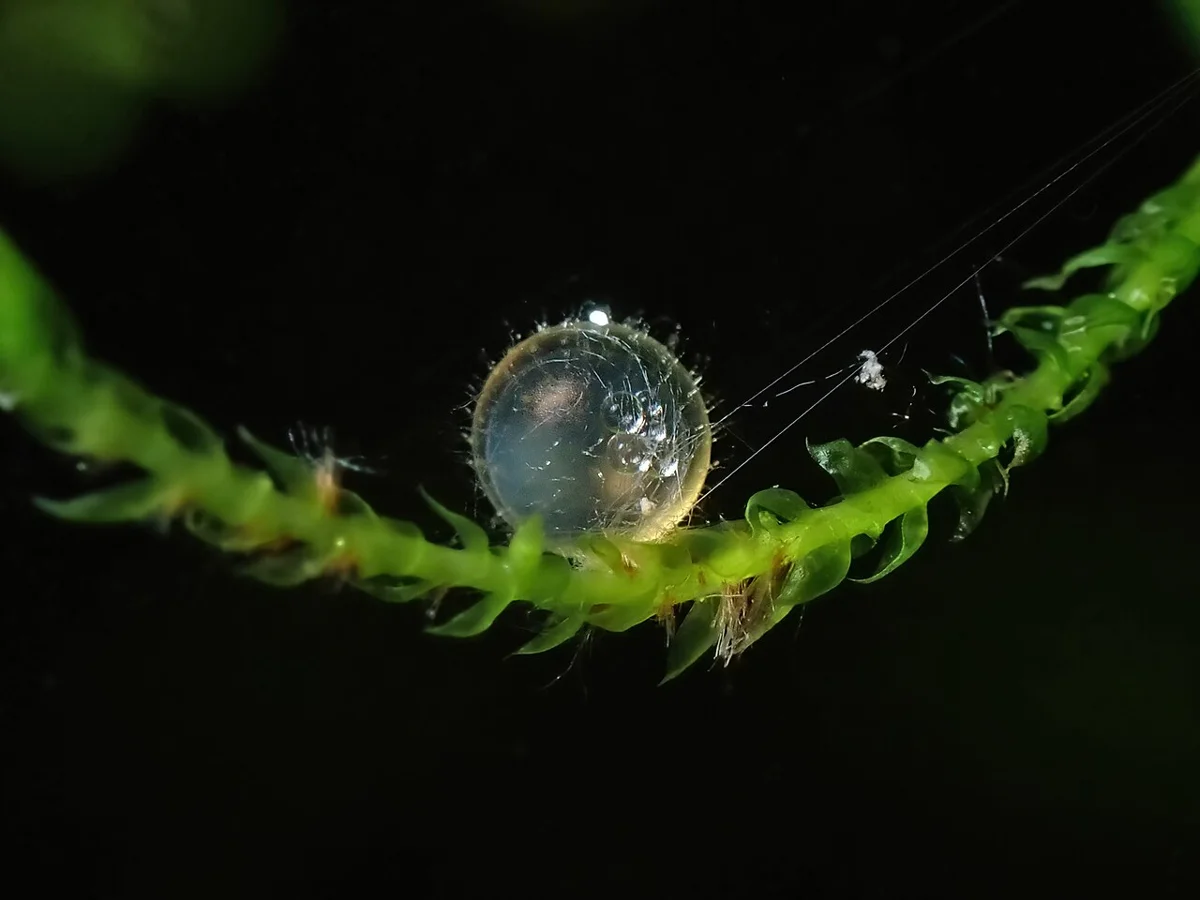
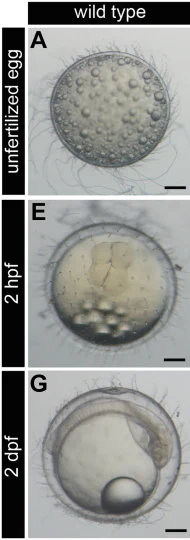
A fresh egg is clear to pale amber and about 1.2 mm across. It carries about 30 long sticky threads at one pole and about 200 short hairs over the shell (Iwamatsu 1994).
| Time at 26 °C | Visible with a 10 to 20× loupe |
|---|---|
| Under 1 hour | Clear gap under the shell, a cap at one pole, oil droplets drifting to the other |
| 1 day | Outline of the head and eye buds |
| 1.5 days | Black dots on the yolk; oil droplets fused into one large drop |
| 2 days | Heartbeat and blood moving over the yolk |
| 2.5 to 3 days | Two dark eye spots, the “eyed egg” |
| 4 to 5 days | Very dark eyes, fluttering fins, silver glitter along the body |
| 8 days | Eyes and jaw moving together |
| 9 days | Shell turns hazy, and the fry leaves tail first |
At 18 °C each stage takes a little over twice as long.
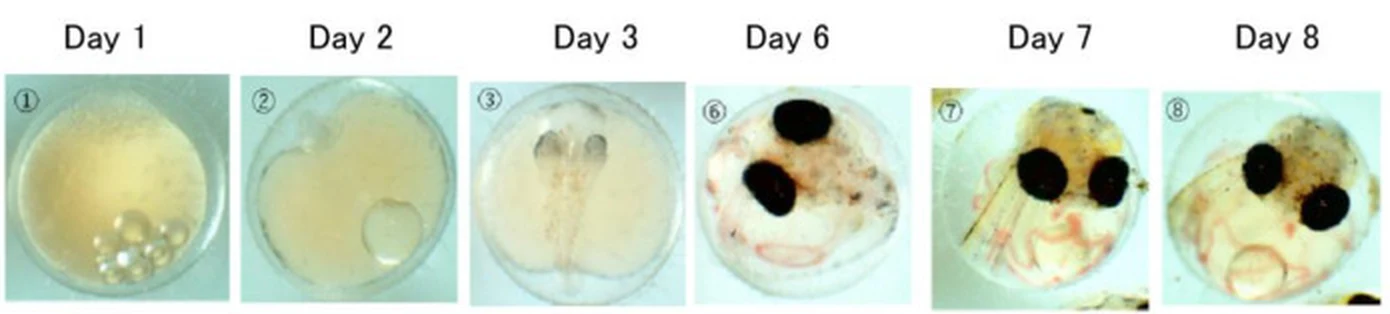
Three normal sights are often mistaken for trouble. Waves of contraction ripple across the embryo during the first 2 days, before the heart starts (Porazinski et al. 2010). Black specks and silver glitter are pigment cells. On hatch day the shell turns cloudy and fragile as the hatching enzyme digests it (Watanabe-Asaka et al. 2014), so an eyed, moving embryo in a hazy shell is about to hatch.
Medaka eggs turning white: infertile, dead or mould
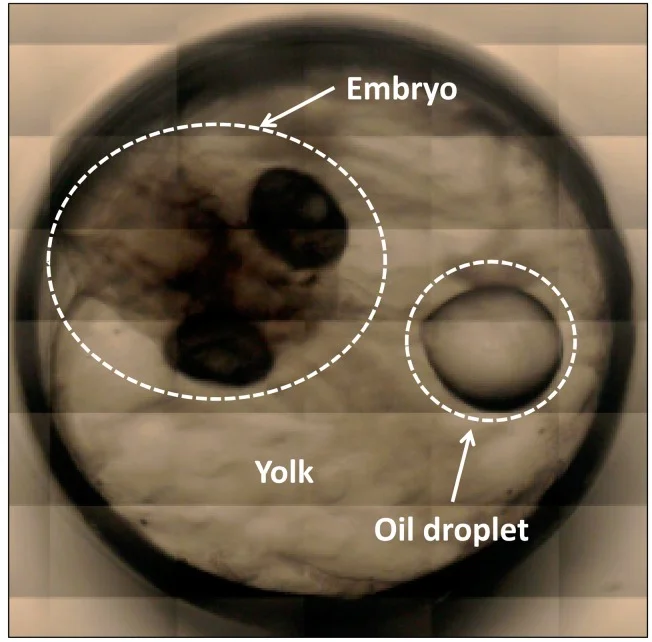
An opaque white egg is dead. Its proteins have coagulated, the same change that sets cooked egg white (OECD TG 212). The timing of the change points to the cause.
| Turned white | Most likely meaning | Action |
|---|---|---|
| Day 1 or 2, no embryo ever seen | Unfertilized, or died within hours | Check the male |
| After a body or eyes appeared | A fertile egg died from cold, heat, low oxygen, chemicals or a mouldy neighbour | Check temperature and crowding |
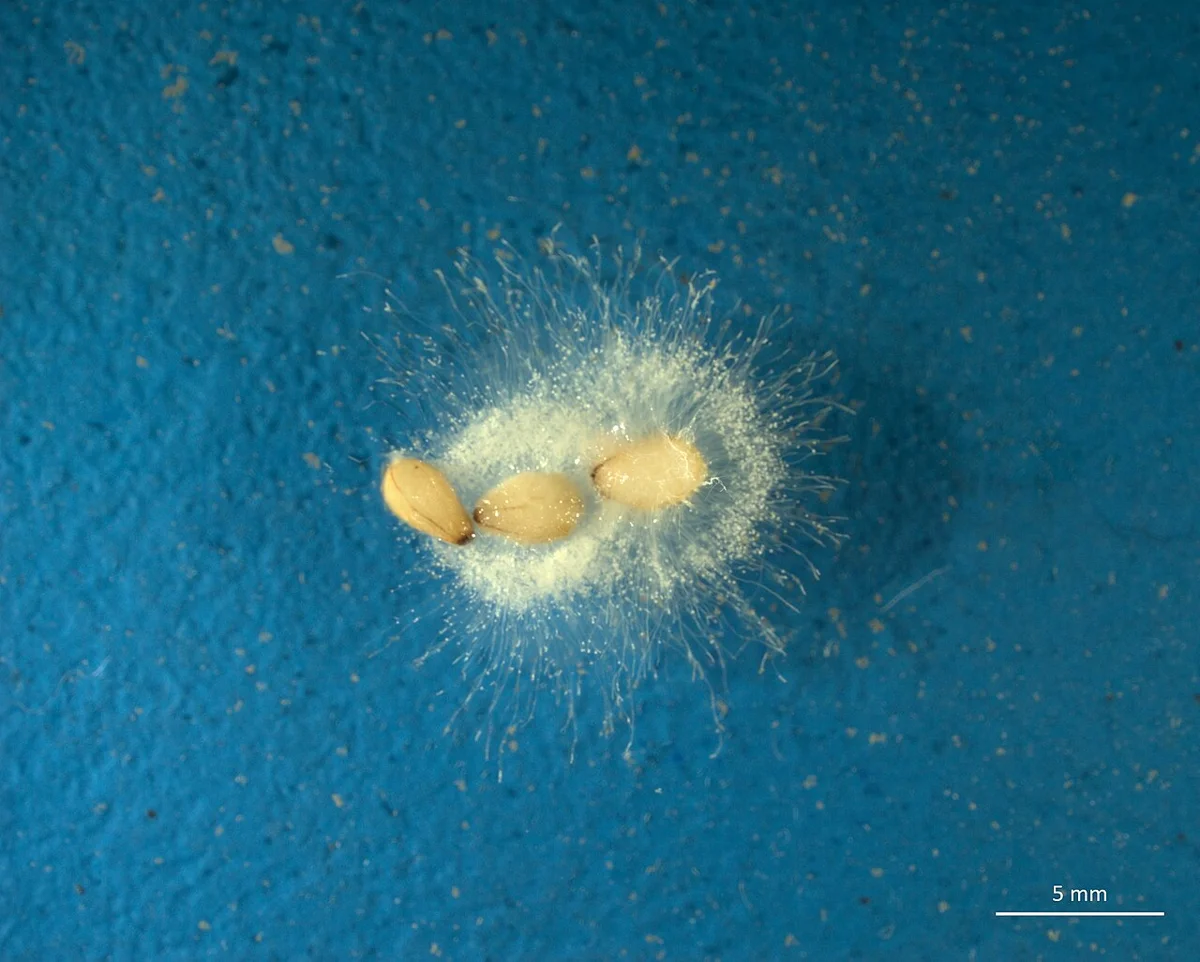
| White with a cotton halo | Water mould on a dead egg | Remove it and every egg its threads touch |
| Hazy shell, eyed embryo moving, near hatch day | Normal pre-hatch softening | Leave it |
The oil-droplet test on day 1
A loupe and a light behind the egg separate fertile from infertile eggs before either turns white. Within an hour a fertilized egg lifts its shell off the yolk, forms a clear cap at one end and sends its oil droplets to the other end. There they fuse into one drop by day 2. An unfertilized egg shows no gap, and its droplets stay scattered over the whole yolk (Iwamatsu 1994). Scattered droplets and no cap after 24 hours mean the egg will not develop.
The squeeze test and its two blind spots
Fertilization triggers an enzyme that cross-links the shell proteins and hardens the chorion (Yasumasu laboratory, Sophia University). A fertile egg resists a gentle squeeze between two fingertips. An infertile egg dents or bursts.
For 30 to 60 minutes after spawning a fertile shell is still soft, and the medaka lab manual advises waiting an hour before handling (Murata et al. 2020). One Japanese breeder crushed eggs collected at 5:00 a.m. and found every egg firm when collected at 5:40. In the last day before hatching the hatching enzyme softens the shell again, so a soft egg with black eyes is close to hatching.
Blue eggs in methylene blue
Live embryos push methylene blue out, while dead embryos collect it and turn blue (Murata et al. 2020). The test holds only at a pale dose. In one Japanese keeper’s trial, about 10 drops per litre stained every egg overnight, and most of those eggs still reached the eyed stage and hatched. After a strong dose, wait a day before discarding blue eggs.
When the whole batch turns white
A clutch that turns white almost entirely points at the parents. A male kept with many females spawns up to 19 times a day. After about 10 spawnings his sperm count and fertilization rate fall sharply (Kondo, Ito and Awata 2026). One male per one or two females avoids this.
Spawning also needs 13 to 14 hours of light and water above about 18 °C, depending on the population (Shinomiya et al. 2023). Genetics set a ceiling as well, since Japan’s national medaka stock centre lists fertilization from 19 % in some long-inbred strains to 97 % in others.
What a photo shows and what it cannot
A photo shows opacity, fuzz and eyes, but it cannot prove the embryo is alive or tell mould from bacterial slime. Daily photos of the same labelled egg, with the temperature logged, settle what one image cannot. Moving blood or twitching eyes under a loupe confirm life.
Medaka eggs with eyes that will not hatch
Late eyed eggs are most often too cool, too crowded or kept moving. Work through the checks in this order.
- Recount the days against the temperature. Two weeks is normal at 22 °C, three at 18 °C.
- Thin the eggs out. Low oxygen (2.8 mg/L) delayed hatching from day 8 or 9 to day 12 to 14. At 2.4 mg/L fewer than half hatched (Mu et al. 2017). Move the eggs to a wider, shallower container and refresh part of the water at the same temperature.
- Restore a day and night cycle. Light triggers release of the hatching enzyme, and more medaka hatch in the light phase than in darkness (Murata et al. 2020; Meijer 1983).
- Stop the airstone. The OECD method bubbles eggs until day 7, then stops so they settle, and hatching follows “typically over the next one or two days”.
- Remove mouldy neighbours, since mould on the shell hinders the exit.
A chill on day 2 can explain a failure a week later. In lab fish, 15 °C near the start of the heartbeat caused heart defects, and 86 % of severely affected embryos never hatched, though they looked normal for days (Watanabe-Asaka et al. 2014).
How to incubate medaka eggs
- Collect eggs at least an hour after spawning. Lifting the whole plant or mop into a separate container avoids touching them at all.
- Roll each clump gently on damp kitchen paper with a fingertip until the eggs separate and the threads come away. The EPA medaka protocol found thread removal harmless to development and hatching (Benoit et al. 1991).
- Use a wide, shallow container with 0.5 to 2 litres per day’s batch. Labs keep fewer than 40 eggs in a 6 cm dish, since crowding starves embryos of oxygen.
- Fill it with parent-tank water or clean, dechlorinated water at the same temperature. Keep every egg submerged, since eggs on bare glass died within 6 hours in air (Yao et al. 2024).
- Hold the water at 24 to 26 °C, away from open windows. In lab strains, incubation above 27 °C turned genetic females into males, rising to 100 % at 34 °C (Hattori et al. 2007), so a hot incubator can leave a male-heavy brood.
- Give normal room light by day and darkness by night, with no full sun on small cups.
- Remove every white or fuzzy egg once a day with a pipette.
- Keep each day’s eggs in a separate container. Hatching enzyme released by hatched fry digests the shells of younger eggs and forces them out early (Murata et al. 2020).
- Move hatchlings out each morning with a pipette or spoon, never a net.
| Optional extra | Benefit | Cost |
|---|---|---|
| Airstone at about 1 bubble per second, stopped at day 7 | Fewer mould transfers and more oxygen | Delays hatching if left running |
| Methylene blue at a pale tint until eyes show | Antimicrobial, stains dead eggs | Called “not necessary” by the lab manual, altered hatching in zebrafish, kills the microfauna fry eat |
| Chlorinated tap water for the egg stage, changed daily | Japanese shop practice against mould | Never studied; chloramine untested; switch to dechlorinated water before hatch |
Skip hydrogen peroxide, formalin, malachite green and acriflavine, none of which has a tested medaka dose.
Fungus on medaka eggs
The fuzz is usually a water mould such as Saprolegnia, a fungus-like oomycete. In salmon-egg trials, live eggs resisted spores in the water and became infected only from a nucleus of dead eggs or debris (Thoen et al. 2011). Medaka labs remove dead embryos promptly, “otherwise fungi and bacteria will multiply sufficiently to kill the embryos” (Murata et al. 2020). A fuzzy egg does not doom its neighbours if it leaves the container the day it appears.
Medaka fry food: what to feed newly hatched fry
Medaka fry eat paramecium, infusoria or green water together with powder of 0.2 mm or finer. Feeding starts on day 1, in water 2 to 3 cm deep. Freshly hatched brine shrimp join the menu from about day 3.
When to start feeding
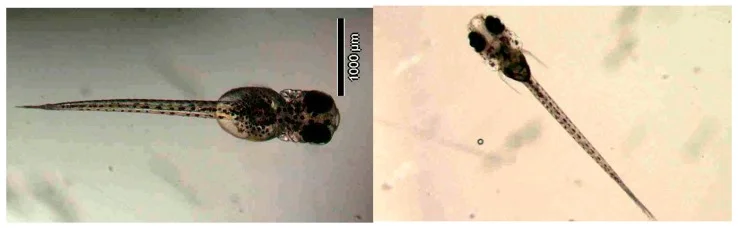
Medaka hatch at about 4 to 4.5 mm long, and the mouth opens before they leave the egg (Iwamatsu 1994). At 25 to 28 °C the yolk was gone about 3 days after hatching. Unfed fry fell behind in growth that same day, and their survival “dramatically drops off 5 days after starvation” (Sakae et al. 2020). A second study found survival held until day 6 and fell below 50 % by day 30 when fry went unfed past day 8 (Myosho et al. 2025). Five days without food also turned about 20 % of genetic females into fully functional males (Sakae et al. 2020).
Food by stage
| Age at about 25 °C | Foods | Size |
|---|---|---|
| Day 0 to 3 | Paramecium or infusoria culture, green water, fine fry powder | Paramecium about 0.2 to 0.3 mm, powder 0.2 mm or finer |
| Day 3 to 7 | The same, plus brine shrimp under 24 hours old, rinsed and free of shells | Newly hatched brine shrimp 0.4 to 0.5 mm |
| Day 7 to 14 | Brine shrimp daily, powder, microworms as an extra | Hikari Medaka-no-Mai Next 0.21 to 0.37 mm |
| Week 2 to 4 | Brine shrimp, larger fry pellets, moina once it fits |
Brine shrimp shells and unhatched cysts cannot be digested and can block the gut. Microworms sink, so a microworm culture only supplements food taken at the surface. Juveniles take moina and daphnia.
The lab routine
Japan’s national medaka stock centre keeps hatchlings in 2 to 3 cm of water. Powder and paramecium go in twice a day. Staff wipe the oily film off the surface before each feed and change no water during the fry stage (NBRP Medaka 2020). Japan’s National Institute for Basic Biology starts hatchlings in 1 litre, because in a full 4-litre tank “they cannot find the food”. Paramecium starts at hatching and brine shrimp at day 3, in 1/10-strength seawater that keeps the shrimp alive until eaten (Chisada 2016).
The Japanese government’s medaka life-cycle test feeds newly hatched brine shrimp from day 0. It requires at least 80 % of control fry to survive to 60 days (Ministry of the Environment 2002), so fresh nauplii are not too large for day-old fry.
Medaka fry food without live cultures
Powder alone can raise fry. Saitama pond trials raised fry on formulated feed from the first day, with about 70 % survival to 60 days, although ponds also supply natural food (Saitama Prefecture 2010). The cost is water quality, since powder fouls water and live paramecium does not. Grind food finer than seems necessary, as the stock centre sieves adult food to about 0.1 mm. Hikari Medaka-no-Mai Baby (0.2 mm) and Hikari First Bites (under 0.2 mm) are sold at that size.
How often to feed
Feed three or more small meals a day, each one gone within a few minutes. A Kyoto facility holding over 100,000 medaka found three smaller daily meals grew fry faster than its standard two, and the maker of Medaka-no-Mai Baby recommends five.
How to tell whether fry are eating
Brine shrimp turn a fry’s belly pink-orange, checked about an hour after feeding, while paramecium leaves it white (Chisada 2015).
Why medaka fry die in the first two weeks
| What happens | Likely cause | Fix |
|---|---|---|
| Fry vanish in days 3 to 7 | Starvation, deep water, food too large | Food from day 1, in 2 to 3 cm of water |
| Fry sit on the bottom and stay small | Swim bladder never filled | Keep the surface open and free of film |
| Mass death after a water change | Temperature or chlorine shock | Small, same-temperature, dechlorinated changes |
| Slow die-off in a dirty cup | Ammonia from leftover food | Smaller, more frequent meals and siphoned leftovers |
| Fry gone near a filter | Open intake | No filter in week 1, then a fry-safe sponge filter |
| Fewer small fry each day | Larger siblings eating them | Fast growers moved to a separate tub |
Medaka fill the swim bladder by gulping air at the surface, and about 80 % start within 24 hours of hatching (Iwamatsu et al. 2003). Fry kept from the surface for 6 days failed to inflate in 47 % of cases. Every one of those later grew a swim-bladder tumour (Furukawa et al. 2022).
Hatchlings are far more fragile than eggs. In copper tests, 7-day fry died at about a thirteenth of the dose embryos survived (Mason and Parrott 2022), and ammonia deaths rise sharply after hatching (Lin et al. 2026).
Fry are overfed for fear of starvation, the water fouls, and the large water change that follows kills them. Labs break the cycle by feeding small and often, skimming the surface film and leaving the water unchanged. In still water, fry capacity depends on surface area more than volume, so a shallow, wide tub beats a deep jar.
Equipment that helps
- A spawning mop or floating plants to collect eggs before the adults eat them.
- A thermometer, since temperature sets the hatch date.
- A pipette for removing dead eggs and moving fry without a net.
- A 10 to 20× loupe or clip-on phone macro lens for oil droplets, heartbeats and early fuzz.
- A preset heater for cool rooms. The Fluval P10 holds 76 to 78 °F (24 to 26 °C) in up to 3 gallons, enough to float egg cups in a small heated tank. Other options are in the aquarium heater guide.
- A small air pump such as the UPETTOOLS mini USB pump, turned down to about 1 bubble per second.
- A Hikari Mini sponge filter for the grow-out tank from week 2.
- A paramecium starter culture and a brine shrimp hatcher, started a week before the eggs are due.
Frequently asked questions
How long do medaka eggs take to hatch?
About 7 to 8 days at 28 °C, 9 days at 26 °C, 2 weeks at 22 °C and 3 weeks at 18 °C.
How can fertile medaka eggs be recognized?
Under a loupe, a fertilized egg shows a gap under the shell, a cap at one end and oil droplets fusing into one drop. Unfertilized eggs keep scattered droplets, stay soft and turn white within a day or two.
When should medaka fry be fed?
From the first day after hatching. The yolk lasts about 3 days, and lab fry left unfed for 5 days start dying.
Sources
- Benoit et al. 1991
- Chisada 2015, 2016
- Furukawa et al. 2022
- Hattori et al. 2007
- Iwamatsu 1994
- Iwamatsu et al. 2003
- Kirchmaier et al. 2015
- Kondo, Ito and Awata 2026
- Lin et al. 2026
- Mason and Parrott 2022
- Meijer 1983
- Mercer 2021
- Ministry of the Environment, Japan 2002
- Mu et al. 2017
- Murata et al. 2020
- Myosho et al. 2025
- NBRP Medaka 2020
- Nipu et al. 2025
- OECD TG 212, TG 240
- Porazinski et al. 2010
- Saitama Prefecture 2010
- Sakae et al. 2020
- Shinomiya et al. 2023
- Thoen et al. 2011
- Watanabe-Asaka et al. 2014
- Yamamoto 1937
- Yao et al. 2024
- Yasumasu laboratory, Sophia University