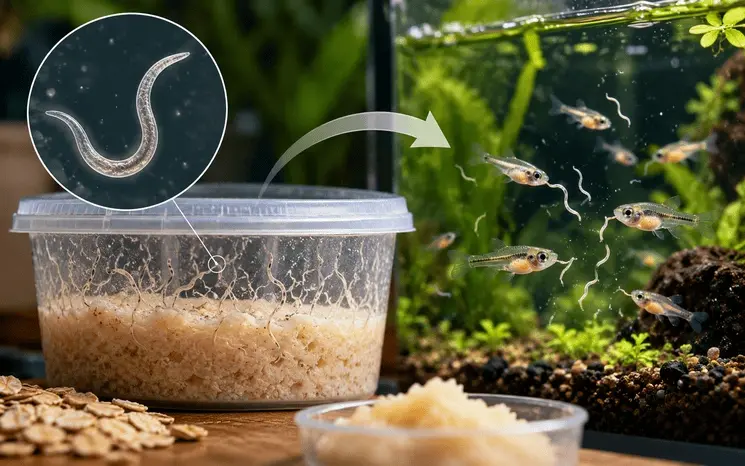
Microworms (also spelled micro worms) are 1.5 to 2 mm nematodes (Panagrellus redivivus) that grow on moist oats or instant mashed potatoes. A microworm culture needs a spoonful of live starter, a shallow tub, and about a week. It then gives a steady supply of live food for fish fry that can swallow a thin worm.
Microworms suit betta fry, guppy fry, and bottom-feeding fry such as corydoras once the fry reach that size. They are too large for the first meal of the smallest fry, such as chili rasbora. They work as a supplement to a varied diet.
Quick answer
Spread 1.5 cm of plain instant mashed potato flakes or softened oats in a ventilated tub and mix to a moist paste. Add a spoonful of live microworm starter culture and keep the tub at 21 to 27°C. Worms climb the walls within days, and the culture is reliably productive after about a week. Wipe worms from the clean wall and offer small portions to fry that can swallow them.
How to Make a Microworm Culture in 5 Steps
- Prepare the tub. Use a clean, smooth-sided tub with a ventilated lid. Cover the vent holes with fine mesh to keep flies out.
- Mix the medium. Spread about 1.5 cm of plain instant potato flakes in the tub. Add water until the mix is a moist paste with no standing water. Softened, cooled oats work the same way.
- Add the starter. Spread a spoonful of active starter culture over the surface. Keep the walls above the medium clean.
- Wait about a week. Hold the tub at a stable 21 to 27°C, out of direct sun. Worms climb the walls within days.
- Harvest. Wipe worms from the wall above the medium into clean water. Feed small portions with a pipette.
Start a fresh tub every one to two weeks while fry depend on this food.
Microworm Culture: Quick Facts
Adult length 1.5 to 2 mm Medium Potato or oats Ready in About a week Lid Ventilated
| Question | Answer |
|---|---|
| What are microworms? | Free-living nematodes, usually Panagrellus redivivus |
| How big are they? | Adults reach 1.5 to 2 mm long and 50 to 70 µm wide |
| Which medium works? | Plain instant mashed potato flakes or oatmeal |
| Is a starter culture needed? | Yes. Starch and water do not grow microworms alone |
| When can they be harvested? | Some cultures climb the walls within days. Plan on about a week |
| What temperature suits the culture? | 21 to 27°C (70 to 80°F), a suggested range |
| Do they need air? | Yes. Use a lid with protected air holes |
| How long do they live in a tank? | About 12 hours in freshwater, and they sink |
| Can they replace all other fry foods? | No. Check fry size and growth, and add other foods as the fry grow |
What Are Microworms (Panagrellus redivivus)?
The aquarium trade uses “microworm” for several small nematodes. The usual starter culture is Panagrellus redivivus, a free-living species raised as live food. It is a different animal from the grindal worm and from the aquatic worms sold as microfex worms.
Adults are white, threadlike, and slender. They measure 1.5 to 2 mm long and only 50 to 70 µm across. A thin body matters. A fry can swallow a long, thin worm that it could not swallow as a round prey item of the same length. Mouth gape, prey handling, and fry development still decide whether a fry can eat one.
Females hold developing young inside and release live juveniles. Under suitable conditions they reach maturity in about three days, so a culture multiplies fast. The time to a harvestable tub also depends on the starter amount, the temperature, and the medium.
Microworms grow in a moist, fermenting medium alongside yeast and other microorganisms. Oats or potato supply a convenient base. A home culture does not need laboratory conditions.
Microworms sink in freshwater. That suits bottom-foraging fry but makes them a poor sole food for tiny surface feeders. The University of Florida ornamental aquaculture guide reports that harvested microworms live about 12 hours in freshwater. That is an estimate, and uneaten worms should still come out of the tank.
How to Culture Microworms: What You Need
A microworm culture setup needs few items:
- An established starter culture from a fish shop, a fish club, or another hobbyist. Check that it is active and free of mold.
- A shallow plastic tub as the microworm culture container. A clean, smooth-sided tub about 13 cm (5 in) across leaves room above the medium for worms to climb.
- A ventilated lid. Small holes covered with fine mesh let air in and keep flies out. An airtight lid does not work.
- A plain starch medium. Use unseasoned instant potato flakes or oats. Skip flavored potato mixes with onion, garlic, salt, or sauces.
- Dechlorinated water.
- A clean spoon, a label, and a swab or small spatula for inoculating, dating, and harvesting.
Microworm Starter Culture: Where to Get One
Pick a starter that is crawling on the tub walls and smells like fermenting grain. Reject a starter with visible mold or insects.
Buy a microworms starter culture or ask a hobbyist for some. A spoonful of an active culture inoculates a new tub. Later tubs take their starter from a healthy, active tub.
Can You Culture Microworms Without a Starter?
Not reliably. A microworm culture without starter does not grow. Oats, potato, water, and yeast are not microworm eggs. Mixing them does not produce Panagrellus redivivus. A tub that grows tiny moving organisms by itself holds unidentified life and is not a safe microworm culture. Obtain a live starter from a shop, a club, or an established breeder.
Microworm Culture Method 1: Instant Mashed Potato
Potato is a convenient method for a beginner. It needs plain flakes, water, and a spoonful of live starter. Extra baker’s yeast is optional.
- Prepare the tub. Wash and rinse it well. Make a small vent in the lid and cover it with secure, fine mesh. Avoid sharp edges.
- Add plain flakes. Cover the bottom with a shallow layer, about 1.5 cm (½ in).
- Add water gradually. Stir until the mix looks like moist, fluffy mashed potato. It should hold together with no pool of water. Add water if it crumbles, and add flakes if it pours.
- Keep the walls clean. Smooth the medium across the base and leave the sides above it free of potato. This gives a clean harvest zone.
- Add the starter. Spread about a spoonful of an active culture over the surface. The amount is a hobby measure.
- Close, label, and place. Fit the ventilated lid, mark the date, and set the tub out of direct sun and away from heaters and hot lights.
- Check daily. Look for white, threadlike worms on the side walls. Harvest once enough have gathered, and do not strip a young culture bare.
Potato cultures run without added yeast, since the starter carries its own microbes. Oatmeal methods often add yeast. Both work.
Microworm Culture Oatmeal Method: Rolled, Quick, or Baby Oats
The University of Florida describes oatmeal, water, and baker’s yeast as a standard microworm culture recipe. Rolled oats, quick oats, and finely processed baby oatmeal all work as a base. Finer oats make a smoother medium, and rolled oats cost less for large batches. No supermarket oat is proven best.
- Soften the oats. Put plain oats in a clean tub. Soften them with hot water, or heat them in a microwave as the pack directs.
- Cool the paste completely. Hot medium kills the starter.
- Aim for a thick, moist paste. The university guide describes a medium depth of about 1 to 4 cm in a larger tub. Scale the amount to the tub.
- Add a small amount of baker’s yeast. The published example uses 7 g of yeast, 500 mL of water, and 250 mL of oatmeal for a shoebox-sized tub. Do not pour that full recipe into a small cup.
- Add the starter. Spread active starter over the cooled surface, close the ventilated lid, and date the tub.
- Inspect daily. Collect worms from the clean side walls once the culture produces.
An established starter that already produces well can run without extra yeast. Test a no-yeast oat tub next to a standard one. Change one variable at a time, since two tubs with different starter amounts give no useful comparison.
Oatmeal or Mashed Potato: Which Is Better?
Use the medium that can be prepared the same way every time. Instant potato mixes fast and has less odor than some oatmeal media. Oatmeal has a published aquaculture protocol behind it. No source shows a winner for worm yield, nutrition, or culture lifespan.
Skip cat food, paprika, and fish food mixes while learning. They add variables with no proven gain, and anything carried over with the worms adds waste to a small fry tank.
Microworm Culture Temperature, Air and Lifespan
A stable room matters more than an exact number. The extension guide suggests 21 to 27°C (70 to 80°F) for the culture. A cooler culture produces more slowly and lasts longer. A warmer culture multiplies fast and breaks down sooner. Keep tubs away from direct sun and hot surfaces. These are culture temperatures. Set the fish tank by the needs of the fish.
A healthy culture is a moist paste with a fermented or yeasty smell. A strong rancid smell, darkening, liquefaction, and falling worm numbers all mean it is time for a replacement. Worms climbing the walls is normal behavior and does not mean the culture is about to crash.
Do Microworm Cultures Need Air?
Yes. Panagrellus redivivus does not thrive without oxygen. Use a loose lid or protected vent holes that keep insects out and limit drying.
How Long Does a Microworm Culture Last?
It varies. A published aquaculture example with cultures at 18 to 20°C reached peak population in about 10 to 11 days. The same extension guide reports that adding fresh medium under suitable conditions extends productivity. That does not guarantee a long life for an untended cup. Replace a culture by its condition, and keep a backup tub running.
A Two- or Three-Culture Rotation
Start two tubs for a small breeding project, so one failure does not end the food supply. Add a third when several spawns depend on the culture or the harvest is large. This is a practical backup plan with no scientific minimum behind it.
- Culture A is the producing tub that supplies the harvest.
- Culture B is a fresh tub started before A weakens.
- Culture C is an optional tub started on a different date.
Make a fresh culture every one to two weeks while fry depend on it, then adjust to the real output. Date each tub and note which ones produce well. Take starter from a healthy, active tub before it turns foul or moldy. Refrigeration or freezing is not a tested way to keep a starter for months.
How to Harvest Microworms Without Fouling the Tank
Collect the worms from the tub walls above the medium. Do not scrape up the oatmeal or potato itself. The extension guide describes harvesting with a spatula or similar scraper. A clean finger, swab, or small brush also works.
- Wash and rinse hands, or use a clean dedicated swab or scraper.
- Wipe a section of smooth wall above the paste where worms gather.
- Swirl the worms into a small cup of clean, dechlorinated water at aquarium temperature.
- Check for clumps of medium, insects, or debris. If the sample is dirty, collect a cleaner one.
- Place a small amount of live microworms with a pipette or dropper where the fry forage.
- Watch the fish. Increase the next portion only if the fry catch the worms and the tank stays clean.
A hatchery can count harvested nematodes in a known water volume. A home tank is better served by small, steady portions and observation than by a fixed number of worms per dropper.
Do not tip culture paste into a fry tank. Do not scrape moldy areas. Do not rest a culture on a hot light fixture to force a harvest.
Microworms for Fish Fry: Which Fry Can Eat Them?
Microworms for fry work only when the fry can swallow them. Start feeding when the fry are free-swimming and seeking external food. The start day varies by species, since some use their yolk stores longer. The fry must see, catch, and swallow the worm.
| Fish or fry type | How microworms fit | What to check |
|---|---|---|
| Pygmy corydoras and other small bottom-foraging fry | A useful candidate, since worms sink into the feeding zone | Offer after yolk absorption. Confirm ingestion and add other foods as the fry grow |
| Betta fry | A useful part of the diet once the fry can swallow them | Offer other accepted foods as size allows |
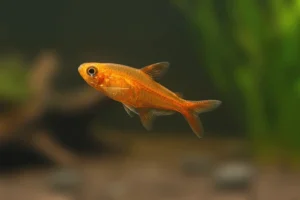
| Chili rasbora fry | Often too large for the first meal | Start with infusoria-sized prey or cultured paramecia. Trial microworms once the fry can swallow them |
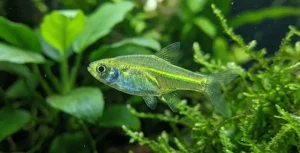
| Scarlet badis fry | Small first-feeders may need finer live prey first | Watch mouth size and actual feeding |
| Ember tetra and celestial pearl danio fry | A possible extra food once the fry handle the worms | Fry size and capture behavior set the start date |
| Guppy and other large livebearer fry | Usually an extra food | Many take newly hatched brine shrimp or commercial fry food from the start |
These rows are practical starting points. No feeding trial covers each species. University of Florida researchers note that ornamental species differ and recommend testing microworms case by case. For breeding and first-food details, see the guides to pygmy corydoras, chili rasboras, scarlet badis, ember tetras, and celestial pearl danios.
Microworms for Betta Fry
Betta fry take microworms once they can swallow them. Some breeders report missing ventral fins in bettas raised on microworms alone. Those reports are hobby observations, and poor nutrition or water quality may also play a part. No source shows that microworms alone cause fin defects after a set number of days.
Feed betta fry prey they can eat, keep the water clean, and add other foods as they grow. A batch with abnormalities needs a check of diet, water quality, and other causes.
Microworms for Guppy Fry
Microworms for guppy fry work as an extra food. Guppy fry are large enough to take newly hatched brine shrimp or a suitable commercial fry food from the start, so microworms are optional. Offer them as part of a varied diet.
Microworms for Corydoras Fry
A sinking worm helps fry that search the bottom. Place a small amount near the feeding area and look for successful ingestion. A bottom-feeding habit does not make an all-microworm diet complete. Add other suitable foods as soon as the fry take them.
Microworms for Chili Rasboras and Other Tiny Fry
Keep smaller live food ready when the first-feeders cannot swallow a standard microworm. “Infusoria” is a broad hobby term for mixed microscopic organisms, with no fixed size or nutrient profile. A known paramecium culture is more predictable than a jar of cloudy water. Once the fry handle microworms, add tiny test portions and keep the first food going.
How Often to Feed Microworms to Fry
Start with small, observable portions when the fry begin seeking food. Several modest feedings through the day suit actively growing fry. No universal rule of three to five feedings a day applies to every nano fish. Species, prey supply, temperature, stocking density, and filtration change the answer.
- Check the stage. The fry should be free-swimming and past their yolk reserves.
- Check the fit. Watch several fry catch and swallow a worm. If they spit it out or ignore it, offer smaller prey.
- Offer a little. Use a pipette near the normal feeding area and watch ingestion.
- Watch the leftovers. Microworms can stay alive for hours, but uneaten worms and culture debris foul the water. Remove obvious excess gently.
- Diversify. Add newly hatched Artemia or a suitable commercial fry food as the species and size allow.
A rounded belly shows that a translucent fry has eaten. It does not prove a balanced diet. A hollow belly, repeated failed strikes, slow growth, or unexpected losses call for a check of food access and water quality.
Keeping the Fry Tank Safe
Use a mature, stable biological filter with an intake that cannot trap fry. An air-driven sponge filter is one practical option. A bare-bottom rearing tank simplifies waste removal, and a planted tank gives shelter and microscopic prey. Choose by species and by how well the tank stays clean.
Test ammonia and nitrite after increasing food. Ammonia toxicity depends on pH and temperature, so any detectable ammonia deserves action. Use dechlorinated, temperature-matched replacement water and change water when tests or visible waste call for it. No single water-change percentage fits every fry species.
Microworms vs Baby Brine Shrimp, Vinegar Eels and Infusoria
Edible size, movement, nutrition, and where the prey ends up in the tank decide whether a fry eats it. A higher protein figure does not settle that, since composition depends on the species, the culture conditions, and for Artemia the source and treatment.
| Live food | Main difference | When to consider it |
|---|---|---|
| Microworms (P. redivivus) | Very narrow, wriggling, and sinking in freshwater | Fry that can swallow them, especially bottom feeders |
| Baby brine shrimp (Artemia nauplii) | Larger swimming prey that hatches in batches | Fry large enough to catch them, and for variety |
| Vinegar eels | Small nematodes that stay suspended in the water column longer | Fry that feed above the bottom and can swallow them |
| Infusoria and cultured paramecia | Prey smaller than standard microworms | The smallest first-feeding fry |
| Grindal worms | Much larger worms than microworms | Older juveniles, not a first food |
Grindal Worms vs Microworms
Grindal worms vs microworms is a question of size. Grindal worms are much larger, so they suit older juveniles. Microworms are slim enough for much smaller fry.
Microworm Nutrition Profile: Protein, Fat and Enrichment
Microworms have a measured composition. The extension guide reports an example of 76% water, with dry matter at 40% protein and 19.5% fat. FAO tables list 48.3% protein for one P. redivivus analysis. Those figures come from different analyses and do not label every home culture.
The medium changes the worms’ fatty acids. In a 1992 experiment, worms raised on wheat flour, yeast, and fish oil held 14.9% total lipid. Worms raised on wheat flour alone held 2.7%, and worms raised on flour with yeast held 4.4%. Omega-3 fatty acids made up 11.2% of that lipid in the fish-oil group, including about 7.4% EPA and 3.3% DHA. Those are percentages of the lipid fraction. The yeast medium gave the highest daily worm yield.
No study sets fish oil as a standard additive for every home tub. The experiment used specific media, and oil can change consistency, yield, and cleanliness. A varied diet of live foods and a commercial larval feed is the simpler route.
A DIY tip says paprika supplies astaxanthin. Paprika’s red carotenoids are capsanthin and capsorubin, so the tip is wrong. Astaxanthin-enriched nematodes have been studied in shrimp nutrition, and that work does not show that paprika in a home culture colors rasboras.
What Feeding Trials Show
Results differ by species, age, and comparison diet.
- Common carp, seven days. Larvae fed lipid-enriched nematodes more than doubled their mass, with mean survival above 80%. The Artemia-fed fish finished about five times heavier.
- Common carp and whitefish. A carp group fed nematodes grown on sunflower-oil oat medium had 87.1% survival, against 82.9% on frozen zooplankton. Early nematode feeding did not improve final survival or biomass in the whitefish trial.
- Silver therapon juveniles, 30 days. Survival reached 97.85% on a Panagrellus diet, against 54.37% on Artemia. The study covers Leiopotherapon plumbeus under its own conditions, and it does not predict survival for betta, corydoras, or chili rasbora fry.
Microworms can support fish larvae, and performance depends on the species. Co-feed a suitable second food, and track growth, behavior, and water quality.
Microworm Culture Troubleshooting: No Worms, Mold and Bad Smells
| Problem | Likely cause | Next step |
|---|---|---|
| No worms on the walls yet | The culture is young, the starter was weak, or conditions are unsuitable | Recheck over a few days. If nothing develops, start fresh from a verified active culture |
| Worm numbers dropping | Aging medium, poor moisture, temperature stress, or fewer microbes | Start a replacement while the source is healthy. Check moisture and ventilation |
| Soupy medium | Too much water, or age | Start a fresh thick-paste culture. Do not harvest from a foul, liquefied tub |
| Dry medium | Evaporation or too little water at setup | Add a little clean water to a healthy culture. Review lid ventilation |
| Strong rotten or rancid smell | The culture is deteriorating | Stop feeding from it. Discard and replace it |
| Visible mold | Unwanted fungal growth | Do not disturb or inhale spores. Discard the tub and restart from a clean backup |
| Fruit flies, mites, or other insects | Gaps in the lid, contaminated starter, or an open tub | Isolate and replace the culture. Improve the mesh on the vent |
| Worms vanish after feeding | They sink, get eaten, or hide in the substrate | Target-feed small amounts and watch ingestion |
Breeder rules of thumb include a vinegar smell meaning a dying culture, wall-climbing meaning a crash, and extra yeast killing worms through alcohol. These are observations and not reliable tests. Judge the whole culture by smell, consistency, contamination, and the trend in worm output.
How to Prevent Mold in a Microworm Culture
Mold enters through ingredients, the starter, or an open tub, and a poorly kept culture favors it. Start with a clean tub, plain fresh medium, a healthy starter, and a covered lid with protected vents. Keep the walls clean and replace aging cultures promptly. Discard a moldy tub instead of scraping off the patch, since the rest is not proven safe.
FAQ: Microworm Culture
How Do You Make a Microworm Culture for Fish Fry?
Mix plain instant mashed potato flakes or softened, cooled oats into a moist paste in a clean, ventilated tub. Add an established Panagrellus redivivus starter and hold the tub at a stable room temperature. Harvest the worms that climb the clean walls once the culture produces steadily.
Can I Make a Microworm Culture Without a Starter?
Not reliably. Starch, water, and yeast are not microworm eggs. Get a live starter from a fish shop, a club, or an established breeder. Unidentified organisms that appear on their own are not a safe substitute.
Do Microworm Cultures Need Yeast?
No. Potato cultures run without extra yeast, and an established starter brings its own microbes. The standard oatmeal recipe includes baker’s yeast. More yeast does not automatically give more worms.
Do Microworm Cultures Need Air Holes?
Yes. The worms need air exchange. Use a loose lid or protected vents that keep insects out and limit drying.
How Long Does It Take to Culture Microworms?
Worms may climb the walls after several days. Plan on about a week before reliable harvesting. Starter amount, temperature, and medium all change the timing.
How Long Do Microworms Live in an Aquarium?
About 12 hours in freshwater, per the University of Florida. They sink, so check the leftovers and the water quality.
Are Microworms Good for Betta Fry or Guppy Fry?
Yes, when the fry can swallow them and can reach them. Guppy fry can also take newly hatched brine shrimp or a commercial fry food right away. Do not use microworms as the only food for bettas.
Why Is My Microworm Culture Moldy?
Mold enters through ingredients, the starter, or an exposed tub. Discard the tub and restart from a clean backup instead of scraping off the patch.
Are Microworms Better Than Baby Brine Shrimp?
Not in every case. Microworms are cheap, slim, and easy to keep running. Baby brine shrimp support faster growth in some trials. In one seven-day carp trial, Artemia-fed fish finished about five times heavier than nematode-fed fish. Choose by species, fry size, and feeding results, and add variety.
What Do Microworms Look Like?
White, threadlike worms about 1.5 to 2 mm long. They wriggle on the walls of the culture tub above the medium.
What Are Microworms Used For?
Microworms are live fish food for fry and small fish that can swallow a thin worm. A hobbyist can keep the culture going in a tub at home.
Related guides: How to Breed Nano Fish, 14 Best Nano Fish, and the daphnia culture guide.
References
- Ramee, S. W., Lipscomb, T. N. & DiMaggio, M. A. Microworm Culture for Use in Freshwater Ornamental Aquaculture. University of Florida IFAS Extension.
- Food and Agriculture Organization of the United Nations. Manual on the Production and Use of Live Food for Aquaculture, section 6.2, Nematodes.
- Rouse, D. B., Webster, C. D. & Radwin, I. A. (1992). Enhancement of the fatty acid composition of the nematode Panagrellus redivivus using three different media. Journal of the World Aquaculture Society, 23, 89 to 95.
- Schlechtriem, C., Ricci, M., Focken, U. & Becker, K. (2004). Mass produced nematodes Panagrellus redivivus as live food for rearing carp larvae: preliminary results. Aquaculture Research, 35, 547 to 551.
- Schlechtriem, C., Ricci, M., Focken, U. & Becker, K. (2004). The suitability of the free-living nematode Panagrellus redivivus as live food for first-feeding fish larvae. Journal of Applied Ichthyology, 20, 161 to 168.
- Castro, J. M. C. et al. (2023). Growth and Survival of Philippine Endemic Juvenile Silver Therapon (Leiopotherapon plumbeus) Fed with Different Natural Live Feeds. Uttar Pradesh Journal of Zoology, 44(21), 251 to 259.
- Maeda, H., Nishino, A. & Maoka, T. (2021). Biological Activities of Paprika Carotenoids, Capsanthin and Capsorubin. Advances in Experimental Medicine and Biology.
- Francis-Floyd, R., Watson, C., Petty, D. & Pouder, D. B. Ammonia in Aquatic Systems. University of Florida IFAS Extension.
Still unknown: a validated home-culture yield per tub, a best medium, a universal fry start day, and a feeding frequency that fits every species.