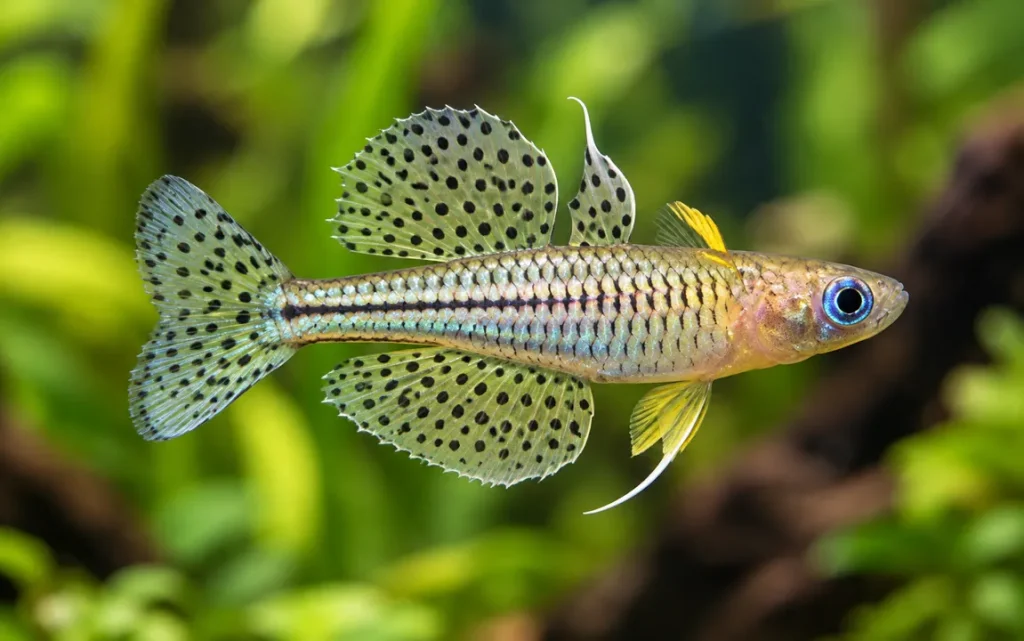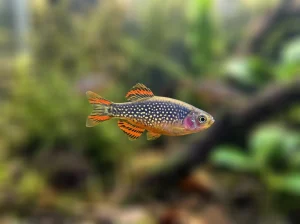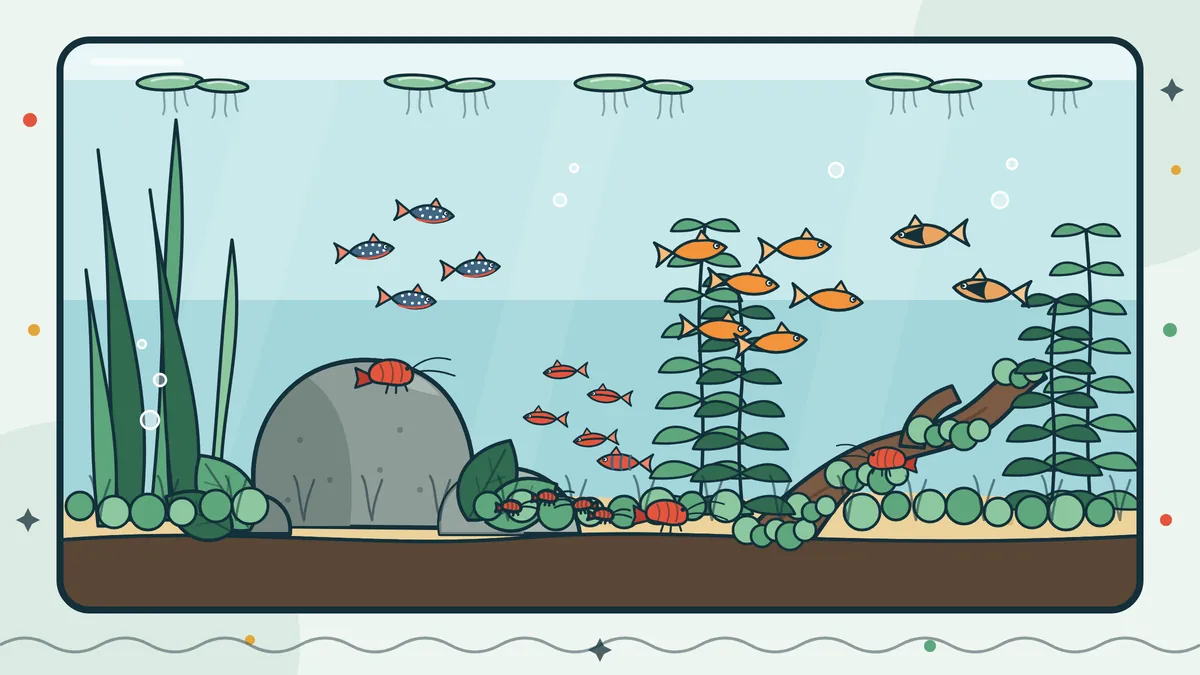
Adult cherry shrimp live beside most of these 14 fish, and none of the 14 is safe for baby shrimp.
A newborn cherry shrimp measures roughly 2-3 mm. The smallest fish below is 15-20 mm long, so even the tiniest mouth has prey that fits.
The chart rates every fish twice, once for adult shrimp and once for shrimplets, the baby shrimp. Each row then gives the reason, what plants and cover change, and the source, and each name links to its care guide.
Nano fish compatibility chart for shrimp and tank mates
How to read it. Two scales. Adult shrimp: Low means no adult losses beyond a molting accident, and Moderate means keepers report adults killed or harassed.
Shrimplets: Moderate means the fish eats small crustaceans, yet many colonies still grow with cover. High means keepers repeatedly report suppressed breeding, and Very high means shrimplets rarely survive.
No fish scores 1 for shrimplets, rows run from the highest shrimplet risk down, and confidence counts independent reports.
| Fish | Adult shrimp | Shrimplets | Why | What cover changes | Fish partners | Source |
|---|---|---|---|---|---|---|
1 | Moderate · 3 | Very high · 5 | Hunting style and temperamentAn active stalker that searches moss for shrimplets. Four of 10 UKAPS keepers report dead adult shrimp, and six report lost shrimplets. | Dense moss does not stop it. One tank held shrimp only with a cave labyrinth and 30 starting shrimp. | Suits Boraras, Microdevario and Trigonostigma. Males claim territory and fight in small, bare tanks. | Seriously Fish, 10 UKAPS keepers and Axelrod 1996 Medium confidence |
2 | Low · 2 | Very high · 5 | Hunting styleA stalking micropredator of copepod-sized prey. Four keepers report or expect eaten shrimplets. Adults are herded and not reported eaten. | Only a shrimp colony established first, in heavy planting, gave keepers a stable tank. | Males fight and need room. Quiet rasboras and harlequins work, but active feeders outcompete it. | Seriously Fish and keepers on 5 forums, 2004-2013 Medium confidence |
3 | Low · 2 | High · 4 | Hunting styleThe jaws are very small and angled upward (Roberts 2007), yet six of seven keepers report or suspect lost shrimplets. | Shrimp first, rock piles and fine moss. Seriously Fish advises against driftwood and leaf litter. | Not with emerald dwarf (hybrids). Kubotai and chili suit it. Males spar. | Roberts 2007, Seriously Fish and 7 keepers Medium confidence |
4 | Low · 2 | High · 4 | Sister speciesRated from the celestial pearl danio, whose jaw shape it matches (Roberts 2007). Keepers describe it as shy. | Water of pH 7-8 rules out Caridina. Neocaridina only. | Not with celestial pearl danio. Needs pH 7-8 and 12-20 dGH. | Roberts 2007 and Seriously Fish Low confidence |
5 | Low · 2 | High · 4 | Hunting styleAn upturned-mouth surface hunter. Aquarium Co-Op writes that adult dwarf shrimp are left alone and baby shrimp are fair game. | Floating plants and moss. Shrimp eat killifish eggs, so spawn the fish apart. | Kept with celestial pearl danio, lampeye, chili and pygmy corydoras. Ember tetras ate its fry. | Seriously Fish, Aquarium Co-Op and UKAPS Low confidence |
6 | Low · 1 | High · 4 | Size and hunting stylePicks worms and crustaceans among plants. Two UKAPS keepers report eaten shrimplets, and one saw babies only after removing the fish. | Heavy moss and low flow. Water of pH 7-8 rules out Caridina. | Males are a snack for many common fish. Pygmy corydoras and pencilfish suit it. | Seriously Fish, Axelrod 1996 and 2 UKAPS keepers Low confidence |
7 | Low · 1 | Moderate · 3 | Hunting styleA copepod-scale micropredator that takes only newborn shrimp. Two keepers report growing colonies beside about 30 chilis. | Rock piles, a coarse sponge filter and a colony established first. | Suits kubotai, harlequin and pygmy corydoras. Timid, so bold fish outcompete it. | Seriously Fish and Aquarium Co-Op keepers Medium confidence |
8 | Low · 1 | Moderate · 3 | Hunting styleA micropredator of tiny live food that stays mid to upper tank. Three keepers report no interest or an odd lost baby. | Fine-leaved plants and heavy cover. | Suits chili, pygmy corydoras and small rasboras. Boisterous fish outcompete it. | Seriously Fish, SKF Aquatics and Aquarium Co-Op keepers Low-medium confidence |
9 | Low · 1 | Moderate · 3 | Hunting styleAn active zooplankton schooler. Three keepers report thriving colonies, and one saw a shrimplet taken once, after it swam to the surface. | Rock piles and live plants, with floating cover for shrimplets that rise. | Suits celestial pearl danio, chili and harlequin. Best with equals. | Seriously Fish and 3 Aquarium Co-Op keepers Low-medium confidence |
10 | Low · 1 | Moderate · 3 | Size and hunting styleA mid-water micropredator with a terminal mouth (FishBase). Two keepers report growing colonies beside it. | More plant cover, less loss. Keepers say sponge pre-filters hide shrimplets. | Suits chili, ember, kubotai and pygmy corydoras. Keep 8-10 or more. | Seriously Fish, Axelrod 1996 and UKAPS Low-medium confidence |
11 | Low · 1 | Moderate · 3 | Hunting styleA midwater forager that does not hunt. Four keepers on one forum report thriving shrimp, and the genus eats bite-sized eggs and fry. | Moss on wood, rock piles and a separate shrimp feeding dish keep losses to the odd shrimplet. | Suits chili, ember, harlequin and celestial pearl danio. Needs a group of 6-10. | Seriously Fish, Axelrod 1996 and Aquarium Co-Op keepers Low-medium confidence |
12 | Low · 1 | Moderate · 3 | Hunting styleEats mainly small crustaceans and midge larvae in the wild and catches smaller prey best (Romand 1985). One keeper runs a planted 12 gallon with many cherry shrimp. | Floating plants and dense moss. A tight lid is needed. | Kept with clown killifish, chili and pygmy corydoras. A pearl danio went after its fry. | Romand 1985, Baensch 1997 and 1 keeper Low confidence |
13 | Low · 1 | Moderate · 3 | Hunting styleAn upper-water micropredator whose adults eat free-swimming fry (Seriously Fish). Two keepers call it indifferent to shrimp. | Dense planting lets some young survive. It needs 16-22 °C, cooler than most rows. | Suits spotted blue-eye. Never with other Oryzias (hybrids). | Seriously Fish and Aquarium Co-Op keepers Low confidence |
14 | Low · 1 | Moderate · 3 | Size and dietA generalist that eats small crustaceans, insects and tadpoles in the wild (ANGFA). One keeper suspects shrimplet loss and sees no interest in adults. | A tannin-stained, heavily planted tank with a log kept losses partial. | Suits medaka and emerald dwarf rasbora. Males fight, and one dominant male killed most of the females in a tank. | Seriously Fish, ANGFA and 2 keepers Low confidence |
Red cherry shrimp (Neocaridina davidi) set the baseline for every rating. Sparkling gourami trade names overlap with Trichopsis schalleri and T. vittata, so keeper reports describe fish sold under the name.
Mouth size does not decide the outcome
Mouth width sets the largest prey a fish can swallow (Hambright 1991, largemouth bass). It sets no floor. A newborn Neocaridina measures about 2.3 mm at hatch and 3.3 mm after 24 hours (Nur and Christianus 2013 and Mahmoud 2020), a small share of the body of every fish below.
- Newborn cherry shrimp2.3 mm
- Scarlet badis15-20 mm
- Chili rasbora20 mm
- Ember tetra20 mm
- Kubotai rasbora20 mm
- Emerald dwarf rasbora20 mm
- Least killifish (male)20 mm
- Celestial pearl danio21 mm
- Pygmy corydoras30 mm
- Clown killifish35 mm
- Medaka36 mm
- Spotted blue-eye38 mm
- Sparkling gourami40 mm
- Harlequin rasbora45 mm
- Norman’s lampeye (TL)45 mm
Standard length from Seriously Fish, except badis (FishBase gives 15) and the lampeye (total length, FishBase). Shrimp length is for Neocaridina denticulata at hatch. Body length is not mouth width, which no source gives for any of the 14.
The celestial pearl danio shows the gap. Roberts 2007 describes its mouth as very small, with jaws angled 45 degrees upward. Six of seven keepers still report or suspect lost shrimplets.
The small jaws did not protect the shrimplets, and one keeper calls the fish a very effective hunter. The emerald dwarf shares the jaw form.
Hunting style sorts most of the fish.
- Stalkers that pounce on copepods, the scarlet badis and the sparkling gourami, sit at the top.
- Midwater schoolers, the chili, ember, kubotai and harlequin, take the smallest shrimplets that enter open water.
- Surface feeders, the clown killifish, Norman’s lampeye and medaka, take what reaches the top layer.
- The pygmy corydoras forages and does not hunt.
Adult shrimp face lower risk, with exceptions
Size and cover protect adults, and neither is absolute. In a laboratory trial, killifish ate adult estuarine grass shrimp (Merchant et al. 2001). Survival rose with the structure of the cover.
- 48 percent on bare gravel
- 71 percent in flat sea lettuce
- 75 percent in a plastic plant shaped like Ambulia
- 98 percent in branched Codium alga
Structure counted for more than whether the cover was living. The species are estuarine, so the trial shows direction only.
The sparkling gourami is the exception on the chart. Four of 10 UKAPS keepers report adult shrimp killed, and two name Amano shrimp as at risk.
Three keepers kept adult cherry or Amano shrimp beside sparkling gouramis without trouble. The scarlet badis herds adults but is not reported to kill them.
Plants and cover change the odds for shrimplets
Three research findings back the idea.
- Cover lowered capture rates in freshwater predator trials (Savino and Stein 1982, Diehl 1988 and Manatunge et al. 2000).
- Plant shape counted for more than plant density in one trial with a native Australian fish (Warfe and Barmuta 2004), which fits fine, branched stems and moss.
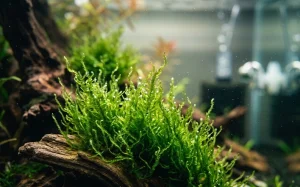
- Juvenile Neocaridina davidi survival reached 90 percent on Vesicularia moss against about 60 percent on other substrates, in a culture study with no fish (Vazquez 2022).
No trial has tested this with nano fish and ornamental shrimp. Keeper reports show the same pattern. The tanks that worked put the shrimp colony in first, then added rock piles, moss and a coarse sponge filter for shrimplets to hide in. One UKAPS keeper notes that a hungry fish eats whatever is available.
Cover does not rescue every pairing. Keepers describe sparkling gouramis searching java moss for shrimplets, and one colony survived only with a cave labyrinth and 30 starting shrimp.
Keepers use coarse sponge filters as shrimplet nurseries, and the sponge filter guide covers the options.
Which fish can live with each other
The chili, ember, kubotai, harlequin, pygmy corydoras and celestial pearl danio share one water window. The overlap of their Seriously Fish ranges is 22-26 °C, pH 6.5-7.0 and 5-8 dGH. Seriously Fish names several of these species as companions for one another, and the celestial pearl danio tank mates and ember tetra tank mates guides cover the pairings.
Four rules cover the problem pairings.
- Keep celestial pearl danios and emerald dwarf rasboras apart. Seriously Fish judges hybridising probable and notes limited evidence of hybrids sold as female pearl danios. The emerald dwarf also needs pH 7-8 and 12-20 dGH, which most other rows cannot supply.
- Keep medaka for cool tanks. They suit 16-22 °C and clash with the tropical rows, and adults eat free-swimming medaka fry (Seriously Fish). Seriously Fish names the spotted blue-eye as a partner.
- Keep least killifish with pygmy corydoras. The males are small enough to be eaten by bigger fish (Axelrod 1996).
- Give males room in the sparkling gourami, scarlet badis and spotted blue-eye. One keeper reports a dominant blue-eye killing all but three females, and a scarlet badis keeper advises a square foot per male.
Check tank space first with the stock calculator.
Amano, bee, crystal and ghost shrimp
Amano shrimp have no shrimplet risk in fresh water, since their larvae need salt water (Hamasaki et al. 2020) and a freshwater tank produces no baby Amano. Only adult risk applies.
Crystal and bee shrimp (Caridina cantonensis) need soft, acidic water. The emerald dwarf and least killifish want pH 7-8, which rules both out. Only the sparkling gourami has Caridina reports, and all of them are bad. One keeper lost adults and another lost eggs and every shrimplet.
Ghost shrimp have no report against any of the 14.
The evidence is mostly keeper reports
No controlled study has paired any of the 14 fish with cherry or Amano shrimp. Keeper reports come mostly from two forums.
- The Aquarium Co-Op forum covers the celestial pearl danio, chili, kubotai, pygmy corydoras and lampeye.
- UKAPS covers the sparkling gourami, least killifish, scarlet badis and harlequin.
Wild diet data exist for one species, Norman’s lampeye (Romand 1985). Every other diet line rests on Seriously Fish descriptions and keeper reports.
Rows marked Low rest on two or fewer keeper reports, and the emerald dwarf rating comes from its sister species. The scoring method sits in the shrimp-safe fish guide, and this chart keeps its scores for the species both pages rate.
How to add shrimp to a tank with fish
- Cycle the tank and plant it heavily with fine-leaved stems, moss and floating plants.
- Add the shrimp first and let the colony breed before any fish arrive.
- Build shrimplet cover with moss on wood, rock piles and a coarse sponge filter.
- Add the fish from the quiet group (chili, ember, kubotai, harlequin, pygmy corydoras) in one batch.
- Keep the fish fed, since a hungry fish eats what is available.
Group size limits how many species fit a tank. The 5 gallon fish guide and the nano fish overview list the group sizes each species needs.
Sources
- Roberts 2007, Raffles Bulletin of Zoology 55(1), original description of Danio margaritatus
- Merchant, Khan and Knowlton 2001, Contributions to Zoology 70(2), grass shrimp, killifish and macrophyte cover
- Nur and Christianus 2013, life cycle of Neocaridina denticulata sinensis
- Mahmoud et al. 2020, Biodiversitas, life cycle of Neocaridina denticulata and N. palmata
- Hamasaki et al. 2020, Crustacean Research, Caridina larvae including C. multidentata
- Hambright 1991, Transactions of the American Fisheries Society, mouth width and prey selection
- Savino and Stein 1982, Transactions of the American Fisheries Society, vegetation and predation
- Diehl 1988, Oikos, structural complexity and foraging efficiency
- Manatunge et al. 2000, Environmental Biology of Fishes, artificial macrophytes and a small cyprinid
- Warfe and Barmuta 2004, Oecologia, habitat complexity and foraging success
- Vazquez et al. 2022, Aquaculture Research, substrates and Neocaridina davidi growth
- Romand 1985, Journal of Fish Biology, diet of Aplocheilichthys normani
- Seriously Fish species profiles for 13 of the 14 species, FishBase species summaries, and ANGFA species notes on Pseudomugil gertrudae
- Axelrod et al., Dr. Axelrod’s Atlas and Encyclopedia of Freshwater Tropical Fishes, 5th revised edition 1996, and Baensch and Riehl, Aquarium Atlas Volume 3, 1997 English edition
- Keeper reports from the UKAPS, Aquarium Co-Op, SKF Aquatics and Aquarium Plants forums, counted by independent author