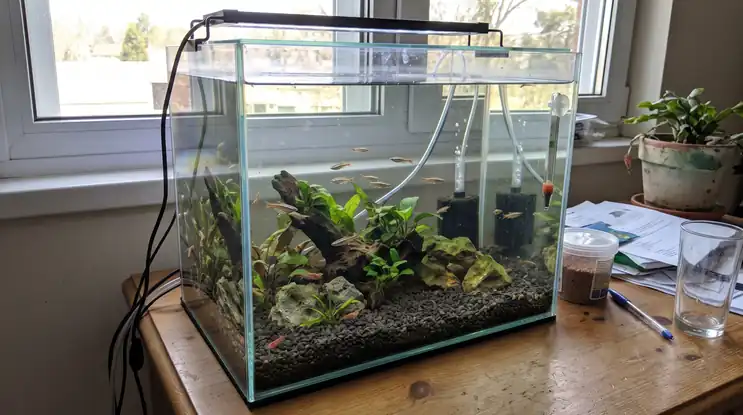
An open nano tank in a 20 °C room settles near 18 °C, since evaporation pulls heat from the water faster than the air puts it back. A lid and a lit LED reverse the gap and hold the water about 1 °C above the room. Stocking an unheated tank starts with that water temperature, measured at its coldest.
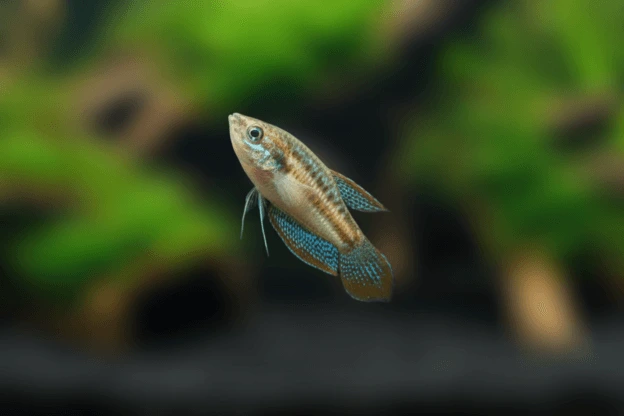
In a tank that stays at 15-22 °C (59-72 °F), Japanese medaka, white cloud mountain minnows and pygmy sunfish need no heater. Cherry shrimp and bladder snails make the best companions. Celestial pearl danios and least killifish need water that stays above about 20 °C. Bettas, chili rasboras, neon tetras and clown killifish need a heater.
Most temperature ranges printed for these fish trace back to one aquarium handbook, the Aquarien Atlas by Riehl and Baensch, which FishBase cites for 8 of the species below. The verdicts here rest on wild water measurements, lab tolerance studies and the 17 °C floor that the Ornamental Aquatic Trade Association (OATA) sets for unheated tanks.
How cold an unheated nano tank gets
The room, evaporation and the heat from the filter and light set the water temperature. A heat-balance model of glass tanks from 10 to 40 L gives the size of each effect.
| Setup | Water versus room | Why |
|---|---|---|
Open top, light off | 1.5-2.2 °C colder | Evaporation pulls heat from the surface. Dry winter air makes it worse. |
Lid, light off | 0.3 °C colder | A lid cuts evaporation by about 85%. |
Lid, filter and LED running | 1.1-1.2 °C warmer | Each watt that reaches the water adds 0.2-0.6 °C. |
Heat-balance model of glass tanks from 10 to 40 L in a 20 °C room at 50% humidity, checked against heater ratings and keeper logs.
A small tank follows the room within hours. A cold night pulls a nano a third to three quarters of the way to the room’s overnight low. Extra water and a lid slow the slide.
| Tank | Lid | Time to close 63% of a gap | Drop after 8 cold hours |
|---|---|---|---|
10 L | Open | 5-9 hours | 4.7-6.2 °C |
10 L | Lid | 7-12 hours | 3.9-5.3 °C |
20 L | Lid | 9-15 hours | 3.3-4.7 °C |
40 L | Lid | 11-19 hours | 2.8-4.1 °C |
The cold night is 8 hours with the room 8 °C below the daytime level.
Keeper logs agree with the model. Unheated tanks in heated homes bottom out near 18-20 °C in winter. Poorly insulated rooms and basements reach 12-16 °C.
Homes run colder than their owners assume. In 750 English homes logged through winter 2017-18, the coldest tenth averaged below 15.0 °C in the main bedroom. Japanese bedrooms averaged 12.8 °C during sleep across 2,190 houses. In the United States, 12% of homes set the thermostat at 63 °F (17.2 °C) or lower at night.
The jar test
Measure before buying fish. Fill the tank or a large jar and stand it where the tank will live. Log the water for 7 days with a min/max or probe thermometer, through at least one cold night. The lowest reading decides the stock in the table below.
Nano fish for an unheated tank, ranked by cold tolerance
Each bar is the fish’s range on a 4-32 °C scale. The pale band is a typical unheated tank in a heated home, 15-22 °C. The dark mark is the 17 °C floor OATA sets for unheated tanks.
| Fish | Verdict | Temperature | What decides it |
|---|---|---|---|
1 Japanese medakaOryzias latipes · 40 mm | No heater | 4-30 °C | Survived two months outdoors at 4-8 °C in northern Japan. Breeds only with 13-14 hours of light. Buy O. latipes, since tropical ricefish fail in cold water. |
2 White cloud mountain minnowTanichthys albonubes · 40 mm | No heater | 14-26 °C | Wild stream water ran 13.4-26.4 °C over a year. Most females stop spawning below 14 °C. Heat above 31 °C is the danger. |
3 Pygmy sunfishElassoma evergladei, E. gilberti · 25-34 mm | No heater | 10-30 °C | Kept with and without a heater with no difference. Eats live food only and lives 1-2 years, so keep a breeding colony. |
4 Bluefin killifishLucania goodei · 29-60 mm | Above 15 °C | 12-22 °C | Easy to keep and common near Florida springs. Large adults outgrow a tank under 40 L. |
5 Dwarf dragon gobyRhinogobius duospilus · 30 mm | Above 15 °C | 15-25 °C | A carnivore that takes frozen or live food. Needs some flow and caves, and hunts shrimplets. |
6 Pacific blue-eye, southern formPseudomugil signifer · 40 mm | Above 15 °C | 15-28 °C | Only fish from southern populations fit. Northern fish grow to about 90 mm and come from warmer water. |
7 Celestial pearl danioDanio margaritatus · 21 mm | Above 20 °C | 20-24 °C | The only wild reading is 22-24 °C, taken in January at a spring-fed pond. No cold limit has been measured. |
8 Least killifishHeterandria formosa · 36 mm | Above 20 °C | 20-30 °C | A native of the southeastern United States, north to North Carolina. No cold limit is published, so hold the tank above 20 °C. |
9 Emerald dwarf rasboraDanio erythromicron · 30 mm | Above 20 °C | 21-25 °C | An Inle Lake endemic listed as Endangered. Suits only a room that holds 21 °C all year. |
Ranges for medaka, white clouds, celestial pearl danios and least killifish come from field and lab studies. The others are documented ranges from FishBase and ANGFA, not measured cold limits. Sizes are FishBase maximum lengths.
The three fish that need no heater
Japanese medaka
Medaka from northern Japan spent December to February in outdoor tanks at Hakodate. The daily mean water temperature ran 3.9-7.6 °C, and ice was broken each morning. Between 68% and 90% survived, depending on the population.
Females develop eggs only with 13-14 hours of light and water above 14-20 °C, depending on where the population comes from. A cool winter tank holds healthy medaka that do not spawn until spring.
Only Oryzias latipes and O. sakaizumii carry this hardiness. A 2026 test dropped the water from 26 to 2 °C. Three tropical ricefish from Indonesia and the Philippines lost balance after 48-59 minutes, sooner than zebrafish at 67 minutes. O. latipes held for 145 minutes. Setup is in the medaka care guide.
White cloud mountain minnow
The claim that white clouds survive 5 °C appears on FishBase without a reference. The only year-long record from a wild stream, at Conghua in Guangdong, ran from 13.4 °C in January to 26.4 °C in August. Most females stop spawning below 14 °C, and no larvae were found in January or February.
In a 1963 study, lab fish lived 40-60 days at 15 °C with negligible losses. The same fish died at 31 °C within 24 hours. OATA lists 17-23 °C and a group of at least 5. For white clouds, a sunny windowsill in July is a greater risk than a cold bedroom in January. The species is a protected animal in China, where a reserve at Conghua holds more than 80,000 fish.
Pygmy sunfish
Pygmy sunfish (Elassoma) are 25-34 mm natives of swamps and slow streams in the southeastern United States. FishBase gives E. okefenokee a documented range of 4-30 °C. A NANFA member kept E. gilberti in a 10 gallon with no heater or filter, then with a heater, and saw no difference.
On flake food, some fish starved and fry production stopped. Breeding resumed once the fish got grindal worms. Each fish lives 1-2 years, so a colony that stops breeding disappears. Males hold territories, so break up sight lines with plants. Never buy the spring pygmy sunfish, E. alabamae, which is listed as Threatened in the United States.
Fish that need the tank above 20 °C
The celestial pearl danio has a coldwater reputation built on one reading. Its type locality, a spring-fed pond near Hopong in Myanmar, measured 22-24 °C in January 2007. January nights in nearby Taunggyi average 8.7 °C. No winter series, cold limit or breeding temperature has been published. Keep celestial pearl danios at 20-24 °C, as set out in the celestial pearl danio care guide.
The least killifish ranges north to the Cape Fear drainage in North Carolina, yet FishBase labels it tropical. One Florida population lives in a spring run held near 22 °C all year. Populations differ in cold tolerance, but no cold limit has been published, so 20 °C is the safe floor. North Carolina lists the species as Special Concern in three counties, so do not collect it. Care details are in the least killifish guide.
Fish sold for unheated tanks that need a heater
Same 4-32 °C scale. Every bar starts at 20 °C or higher, warmer than a typical unheated tank holds on a winter night.
| Fish | Verdict | Temperature | What decides it |
|---|---|---|---|
1 BettaBetta splendens | Heater | 24-27 °C | Wild habitat in Thailand averaged 29.9 °C. OATA requires a heater all year, and the RSPCA calls normal room temperature generally too cold. |
2 GuppyPoecilia reticulata | Heater | 22-28 °C | In cooling tests, guppies lose balance at 12.4-14.6 °C. Germany’s feral guppies survive only in a stream that a power plant keeps at 19 °C or more. |
3 Endler’s livebearerPoecilia wingei | Heater | 22-28 °C | From the Cumaná coast of Venezuela, where the coldest month averages a 21.6 °C low. Listed as Endangered. |
4 Chili rasboraBoraras brigittae | Heater | 25-28 °C | A Borneo peat-swamp fish. Its documented range starts at 25 °C. |
5 Neon tetraParacheirodon innesi | Heater | 20-26 °C | The printed 20 °C minimum comes from an aquarium handbook. Food intake rises steadily from 20 to 32 °C. |
6 Pygmy coryGastrodermus pygmaeus | Heater | 22-26 °C | A lowland Amazon fish with a documented range of 22-26 °C. |
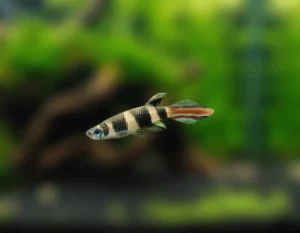
7 Clown killifishEpiplatys annulatus | Heater | 23-25 °C | Listed as coldwater on many unheated lists. Its documented range is 23-25 °C, from coastal West African swamps. |
8 Tropical ricefishOryzias woworae, O. celebensis | Heater | Tropical | Sold beside medaka. In a cold test, three tropical species lost balance sooner than zebrafish. |
A betta needs a heater. Normal room temperature is generally too cold for it, and few homes hold 24 °C through a winter night. Guppies breed in unheated tanks in warm rooms, but their cold limit sits near 13-15 °C. Sizing and placement for a heater are covered in the aquarium heater guide.
Shrimp and snails for an unheated tank
| Animal | Verdict | Evidence |
|---|---|---|
1 Cherry shrimpNeocaridina davidi | Top pick | Wild-living European populations at 15-20 °C had the most egg-carrying females, 61.5%, against 14.6% above 25 °C. Colour held from 20 to 28 °C in lab tests. |
2 Bladder snailPhysa acuta | Top pick | A temperate snail found across Europe. High temperatures, not cold, suppress its breeding. |
3 Amano shrimpCaridina multidentata | Good | Grazes algae at 17-27 °C. Larvae need salt water of 17-34 ppt, so numbers never grow. |
4 Crystal and bee shrimpCaridina spp. | Conditional | Survive a cool room. Related shrimp in Hong Kong streams breed only above 20 °C. |
5 Malaysian trumpet snailMelanoides tuberculata | Skip | Survival is unlikely below 18 °C for more than 48 hours. |
6 Mystery snailPomacea spp. | Skip | Grows to 40-70 mm, too big for a nano. Import into the EU is banned. |
No study has measured shrimplet losses to medaka, white clouds or pygmy sunfish. Ratings for more species are in the shrimp-safe fish guide.
Tank size for an unheated nano
Water volume sets how fast a tank follows the room, so it matters more without a heater. A lidded 40 L tank takes about 1.5 times as long to cool as a lidded 10 L tank. The RSPCA advises a tank larger than 45 × 30 × 30 cm, about 40 L. Germany’s federal guidance sets 60 L, with 54 L as the minimum, and allows smaller tanks for particularly small species. The same document calls binding stocking rules “more counterproductive than useful” (translated from the German).
Plan 20-40 L for a group of medaka, white clouds or pygmy sunfish. A tank under 20 L swings fastest in a cool room. Cherry shrimp, snails or a trio of pygmy sunfish suit it best. Check a mix with the stock calculator.
Winter care for an unheated tank
- Fit a lid. It cuts the evaporation loss from about 1.6 °C to 0.3 °C and slows every swing.
- Place the tank against an inside wall, away from windows, radiators, draughts and direct sun, as OATA and the RSPCA both advise.
- Fix 10-20 mm foam to the back and sides. In a lidded 20 L tank this stretches the time to cool from about 9 to 15 hours.
- Run the filter and light on a fixed schedule. Together they add about 1 °C.
- Feed less as the water cools. At 18 °C a fish’s resting metabolism runs at about 55-65% of its rate at 25 °C.
- Match the temperature of new water at every water change.
- Keep a small adjustable heater as a floor, set at the species’ lower limit. A 25 W unit holds a lidded 20 L tank at 18 °C in a 12 °C room.
OATA advises a heater for any unheated tank that could fall below 17 °C. Avoid oversized heaters and presets fixed at 78 °F. A 50 W heater stuck on can lift a lidded 10 L tank by 10 °C in about 3 hours.
Established filter bacteria keep working through a cool winter. Nitrification holds steady from 15 to 30 °C and slows by a quarter to a third at 10 °C. Cold water also makes ammonia less toxic, since less of it takes the free form. White spot arrives with new fish or plants, and outbreaks track rapid temperature changes. Quarantine new stock for 30 days.
Summer is the bigger risk for an unheated nano
A nano gains heat as fast as it loses it. An afternoon of sun on a lidded 10 L tank adds about 5 °C. In a 2018 heatwave week in England, the warmest fifth of bedrooms averaged above 26.9 °C. Saturated oxygen falls from 9.1 mg/L at 20 °C to 7.6 mg/L at 30 °C. The OATA minimum is 6 mg/L, and fish in warm water need more of it.
- Move the tank out of direct sun.
- Prop the lid open in hot spells to restore evaporative cooling.
- Blow a clip-on fan across the surface. JBL rates its fan at up to 4 °C. Humidity sets the result, about 5 °C in dry air and 1.5 °C at 80% humidity.
- Top off with RO or distilled water. A fan can evaporate 2.5-3.6% of a 20 L tank each day, and tap water top-offs concentrate minerals.
- Run the light in the cooler hours and add surface agitation.
In tropical homes the problem reverses. Rooms stay warm enough for tropical nanos, and medaka and white clouds face the heat risk instead. A tank with no heater and no filter is covered in the filterless nano aquarium guide, and the smallest tanks in the 5 gallon guide.
Unheated tank claims checked
| Claim | What the evidence shows |
|---|---|
Tank water matches room temperature | An open tank runs 1.5-2.2 °C colder. A lidded tank with a light runs about 1 °C warmer. |
White clouds survive 5 °C | The figure has no source. Wild stream water bottomed out at 13.4 °C, and lab fish lived for months at 15 °C. |
Celestial pearl danios are coldwater fish | The claim rests on one January reading of 22-24 °C at a spring-fed pond. |
Any ricefish handles cold | Only Japanese O. latipes and O. sakaizumii. Tropical species failed a cold test sooner than zebrafish. |
Cold water stops the filter | Established nitrification holds steady from 15 to 30 °C and slows by a quarter to a third at 10 °C. |
Cherry shrimp stop breeding in cool water | Wild-living populations at 15-20 °C had the highest share of berried females. |
One inch of fish per gallon | No primary source exists. Germany’s federal guidance rejects fixed stocking rules. |
Sources
- Zhou et al. 2016, temporal and spatial variation of a wild Tanichthys albonubes population, Sichuan Journal of Zoology 35(3): 344-350
- Cheverie and Lynn 1963, high temperature tolerance in Tanichthys albonubes, Biological Bulletin 124: 153-162
- Shinomiya et al. 2023, photoperiod and temperature responses in Japanese medaka, Zoological Letters 9: 16
- Matsuo et al. 2026, temperature tolerance among medaka strains and related Oryzias species, Scientific Reports 16: 25893
- Jourdan et al. 2014, an introduced guppy population in Germany, BioInvasions Records 3(3): 175-184
- Landy and Travis 2018, maternal and environmental effects in the least killifish, Ecology and Evolution 8(12): 6265-6279
- University of Florida IFAS Extension FA212, Evolution, Culture, and Care for Betta splendens
- NANFA, Fish in Focus: Gulf Coast pygmy sunfish, Elassoma gilberti
- United States Fish and Wildlife Service, Ecological Risk Screening Summary: cherry shrimp (2025)
- OATA, how to pick and look after fish in unheated aquariums
- OATA, water quality criteria (2022)
- RSPCA, choosing an aquarium
- BEIS, Energy Follow Up Survey: thermal comfort, damp and ventilation (2021)
- Umishio et al. 2020, disparities of indoor temperature in winter in Japan, Indoor Air 30(6): 1317-1328
- United States Energy Information Administration, Residential Energy Consumption Survey 2020
- German Federal Ministry of Agriculture, minimum requirements for keeping ornamental fish
- JBL, saving energy costs in the aquarium
- FishBase species pages for each fish in the tables
- Roberts 2007, original description of Danio margaritatus, Raffles Bulletin of Zoology 55(1): 131-140
- Mitchell and Brandt 2005, temperature tolerance of Melanoides tuberculatus, Transactions of the American Fisheries Society 134(1): 126-131
- Clarke and Johnston 1999, scaling of metabolic rate with body mass and temperature in teleost fish, Journal of Animal Ecology 68: 893-905