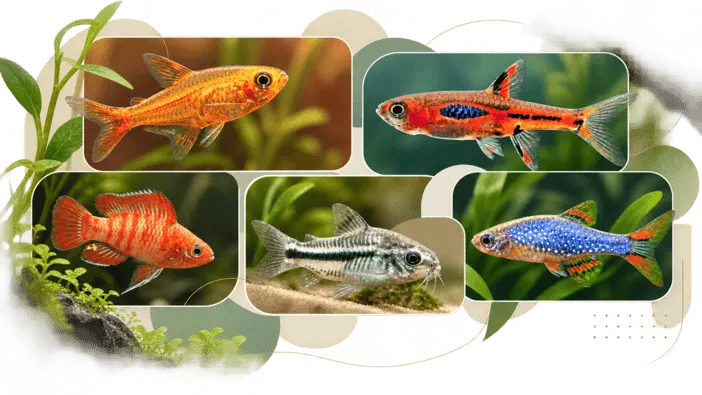
The best nano fish is one that fits your water, tank dimensions and feeding routine. Ember tetras are a practical choice for a peaceful planted community; Endler’s livebearers suit harder water; chili rasboras need a quiet, mature aquarium with soft, acidic water. Small size alone does not make a nano fish suitable for a tiny tank.
This guide compares 14 small aquarium fish options, explains their main care requirements and helps you choose a compatible group. “Nanofish” is an informal aquarium term, not a scientific category. The term also covers micro fish and dwarf fish. A fish only a few centimetres long may still need swimming room, companions or a defended territory.
This list of nano fish we link to are guaranteed to be alive on arrival.
Jump to: comparison table · choosing your fish · 14 profiles · stocking by tank size · setup and feeding · FAQs
0. Betta (Betta splendens)
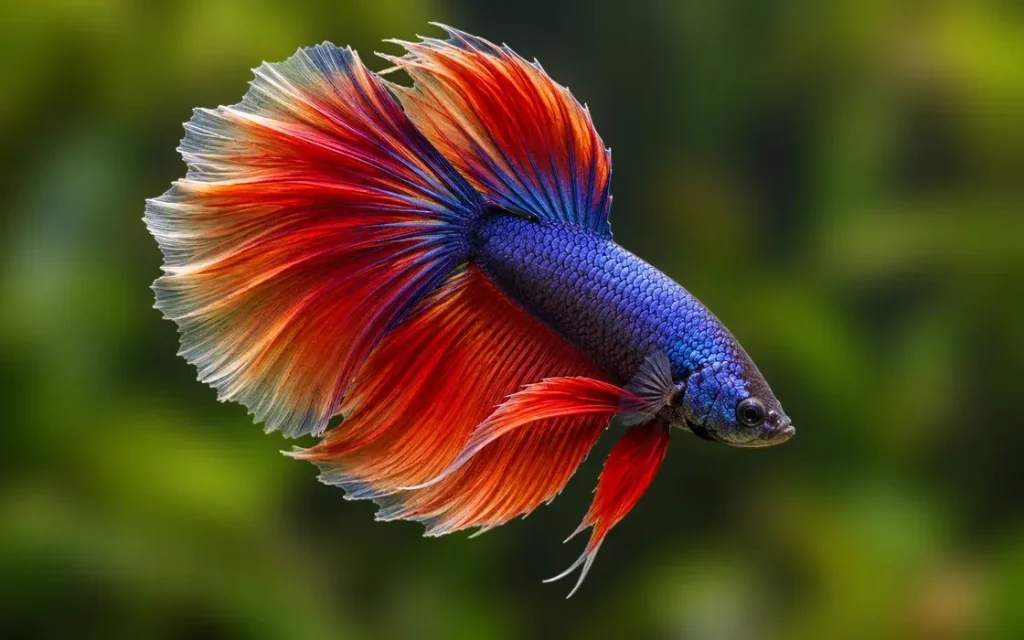
Size: About 5–6.5 cm (2–2.6 in). Social plan: One fish; avoid keeping two males together. Water: 24–27°C (75–81°F); pH 6.5–7.8.
Betta splendens is a good choice if you want a beautiful aquarium. It’s the most colorful nano fish here. Needs warm, stable water. Gentle filtration and a clear route to the surface to gulp air.
Plan tank mates around its temperament. A peaceful individual may accept suitable companions, but others fare better alone. Avoid fin-nippers, flowing-finned fish and female groups unless you can manage aggression and separate fish if the situation arise.
Feed a high-protein diet suited to a carnivorous fish, and confirm the betta is eating. Keep a secure lid on the aquarium because they jump.
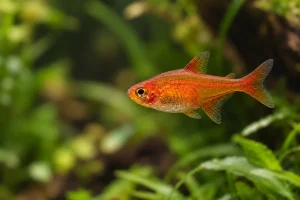
1. Ember tetra (Hyphessobrycon amandae)
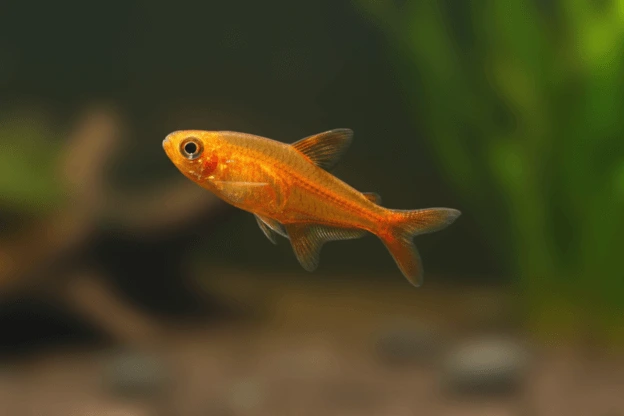
Size: About 2 cm (0.8 in). Social plan: 8–10+. Water: 20–28°C (68–82°F); pH 5–7.
Ember tetras are a practical starting point for a planted community. Their small mouths suit finely crushed food, and a proper group looks more settled than a few scattered fish. Keep open swimming room between planted areas rather than filling every inch with hardscape.
Choose calm companions that will not take every meal before the embers can feed. Small size does not make them safe with every shrimp: adults usually have a better chance than newly hatched shrimplets.
Read our Ember tetra breeding guide.
2. Chili rasbora (Boraras brigittae)

Size: About 2 cm (0.8 in). Social plan: 10+. Water: 20–28°C (68–82°F); pH 4–7.
Chili rasboras suit a quiet tank with plant cover, gentle flow and very small food. They are attractive in a nanofish aquarium, but they are a less forgiving first choice when a tank is newly cycled or the tap water is hard and alkaline.
Feed where you can watch them eat. A full-size pellet can be useless to a fish this small, and fast tankmates can leave a shy group underfed. Use a fitted lid and avoid sudden changes in water conditions.
Read our Chili rasbora breeding setup.
3. Pygmy corydoras (Corydoras pygmaeus)
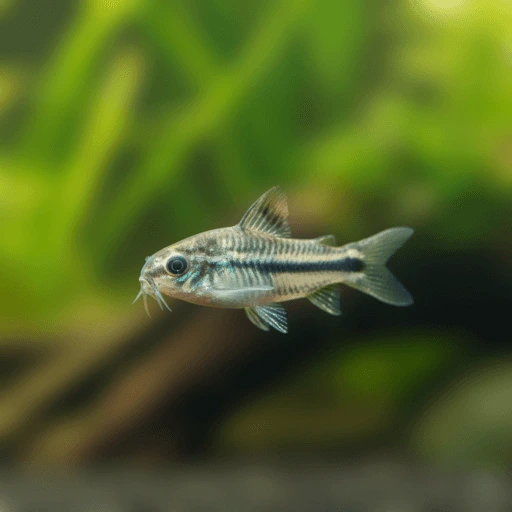
Size: About 3 cm (1.2 in). Social plan: 6 minimum; 10 preferred. Water: 22–26°C (72–79°F); pH 6.4–7.4.
Pygmy corydoras need their own group and food. They rest on leaves and surfaces, forage below and also swim in midwater, so they are not simply a bottom-dwelling cleanup crew. Offer suitably small sinking foods and check that the group gets them.
Fine sand or a smooth, nonabrasive substrate gives them somewhere comfortable to forage. Keep it clean without stripping the whole tank at once. Pair them with peaceful fish and leave an accessible feeding area.
Read our How to breed pygmy corydoras.
4. Celestial pearl danio (Danio margaritatus)

Size: About 2–2.5 cm (0.8–1 in). Social plan: 10+. Water: 20–26°C (68–79°F); pH 6.5–7.5.
Celestial pearl danios, also sold as galaxy rasboras, are small but need space to avoid one another. Dense plants break sightlines between males, while small clear areas let you observe feeding. Displays can involve courtship as well as rivalry.
A bare tank or pushy companions can leave timid fish hiding and missing meals. Keep a group, distribute food and watch for a male persistently driving another fish into a corner. They are not a reason to heat every nano aquarium to tropical extremes.
Read our Celestial pearl danio breeding guide.
5. Scarlet badis (Dario dario)

Size: Males about 2 cm (0.8 in). Social plan: Single male or planned breeding setup. Water: 18–26°C (64–79°F); pH 6.5–8.5.
Scarlet badis are a specialist choice despite their tiny size. Many will not reliably accept dry food, so arrange a supply of appropriately sized live or frozen foods before buying them. A tank full of faster feeders makes this harder.
Do not buy them as schooling fish. Males defend areas, and shops often have mostly males. Plant cover helps, but it does not guarantee compatibility. These micropredators are also a poor choice when protecting baby shrimp is the priority.
Read our Scarlet badis breeding guide.
6. Endler’s livebearer (Poecilia wingei)
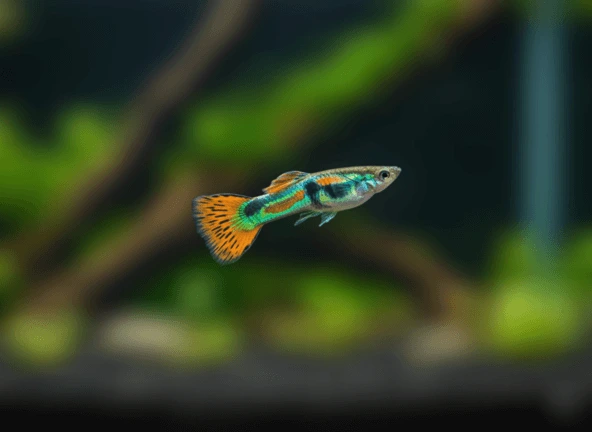
Size: Males 2–3 cm; females around 4 cm. Social plan: Small group; males only to avoid fry. Water: 24–30°C (75–86°F); pH 7–8.5.
Endlers are active livebearers that generally fit harder water better than chili rasboras or green neon tetras. Their constant movement and readiness to breed matter more than the size of a single male. Check the seller’s water conditions rather than aiming for the warm end of the range.
A male-only group avoids ongoing reproduction, although individual males can still chase. Mixed-sex groups need enough room and a plan for offspring. Do not combine them with soft-water species simply because both are marketed as nano fish.
7. Green neon tetra (Paracheirodon simulans)
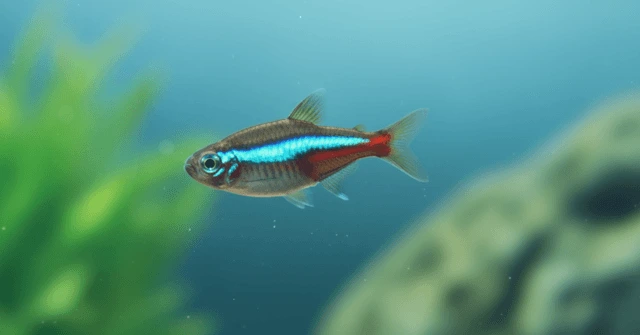
Size: About 2.5 cm (1 in). Social plan: 8–10+. Water: Soft acidic water; published pH range 3–6.5.
Green neon tetras are smaller than ordinary neon tetras, but they are not an interchangeable hard-water community fish. Choose them for an established aquarium whose water already suits them, with shaded areas and a peaceful group.
Ask the supplier about temperature, source and acclimation. Published habitat extremes are not targets for a home aquarium. Avoid chasing a very low pH with chemicals; stable, suitable water and a mature filter come first.
8. Clown killifish (Epiplatys annulatus)

Size: About 3.5 cm (1.4 in). Social plan: Small group, with surface cover. Water: 20–26°C (68–79°F); pH 4–7.
Clown killifish spend much of their time near the surface. Floating plants, gentle circulation and small floating or live foods make that space more usable. A lid with gaps closed around cables and pipes is part of the setup.
Avoid boisterous surface feeders that crowd them out. Check that each fish eats, and leave access to open surface water rather than covering it completely. Small groups still need enough cover to escape persistent chasing.
9. Sparkling gourami (Trichopsis pumila)
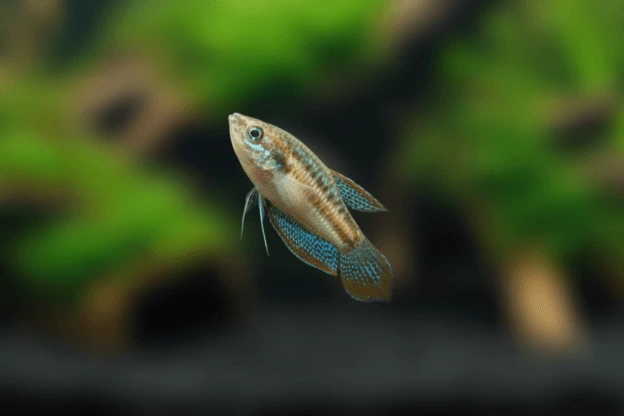
Size: About 4 cm (1.6 in). Social plan: Compatible pair or carefully managed small group. Water: 22–28°C (72–82°F); pH 5–7.5.
Sparkling gouramis are small labyrinth fish with more territorial behavior than a shoal of tetras. Plant cover and broken sightlines matter, especially when breeding. Give them access to the surface to breathe and use a suitable lid.
Do not assume a fixed male-to-female ratio guarantees peace. Watch individual behavior and be ready to separate a bullied fish. Offer small foods they actually eat, with appropriately sized live or frozen foods as part of the diet.
10. Norman’s lampeye (Poropanchax normani)

Size: About 3–4 cm (1.2–1.6 in). Social plan: 8–10+. Water: Confirm the supplier’s temperature and water conditions.
Norman’s lampeyes are group fish whose reflective eyes stand out in a planted aquarium. Their activity makes a longer tank more useful than a tall, narrow one of the same volume. Leave open swimming space alongside cover.
Use a fitted lid, peaceful companions and small foods. Check the scientific name when buying: several different fish are sold as lampeyes, and their requirements are not identical. Ask the seller for the conditions in which the actual stock is being kept.
11. Emerald dwarf rasbora (Danio erythromicron)
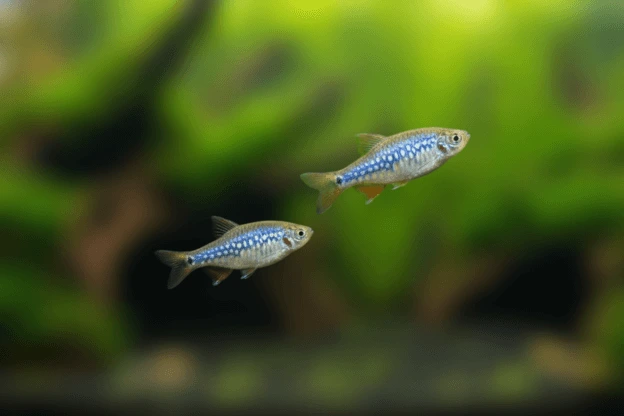
Size: About 2 cm (0.8 in). Social plan: 10+. Water: 20–24°C (68–75°F); pH 7–8.
Emerald dwarf rasboras are a useful reminder that “rasbora” does not mean every fish wants soft, acidic water. This species comes from a different environment than chili rasboras and suits cooler, harder conditions. Plant the tank well while retaining feeding space.
This blue nano fish can be shy, and males can compete. A group and broken sightlines help, but a tiny bare aquarium does not. Make sure small foods reach the quieter individuals instead of judging feeding success by the boldest fish.
12. Medaka ricefish (Oryzias latipes)
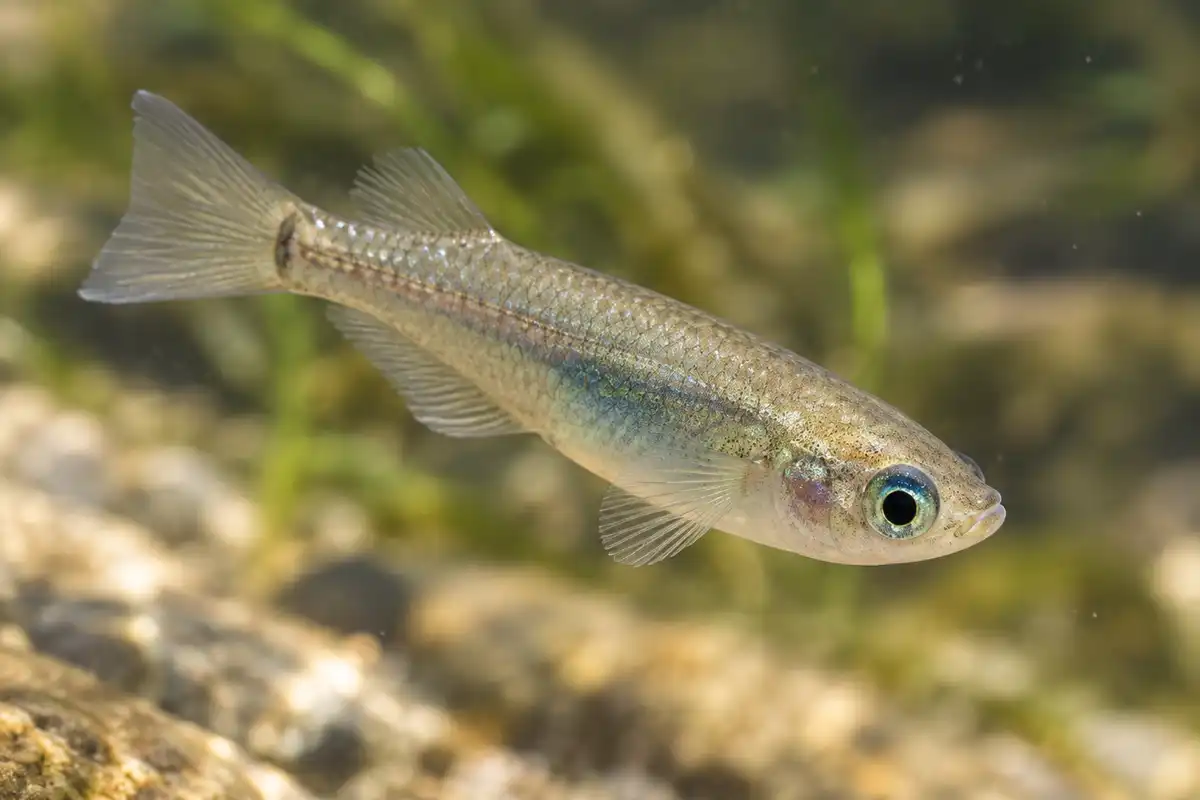
Size: Up to 4 cm (1.6 in). Social plan: 10 to start, with 1 L (0.26 gal) of water per fish. Water: 0–38°C (32–100°F) tolerated; 25–28°C (77–82°F) for best growth; pH weakly acidic to weakly alkaline.
Medaka ricefish, also called Japanese ricefish, are among the hardiest nano fish on this list. They tolerate a far wider temperature range than the other fish here, so most homes need no heater. A heater only helps winter breeding or very cold regions.
Warm water makes medaka busy, and busy fish make more waste. Keep to 1 L of water per fish, and feed only what the group finishes in 5 minutes. Other medaka are the safest tank mates. Adults eat hatchlings, so move eggs to a separate container. Beginners do best with half-daruma or a rainbow mix.
Read the Medaka ricefish care guide.
13. Least killifish (Heterandria formosa)
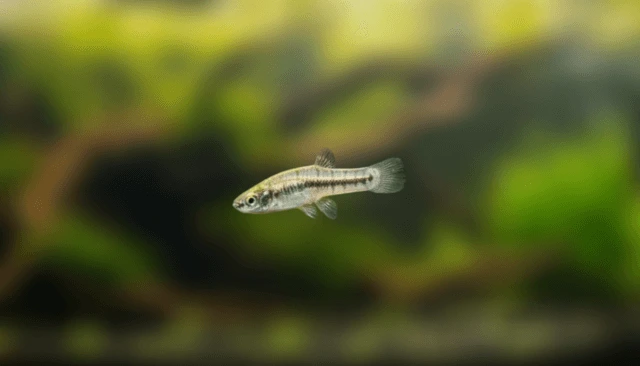
Size: Males about 2 cm; females about 3.5 cm. Social plan: Small colony; allow for offspring. Water: 20–26°C (68–79°F); pH 7–8.
Least killifish are livebearers, despite the common name. A planted species tank makes it easier to observe the colony and feed small mouths without competition. Start with a modest number and leave room for reproduction.
Do not build a stocking plan around a rigid sex ratio or a claim that adults never eat fry. Provide cover, monitor population growth and have a responsible destination for surplus fish before the aquarium becomes crowded.
14. Spotted blue-eye (Pseudomugil gertrudae)
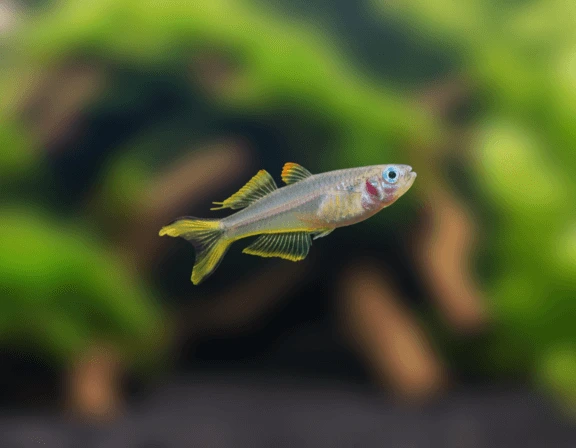
Size: About 3.8 cm (1.5 in). Social plan: 8–10+. Water: 21–28°C (70–82°F); pH 4.5–7.5.
The existing image illustrates a Pseudomugil blue-eye; use the seller’s scientific identification when choosing the species.
Spotted blue-eyes combine small size with active swimming and male displays. Keep a group in a mature, well-oxygenated planted tank, with open space and plant cover. Feed small foods that stay available long enough for the group to find them.
Where to buy Nano Fish?
If you want alive fish on arrival; try theshrimpfarm.com
Flat shipping rate $11.99.
Check the species name before using these ranges. Other Pseudomugil, including fork-tailed blue-eyes, have different water requirements. A genus-wide label such as “all blue-eyes need hard alkaline water” is misleading.
Read our Spotted blue-eye breeding guide.
List of Nano Fish comparison: size, space and group needs
The footprints below are planning references, not permission to stock every listed group together. Length and width matter as well as litres or gallons. A 45 × 30 × 30 cm aquarium holds about 40 litres (11 US gallons) before substrate and equipment; shop labels such as “10 gallon” can describe different dimensions. More space is useful for active fish, mixed communities and breeding.
On a phone, swipe the table sideways to see all columns.
| Fish and adult size | Tank footprint / planning space | Group plan | Main fit or tradeoff |
|---|---|---|---|
| Ember tetra About 2 cm (0.8 in) | 45 × 30 cm | 8–10+ | Peaceful community; soft to moderately soft water |
| Chili rasbora About 2 cm (0.8 in) | 45 × 30 cm | 10+ | Mature, soft, acidic aquarium |
| Pygmy corydoras About 3 cm (1.2 in) | 45 × 30 cm | 6 minimum; 10 preferred | Social bottom and midwater fish |
| Celestial pearl danio About 2–2.5 cm (0.8–1 in) | 45 × 30 cm; more room helps | 10+ | Cooler planted tank with cover |
| Scarlet badis Males about 2 cm (0.8 in) | 45 × 30 cm for a carefully managed setup | Single male or planned breeding setup | Dedicated feeding; territorial males |
| Endler’s livebearer Males 2–3 cm; females around 4 cm | 45 × 30 cm; larger for mixed-sex colonies | Small group; males only to avoid fry | Harder, alkaline water |
| Green neon tetra About 2.5 cm (1 in) | 45 × 30 cm | 8–10+ | Established, warm, soft and acidic water |
| Clown killifish About 3.5 cm (1.4 in) | 45 × 30 cm | Small group, with surface cover | Quiet surface habitat; secure lid |
| Sparkling gourami About 4 cm (1.6 in) | 45 × 30 cm; larger for more fish | Compatible pair or carefully managed small group | Planted territory; not a schooling fish |
| Norman’s lampeye About 3–4 cm (1.2–1.6 in) | Plan a 60 cm long aquarium | 8–10+ | Open swimming room with planted margins |
| Emerald dwarf rasbora About 2 cm (0.8 in) | 60 × 30 cm | 10+ | Cooler, harder and alkaline water |
| Medaka ricefish Up to 4 cm (1.6 in) | 30 cm (12 in) container for 10 fish; 1 L (0.26 gal) per fish | 10 to start | Hardy fish for unheated rooms and outdoor tubs |
| Least killifish Males about 2 cm; females about 3.5 cm | Plan around 10 US gal or larger | Small colony; allow for offspring | Small livebearer for moderately hard water |
| Spotted blue-eye About 3.8 cm (1.5 in) | 45 × 30 cm; a longer tank is preferable | 8–10+ | Mature planted aquarium; active displays |
Choose nano fish for your water and experience
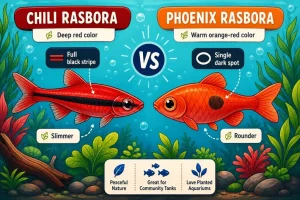
For a first planted community: consider ember tetras if your water suits them. A group with peaceful companions is easier to manage than mixing several tiny species with competing requirements. Compare chili and phoenix rasboras if you are choosing between those closely related fish.
For harder water: look at Endlers, least killifish or emerald dwarf rasboras, then check temperature and space. For cooler rooms: celestial pearl danios and emerald dwarf rasboras are worth considering. Medaka ricefish suit unheated rooms best. They still need stable conditions; “cooler” does not mean an unheated tank is suitable in every home.
For soft, acidic water: chili rasboras, green neon tetras and clown killifish may fit an established setup. Scarlet badis are a specialist feeding choice, and sparkling gouramis require attention to territories. If you cannot provide the food or separate bullied fish, choose something simpler.
For hardy, easy nano fish: medaka ricefish are the easiest start on this list. They tolerate 0 to 38°C, live without a heater in most homes, and suit a plain 30 cm (12 in) container or an outdoor tub with summer shade. Plan for fry, since adults eat hatchlings.
For shrimp breeding: a shrimp-only tank gives newborns the best protection. Adult shrimp may coexist with some small peaceful fish, but no “shrimp-safe” label guarantees survival of shrimplets. Moss and dense plants offer cover without making predation impossible.
Adult lengths are approximate and may differ by sex. The temperature and pH ranges below are reference ranges, not instructions to push nano fish toward an extreme or change pH suddenly. Check hardness and the supplier’s conditions too. Most profiles draw on the species references linked below; these are researched care summaries, not claims that every fish was tested in our own tanks.
Stocking a nano aquarium by tank size
5 US gallons (about 19 litres): treat this as a very limited footprint, not an invitation to squeeze in a schooling species. A planted shrimp aquarium is often easier to stock responsibly. Small volume changes temperature and water quality quickly, and equipment reduces usable space.
10 US gallons (about 38 litres): check the actual base dimensions against the profile. A long, well-planted aquarium with a suitable footprint may support one carefully chosen small group; a tall, narrow tank of the same volume is a different proposition. Keep the group’s needs intact rather than buying two of five species.
15–20 US gallons (about 57–76 litres): the extra space opens up better group sizes and more stable conditions. Start with one main species. Add a second compatible group only when water requirements, adult size, feeding access and remaining space all fit. Pygmy corydoras still need a proper group and their own meals; they are not a free addition because they use the lower tank.
Avoid inches-of-fish-per-gallon rules. Adult size, activity, territories, reproduction and tank shape all change the answer. Test ammonia and nitrite after additions and reduce stocking or feeding pressure if the aquarium is not coping. A bigger filter does not create more swimming room.
Set up a stable nano fish aquarium
Cycle before stocking. Use a fishless cycling method appropriate to the setup and verify its progress with reliable tests. The filter must be able to process ammonia and nitrite before nano fish are introduced. Four weeks on a calendar or nitrate alone is not proof: plants can consume nitrate, and an uncycled aquarium can still contain it. Stock gradually after readiness is confirmed.
Choose gentle, effective filtration. Match circulation to the fish. A sponge filter can be useful for small fish and fry; see our nano tank sponge filter guide. Do not wash all biological media under untreated tap water or replace it all together. Clean as needed while preserving the established filter.
Match temperature and lighting to the inhabitants. Measure the aquarium’s daytime and nighttime temperature before deciding whether it needs heating. If suitable for the tank, the Hygger digital mini heater is one existing equipment option to compare by rated capacity and dimensions. Use an independent thermometer.
Choose lighting for the plants and tank depth rather than simply buying the brightest fixture. Our planted aquarium light comparison explains the tradeoffs. The Hygger planted aquarium light is another option to check against tank length and control needs. Floating plants and shaded areas can help shy nano fish feel less exposed.
Make feeding observable. Use food small enough for nano fish mouth and check that every part of the group gets some. Surface feeders, midwater fish and pygmy corydoras may need food delivered differently. Offer modest portions and remove uneaten food. Live foods can be useful for specialist feeders and breeding; our microworm culture guide explains one option for suitable fry.
Maintain stable water. Test your source water’s pH and hardness before choosing species. Use appropriate water conditioner and match replacement water reasonably closely in temperature and chemistry. Base water changes on stocking, feeding and test results rather than assuming every tank needs the same percentage. Top-offs replace evaporation but do not remove accumulated waste.
Buy healthy, correctly identified nano fish. Ask what the stock is eating and how it has been kept. Plan quarantine where practical, use the seller’s acclimation advice and do not treat every purchase automatically with salt or medication. A disease or feeding problem is easier to investigate with the species, symptoms, temperature and water tests written down.
Plan for breeding before the tank fills up
Livebearers can increase the population without much encouragement, while egg-scattering fish need different arrangements to raise fry. Decide whether you want offspring and where they will go. Use a separate breeding or grow-out setup when the community tank cannot provide the space and feeding access.
For the next step, start with our nano fish breeding hub and the species-specific guides linked in the profiles. Successful spawning does not mean the display aquarium can hold every juvenile.
Nano fish FAQs
What are the best nano fish for beginners?
Ember tetras are a practical option for a cycled planted aquarium with suitable softer water. Endler’s livebearers are often a better match for harder, alkaline water. Choose a species that fits your tap water, tank footprint and feeding routine rather than buying by size alone.
Can nano fish live in a 5-gallon tank?
A 5 US gallon aquarium leaves little room for a proper group, territories or mistakes in water quality. A planted shrimp tank is often a better choice. Most fish groups in this guide need a larger footprint; check the individual profile before stocking.
How many nano fish can I keep in a 10-gallon aquarium?
There is no safe universal number. Check the tank dimensions, adult size, group needs, filtration and water conditions. Start with one compatible group rather than adding the recommended group size of every species together, and monitor ammonia, nitrite and behavior.
Are nano fish safe with shrimp?
No fish in this guide can be guaranteed safe with newborn shrimp. Peaceful small fish may coexist with adult shrimp, but shrimplets can still be eaten. Dense plants improve cover; a separate shrimp-only tank is the reliable choice when breeding shrimp is the priority.
Do nano fish need a heater?
It depends on the species and the room’s actual temperature range. Some tolerate cooler conditions, while others need consistently warm water. Use a thermometer, check nighttime temperatures and choose a heater when the aquarium cannot stay within the species’ suitable range. Medaka ricefish are the exception, since they tolerate 0 to 38°C.
Which nano fish suit hard water?
Endler’s livebearers, least killifish and emerald dwarf rasboras can be better candidates than chili rasboras or green neon tetras. Their temperature and other requirements still differ. Test pH and hardness and check the supplier’s conditions before combining species.
Are all nano fish schooling fish?
No. Tetras, small rasboras and pygmy corydoras need groups, but scarlet badis and sparkling gouramis have different social and territorial needs. Do not apply a six-fish rule to every species.
How do I know a nano aquarium is ready for fish?
Use water tests and an appropriate cycling method to verify that the filter can process ammonia and nitrite before stocking. A fixed number of weeks or a nitrate reading alone does not prove readiness. Add livestock gradually and keep checking water quality.
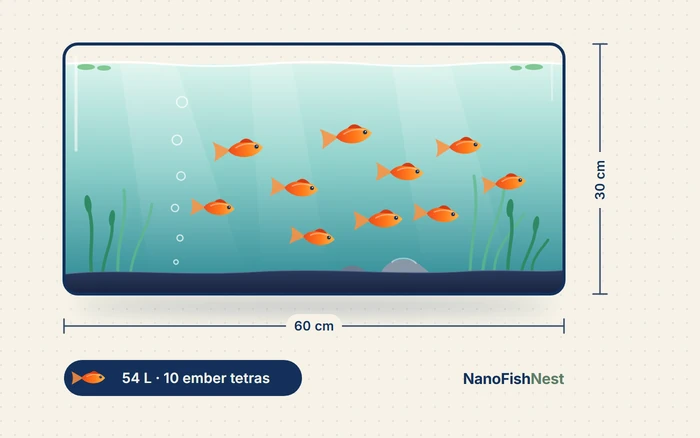
The point about small size not making a fish suitable for a tiny tank stuck with me, especially since pygmy corydoras are listed at 3 cm but still need a group of six or more. A practical tweak: before buying, measure the actual footprint of the tank and subtract space taken by filter, heater and plants, then check that the remaining open swimming length is at least ten times the adult body length of your chosen species. That quick check prevents a lot of cramped setups.