Norman’s lampeye care rests on five rules.
- Keep 10 or more fish, with more females than males.
- Use a tank at least 60 cm long.
- Fit a tight lid.
- Hold the water at 21 to 25 °C and keep it stable.
- Quarantine every new batch.
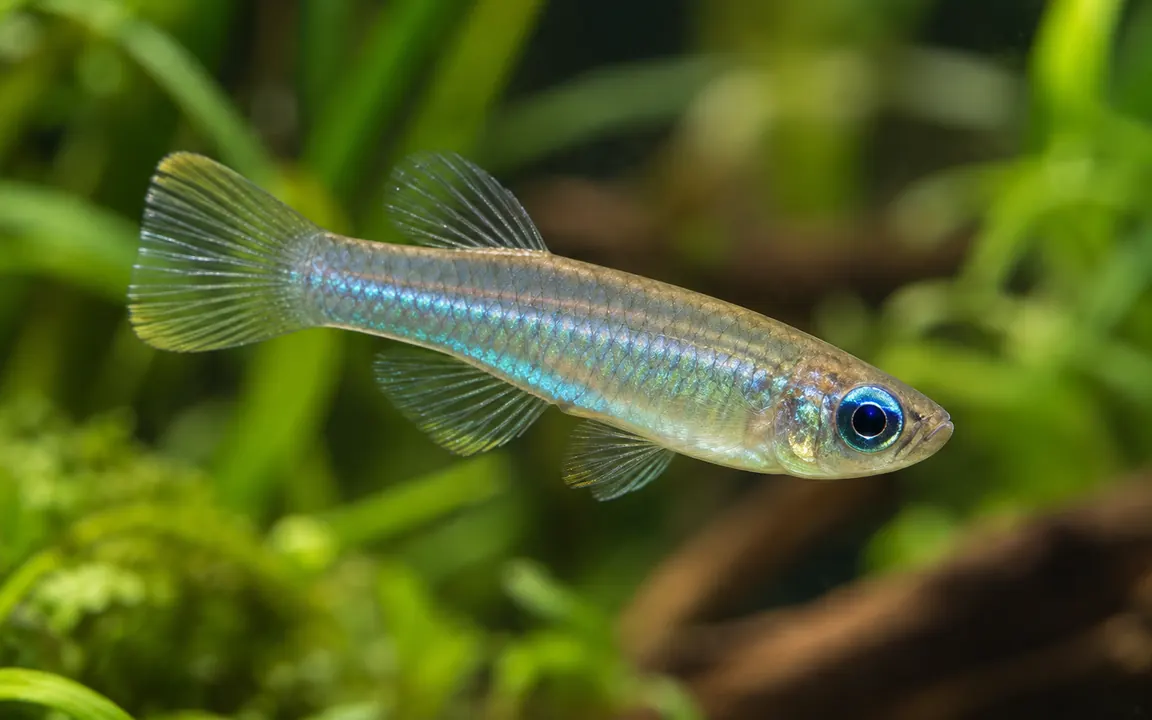
Poropanchax normani is a 3 to 4 cm shoaling killifish from the savanna streams of West and Central Africa, from Senegal to Lake Chad. Both sexes carry a blue reflective patch in the upper iris.
The patch reflects light and does not glow, so a school of 20 or more in dim, planted water shows it at full effect.
The fish has a reputation as a hardy beginner species. Settled fish are tough, but farm-bred imports often die in the first weeks.
Most care sheets repeat one set of figures from a 1991 aquarium handbook. This guide uses peer-reviewed field and laboratory studies, killifish club records from 1983 and keeper reports in five languages. Where no measurement exists, the text says so.
Norman’s lampeye care
Working targets for Norman’s lampeye care come from keeper reports and studies, since no field measurements exist.
| Item | Value |
|---|---|
| Scientific name | Poropanchax normani (Ahl, 1928) |
| Family | Procatopodidae (African lampeyes) |
| Origin | West and Central Africa, Senegal to Lake Chad and Sudan |
| Adult size | 3 to 4 cm, up to 4.5 cm including the tail |
| Lifespan | Not documented. Keepers report 2 to 4 years |
| Minimum tank | 60 cm long, 55 to 60 L, for 10 to 12 fish |
| Group | 10 minimum, 15 to 30 ideal, more females than males |
| Temperature | 21 to 25 °C, with 22 to 24 °C as the working target |
| pH | 6.5 to 7.5 |
| Hardness | 4 to 15 °dH (moderately soft to hard) |
| Swimming zone | Open mid and upper water |
| Diet | Small live, frozen and floating foods |
| Temperament | Peaceful, swims in groups. Males spar |
| Breeding | Lays eggs daily on plants. Eggs hatch in about 2 weeks |
| Difficulty | Easy once settled. Fresh imports are fragile |
Norman’s lampeye tank size and footprint
Norman’s lampeye tank size depends on length more than volume. A tank 60 cm long (55 to 60 L) is the real minimum for a group of 10 to 12.
| Tank | Fish | Verdict |
|---|---|---|
| 20 L (5 gallons) | Any group | Fails. One male killed two females within days |
| 38 to 40 L, 45 to 50 cm | 6 to 8, mostly female | Workable. Aggression risk rises |
| 55 to 60 L, 60 cm | 10 to 12 | Recommended minimum |
| 90 cm and longer | 20 to 30 | Full display and breeding colonies |
American retailers list 10 gallons as the minimum, and European sources center on 60 cm. Keepers running full groups report trouble in 10-gallon tanks.
The fish use the whole tank, mostly in the upper and middle water. They are more active than rasboras. Males chase rivals and females across the tank, so length gives the chased fish room to escape. One keeper with 12 fish in a 90 cm tank advises nothing shorter than 75 cm for breeding groups.
Norman’s lampeye care: group size and sex ratio
For Norman’s lampeye care, keep at least 10 fish, and 15 to 30 where space allows.
Six is the retail floor, and it is too low. Groups under 8 hide and fade. One keeper’s 2 females and 3 juveniles never shoaled, and the females picked on each other. At 12 fish, the same keeper described a calmer and more active group.
A wholesale importer recommends 20 to 30, and Aqualog, a German aquarium-book publisher, sets a floor of 10 for shoaling fish in its symbol key.
Larger groups help in three ways.
- Aggression spreads across many fish instead of landing on one.
- The fish stay in the open instead of hiding.
- The eye-shine effect is collective. A single fish looks plain.
Sex ratio
Keep more females than males, at a working ratio of 1 male to 2 or 3 females.
A group of 12 with mostly males lost its males one by one, while all the females lived.
Males squabble in any group, and spread fins with rivals facing off count as normal display that rarely injures. Chasing that draws damage is a problem.
Norman’s lampeye care: water parameters
The standard figures are 22 to 26 °C and pH 6.5 to 7.2, and they appear on almost every care page.
They trace to a 1991 aquarium handbook (Baensch and Riehl, Aquarien Atlas, vol. 3). No one has published temperature, pH or hardness measured at a lampeye site.
Aqualog states the same limit for its own care symbols, which describe aquarium conditions only.
Temperature
Experienced keepers run cooler than the care sheets.
| Range | What it means |
|---|---|
| 18 to 21 °C | Peak spawning. A long-time breeder of wild Nigerian and Guinean stock found the fish most prolific here and got no regular spawns above 22 to 23 °C |
| 21 to 23 °C | Preferred by long-term keepers in North America, Germany and France |
| 22 to 25 °C | Everyday range for most keepers |
| 26 to 27 °C | Tolerated. Eggs still appear, but output drops |
| 28 °C and above | Avoid. Warm water holds less oxygen, and keepers report losses in heat waves |
A 1983 British killifish report advised “the cool side of 70 to 72 °F”, and a 2005 breeder reported successful spawning at 16 to 19 °C.
Japanese retailers list 23 to 27 °C. Cool-water and warm-water keepers agree on the limits, so keep the water stable and under 28 °C.
Swings do more harm than any fixed number. Cold water added to a tank can kill lampeyes. One keeper lost three lampeyes after a jump from 24 to 26 °C and a full dose of tea-tree remedies. The other fish lived.
pH and hardness
Aim for pH 6.5 to 7.5 and 4 to 15 °dH. Tank-bred stock tolerates more than the wild type.
- Eleven tank-bred fish held for over a month at pH 8.0, with no quarantine losses.
- The 1983 British breeder spawned them at 20 °dH and pH 7 to 7.2.
- A laboratory group spawned in peat-treated water at pH 6.0.
Match the shop’s water first, then shift slowly. Soft, acid water is not a requirement for farm stock.
Nitrate and maintenance
Keep nitrate low, since Japan’s largest online retailer reports the fish dislikes nitrate build-up and prefers fresh water. A German breeder found fry growth slows above 10 mg/L.
Routine Norman’s lampeye care means changing 25 to 30 percent of the water weekly, with new water at the tank temperature.
Norman’s lampeye care: setup, light, lid and flow
Substrate and background
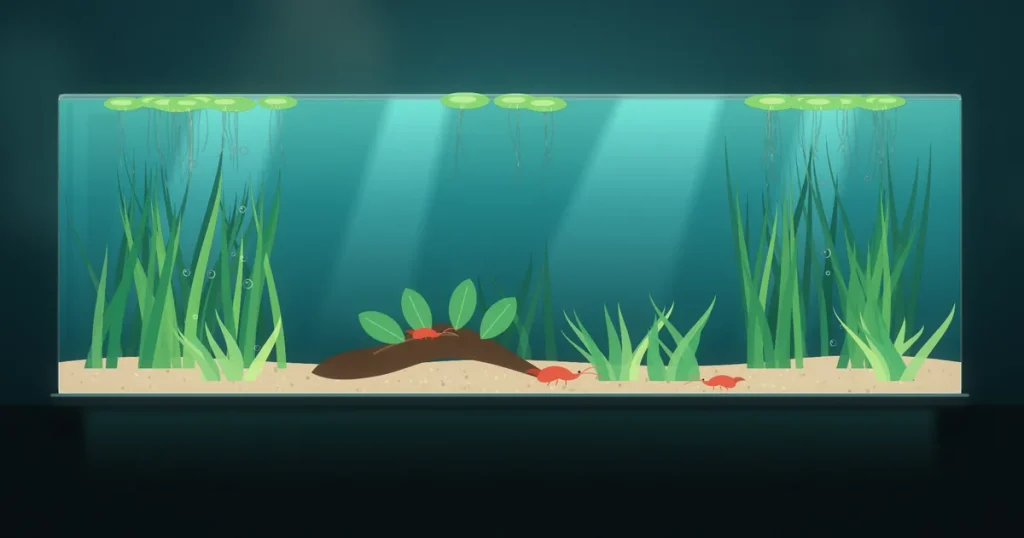
Use dark sand or fine gravel and a dark background. Dark surfaces deepen the blue of the patch.
Plants
Plant the back and sides densely and leave the center open.
Anubias, Bolbitis, ferns, Java moss, hornwort and Najas all work. Anubias and Bolbitis are African plants, and Japanese aquascapers pair them with this fish.
Add floating plants such as frogbit, Salvinia and Ceratopteris. They dim the light, give cover and hold eggs in their roots.
Light
Keep the light dim and overhead. Strong light washes out the blue patch and stresses the fish.
The lid
A tight lid is mandatory in Norman’s lampeye care, since the fish jump.
In one open-top tank, 5 of 15 fish jumped within the first hour. The keeper kept picking fish off the floor whenever someone came within 5 feet.
A Korean shop video names jumping as the top killer of lampeyes, and Korean keepers report finding dried fish behind tanks. When fish go missing, check behind the tank before suspecting disease.
Three triggers recur across the reports.
- Light switched on or off without warning.
- A person approaching the tank.
- A new arrival, since fresh fish are the most skittish.
Fit a lid with no gaps, including around cable and filter cutouts. Lower the waterline 7 to 8 cm below the rim, as French killifish keepers do. Ramp the lights with a dimmer or sunrise-sunset timer, and cover part of the surface with floating plants.
Filtration and flow
Use a sponge filter, a hang-on-back unit, or a canister with a spray bar. The tank must be mature before the fish arrive.
Flow in Norman’s lampeye care is disputed among keepers. Retailers say “as gentle as possible”. Experienced keepers say the fish like some current, and wild lampeyes often sit where a slight current runs.
A French club report from 1983 describes a river-like surface current that ended disease problems, improved appetite and sped fry growth. The fish held station in the current by day and rested in calm zones at night.
Aim for moderate, even flow across the surface, with calm planted corners as refuge and high oxygen throughout.
Norman’s lampeye care: diet and feeding
Feeding in Norman’s lampeye care follows the mouth. It is small and upturned, which makes the fish a surface feeder. Food on the bottom is usually ignored, though some fish forage lower at feeding time.
Wild fish eat mainly small crustaceans and midge larvae (Romand, 1985), so live and frozen crustaceans and larvae make the best base diet.
In trials the fish preferred small, young mosquito larvae over large ones, so small moving food works best.
Foods that work
- Live foods include newly hatched brine shrimp (adults accept them), Daphnia, cyclops, microworms, grindal worms, wingless fruit flies, small white mosquito larvae.
- Frozen foods include cyclops, Daphnia and mini bloodworm.
- Dry foods include fine floating flake and micro-pellets. Acceptance varies by batch.
Dry food acceptance varies. One German keeper never saw fish take flake or granules, and another keeper’s survivors turned thin on flake, so the keeper switched to baby brine shrimp. Test acceptance in quarantine before relying on dry food.
Avoid live Tubifex worms, which carried fish TB (mycobacteriosis) to a related killifish.
When to feed
Feed twice daily in small portions that vanish in 2 to 3 minutes. Make the evening feed the main one.
A laboratory study found feeding peaks in the two hours before dark (Romand, 1985). Daytime feeding runs only slightly above night feeding.
Getting enough food to every fish
Competition depends on the tank mates. Against boisterous fish, lampeyes lose at feeding time. Against keyhole cichlids and kuhli loaches, one keeper’s lampeyes ate so much they “can barely swim”.
Feed at two points of the surface, and avoid fast surface feeders such as large barbs.
Norman’s lampeye tank mates
The species is peaceful, small and quick. Norman’s lampeye care in a community tank means choosing fish that ignore the surface and do not outcompete it.
| Status | Fish |
|---|---|
| Compatible | Boraras rasboras, Trigonostigma espei, jellybean tetras (Ladigesia), ember tetras, one-line tetras, small pencilfish |
| Compatible | Corydoras pygmaeus and other small corydoras, otocinclus, kuhli loaches |
| Compatible | Keyhole cichlids and Apistogramma in planted tanks, clown killies (Epiplatys) |
| Conditional | Dwarf shrimp. Adults are safe, but shrimplets are eaten |
| Conditional | Bettas. A large surface-owner keeps lampeyes away from the surface |
| Conditional | Newly bought gouramis. Quarantine them apart from new lampeyes |
| Avoid | Fish of 10 cm or more, angelfish, discus, puffers |
| Avoid | Fin nippers and boisterous surface feeders |
Shrimp
Adult shrimp live in peace, but shrimp colonies stall. Two German keepers saw almost no shrimp young in planted tanks with lampeyes. In one tank the colony “exploded” once the lampeyes left, and in a larger tank shrimp fry survived.
Egg and fry predators
Celestial pearl danios, platies, shrimp and snails take eggs or fry, and keyhole cichlids are suspected. Adult lampeyes rarely eat their own young, but growing juveniles do.
Male and female Norman’s lampeye
Look at the pelvic fins first.
| Trait | Male | Female |
|---|---|---|
| Pelvic fins | Long, ending in a filament that reaches the base of the last anal-fin ray | Shorter |
| Dorsal and anal fins | Larger | Smaller |
| Size | Slightly larger, up to 4.5 cm including the tail | Up to 4.0 cm including the tail |
| Blue eye patch | Present | Present |
| Behavior | Spreads fins and faces rivals | Dives into plants to spawn |
Fish sold at 1 to 2 cm are juveniles, and sex shows as the fins develop.
Shops sometimes mislabel the sexes. One store sold females under a different name from the males, and a forum member then misidentified them as a Lake Tanganyika species.
Norman’s lampeye care: normal behavior and what the eye shows
Five patterns count as normal.
- Loose shoaling in open mid and upper water, tighter when alarmed.
- Males spreading fins at each other without injury.
- A fast feeding rush when food lands.
- Hiding for the first days in a new tank, then exploring.
- Pairs vanishing into plants to spawn, with the eye patch “switching off”.
Norman’s lampeye care: health and the first-month problem
In Norman’s lampeye care, most trouble comes in the first weeks after purchase.
| Sign | Likely meaning |
|---|---|
| Dim eye patch | Stress or early illness |
| Hiding, faded color | Group too small, light too bright, new arrival |
| Hanging at the surface or in a corner, fins clamped | Common precursor of death |
| White coating, refusal of food | Bacterial infection or water mold. Not diagnosed in reports |
| Fuzzy white tufts after netting | Water mold from skin damage |
| Fin melt, cloudy white patches | Columnaris, a bacterial infection that a Japanese blogger calls the most common disease |
| Sunken belly | Underfeeding, unsuitable food or parasites |
| Gold dust sheen | Velvet, a skin parasite. Killifish suffer it, though no report covers this species |
Why bought fish die
Reports from English, German, Japanese and Korean keepers (2007 to 2024) share one pattern. Bought adults die one by one over weeks to months. Fish born in the tank do well.
An experienced breeder found farm fish “more delicate than wilds, by a huge margin”. The Japanese retailer says wild lampeyes are larger and easier to keep than bred ones, which reverses the usual rule.
Documented causes include acclimation shock, uncycled tanks and skin injury from netting, and the retailer names water mold from net abrasion as the most common lampeye disease.
One cause has peer-reviewed support, and Sudthongkong and colleagues (2002) found a lethal virus (an iridovirus) in lampeyes farmed on Sumatra and imported through Singapore. Infected fish showed tissue death in the spleen and blood-forming organs.
The virus is 95.3 percent identical to one found in dwarf gouramis, and no standard treatment exists for these infections. It also infected pearl gouramis in challenge trials, so quarantine new lampeyes and new gouramis in separate tanks.
No hobby die-off has been diagnosed as this virus. Current prevalence is unknown, since the data date from 2002.
Protocol for new fish
- Buy a large group and expect early losses.
- Prefer wild or club stock where available.
- Scoop with a fine net or a cup. Coarse nets damage the skin.
- Drip-acclimate for at least an hour, starting from the shop’s water parameters.
- Quarantine for 2 to 4 weeks in a mature, lidded tank.
- Keep temperature stable at 22 to 24 °C, nitrate low and oxygen high.
Medication
No study tests copper, formalin, salt or any medicine on this species. Killifish keepers use acriflavine or methylene blue for velvet. Salt is debated, and some killifish do not tolerate it.
Fix water quality first, then treat only a confirmed disease, in a separate tank.
Norman’s lampeye breeding
The species lays a few eggs each day on plants and needs no dry period.
A mature group in a planted tank will produce fry without help. Norman’s lampeye care for breeders adds only cooler water and live food.
Triggers
- Cool water raises output, with 18 to 21 °C reported as most productive.
- Feed daphnia, whiteworms and brine shrimp daily.
- A small water change can start spawning.
- Use a dedicated tank with 1 male to 2 or 3 females.
Spawning sites
Provide several options for the fish to choose from.
- Java moss, Najas or hornwort.
- Floating plant roots (Salvinia, frogbit).
- Floating yarn mops.
- A bottom mop or low moss. One breeder reports more eggs from a bottom site than from floating ones.
Eggs also turn up between Anubias leaf bases and in Bolbitis roots, so check plant trimmings.
Eggs
Kim (2022) measured the eggs under light and electron microscopes. They are 1.49 mm across (± 0.07 mm), spherical and sinking.
Each egg carries a single bundle of elastic filaments, 1 to 3 mm long, on one side. Only the bundle is sticky, and the egg surface is not. That explains why eggs hang from mop strands and roots, and why they lift off with wet fingers.
One report gave about 10 eggs a day from one male and several females, and the 1983 British breeder collected 30 in one day.
Incubation
| Time | Conditions |
|---|---|
| 12 to 14 days | Wildekamp, 1995 (killifish reference book) |
| About 2 weeks | Several breeders |
| 15 to 18 days | 18 °C |
| 19 days | 22 °C, water incubation |
Plan for about 2 weeks, up to 19 days when cool. Fry emerge over several days.
Eggs die late if the incubation water carries organic matter. A New Zealand breeder lost eggs just before hatching until he switched to fresh tap water at the correct temperature. Others incubate in shallow, aerated water. Remove white, fungused eggs with a pipette.
Fry
Fry take newly hatched brine shrimp from the first day, per Wildekamp. Many breeders start with infusoria (tiny pond organisms) or powdered food for 2 to 3 days and move to microworms next. The fry stay near the surface and near current.
Fry react badly to nitrogen waste, so change water often. Grade them by size, since larger fry eat smaller ones. Blue eye spots appear within days, which makes fry easy to count.
Growth is slow, with fry reaching about 12 mm at 1 month. Maturity arrives at 6 to 7 months in Wildekamp’s account and at 10 to 12 months in some keeper reports.
Two methods
- The colony method uses a species tank packed with tangled plants. Fry appear continuously. One breeder grew 6 fish to 50, then collected 100 fry a week after moving out 50 juveniles. Remove growing juveniles.
- The mop-and-pick method collects eggs every few days. Incubate them in a separate tub. This gives higher yield and takes more work.
Norman’s lampeye lifespan
No study records lifespan. Keepers report 2 to 4 years, with a few fish at 5. Japanese sources give 1.5 to 3 years, and one German group began to decline at 1.5 years.
Buying Norman’s lampeye
Origin matters in Norman’s lampeye care, so ask where the fish came from. Wild fish come from Guinea, and farm-bred fish come from Indonesia, usually through Singapore. Wild lots can contain other Poropanchax species.
Retail runs about $3 to $5 per fish in 2026, and shops sell juveniles of 1 to 2 cm.
A specialist killifish database lists 12 documented aquarium populations, such as Gambia River and Harbel, and rates their availability as rare. Killifish clubs are the route to fish with a known collection site, and albino strains also exist in the trade.
Name traps
- Poropanchax luxophthalmus is sold as the neon stripe lampeye and as “Aplocheilichthys macrophthalmus“.
- About 30 African killifish carry the name lampeye, and 5 or 6 reach the hobby.
- The Amazon lampeyes (Fluviphylax) share the blue patch but sit in a separate family. Aqualog’s New World Killis volume marks them for soft, slightly acid water and experienced keepers, so their care does not apply.
Myths that circulate
Several claims about Norman’s lampeye care circulate online and fail against the sources.
| Claim | Fact |
|---|---|
| Eggs hatch in 24 to 48 hours | About 2 weeks |
| It is a brackish-water fish | It is a freshwater fish. The Sahara population lives in a freshwater lake |
| The eye glows in the dark | It reflects light and gives no light of its own |
| Adults eat eggs and fry | Most breeders report few losses to adults. Juveniles and tank mates eat fry |
| It suits a 5-gallon tank | Small tanks produce bullying and deaths |
| It needs soft, acid water | Tank-bred stock holds at pH 8.0 |
Norman’s lampeye care FAQ
How many Norman’s lampeyes should be kept together
Keep at least 10, and 15 to 30 where space allows, with more females than males.
What size tank does a Norman’s lampeye need
A tank 60 cm long and 55 to 60 L holds a group of 10 to 12, while smaller tanks raise aggression.
Do Norman’s lampeyes need a heater
Not in a room that holds 21 to 24 °C, since experienced keepers run unheated tanks. Add a heater if the room drops below 20 °C or swings.
Why do Norman’s lampeyes jump
Sudden light changes, approaching people and new surroundings trigger jumping. A tight lid, a lowered waterline and ramped lighting reduce it.
Why do Norman’s lampeyes die after purchase
Causes include acclimation shock, skin injury, uncycled tanks and infections in farm stock. A lethal virus has been documented in Indonesian-farmed lampeyes. Quarantine and slow acclimation cut losses.
How to tell male and female Norman’s lampeyes apart
Males have long pelvic fins ending in a filament that reaches the last anal-fin ray, and larger dorsal and anal fins.
About Norman’s lampeye: name, range and the blue patch
Ahl described the species in 1928 from the Kiyawa River in northern Nigeria. The name honors J. R. Norman of the British Museum, who sent the specimens.
Older books file it as Aplocheilichthys normani or Micropanchax normani, and some place it with the livebearers, but it lays eggs. DNA places it outside true Poropanchax, on its own branch about 11.6 million years old, so expect a name change.
It is the most widespread African lampeye, found from the Senegal River to Lake Chad. The latest Nile checklist lists Sudanese fish only as “close to normani“, so those fish may be another species.
One population lives in the Sahara. Trape (2013) found the fish abundant in Lake Boukou, northern Chad, where groundwater feeds the lake and the region gets about 3 mm of rain a year. The nearest other population sits roughly 800 km south, at Lake Chad.
Elsewhere it lives in savanna rivers, brooks, swamps and rice fields. In Guinean and Senegalese rice fields, other killifish hide in plants by day, but P. normani stays in open water, and lampeye groups often number a few dozen. That means the tank needs open swimming space and a real shoal.
What the blue patch is
The patch is reflective tissue in the iris. It makes no light of its own, so it does not glow in the dark, and no moonlight LED lights it. It shows only with light from above and a view from the side.
Fry show it within about 2 days of hatching. It dims under stress, and Japanese and Korean keepers read it as a health signal. No study has tested what it is for.
Sources
Primary sources behind this Norman’s lampeye care guide:
- Romand, R. (1985). Feeding biology of Aplocheilichthys normani. Journal of Fish Biology 26:399-410. doi:10.1111/j.1095-8649.1985.tb04280.x
- Trape, S. (2013). A study of the relict fish fauna of northern Chad. Comptes Rendus Biologies 336:582-587. doi:10.1016/j.crvi.2013.10.001
- Sudthongkong, C., Miyata, M. and Miyazaki, T. (2002). Iridovirus disease in two ornamental tropical freshwater fishes. Diseases of Aquatic Organisms 48:163-173. doi:10.3354/dao048163
- Kim, D. H. (2022). Morphology of the fertilized egg of Poropanchax normani. Applied Microscopy 52:6. doi:10.1186/s42649-022-00075-0
- Bragança, P. H. N. and Costa, W. J. E. M. (2019). Multigene fossil-calibrated analysis of the African lampeyes. Organisms Diversity & Evolution 19:303-320.
- van der Zee, J. R. et al. (2019). An unexpected new Poropanchax. American Museum Novitates 3941.
- Pandare, D. and Romand, R. (1989). Feeding rates of Aphyosemion geryi on mosquito larvae. Revue d’Hydrobiologie tropicale 22:251-258.
- Romand, R. (1992). Cyprinodontidae. In Faune des poissons d’eaux douces et saumâtres de l’Afrique de l’Ouest, vol. 2. ORSTOM/MRAC.
- Wildekamp, R. H. (1995). A World of Killies, vol. 2. American Killifish Association.
- Seegers, L. Killifishes of the World: New World Killis. Aqualog Verlag.
- Eschmeyer’s Catalog of Fishes, Poropanchax normani. California Academy of Sciences
- Burge, A. (1983). Breeding report. British Killifish Association Newsletter 218.
- Killi Club de France. Fiche technique no. 1983-075, Poropanchax normani.
- Keeper and breeder reports in English, German, French, Japanese and Korean, 2004 to 2025.