Pseudomugil gertrudae breeding is easy to start and hard to finish. The spotted blue-eye (also called Gertrude’s blue-eye) spawns daily in a small group with a spawning mop or Java moss. The eggs usually hatch in 10 to 14 days, though sources range from 4 days to 3 weeks. The fry are tiny and need microscopic food in the first days.
Adults eat their own eggs and fry. Check the mop every day, move the mop or moss strand that holds the eggs to a separate container, and start a Paramecium culture before the first spawn.
Quick answer
Keep 8 to 10 or more spotted blue-eyes with several females per male, add nylon mops or Java moss, and feed small live foods. Check the mop every day, since adults eat the eggs, and move the strand that holds them to a container. Eggs usually hatch in 10 to 14 days, so wait until day 21 before discarding them. Feed Paramecium or other microscopic food at hatching, then baby brine shrimp after about 5 days.
How to Breed Pseudomugil Gertrudae in 6 Steps
- Stock a group. Keep a male with several females, and aim for a group of 8 to 10 fish or more.
- Add spawning media. Use a nylon spawning mop or Java moss. Place it low in the tank, within about 10 cm of the bottom.
- Feed live food. Offer small live foods such as Daphnia and baby brine shrimp, with prepared food as a supplement.
- Collect the eggs. Check the mop every day and move the mop or moss strand to a container of water from the tank.
- Incubate for 10 to 14 days. Hold the temperature steady and keep the eggs clean. Remove any white or fuzzy egg.
- Feed the fry at hatching. Offer Paramecium or other microscopic food for the first days, then baby brine shrimp.
Pseudomugil Gertrudae Breeding: Quick Facts
Adult size Up to 38 mm Temperature 21 to 28°C Eggs hatch 10 to 14 days Group 8 to 10 or more
| Item | Answer |
|---|---|
| Scientific name | Pseudomugil gertrudae Weber, 1911 |
| Common names | Spotted blue-eye, Gertrude’s blue-eye, spotted blue-eye rainbowfish |
| Adult size | Up to 38 mm (1.5 in) standard length |
| Temperature | 21 to 28°C (70 to 82°F) |
| pH and hardness | pH 4.5 to 7.5, 5 to 12 dGH |
| Tank | 45 × 30 cm base, about 41 L (11 gallons), for a group |
| Group size | At least 8 to 10 fish, and more is better |
| Spawning site | Nylon mops, Java moss, or other fine vegetation |
| Spawning | 1 to 3 eggs at a time, up to 10 to 12 per female per day |
| Egg incubation | Usually 10 to 14 days (4 days to 3 weeks across sources) |
| First fry food | Paramecium or other microscopic food for the first days |
| Parental care | None. Adults eat eggs and fry |
Are Pseudomugil Gertrudae Easy to Breed?
Moderately easy. The fish spawn through the daylight hours when well fed, and they need no special trigger. Egg collection takes effort, since the adults eat what they lay. Raising the fry is the harder step, since the fry need microscopic first food.
A planted tank may produce a few surviving fry. A dedicated setup with regular egg collection produces far more. If no fry appear after about 2 weeks in a planted tank, inspect the moss or mops for eggs.
Spotted Blue-Eye Species Profile: Size, Lifespan and Care
Pseudomugil gertrudae is one of the smallest rainbowfish. It lives in northern Australia, southern Papua New Guinea, and the Aru Islands of eastern Indonesia. Wild fish live in the shallow, heavily vegetated margins of slow-moving or standing water in creeks, small streams, lakes, billabongs, and swamps. Weber described the species in 1911. It is named for the wife of the German naturalist Dr. Hugo Merton.
Pseudomugil Gertrudae Size
Adults reach up to 38 mm (1.5 in) standard length, which excludes the tail fin.
Pseudomugil Gertrudae Lifespan
Captive fish can reach 4 years, according to the ANGFA manual. Most wild fish die in their first year, and wild females often spawn only once, at about a year old. Egg output falls after 12 to 18 months in captivity. Breed a group while the fish are young.
Pseudomugil Gertrudae Care at a Glance
| Care factor | Guidance |
|---|---|
| Tank | 45 × 30 cm base, about 41 L (11 gallons), for a group |
| Water | 21 to 28°C, pH 4.5 to 7.5, 5 to 12 dGH |
| Flow | Well-oxygenated water with some flow |
| Group | At least 8 to 10 fish. Males spar and display in numbers |
| Temperament | Peaceful but timid. Easily outcompeted |
| Tank mates | Fish of similar size and needs, plus adult Caridina and Neocaridina shrimp |
| Diet | Live foods such as Daphnia, Moina, baby brine shrimp, and microworms |
The spotted blue-eye does not suit a general community tank. Fast, boisterous fish take the food. Use the aquarium fish stock calculator to check a group against the tank size, and see the nano fish guide for compatible species.
Pseudomugil Gertrudae Male vs Female
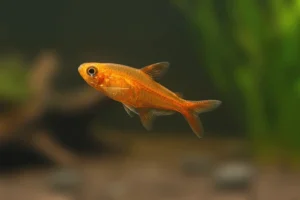
Males are more patterned and colorful than females. Their dorsal, anal, and pelvic fins extend as they mature, with black spotting and white-tipped fin rays. Males show intense yellow and blue color and spread their fins in courtship.
Females have shorter, rounded fins and subdued orange-yellow color. A gravid female looks deeper in the body.
Males spar with each other when the group is large enough. Sparring is display, and it is harmless while no fins tear.
Pseudomugil Gertrudae Breeding Tank Setup
Breeding Tank Size
A small dedicated tank works for egg collection. Breeders use setups of about 15 to 20 L filled with Java moss. A group of 8 to 10 fish does better in the 45 × 30 cm base of about 41 L (11 gallons) described above. Allen sets up 28 to 40 L tanks for groups of 10 to 15 fish at 2 to 3 females per male. For rainbowfish and blue-eyes generally, he adds a thin gravel layer, moderate aeration, and optional filtration.
Spawning Mops, Java Moss and Floating Plants
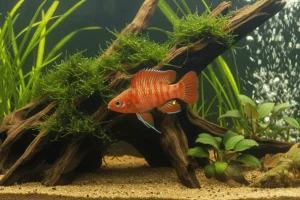
Use nylon or acrylic yarn spawning mops or Java moss. Allen finds that olive green or brown mops work best for rainbowfish and blue-eyes. Allen reports that eggs are laid within about 10 cm of the bottom, so keep the medium low, or lower the water to 15 to 20 cm if a mop hangs from the surface. Floating roots also work, and eggs have been recovered from duckweed roots in ponds. Eggs attach to the fibers with adhesive filaments. Floating plants such as water lettuce, frogbit, and Riccia give extra spawning sites and hiding places for any fry that survive.
Filtration and Flow
Use a mature, gently running filter. An air-powered sponge filter keeps fry out of the intake. See the guide to sponge filters for nano tanks for sizing. Keep the water well oxygenated.
Temperature, pH and Water Parameters
The species tolerates 21 to 28°C, pH 4.5 to 7.5, and 5 to 12 dGH. Spawning and male display are reported at 24 to 28°C, with activity peaking in late morning and early afternoon. Keep the water stable, and avoid sudden changes. Allen recommends pH 6.0 to 7.0 for this species and reports success in both acidic (pH 5.5 to 6.9) and alkaline (pH 7.0 to 7.5) water. He finds hardness not critical for rainbowfish and blue-eyes generally. Allen adds that regular 20 to 30% water changes stimulate spawning in rainbowfish. A cool room needs a heater.
For a planted tank, the guide to LED lights for planted tanks covers lighting.
Keep One Pseudomugil Species Per Tank
Pseudomugil gertrudae can hybridize with close relatives such as P. paskai. P. luminatus belongs to the same gertrudae group. Hybrids exist in the hobby, and wild-collected lines carry locality labels such as Aru II, Aru IV, and Cadell River to discourage hybridization. Keep one species per tank, and keep locality lines apart.
Conditioning Pseudomugil Gertrudae for Breeding
Feed small live and frozen foods, such as Daphnia, Moina, baby brine shrimp, and microworms. Prepared food works as a supplement. See the daphnia culture guide and the microworm culture guide to keep live food on hand.
No special conditioning period is needed, but diet matters. Allen links spawning to live or frozen food and advises against exclusive dry flake. Well-fed adults spawn through the daylight hours.
Pseudomugil Gertrudae Spawning Behavior
Spawning runs throughout the daylight hours. The male chases the female near the spawning site and displays side-on, with spread dorsal and anal fins and pectoral fins raised and lowered. Color deepens in both sexes and the spots darken. The male never touches the female. The pair then shake hard and push deep into the spawning medium to shed eggs. Spawning continues when several pairs share the tank.
A female sheds 1 to 3 eggs at a time (up to 7 on some occasions) and up to 10 to 12 in a day. One male can mate with several females in a day. The eggs are clear to amber, about 1.3 mm across, and carry adhesive filaments that attach them to mop fibers, plants, or floating roots.
Pseudomugil Gertrudae Eggs: Collection and Incubation
How Many Eggs Do Pseudomugil Gertrudae Lay?
Females shed 1 to 3 eggs at a time and up to 10 to 12 per day (ANGFA manual), or 4 to 10 per day (Fishes of Australia). The weekly total rises with the number of females, the food supply, and how often the mop is checked.
How to Collect the Eggs
The adults eat their own eggs and fry. Check the mop or moss every day, or every 1 to 3 days at most. Leave the eggs attached to the strand and move the strand to a small container of water from the breeding tank, which limits handling. Allen finds that rainbowfish and blue-eye eggs are tough and survive 10 to 15 minutes out of water if kept moist. Floating the container in the tank keeps the temperature steady.
Egg Incubation Time
Eggs usually hatch in 10 to 14 days, and Allen gives 10 to 12 days at 27°C. Other sources range from 4 to 9 days (ANGFA manual) to 2 to 3 weeks (Fishes of Australia). Warmer water shortens the time, and cooler water lengthens it. Hold the temperature within 1°C, use gentle aeration, and keep the water clean. Label each mop with its date, and wait until day 21 before discarding it.
Fresh eggs are clear. Remove any white, opaque, or fuzzy egg at once, since fungus spreads to healthy eggs. Change the container water often, using water from the breeding tank.
Some breeders add methylene blue to the incubation water. No dose is established for this species, so skip blind dosing.
Eggs Not Hatching
Do not shake eggs to force hatching. The method is anecdotal, and no source tests it or its risk of damage. Keep the eggs in clean water with gentle flow and wait.
Unhatched eggs often trace to cool water, poor water quality, or stagnant water. Check the temperature and the water change routine first.
Pseudomugil Gertrudae Fry: The First Week
The fry are tiny, and food decides success. The larvae are 3 to 4 mm long and swim in the top 1 cm of water. Allen reports that rainbowfish and blue-eye larvae in general sink at first, rise after 12 to 24 hours, and carry yolk for about 12 hours, while the ANGFA manual says this species feeds within hours. For rainbowfish and blue-eyes generally, Allen also raises fry on dust food and liquid fry food without live cultures. Have microscopic food ready at hatching. Seriously Fish advises Paramecium for up to 5 days, before the fry can accept baby brine shrimp or microworms.
First Foods for Pseudomugil Gertrudae Fry
- Paramecium. Start a culture a week before the first expected hatch.
- Infusoria and green water. These add microscopic organisms, and a Paramecium culture is more predictable.
- Vinegar eels. They stay near the surface where the fry feed.
- Powdered fry food. Choose a fine grade sized for tiny fry.
When to Add Baby Brine Shrimp and Microworms
Offer newly hatched baby brine shrimp once the fry can swallow them, after about 5 days. Allen waits 1 to 2 weeks, so test a few and watch the gut: an orange belly shows that the fry are eating them. Add microworms as a supplement once the fry handle them. The microworm culture guide covers the setup.
Fry Tank and Water Changes
Raise the fry in a small container or tank with a sponge filter or gentle aeration. Keep the water warm, in the same range as the adults. Change small amounts of temperature-matched water, and use airline tubing for siphoning. Check the removed water for fry.
Growth and Juveniles
Fry grow fast and reach maturity in about 3 months at 15 to 20 mm. Juveniles reach a size for the main tank after about three to four months. Males color up and extend their fins as they mature. Move juveniles to the main tank once they are too large to swallow.
Pseudomugil Gertrudae Breeding Problems
| Problem | What to check | Next action |
|---|---|---|
| Few or no eggs | Group size, food, mop placement, check frequency | Add females, feed live food, and check the mop daily |
| Eggs vanish | Adults eating eggs | Collect the mop every day |
| Fuzzy or white eggs | Dead eggs, water quality | Remove them at once and change the container water |
| Eggs do not hatch | Temperature, water quality, stagnation | Hold the temperature steady, change the water, and wait until day 21 |
| Fry die in the first days | Food size, food supply, temperature | Offer Paramecium at hatching and keep the water warm |
| Fry refuse baby brine shrimp | Fry too small | Keep feeding microscopic food and retry in a few days |
| Males harass females | Too few females, no cover | Add females and plants |
FAQ: Pseudomugil Gertrudae Breeding
How Do You Breed Pseudomugil Gertrudae?
Keep a group with several females per male, add a spawning mop or Java moss, and feed live food. Check the mop every day, move the mop or moss strand to a container, and feed Paramecium to the fry at hatching.
How Long Do Pseudomugil Gertrudae Eggs Take to Hatch?
Usually 10 to 14 days. Sources range from 4 days to 3 weeks, so wait until day 21.
What Do Pseudomugil Gertrudae Fry Eat?
Paramecium and other microscopic foods for up to 5 days. Then baby brine shrimp and microworms.
How Many Eggs Do Spotted Blue-Eyes Lay?
Females shed 1 to 3 eggs at a time and up to 10 to 12 per day.
Do Pseudomugil Gertrudae Eat Their Eggs?
Yes. Adults eat eggs and fry, so move the eggs every day.
How Big Do Spotted Blue-Eyes Get?
Up to 38 mm (1.5 in) standard length.
How Long Do Pseudomugil Gertrudae Live?
Captive fish can reach 4 years, but egg output falls after 12 to 18 months, so breed them while they are young.
What Temperature Do Pseudomugil Gertrudae Need?
21 to 28°C (70 to 82°F). Spawning is reported at 24 to 28°C.
What Tank Size Do Spotted Blue-Eyes Need?
A group of 8 to 10 or more needs a 45 × 30 cm base, about 41 L (11 gallons). A smaller tank works for egg collection.
How Do You Tell a Male From a Female Pseudomugil Gertrudae?
Males are more colorful and patterned, with extended dorsal, anal, and pelvic fins. Females have shorter, rounded fins and subdued color.
Can Spotted Blue-Eyes Live With Shrimp?
Adult shrimp usually do well. Seriously Fish lists Caridina and Neocaridina shrimp as suitable tank mates. Newborn shrimp are small enough to be eaten.
Can Different Pseudomugil Species Live Together?
Not for breeding. Pseudomugil gertrudae can hybridize with close relatives such as P. paskai. Keep one species and one locality line per tank.
Final Breeding Checklist
- A group of 8 to 10 or more, with several females per male.
- Spawning mops or Java moss placed low in the tank.
- Small live foods, with prepared food as a supplement.
- A Paramecium culture started a week before the first expected hatch.
- A daily mop check, and a container ready for eggs.
- Warm, clean water for incubation, with fungus removed at once.
- One Pseudomugil species and one locality line per tank.
- A fry container with a sponge filter and warm water.
Related guides: Kubotai Rasbora Breeding, How to Breed Nano Fish, Chili Rasbora Breeding, and Celestial Pearl Danio Breeding.
Sources and Evidence Notes
- Seriously Fish: Pseudomugil gertrudae. Size, water ranges, group size, diet, sexing, spawning, egg collection, incubation, first foods, and egg eating.
- Fishes of Australia: Spotted Blue-eye, Pseudomugil gertrudae Weber, 1911. Description and distribution.
- FishBase: Pseudomugil luminatus. Placement in the gertrudae group.
- Australian rainbowfish society species pages: Pseudomugil gertrudae and P. luminatus. Locality lines and hybridization notes.
- Allen, G.R. (1995). Rainbowfishes in Nature and in the Aquarium. Tetra-Verlag. Egg depth, egg handling, spawning diet, breeding tank, hatch time, and fry feeding.
- Rainbowfishes: Their Care & Keeping in Captivity (ANGFA, 2011). Courtship, egg counts, hatch time, lifespan, and larvae.
Still unknown: a best incubation temperature and a survival rate for fry.