Pygmy corydoras grow to only about 2 to 3 cm, yet they are not a fish for any small tank. They live in shoals, swim in open midwater as well as on the bottom, and gulp air at the surface. Keep at least 6, preferably 10 or more, at 22 to 26 °C in a mature tank with a footprint of 45 x 30 cm or larger. Feed foods small enough for a 2 cm fish, and choose tank mates too small to eat them.
This guide covers Gastrodermus pygmaeus, still sold as Corydoras pygmaeus. Each figure traces to published research, veterinary guidance, specialist breeders, or Derek Lambourne’s 1995 handbook Corydoras Catfish.
Pygmy corydoras care: quick facts
| Fact | Figure |
|---|---|
| Scientific name | Gastrodermus pygmaeus (Knaack, 1966), formerly Corydoras pygmaeus |
| Adult size | Males about 2 cm, females up to about 2.5 to 3 cm (standard length) |
| Native range | Amazon basin in Brazil, Colombia, Ecuador and Peru |
| Group size | 6 minimum, 10 or more preferred |
| Tank footprint | 45 x 30 cm minimum, 60 to 76 cm long for 10 or more |
| Temperature | 22 to 26 °C (72 to 79 °F) |
| pH | About 6.4 to 7.4, kept stable |
| Hardness | Soft to moderately hard, about 2 to 12 °dGH |
| Diet | Baby brine shrimp, microworms, fine flake, small frozen foods |
| Breeding | Eggs placed on surfaces, hatching in 3 to 4 days |
| Lifespan | Not documented |
How firm are these numbers
No study sets a minimum tank, group size or ideal temperature for this species. Those figures are specialist consensus. Water-quality limits come from veterinary guidance for freshwater fish. Air-breathing and diet data come mostly from the bronze cory, Corydoras aeneus, and are marked as such.
Pygmy corydoras tank size and footprint
Every tank figure for G. pygmaeus is husbandry guidance, since no study sets a minimum. Seriously Fish gives a base of 45 x 30 cm, about 41 L, and says a large group fits a 45 x 30 x 30 cm tank. Breeder Mike Hellweg writes that the miniature corys shine in a 76 L (20-gallon) long tank or larger. For 10 or more fish, a tank 60 to 76 cm long is the safer choice.
Footprint matters more than height. The shoal needs open water to swim in, open floor to forage on, and a short trip to the surface for air. In the bronze cory, water depth between 10 and 120 cm changed air-breathing rates. The pattern depended on oxygen level and activity. Height is not neutral for an air-breather, but no study shows a harmful height.
Small volumes swing in temperature and ammonia faster. Stock only a cycled tank that reads 0 ammonia and 0 nitrite. The stock calculator helps when the corys share the tank.
How many pygmy corydoras to keep together
Keep at least 6, and preferably 10 or more. Seriously Fish, ScotCat and Hellweg agree on that floor. Hellweg describes pygmies forming tight groups of up to several dozen as they forage. No experiment has tested group size in this species, so 6 is a consensus figure.
Lambourne wrote that it “likes to swim in a shoal and is one of the few Corydoras species that likes to swim in mid-water.” Research describes the related bronze cory as highly gregarious, with fish communicating through touch.
Buy several young fish at once. Lambourne advised that over one or two adults, which also makes a breeding pair likely. Females grow larger and fuller than males, a difference best seen from above.
Water parameters: temperature, pH and hardness
| Parameter | Target | Basis |
|---|---|---|
| Temperature | 22 to 26 °C, 22 to 25 °C long term | Species profiles and breeders; no thermal study |
| pH | 6.4 to 7.4 | Species profiles; stability first |
| GH | About 2 to 12 °dGH | Avoid near-zero mineral water |
| KH | Low but not zero, about 2 to 3 °dKH | Lab practice; prevents pH crashes |
| Ammonia and nitrite | 0 | Un-ionized ammonia below 0.05 mg/L |
| Nitrate | Below 20 mg/L | 40 mg/L was the lab ceiling |
| Oxygen | Above 5 mg/L | Surface kept open for air gulps |
Four species profiles agree on 22 to 26 °C. Hellweg keeps the miniature corys at 22 to 25 °C and warns only against water that gets too warm. Lambourne warned that many aquariums run at 25 to 27 °C, too warm. No thermal study exists for G. pygmaeus.
A pH of 6.4 to 7.4 in soft to moderately hard water covers most successful keeping. FishBase lists pH 6.0 to 8.0 and 2 to 25 °dH, but those figures come from a 1996 hobby atlas. No published water chemistry from a wild pygmy cory site turned up in this research. Lambourne’s records show related dwarf species spawning in aged tap water at pH 7.3 to 7.4 and 12 to 14 °GH. Captive-bred fish do not need acidic, mineral-free water. Veterinary tables flag total hardness below 20 mg/L, about 1 °dGH, as a lack of minerals.
Water with almost no alkalinity lets pH crash, and nitrifying bacteria stop working below pH 6. A Corydoras research lab settled on remineralized RO water at GH 4 to 5 °dGH and KH 2 to 3 °dKH.
pH also sets how toxic ammonia is. At 26 °C, 0.60% of total ammonia is in the toxic un-ionized form at pH 7.0. At pH 8.0 the share is 5.74%, so the same test reading is about ten times more dangerous. Tissue damage begins above 0.05 mg/L of un-ionized ammonia. Kits that report nitrate-nitrogen (NO3-N) need the reading multiplied by 4.4 to give nitrate.
Change 30 to 50% of the water weekly, matched for temperature and chemistry. Hellweg changes 50% or more weekly, and the lab held nitrate below 40 ppm with 40 to 50%. Use a conditioner rated for chloramine. Lambourne’s advice to let tap water stand 48 hours works for chlorine, but standing water is not a safe way to remove chloramine.
Tank setup: substrate, plants, filtration and flow
Use a fine, smooth, rounded substrate and keep it clean. No controlled study links substrate type to barbel damage in any Corydoras. Lambourne recommended small pea gravel and warned only against grains too large or too sharp. Heiko Bleher favors sand for most Corydoras, yet calls a fine substrate “not essential” for pygmaeus and hastatus. Seriously Fish links barbel infections to dirty or unfavorable conditions, which makes hygiene the variable that matters most.
One old record cuts against the sand rule. Breeding the dainty cory (C. habrosus), Lambourne found that fine sand “caused considerable damage to the barbels of the fry,” while adults were unaffected. He switched to 1.5 mm gravel. Seriously Fish reports pygmy cory fry less prone to disease over a thin layer of sand. Grain shape and cleanliness decide the outcome more than the label.
Plant heavily, but leave open water and an open strip at the front for feeding. Lambourne noted the species “seems to be happiest in a well-planted aquarium.” Floating plants give shade but must not seal the surface. In very low oxygen, bronze corys survived only if they could reach the surface.
A mature sponge filter suits the species, and breeders use them. Hellweg reports that all three miniature corys appreciate a decent current, and that sponge, canister and waterfall filters all work. Cover any filter intake with a sponge, since adults measure about 2 cm and new fry a few millimeters. The sponge filter guide covers sizing.
Lighting is not critical. Seriously Fish says the species prefers dim light, while Hellweg finds the miniature corys out in the open all day, so provide shade. Fit a lid, as Lambourne recommends. Use a guarded heater and check a separate thermometer daily.
What pygmy corydoras eat and how to feed them
No gut-content study exists for this species. Chironomid larvae, then nematodes, were the main prey of wild C. paleatus at the healthier reaches of a prairie stream. Juvenile bronze corys of 25 to 30 mm ate up to 75,849 nematodes each in 24 hours in a lab trial.
A peer-reviewed husbandry protocol names frozen baby brine shrimp and live microworms as foods that work for C. pygmaeus. Add newly hatched brine shrimp, crushed flake, fine sinking granules, small frozen Cyclops and Daphnia, and sifted live Daphnia. A microworm culture and a Daphnia culture supply live food cheaply.
Feed small amounts once or twice a day, more often when conditioning for breeding. Lambourne fed 2 to 3 small meals a day, each eaten within 2 to 3 minutes.
Corydoras appear to find food mainly by smell and eat more slowly than midwater and surface feeders. Faster tank mates can strip a meal before the corys reach it. Drop some food where the shoal forages, or feed after the other fish are full. Bellies should look slightly rounded, never pinched. Leftovers are not a diet, since uneaten food rots and fouls the water.
Tank mates for pygmy corydoras
| Category | Examples | Reason |
|---|---|---|
| Suitable | Small rasboras such as Boraras, small danios, pencilfish, hatchetfish, small peaceful tetras | Similar size, peaceful |
| Caution | Dwarf shrimp, fast-feeding small fish | Shrimplets are plausible prey; fast fish win the food |
| Avoid | Angelfish, gouramis, larger catfish, three-spot or Paraguay tetras, any fish that can swallow a 2 cm fish | Predation or harassment |
Seriously Fish warns that angelfish, gouramis and larger catfish will find it “an ideal snack.” It is easily intimidated by larger tank mates and loses out to them at feeding time. Hellweg advises against three-spot or Paraguay tetras. Chili rasboras and ember tetras fall in the small, peaceful size range the sources recommend.
Adult dwarf shrimp are commonly kept with pygmy corys. Nobody has tested whether the corys eat shrimplets, though Corydoras do eat small crustaceans.
Normal behavior, stress signs and health
Midwater swimming is normal
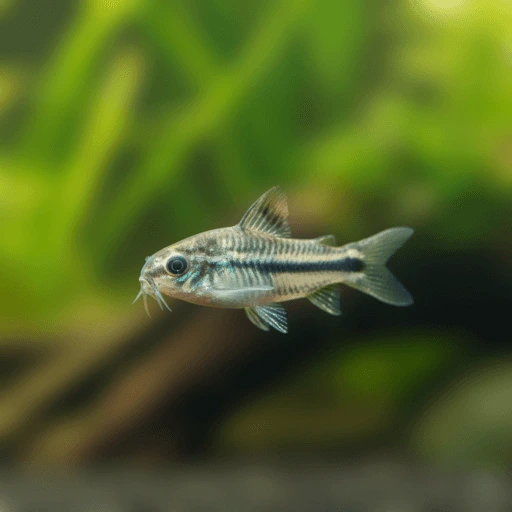
Pygmy corys forage near the bottom and swim in midwater in short bursts, often as a tight group. The habit is less pronounced than in the dwarf cory, G. hastatus, which spends most of its time in midwater. At night they rest in small groups on the bottom.
Air gulps and winking
Brief dashes to the surface are normal, since Corydoras breathe air through the gut. In the bronze cory the mouth is exposed for only 0.06 to 0.07 seconds per breath, and the air leaves through the vent. Breathing occurs at every oxygen level, from 1 to 45 times an hour. Gulping that rises across the whole group is a warning. Severe hypoxia raised group breathing by about 45% in one study. Continual dashing, Lambourne wrote, means testing the water.
The eye rolling called winking is normal too. The eyes move independently and rotate in their sockets. Lambourne suggested it cleans them, and no study has tested that.
Signs of stress or illness
- The whole group gulping at the surface more than usual
- A scattered shoal, or fish hiding all day
- Frantic darting or rubbing against decor
- Clamped fins, lethargy or a pinched belly
- Red, shortened or missing barbels
- White spots or cloudy eyes
Behavior alone does not diagnose disease. Test ammonia, nitrite, nitrate and temperature first. Lambourne found a water change usually fixed the problem.
Quarantine, medication and when to call a vet
Quarantine new fish for 30 to 60 days, the veterinary standard. Restart the clock if another fish joins. Lambourne’s 10 to 14 days falls short of that. In one Amazon survey, 66% of 151 wild Corydoras carried parasites, mostly internal.
The old rule of half-dosing medication for scaleless fish has never been tested. Corydoras are covered in bony plates. One Corydoras species ranked among the most copper-tolerant of nine Amazonian fish in a lethality test, which does not make treatment doses safe. Copper risk depends on alkalinity. Below 50 ppm, about 2.8 °dKH, UF/IFAS advises against copper treatment, and water at the lab’s KH of 2 to 3 °dKH sits at or below that line. Remove activated carbon while medicating, since it absorbs the drug. Losses in good water, or infections needing antibiotics, call for an aquatic vet. The American Association of Fish Veterinarians runs a Find a Fish Vet search.
The Corydoras family has venom glands at the fin spines. In one injection test, spine extract from C. paleatus caused nothing beyond color loss in bass. Claims that stressed corys poison tank mates in transport bags have never been tested. Net gently, since the dorsal and pectoral spines lock rigidly outward.
Breeding pygmy corydoras
Hellweg calls the species easy to induce to spawn. Lambourne recorded that “usually no temperature reduction is needed to induce spawning.” Many larger Corydoras spawn after a cold water change. In a research colony, heavier feeding and twice-weekly water changes were associated with spawning.
Pairs form the T-position on a surface. The female places her eggs singly or in small clusters on glass, plants or the filter. Reported egg sizes run from 1 to 2 mm, and eggs hatch in 3 to 4 days. Lambourne noted that the female’s eyes dilate during spawning. For the related dwarf cory he treats their return to normal as the signal to remove the adults.
Well-fed adults rarely eat eggs or fry. Hellweg leaves them together for about 3 weeks, which yields several dozen to several hundred fry. In a lab colony, 20 to 50% of Corydoras eggs were infertile and turned milky white within a day. Remove white eggs before fungus spreads. Start fry on microworms, then newly hatched brine shrimp and powdered flake. Fry of this species are harder to rear than those of larger Corydoras. Adult coloring appears at about 6 weeks. The full method is in the pygmy corydoras breeding guide.
Pygmy cory, dwarf cory or habrosus: telling them apart
Three tiny corys share the shop tank, and labels mix them up. Since 2024 the pygmy cory has been Gastrodermus pygmaeus, and the 2024 analysis pairs it with the dwarf cory, G. hastatus. The dainty cory, formerly C. habrosus, is now Hoplisoma habrosum, in a different genus.
| Feature | G. pygmaeus | G. hastatus | H. habrosum |
|---|---|---|---|
| Flank pattern | Thick black stripe ending in a tail-base blotch | Thin, diffuse stripe and a diamond spot at the tail base | 2 to 3 blotches on a speckled body, no continuous stripe |
| Swimming level | Midwater and bottom | Mostly midwater | Nearer the bottom |
| Native range | Amazon basin | Amazon and Paraguay basins | Orinoco basin |
| IUCN status | Least Concern | Least Concern | Near Threatened |
Boxes labeled hastatus often hold pygmaeus, as Hellweg found several times. The range is also wider than many sites claim. The type locality lies on the Rio Madeira in Brazil, but the Catalog of Fishes lists the Amazon basin in Brazil, Colombia, Ecuador and Peru.
No lifespan has been documented for G. pygmaeus. The 3 to 5 years quoted by shops has no traceable source.
Pygmy corydoras myths checked
| Claim | Verdict | Evidence |
|---|---|---|
| They need sand | Not proven | No study; smooth fine gravel also works |
| Air-breathing makes them tolerant of dirty water | Partly false | Air adds oxygen but does not shield the gills from ammonia or nitrite |
| A cold water change is needed to spawn | Usually false | Lambourne: usually not needed |
| Stressed corys poison tank mates | Untested | Gland exists, effect never measured |
Pygmy corydoras FAQ
How many pygmy corydoras should be kept together?
At least 6, and preferably 10 or more. That floor is specialist consensus, since no experiment has tested group size.
What size tank do pygmy corydoras need?
A footprint of at least 45 x 30 cm, about 41 L, for a small group, and 60 to 76 cm of length for 10 or more. Footprint matters more than height.
Can pygmy corydoras live in a 10 gallon tank?
A standard 10-gallon tank (about 38 L, 51 x 25 cm) sits just under the common 45 x 30 cm guideline. A research lab considers it acceptable for small Corydoras, but a 20-gallon long gives a group of 10 more room. A 5-gallon tank falls below every adult-keeping guideline in the sources.
Do pygmy corydoras need sand?
No study proves it. A fine, smooth, rounded substrate kept clean is the safe choice, and small pea gravel also works.
Why do pygmy corydoras swim to the surface?
They breathe air through the gut, so brief dashes are normal. Gulping that rises across the whole group signals low oxygen or poor water.
What do pygmy corydoras eat?
Foods small enough for a 2 cm fish: baby brine shrimp, microworms, crushed flake, fine granules and small frozen foods. Place some food where the shoal forages, since faster fish eat first.
Can pygmy corydoras live with shrimp?
Adult dwarf shrimp are commonly kept with them. Whether the corys eat shrimplets has never been tested. Corydoras eat small crustaceans, so some shrimplet losses are possible.
How long do pygmy corydoras live?
No lifespan has been documented for this species. The 3 to 5 years quoted by shops has no traceable source.
Sources
- Lambourne, D. (1995). Corydoras Catfish: An Aquarist’s Handbook. Blandford.
- Tencatt, L.F.C. and Pavanelli, C.S. (2015). Neotropical Ichthyology 13(2): 287–296.
- Dias, A.C. et al. (2024). Zoological Journal of the Linnean Society 203(3): zlae053.
- Eschmeyer’s Catalog of Fishes, genus Gastrodermus, accessed October 2026.
- Chiang, A. et al. (2024). Husbandry protocol for Corydoras catfish. JAALAS 63(5): 472–479.
- Kramer, D.L. and McClure, M. (1980). Canadian Journal of Zoology 58: 1984–1991.
- Pineda, M. et al. (2020). Journal of Experimental Biology 223: jeb222133.
- Bertora, A. et al. (2021). Anais da Academia Brasileira de Ciências 93(3): e20200981.
- Majdi, N. et al. (2018). Annales de Limnologie 54: 29.
- Wright, J.J. (2009). BMC Evolutionary Biology 9: 282.
- Duarte, R.M. et al. (2024). Environmental Pollution 341: 122988.
- Ferreira, D.O. et al. (2019). Anais da Academia Brasileira de Ciências 91(1).
- Tampa Bay Water: monochloramine information for fish owners.
- Merck Veterinary Manual and UF/IFAS (FA031, FA-13) water-quality guidance.
- Hellweg, M. Corydoras in Miniature. Tropical Fish Hobbyist.
- Seriously Fish, PlanetCatfish, ScotCat and FishBase profiles; Bleher, H. (2009), Practical Fishkeeping.