Breeding scarlet badis (Dario dario) takes a confirmed male and female, a mature planted tank, and small live foods. The male claims a territory and courts the female for several days. The pair then spawns on the underside of a solid surface such as a plant leaf, and the eggs hatch in 2 to 3 days.
Scarlet badis breeding is simple to start. Raising the fry is the hard part, since they need infusoria-sized food and the adults prey on them after hatching. Start a first-food culture before the spawn, and plan to move either the eggs or the adults.
If the fish have already spawned, jump to the eggs or fry food sections. The ranges and timings here come mainly from the Seriously Fish species profile. They are aquarium observations, and no source proves a breeding optimum.
How to Breed Scarlet Badis: The Short Answer
- Confirm the pair. Pick healthy, mature fish. A pale juvenile is not proof of a female.
- Prepare the tank. Use established filtration, dense planting, and sheltered spawning surfaces.
- Condition the adults. Offer small live or frozen foods and check that both fish eat.
- Watch for spawning. The male claims a territory and courts the female. A receptive pair performs a brief embrace.
- Protect the eggs. After a confirmed spawn, move the spawning surface to a prepared tank or remove the adults.
- Prepare first food early. Eggs hatch in 2 to 3 days. The larvae start feeding after they absorb their yolk sacs, which can take up to a week.
- Feed by development. Start with infusoria-grade food. Add microworms and baby brine shrimp once the fry can swallow them.
Have the first-food culture ready before the spawn.
Scarlet Badis Breeding: Quick Facts
Adult size 1.2 to 2 cm Breeding tank 45 × 30 cm or larger Water range 18 to 26°C Eggs hatch 2 to 3 days
| Breeding factor | Answer |
|---|---|
| Scientific name | Dario dario (family Badidae) |
| Adult size | 1.2 to 2 cm standard length, which excludes the tail fin |
| Breeding tank | 45 × 30 cm base (about 41 L, 11 gallons) for a pair or one male with females |
| Temperature | 18 to 26°C (64 to 79°F) |
| pH and hardness | pH 6.5 to 8.5, 1 to 15 dGH |
| Spawning site | Underside of a solid surface such as a plant leaf |
| Egg hatching time | 2 to 3 days |
| Yolk-sac absorption | Up to about a week after hatching |
| First fry food | Infusoria-grade organisms |
| Later foods | Microworms and freshly hatched Artemia |
| Parental care | The male defends the territory but does not protect the fry |
Egg counts, growth rates, and food transitions vary. Use the behavior of the fish to set the next step.
Scarlet Badis Size, Lifespan and Care Basics
The scarlet badis fish is among the smallest percoid fishes known, per Seriously Fish. It is slow-moving and easily intimidated.
Scarlet Badis Size: How Big Do They Get?
Scarlet badis reach about 1.2 to 2 cm standard length. The scarlet badis max size is 20 mm per Seriously Fish. Females run smaller than males, but size alone does not separate a young male from a female.
This scarlet badis size comparison lists the reported sizes by source.
| Source | Size reported |
|---|---|
| FishBase, males or unsexed | About 15 mm |
| FishBase, females | About 12 mm |
| Seriously Fish | Up to 20 mm, sexes not split |
Scarlet Badis Lifespan
Neither Seriously Fish nor FishBase gives a lifespan for the species. Figures repeated online are estimates without documented records.
Scarlet Badis Care Guide at a Glance
| Care factor | Guidance |
|---|---|
| Tank | 45 × 30 cm base, about 41 L (11 gallons) |
| Water | 18 to 26°C, pH 6.5 to 8.5, 1 to 15 dGH |
| Filtration | Seriously Fish gives a turnover of four to five times the tank volume per hour |
| Diet | Small live or frozen foods. Skip bloodworm and Tubifex |
| Temperament | Slow-moving and easily intimidated. Rival males can be very aggressive in confined spaces |
| Tank mates | Best kept alone or with small pelagic species |
Have an accepted live or frozen food available before buying the fish.
Scarlet Badis Male vs Female: How to Identify a Breeding Pair
Male vs female scarlet badis differ in color, fins, and body shape. A fully colored adult male is easy to recognize. A scarlet badis female is harder to confirm, since juveniles and subordinate males can also look plain. Compare several features on mature fish.
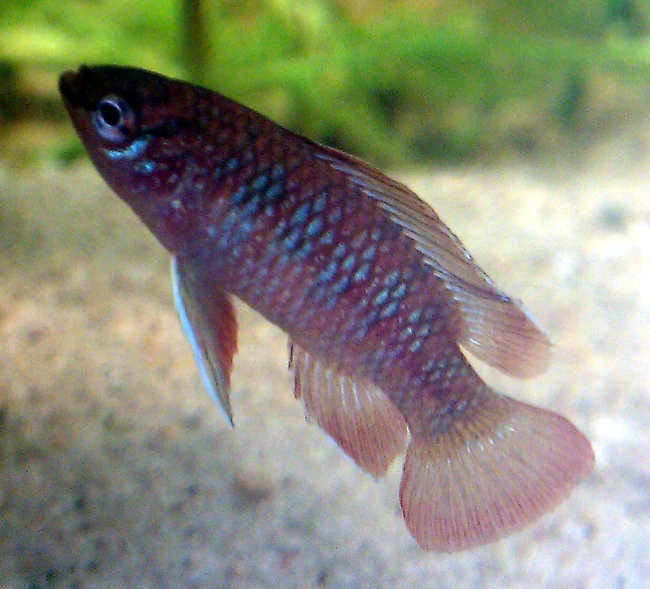
Look for: red-and-blue flank markings and more developed fins on a mature, settled fish.
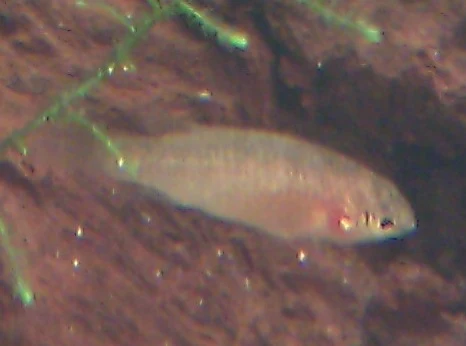
Look for: subdued coloration and shorter fins. A pale juvenile still needs time to mature before you can sex it reliably.
Real photographs by ATuin-hek, via Wikimedia Commons: male and female, CC0. Resized or converted to WebP; fish appearance unaltered. Photographs are not to scale.
| Feature | Male | Female |
|---|---|---|
| Color pattern | Red to orange-red body with seven iridescent blue vertical bars | Subdued, with no red or blue on the flanks and only faint bars or none |
| Fins | Extended pelvic, dorsal, and anal fins | Shorter, less elaborate fins |
| Body profile | Slightly larger, though size overlaps | Smaller, with a short, stumpy body. Looks fuller with eggs |
| Behavior | Territorial display and courtship | May follow a courting male into his territory when receptive |
Female Scarlet Badis: What to Look For
A female scarlet badis is smaller and plainer than the male. She has no red or blue pigment on the flanks, only faint bars or none, and her fins are shorter. A rounded belly can mean eggs, but it is not a reliable single test.
Can a Pale Scarlet Badis Be a Juvenile Male?
Yes. A juvenile male or a subordinate adult may lack the bright pattern of a dominant male. Let uncertain fish mature and settle, then reassess markings, fins, and behavior.
Choosing a Scarlet Badis Pair
A confirmed adult scarlet badis male and female make the simplest start. One male with several females can also work when space and shelter allow. Multiple males need a larger, divided layout, since territorial disputes interfere with feeding and courtship.
Pick fish that eat well and show no illness. Quarantine new arrivals before adding them to an established group. Treat a pale fish as unsexed unless the seller can confirm the sex.
Scarlet Badis Breeding Tank Setup
A scarlet badis tank setup centers on territory and cover, with food kept easy to reach. A species-only tank makes spawning easier to observe and protects the offspring.
What Tank Size Do Scarlet Badis Need for Breeding?
Seriously Fish recommends a base of about 45 × 30 cm (18 × 12 inches) for a pair or one male with females. That is roughly 41 liters, or 11 gallons. The footprint matters because males defend areas of the tank. That base sets the minimum scarlet badis tank size for breeding.
The aquarium fish stock calculator sends this species to review. It checks the base footprint and flags territory and feeding.
For multiple males, add horizontal space and separate sheltered areas with plants or hardscape. Persistent chasing, missed meals, or a fish stuck in one corner means the layout needs changing.
Plants, Substrate, and Spawning Surfaces
Use aquarium-safe sand or fine gravel with dense vegetation, roots, and visual barriers. Java moss, Java fern, Cryptocoryne, Anubias, and floating plants all give cover. Leave open feeding areas so both adults can be seen eating.
Scarlet badis spawn on sheltered solid surfaces, including the undersides of plant leaves. Java moss supplies cover and microorganisms, and removable planting helps with egg transfer. Neither a particular moss nor a cave is required. Set up several sheltered sites so one male cannot control them all.
Filtration, Flow, and Lighting
Seriously Fish gives a turnover of four to five times the tank volume per hour. A mature air-driven sponge filter suits a breeding tank, since it has no exposed intake. Other filters work when the intake is covered and the flow does not sweep fry around the tank.
Confirm the filter is established and ammonia and nitrite stay undetectable. Keep a steady day and night cycle with shaded retreats. Floating plants soften the light without special equipment.
Scarlet Badis and Shrimp in a Breeding Tank
Leave shrimp and other fish out of a breeding tank. Scarlet badis eat small live prey, so shrimplets are at risk. Seriously Fish does not rate shrimp compatibility. A community tank may produce a few fry but gives less control over predation and food competition.
For stocking and compatibility, see the nano fish species and care guide.
Scarlet Badis Temperature and Water Parameters for Breeding
Scarlet badis water parameters sit in a wide published range, pH 6.5 to 8.5 and GH 1 to 15 dGH. A stable 23 to 25°C (73 to 77°F) is a practical starting point within the published temperature range. It is not a proven optimum. Fish that thrive at another suitable temperature need no sudden change to reach a number. A room that falls below 18°C needs a heater.
| Parameter | Guidance |
|---|---|
| Temperature | 18 to 26°C (64 to 79°F) |
| pH | 6.5 to 8.5 |
| GH | 1 to 15 dGH |
| Ammonia and nitrite | Undetectable |
| KH and TDS | No verified breeding target |
Use water the fish stay healthy in, and match replacement batches closely. Reverse-osmosis water needs preparation and remineralizing. GH measures general hardness, KH measures buffering, and TDS measures all dissolved substances.
Do Scarlet Badis Need Hard Water or a Cold Water Change?
No. No source sets a minimum of 10 dGH for egg production or a cold water trigger for spawning. Avoid sudden shifts in temperature, pH, or hardness. If the fish do not breed, check the sexes, feeding, cover, and territorial conflict first.
Scarlet Badis Feeding: Food and Conditioning for Breeding
Scarlet badis eat small aquatic invertebrates, so scarlet badis food means small live or frozen prey. Offer prey the adults can catch, and watch both fish feed. A dominant male that eats well does not prove the female eats enough.
- Small Daphnia or suitably sized Moina.
- Newly hatched Artemia (baby brine shrimp).
- Microworms and other small worms, including banana worms.
- Small grindal worms where the adults can handle them.
- Small frozen foods that the fish accept.
For a steady live-food supply, see the daphnia culture guide. Offer modest portions and remove excess food. Seriously Fish advises against bloodworm and Tubifex for badids, since both can lead to obesity and disease. Build the diet around smaller accepted foods.
How Long Should a Scarlet Badis Pair Be Conditioned?
Condition the fish until they feed steadily, look healthy, and show reproductive behavior. A male may deepen his color and claim a territory. A female may become fuller. Swelling with poor appetite or abnormal swimming needs investigation, since it may not mean eggs.
No fixed conditioning period guarantees spawning. Give settled, well-fed fish time, and stop rearranging the tank.
Scarlet Badis Courtship and Spawning Behavior
Scarlet badis form temporary pair bonds. Watch the interaction, since not every chase leads to spawning.
- The male claims a territory. His colors deepen, and he defends a sheltered area.
- He courts the female. He approaches, displays, and seems to invite her into the center of his territory. Courtship can last several days, and the female is often chased off, then courted again minutes later.
- The pair spawns. A receptive female enters the spawning area. A brief embrace releases eggs on the underside of a solid surface.
- The male ejects the female. He resumes defending the territory. He does not tend the eggs or protect the fry.
Add cover or separate the fish if the female cannot feed or rest. Do not wait for spawning while harassment continues.
How Often Do Scarlet Badis Spawn?
No source gives a dependable interval for every pair. Condition, maturity, feeding, and disturbance all affect readiness. Keep a dated record of confirmed spawns, and do not count each courtship display as a separate spawn.
Scarlet Badis Eggs: Identification, Collection, and Hatching
What Do Scarlet Badis Eggs Look Like?
The eggs are small and easy to miss among vegetation. Inspect the spawning area and sheltered surfaces, including leaf undersides. A confirmed embrace followed by watching the same spot works better than guessing an egg diameter.
Photograph the eggs if possible, and record the date, parents, and water temperature. A scale in the photograph helps. Count only what is visible, since a few eggs do not show the total laid.
How Many Eggs Do Scarlet Badis Lay?
No source reviewed gives a reliable count per spawn. Aquarium articles cite 70 to 90 eggs, but that is not a guaranteed yield. Breeding records are most useful when they separate eggs observed, larvae hatched, and juveniles surviving.
How to Collect Scarlet Badis Eggs
Pick one approach after a confirmed spawn:
- Move the spawning surface. Transfer the removable plant or surface holding the eggs to a biologically prepared tank. Match temperature and water chemistry, keep movement gentle, and protect the filter intake. Do not scrape or crush the eggs.
- Remove the adults. Leave the eggs in the breeding tank and move the parents. This works when the tank can already raise fry, though netting adults may disturb the spawning area.
Use the approach that causes less disturbance. Water from the breeding tank helps match conditions but does not add biological filtration to a new container. Prepare the receiving tank before the spawn.
Some fry survive with the parents in dense planting. Seriously Fish warns that fry are preyed on once hatched, so plan protection when raising more juveniles is the goal.
Scarlet Badis Egg Hatching Time
Seriously Fish reports hatching after 2 to 3 days. The larvae can take up to a week to absorb the yolk sac. Hatching and first feeding are separate milestones.
Keep conditions stable and avoid checking the eggs repeatedly. Record when hatching and active feeding begin, and skip an hour-by-hour schedule.
Preventing Egg Fungus
Keep the incubation tank clean. Remove dead eggs or cotton-like growth without damaging nearby eggs. Water molds such as Saprolegnia grow on dead material and spread, so check water quality if losses recur.
Do not add medication to every spawn. Egg-treatment research on other ornamental fish sets no safe methylene blue dose for Dario dario. Repeated losses need an identified cause and a species-specific protocol.
Scarlet Badis Fry Development: From Hatching to Free Swimming
| Stage | What to look for | Next step |
|---|---|---|
| Eggs | Development on the spawning surface | Keep water stable. Remove dead eggs if reachable |
| Hatching | Larvae emerge, about 2 to 3 days | Avoid disturbance. Have first foods ready |
| Yolk-sac stage | Larvae live on internal reserves | Observe. Do not offer larger prey |
| External feeding | Fry seek and capture tiny prey | Supply infusoria-grade food |
| Early growth | Some fry handle larger prey | Test microworms or Artemia. Keep smaller food |
| Juveniles | Larger size, developing social behavior | Vary the diet. Add space as needed |
Use these stages as observation points. Fry in one batch develop at different rates, so the largest fry should not set the diet for every sibling.
Best First Food for Scarlet Badis Fry
Start with infusoria-sized organisms when the fry begin feeding. Seriously Fish recommends an infusoria-grade diet until the fry accept microworms, Artemia nauplii, or similar prey. Newly hatched baby brine shrimp can be too large for the first feeding stage.
Infusoria, Paramecium, and Small Rotifers
Infusoria is a loose term for microscopic organisms. A kept culture of suitably sized prey, such as Paramecium, gives a ready supply when the fry need it. Start the culture before an expected spawn.
Add modest amounts of food, and do not pour deteriorating culture water into the fry tank. Small freshwater rotifers may also work, but confirm that the fry eat them.
Can a Mature Tank Feed the Fry?
Moss, leaf litter, and established surfaces support microfauna. This can supplement a culture, but no one can tell whether enough organisms exist for a whole batch. Keep a reliable first-food supply.
How Often Should Scarlet Badis Fry Be Fed?
Offer small amounts often enough that prey is always available without fouling the water. The amount depends on culture density, fry numbers, tank volume, and what the fry eat. Check feeding and water quality daily and adjust.
When Can Scarlet Badis Fry Eat Microworms?
Offer a small test feeding once the fry can catch and swallow the worms. If they ignore them, keep feeding the smaller food. Microworms are a transitional food, so start newly free-swimming fry on infusoria-grade prey.
The microworm culture guide for fish fry explains how to keep and harvest a culture.
When Can Scarlet Badis Fry Eat Baby Brine Shrimp?
Test a few freshly hatched Artemia nauplii. Watch whether the fry chase, catch, and swallow them. If they ignore the nauplii, spit them out, or struggle, keep the smaller prey and try again after more growth.
Once the fry eat Artemia, increase it gradually. Keep smaller food available for slower growers. No verified day exists when every fry is ready to switch.
Hatching and Harvesting Artemia
Follow the instructions for the cyst batch and hatchery, and measure salinity, warmth, and aeration. The FAO hatching guide explains the variables. A fixed spoonful recipe may not suit every batch.
Empty shells collect near the surface and unhatched cysts near the bottom. Concentrate the live nauplii with light, separate them from shells and cysts, collect them in a fine sieve, and rinse before feeding. The FAO harvesting guide covers separation. Do not siphon everything from the bottom into the fry tank.
Water Changes and Maintenance for Scarlet Badis Fry
Balance steady feeding with clean, stable water. Check the fry and water quality daily, and remove food and debris with a pipette or narrow airline tubing.
- Prepare dechlorinated replacement water and match its temperature and chemistry.
- Change water slowly, and protect the fry from the siphon and strong turbulence.
- Inspect the removed water before discarding it, since tiny fry are easy to miss.
- Keep ammonia and nitrite undetectable, and respond at once if tests show a problem.
- Scale maintenance to the feeding load, filtration, and stocking.
Do not keep the tank clean by withholding first food. Control excess food and waste while the fry can still find prey.
Growing Out Juvenile Scarlet Badis
As juveniles grow, offer a wider range of foods they can swallow. A larger grow-out tank gives more room, but extra volume must not scatter prey so widely that small fish cannot find it.
Male color develops at different rates. Let plain juveniles mature before assuming they are female. As territories form, watch for persistent chasing or restricted feeding. Add visual barriers, separate fish, or move them to more space.
Keep records of parentage and each batch. Use unrelated, correctly identified stock where possible, and avoid repeated pairing of close relatives.
Scarlet Badis Breeding Problems and Solutions
| Problem | What to check | Next action |
|---|---|---|
| No spawning | Sexes, maturity, food intake, cover, disturbance | Confirm a mature female. Check that both adults feed and can retreat |
| Male attacks female constantly | Shelter and access to food | Add visual barriers or separate the fish if she cannot rest or feed |
| Eggs cannot be found | Whether spawning occurred, hidden surfaces | Watch for the embrace. Inspect the spawning area |
| Eggs disappear | Hidden eggs, predation, mistaken identification | Move the spawning surface or remove the adults |
| Eggs do not hatch | Fertilization, stability, egg condition | Review the spawn and conditions. Skip automatic medication |
| Cotton-like growth on eggs | Dead eggs, water quality | Remove affected material. Investigate recurring losses |
| Fry disappear | Predation, first food, water quality, filter intake | Check all four before blaming starvation |
| Fry refuse larger foods | Prey size, actual swallowing | Continue smaller prey and test again after growth |
| Uneven growth | Individual feeding, competition | Keep smaller food available and add space |
Change one factor at a time and keep notes. Altering pH, temperature, lighting, food, and layout together hides what helped.
Scarlet Badis Diseases and Medication Safety
A failed egg is not automatically a disease. Check fertilization, water quality, and development first. For recurring losses or sick adults, identify the problem before choosing a treatment.
Use a protocol that accounts for the product concentration, water volume, and species tolerance. Skip routine salt or chemical recipes without those details. A veterinarian with fish experience can help with serious cases. The MSD Veterinary Manual fish parasite guidance gives background.
Scarlet Badis Breeding Checklist
- A healthy, mature male and a verified female.
- An established tank with sheltered spawning surfaces and room to retreat.
- Stable water with undetectable ammonia and nitrite.
- Accepted, suitably sized food for both adults.
- A plan to protect the eggs and fry.
- A first-food culture ready before external feeding begins.
- Protected filtration and gentle maintenance.
- Food changes based on observed swallowing, with smaller prey kept for slow growers.
Frequently Asked Questions About Scarlet Badis
Can Scarlet Badis Live Alone?
Yes. A single male can live without a partner when its feeding and habitat needs are met. Breeding needs both sexes, and several plain juveniles do not guarantee a pair.
Can Scarlet Badis Be Bred in a 5 Gallon Tank?
No. A scarlet badis 5 gallon setup falls short. Seriously Fish recommends a 45 × 30 cm base for a pair or one male with females, and a 5 gallon tank leaves less room for territories, cover, and a female’s retreat. Judge by footprint and layout.
Are Scarlet Badis Aggressive?
Scarlet badis temperament is slow and retiring, but males can be territorial toward rivals and may chase females. Seriously Fish describes rival males as very aggressive in confined spaces. Provide cover and check access to food. Persistent harassment means the layout or stocking needs changing.
Will Scarlet Badis Eat Shrimp?
Keeping scarlet badis with shrimp puts shrimplets at risk, since scarlet badis eat small live prey. Seriously Fish does not rate shrimp compatibility. Keep shrimp out of a breeding tank.
What Do Scarlet Badis Eat?
Small live or frozen foods such as Artemia nauplii, Daphnia, grindal worms, microworms, and banana worms. Seriously Fish advises skipping bloodworm and Tubifex.
Do Scarlet Badis Need Caves or Java Moss to Breed?
No. Moss gives useful cover and caves can divide territories, but sheltered plant leaves and other solid surfaces also work as spawning sites.
Do Scarlet Badis Eat Their Eggs or Fry?
Do not rely on the parents to protect the offspring. Seriously Fish warns that fry are preyed on once hatched. Move the spawning surface or remove the adults when raising more juveniles is the goal.
Are Scarlet Badis Easy to Keep?
Their small size does not remove the feeding challenge. They are slow, selective eaters and lose food to faster tank mates. Arrange an accepted diet, stable water, and cover before buying them. Breeding adds the task of supplying microscopic first food.
How Long Do Scarlet Badis Live?
No source reviewed documents a lifespan. Treat figures repeated online as estimates.
What Temperature Do Scarlet Badis Need?
18 to 26°C (64 to 79°F) is the published aquarium range. A stable 23 to 25°C is a practical starting point for breeding.
Scarlet Badis Natural Habitat and Species Background
Scarlet badis belong to Badidae. Hamilton described the species in 1822, and Kullander and Britz placed it in Dario in their 2002 family revision. It is documented from Indian tributary systems of the Brahmaputra drainage in West Bengal and Assam, with a possible extension into Bhutan.
A documented collection locality had shallow, clear water, sand and fine gravel, and dense vegetation including Limnophila, Hygrophila, Vallisneria, Ottelia, and Rotala. An aquarium needs shelter, dense planting, gentle movement, and separated territories.
Keep a simple breeding log. Record the parents, measured water conditions, foods, spawning date, observed hatch, first feeding, and the juveniles counted. A log helps repeat a good setup and diagnose losses without guessing.
Sources and Further Reading
The sources reviewed do not establish precise breeding optima, universal egg counts, fixed growth schedules, or guaranteed survival rates.
- Kullander, S. O. & Britz, R. (2002), revision of Badidae: taxonomy, morphology, and habitat.
- FishBase: Dario dario: classification, documented size, and distribution.
- Seriously Fish: Dario dario: aquarium conditions, sexing, courtship, incubation, and fry food.
- FAO: Artemia cyst hatching and Artemia harvesting: preparing and separating nauplii.
- SVA: Saprolegniosis: water molds and hygiene.
- Chambel et al. (2014), egg-disinfection research: species differences in treatment concentrations.
- MSD Veterinary Manual: parasitic diseases of fish: diagnosis and treatment background.
Related guides: Celestial Pearl Danio Breeding, Chili Rasbora Breeding, and How to Breed Nano Fish.