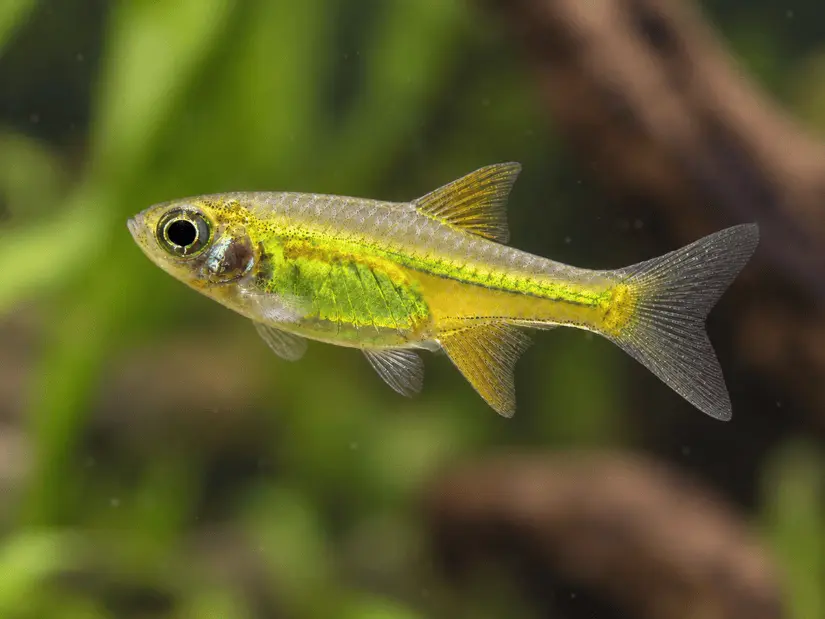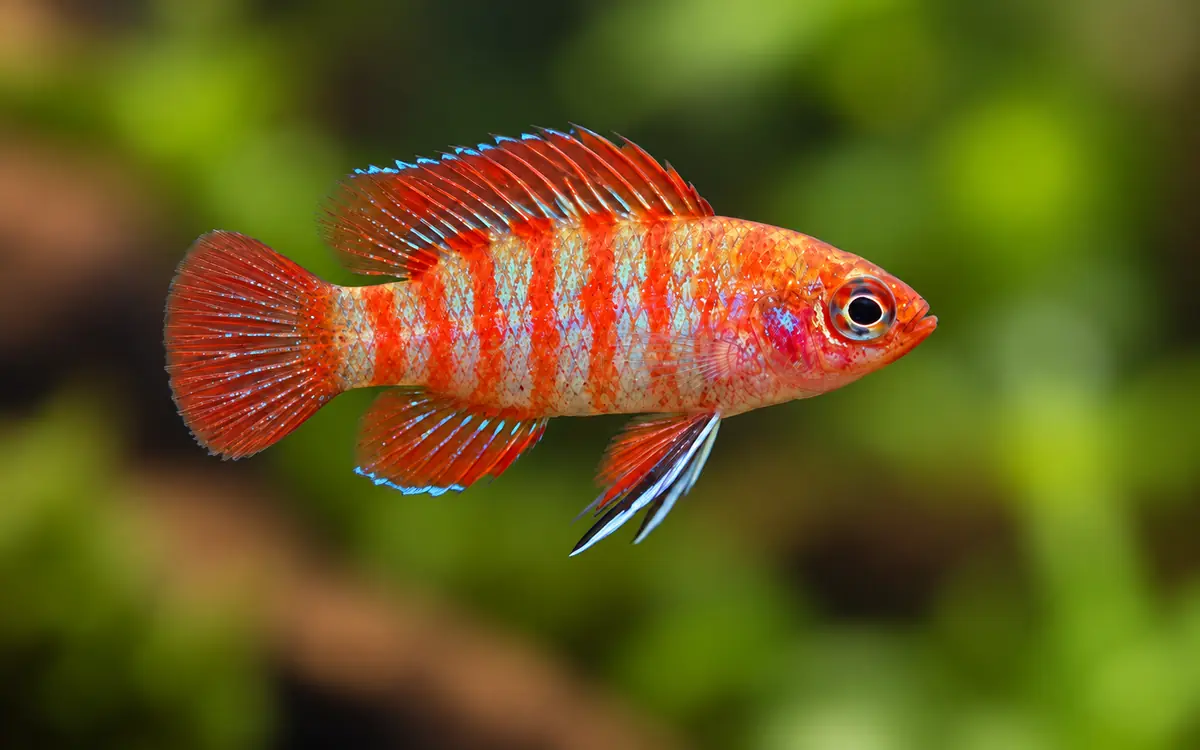
Scarlet badis care is mostly a feeding problem. Dario dario is a micropredator from the Brahmaputra basin of India, 1.5 to 2 cm long, and it hunts tiny live animals. It does not reliably eat flakes or pellets. The tank itself is simple: a 45 × 30 cm base, a mature sponge filter, dense plants, and one male with one or a few confirmed females. The common failure is hunger in a tank full of food the fish cannot catch or swallow.
Three claims circulate widely: keep six, keep them at 26°C, feed them whatever fits. The research behind this guide supports none of them, and several other popular numbers fail the same check.
Scarlet badis care
| Question | Short answer |
|---|---|
| Minimum tank | 45 × 30 cm base (18 × 12 in), about 40 L (10.7 gal) at 30 cm water height |
| Group | One male plus 1 to 3 confirmed females. No school of six is needed |
| Temperature | 18 to 26°C (64 to 79°F) published range, 22 to 24°C (72 to 75°F) as a steady target |
| pH and hardness | pH 6.5 to 8.5, 1 to 15 °dGH |
| Food | Live microfood: baby brine shrimp, small Daphnia, copepods, microworms |
| Tank mates | Species-only is safest. Very small, peaceful open-water fish are a trial, not a promise |
| Shrimp | Adults may coexist. Shrimplets are prey |
| Lifespan | Not reliably established. Secondary sources say 3 to 6 years |
Tank size: footprint matters more than volume
The figure quoted everywhere, a 45 × 30 cm base, comes from the Seriously Fish husbandry profile. It is rated for a pair or a single male with several females. No study has defined a minimum humane tank for this species, so the figure is a husbandry reference with no measured threshold behind it.
Volume depends on height, and height is the wrong dimension to optimize. At 30 cm of water the 45 × 30 cm base holds about 40.5 L gross (10.7 gal). Substrate and décor take some of that. The same volume in a taller tank gives the fish a smaller floor, and territories are horizontal.
Sketch the tank from above before buying it. Male badis defend patches of plants and wood, and extra height does nothing for two males that can see each other across the same floor. A long tank with broken sightlines separates rivals. A tall tank with one open view does not.
A 60 × 30 × 30 cm tank (54 L, 14.3 gal) is the sensible upgrade. No published evidence shows it is better. It gives separate feeding and hiding zones more room and makes starvation easier to spot. Plan for it if a breeding group is the goal.
Ignore the figure of roughly 30 cm² per individual that appears in one breeding account. It equals a square about 5.5 cm on a side, far too small for a foraging territory, and no method supports it. Do not use it as a stocking calculator.
Group size: scarlet badis do not need a school of six
Scarlet badis are not obligate schooling fish. Males hold territories, and pairs associate only to court and spawn. The group of six is a trade habit with no basis in the research. No source documents a minimum number for this species.
Buying six unsexed fish is the common mistake. Shops can carry mostly males, and several males in a small tank produce the aggression that dense planting was supposed to prevent. If the sexes cannot be confirmed, postpone the purchase.
| Arrangement | Starting plan |
|---|---|
| One male, no breeding | At least the 45 × 30 cm footprint, densely planted |
| One confirmed pair | 45 × 30 cm base, with hiding and feeding zones built before the fish arrive |
| One male, 2 to 3 females | 45 × 30 cm minimum, 60 × 30 cm preferred |
| Two or more males | A much longer tank, separate territories, and a backup tank ready |
A sex ratio does not repair a bad layout. One male and three females in a tank with a single cave still means three females chased around one space. Spread cover across the whole base so the male cannot see and control every resting point. The test is whether each fish can forage without evading anyone.
Water parameters for scarlet badis
| Parameter | Published range | Practical target |
|---|---|---|
| Temperature | 18 to 26°C (64 to 79°F) | Steady 22 to 24°C (72 to 75°F) |
| pH | 6.5 to 8.5 | A stable, tested value inside the range |
| GH | 1 to 15 °dGH | Whatever the source water gives, kept consistent |
| KH | Not reliably established | Measure it, since it buffers pH |
| Ammonia and nitrite | 0 mg/L | 0 mg/L |
| Nitrate | No species figure. General freshwater reference is under 20 mg/L | Low and not rising |
| Dissolved oxygen | General reference is above 5 mg/L | Surface movement, no sealed floating-plant mat |
The ranges are published aquarium limits, and no tolerance experiment backs them. The 22 to 24°C target is a conservative choice inside them and has not been shown to be optimal.
One wild reading should not be treated as a rule. The collection stream described in the 2002 badid revision by Kullander and Britz was 2 to 5 m wide, 30 to 70 cm deep, clear, and about 26°C in November, during the dry season. That is one site on one date. It does not show that scarlet badis need 26°C all year, blackwater, low pH, or still water. The same record describes sand or fine gravel and dense growth of Limnophila, Hygrophila, Vallisneria, Ottelia, and Rotala. The plant list is the usable part of that record.
A stable, slightly imperfect pH is safer than one chased with additives. Cycle the tank fully before adding fish. Start with weekly water changes of 15 to 25 percent, matched in temperature and conditioned for chlorine, and adjust to test results. No measured species requirement sets that rate.
Setting up a scarlet badis tank: substrate, plants, cover and flow
Substrate
Fine sand or small rounded gravel. The wild sediment was sand and fine gravel, and nothing in the research supports specialty soil.
Plants
Dense clumps of stems, Cryptocoryne, Microsorum, Anubias, and Taxiphyllum moss. Fine-leaved plants and moss serve three jobs at once: refuge, foraging ground, and spawning surface. Leave lanes between clumps so fish can move without crossing a rival. For lighting options, see the best aquarium lights for planted tanks.
Cover
Wood, root tangles, and leaf litter, spread across the tank and not stacked in one corner. A single prized shelter becomes the thing males fight over. Several shelters in different places remove the reason.
Floating plants
Useful for diffusing bright light. They should not seal the surface, since gas exchange matters more than shade.
Filter and flow
A mature sponge filter is the easiest answer. Slow hunters and tiny fry are pulled toward intakes, and a sponge guards against that. Seriously Fish gives an equipment example of 4 to 5 tank volumes per hour, about 165 to 205 L/h for a 41 L tank. That figure sizes a pump. It does not describe the current a fish feels. Diffuse the outlet so the water behind the plants stays calm, and keep the outlet away from the spots where fish hover.
Lid
Fit one snugly and close gaps around cables and pipes. The jump rate for this species is not documented, but the cost of a lid is low.
Maturity
Establish the tank before stocking. Moss, wood, and biofilm hold micro-invertebrates, and a settled tank may feed fish between meals. The population in any one tank is unmeasured and falls quickly under predation. It can cover a missed meal and nothing more.
What scarlet badis eat, and how to make sure they eat it
Seriously Fish describes the genus as micropredators. No wild stomach-content study for D. dario was found, so the exact diet is inferred from the group. The practical result is the same. A fish this small can hunt well and still be unable to swallow a standard pellet.
| Food | Verdict |
|---|---|
| Newly hatched Artemia (baby brine shrimp) | First choice. Moving, small, widely accepted |
| Small Daphnia and copepods | Good if sized to the mouth. Large Daphnia can be too big |
| Microworms, banana worms, small grindal worms | Good as variety, if swallowed |
| Frozen cyclops and fine frozen plankton | Useful only after the fish is seen eating it |
| Flake, fine pellets, powder | Do not rely on them. Some fish learn, others refuse |
| Bloodworms and Tubifex | Not for routine use. Seriously Fish links them to obesity and illness in badids, though no D. dario trial exists |
| Wild-collected larvae | Not recommended. Pesticide and pathogen risk is uncontrolled |
Set up the food supply before the fish arrive. An Artemia hatchery takes days to run smoothly. A culture that crashes after the fish arrive means hunger within days. Keep two independent sources, such as baby brine shrimp plus microworms, and a frozen food the fish have been seen to swallow. A frozen food counts as a backup only after that.
Feed small portions once or twice daily. Use a pipette to place live food at the edge of vegetation, where the fish hunt. Remove leftovers. No ration per fish exists in the literature, so body condition is the guide.
The seven-day feeding audit
A tank that looks fed says nothing about the badis. A school of rasboras will intercept food while a badis stalks it slowly. Uneaten pellets prove nothing.
- Day 1. Check that each fish orients to moving prey of the right size.
- Day 2. Watch each fish capture and swallow at least one item. If one does not, deliver food by pipette at its shelter.
- Day 3. Note whether shy fish are coming out to feed more often. If not, rethink territory placement and tank mates.
- Days 4 and 5. Compare body condition. A concave belly in one fish is a signal even when the rest look round.
- Days 6 and 7. Confirm the backup food exists and is accepted.
Never fast a badis to push it onto dry food. Trials are supplements, and accepted live prey stays available throughout.
Wait to buy until a dependable source of live or accepted frozen microfood exists. A small bioload does not cancel a specialist diet.
Male and female scarlet badis: how to tell them apart
Mature males show vivid scarlet and iridescent bars, with seven prominent flank bars in the species description, and longer dorsal, anal, and pelvic fins. Females are smaller and much duller. Sexing is easy in mature fish and unreliable in juveniles.
A dull fish is not automatically a female. Young males and males that lose a territorial contest can stay pale, and no validated non-invasive method sexes juveniles with full accuracy. The frequency of this color suppression has not been quantified.
At the shop, ask for side-on photos, compare fin shape and size across the group, and ask where the fish was bred. Keep a plan for rearranging the tank if supposed females mature into males. For breeding, one confirmed female is worth more than a 0.2 shift in pH.
Adult size is also disputed. FishBase lists 1.5 cm standard length for males and 1.2 cm for females. Seriously Fish lists up to 20 mm standard length. The sources disagree, and neither should be quietly converted to total length. Plan for a centimeter-scale fish.
Scarlet badis tank mates
Species-only is the safest option. Feeding is easier to monitor, breeding is controllable, and no fish competes at mealtime.
In a community the risk is competition more than attack. A peaceful school of micro-rasboras can finish the food while a badis watches, and the badis loses weight slowly with no visible aggression.
| Candidate | Assessment |
|---|---|
| Species-only | Lowest feeding risk. Best for breeding |
| Very small, peaceful open-water fish (some Boraras, Microdevario) | A trial, not a guarantee. Seriously Fish allows them with care |
| Celestial pearl danio (Danio margaritatus) | Trial only, with extra space and close feeding checks |
| Pygmy corydoras | Often less ideal than claimed. They share foraging space and intercept food |
| Dwarf shrimp | See the next section |
| Large, boisterous, or predatory fish | Avoid. Fast danios, aggressive barbs, and eager feeders outcompete a slow hunter |
To test a companion, document two weeks of reliable feeding in a species-only tank first. Add the new fish. Compare each badis for food capture, body condition, and time spent in shelter. If those markers fall, remove the competitors. The feeding test decides compatibility.
Scarlet badis and shrimp: what is actually safe
The shrimp question has two answers, depending on which shrimp is meant.
Adult dwarf shrimp can sometimes live with scarlet badis. Shrimplets cannot be assumed to survive. A micropredator that hunts tiny invertebrates will treat a newborn shrimp, a few millimeters long and slow, as the size of food the genus hunts. The overlap between shrimplet size and natural prey is the reason for caution, and no predation rate has been measured.
Losses are hard to see. Shrimplets hide in moss and vanish without a body. A colony can look healthy while its recruitment is zero. “Shrimp-safe” in a sales description usually means adult shrimp survive.
| Goal | What works |
|---|---|
| Breeding shrimp reliably | A shrimp-only nursery tank. No badis |
| Keeping both in one display | Accept that newborn shrimp will be hunted. Dense moss lowers encounters but is not a firewall |
| Protecting a badis breeding colony | Species-only tank, no shrimp |
| Adult snails | Often tolerated. Hatchlings may be eaten. Not proven as pest control |
For a mixed display, add established adult shrimp first and track the count over months.
Normal behavior: why midwater swimming is not a warning sign
FishBase classifies D. dario as benthopelagic, a fish that uses the bottom and the water above it. A secondary profile describes mid-depth and near-bottom use. Midwater swimming is documented behavior.
Normal activity includes hovering among stems, inspecting leaves, short darts to capture prey, patrolling a plant leaf, and an occasional upward lunge at food. Males display with extended fins and brighter color, and chases are short. A fish that feels safe forages in the open.
Swimming height alone is weak evidence of anything. Combine location with respiratory effort, appetite, posture, and water readings. Frantic, sustained glass-surfing after a move is different from controlled hunting, but neither can be diagnosed from position.
A healthy fish does not need treatment for swimming in the middle of the tank. Treating a fish for its swimming height adds stress with no diagnosis behind it.
Keep a two-minute weekly log for each fish. Note where it rests, whether it swallowed live food, whether its breathing looks normal, any chases, and body condition. A fish that starts using midwater after it settles has a new baseline. If something does go wrong, the log gives a vet or experienced keeper a before-and-after record.
Scarlet badis health: signs of stress and illness
No verified list of diseases specific to D. dario was found. Use general aquatic medicine, and check the water first.
| Sign | Possible cause | First response |
|---|---|---|
| Thinness, concave belly, missed meals | Food too large, competition, parasites, chronic illness | Watch capture and swallowing, isolate for monitored feeding if needed, test water |
| Surface gasping, rapid gill movement | Low oxygen, ammonia, nitrite, gill disease | Test temperature, oxygen, ammonia, nitrite, and pH, and restore gas exchange |
| Clamped fins, constant hiding | Poor water, aggression, infection | Test water, find the aggressor, reduce harassment |
| White patches, ulcers, damaged fins | Infection or injury | Quarantine if appropriate and consult an aquatic vet |
| Brief hovering, fin display, midwater passes | Often normal | Compare with the individual baseline |
A lethargic fish can look infected when the tank is the problem. Ammonia and nitrite toxicity are the main water-quality dangers, and low dissolved oxygen can kill fast. Ammonia exists as NH₃ and NH₄⁺, and the toxic NH₃ fraction rises with pH and temperature. In an old tank with high ammonia, raising pH suddenly makes it worse. The Merck Veterinary Manual warns against abrupt correction.
The weakest week of a tank can follow a deep clean. Replacing all sponges or media at once removes the bacteria that process ammonia. Rinse pre-filters gently in old tank water, keep mature media, and retest after any big change.
Quarantine new fish in a cycled, covered tank with the same tiny foods as the final tank, since an empty quarantine tank becomes a starvation tank. No validated quarantine interval or medication dose exists for D. dario. Do not medicate prophylactically.
Breeding scarlet badis
Scarlet badis are substrate spawners with temporary courtship associations. Males color up, claim a territory, and court approaching females. Spawning happens under or near leaves and other sheltered surfaces, with eggs scattered on the underside of a leaf or similar surface. The female is then chased away, and the male stays with the territory.
That last point is often overstated. A male that remains at a territory is not proven to fan eggs, remove fungus, or protect fry. Plan for the adults to eat the young.
Reported timing is 2 to 3 days to hatch, followed by a yolk-sac phase of up to about a week. These are aquarium observations and vary. Clutch size is not reliably established, and online egg counts conflict.
No breeding trigger has been isolated. Articles recommending a pH drop, simulated rain, or a temperature jump cite no controlled test, and sudden changes can harm the fish. Good conditioning and fewer disturbances are the sensible approach, though no test isolates them as triggers. A readiness checklist:
- One confirmed male and one confirmed female
- Both eating varied live microfoods
- No injury, pallor, or wasting
- Spawning surfaces in several places
- A mature tank with stable water
- A nursery and food cultures ready before hatching
- A plan to separate adults from eggs and fry
Fry need food smaller than adult food. Run an infusoria or Paramecium culture before spawning, in addition to a larger prey culture. Offer small, repeated doses once the fry are free-swimming, and move to microworms and newly hatched Artemia only once swallowing is seen. A spawn that hatches and starves is not a success. The full protocol, with equipment and timelines, is in the scarlet badis breeding guide.
Buying scarlet badis: wild-caught or captive-bred
A 2023 report from the Indian fisheries sector said aquarium supply relied heavily on wild collection and called for breeding research. It covers one place and time and is not an audit of the current trade. FishBase shows the IUCN Red List status as Data Deficient, assessed on 28 March 2010. The category reflects missing data and says nothing about whether the species is secure.
Ask the seller whether the stock is captive-bred, where it was bred or collected, and how they know. A label proves nothing without a source behind it. When captive-bred fish are available and the claim can be backed, choose them.
Common scarlet badis care mistakes
- Buying six unsexed fish. Multiple males mean territorial harassment. Buy by verified sex.
- Sizing the tank by volume or by inches per gallon. Plan the floor map and the sightlines.
- Buying before the food culture runs. A full tank with no accepted food is a slow starvation.
- Assuming a pale fish is a female. Confirm over time.
- Adding fast community fish. Food interception costs more than any benefit.
- Treating midwater swimming as illness. Check breathing, appetite, and water first.
- Copying 26°C. A stream reading is not a set point.
- Replacing all filter media at once. The biofilter is the first protection against ammonia.
- Taking web numbers as proven. KH targets, egg counts, and exact lifespans are unverified.
Scarlet badis care FAQ
How many scarlet badis should be kept together?
One male alone is possible. For breeding, use one confirmed male and one confirmed female, or one male with 2 to 3 confirmed females if the tank has the space and cover. Multiple males need a much larger footprint.
What size tank do scarlet badis need?
A 45 × 30 cm base (about 40 L at 30 cm water height) is the published starting point. A 60 × 30 cm base gives more buffer and suits a breeding group.
Can scarlet badis live with shrimp?
Adult dwarf shrimp may coexist. Shrimplets are potential prey and should not be assumed safe. Breed shrimp in a separate tank.
Do scarlet badis eat flakes or pellets?
Some individuals learn to. Many refuse. Rely on live microfood such as baby brine shrimp, small Daphnia, and microworms, and confirm every fish swallows.
How long do scarlet badis live?
Not reliably established. Secondary sources quote 3 to 6 years, and no longitudinal study confirms it.
Are scarlet badis hard to keep?
Water chemistry is forgiving and food is the hard part. Anyone who can culture live microfood and confirm each fish is eating can keep them well.
What temperature do scarlet badis need?
The published range is 18 to 26°C (64 to 79°F). A steady 22 to 24°C (72 to 75°F) is a practical target. Stability matters more than the exact number.