Most nano fish leave adult dwarf shrimp alone. Baby shrimp are the problem, and the gap between the two decides whether a colony breeds.
Tank-bred otocinclus carry the lowest risk to babies. Chili rasbora and ember tetras follow. All three need a mature, mossy tank of 10 gallons or more and a colony of 20 to 30 shrimp established first. No fish is guaranteed shrimplet-safe. Berried females with no juveniles for months mean the babies are being eaten.
No controlled study has tested a nano fish against Neocaridina or Caridina. The ratings below combine diet records, body size, specialist references, and 214 coded keeper reports.
Quick verdict by goal
- Breeding colony. Tank-bred otocinclus, chili rasbora, and ember tetra. Pygmy cory, Norman’s lampeye, and medaka follow with low confidence.
- Adult shrimp on display, breeding unlikely. Celestial pearl danio and clown killifish.
- Poor fit for colonies. White cloud, Endler’s livebearer, betta, and guppy.
- Avoid. Scarlet badis, toothpick fish, dwarf puffer, and chocolate gourami.
- Caridina (crystal red, bee). Shrimp only, or with otocinclus and snails.
How the ratings work
Scores run from 1 (very low) to 5 (very high) on two separate scales. Adult risk 1 means the fish cannot take an intact adult and reports show no adult losses beyond a molting accident or one rogue fish. Baby risk 2 is a grazer with rare losses. Baby risk 3 is an eater of small crustaceans, but many colonies still grow with cover and enough volume. Baby risk 4 means keepers repeatedly report suppressed breeding. No fish earns a baby score of 1.
Confidence is medium at best, since the evidence is reports and specialist opinion with no measurement. Scores rise with sparse cover, small volume, live-food feeding, and fish added to a young colony. They fall in large planted tanks with an established colony. Tank sizes follow the minimum footprints from Seriously Fish, 45 x 30 cm for most species here. A standard 5 gallon tank measures about 40 x 20 cm, below that base.
| Species | Adult size | Base | Adult risk | Baby risk | Group | Confidence | Best use |
|---|---|---|---|---|---|---|---|
| Otocinclus (tank-bred) | 35 mm | 45 x 30 cm | 1 | 2 | 6+ | Medium | Mature, mossy Neocaridina tank |
| Chili rasbora | 20 mm | 45 x 30 cm | 1 | 3 | 8 to 10 | Medium | Neocaridina, 10 gallons or more |
| Ember tetra | 20 mm | 45 x 30 cm | 1 | 3 | 8 to 10 | Medium | Neocaridina, light feeding |
| Pygmy cory | 30 mm | 45 x 30 cm | 1 | 3 | 10+ | Low | Sand bottom, heavy moss |
| Norman’s lampeye | 4 to 4.5 cm TL | 10 gallons | 1 | 3 | 6+ | Low | Floating cover, tight lid |
| Medaka | 36 mm | 45 x 30 cm | 1 | 3 | 8+ | Low | Cool room, 22°C or below |
| Hillstream loach | 65 mm | 75 x 30 cm | 1 | 3 | Small group | Low to medium | Cool Caridina, large planted tank |
| Green neon tetra | 25 mm | 45 x 30 cm | 2 | 3 | 8 to 10 | Low to medium | Soft, acidic Caridina water |
| Clown killifish | 35 mm | 45 x 30 cm | 2 | 4 | 8 to 10 | Low to medium | Adult shrimp, floating cover |
| Celestial pearl danio | 21 mm | 45 x 30 cm | 2 | 4 | 20+ | Medium | Adult shrimp display |
| White cloud | 40 mm | 60 x 30 cm | 3 | 4 | 10+ | Low to medium | Cool adult display |
| Endler’s livebearer | 25 mm | 45 x 30 cm | 3 | 4 | Colony | Medium | Hard-water adult display |
The 12 species, lowest baby risk first
1. Otocinclus (tank-bred)
Adult risk 1, baby risk 2, confidence medium. A sucker-mouthed grazer of 35 mm (O. macrospilus). About 14 keeper reports list one adult taken at night, two baby losses, and eight thriving colonies. Aquatic Arts calls it “the only fish we know of that is not likely to eat shrimp fry.”
Wild stock starves in transit and in young tanks, and Seriously Fish advises against adding otocinclus to an immature aquarium. Trade names are unreliable, since “O. affinis” is rarely what is sold and the genus holds about 20 valid species. One seller raises tank-bred fish at GH 7 to 8, which suits Neocaridina better than soft Caridina water. It carries the lowest baby risk here if the tank grows enough algae to feed it.
2. Chili rasbora (Boraras brigittae)
Adult risk 1, baby risk 3, confidence medium. Up to 20 mm, and about 30 Boraras reports list no adult losses. Sixty chilis with 300 to 400 shrimp in 240 L thrived for about two years, while chilis in a 6 gallon tank staked out the spot where a crystal red released young.
Seriously Fish calls the species “likely to be a micropredator” and also says it can share a tank with Caridina and Neocaridina. Retailers call the mouth too small for newborns, but nobody has measured it. In one tank, shrimplets stopped appearing after the first feeding of live moina.
The name on the label is unreliable. B. urophthalmoides is sold as brigittae, and B. merah is usually offered as brigittae. Merah and B. maculatus need pH 6.5 or lower, which fits Caridina better than Neocaridina. Newborn losses are expected, but colonies grow in mature, mossy tanks.
3. Ember tetra (Hyphessobrycon amandae)
Adult risk 1, baby risk 3, confidence medium. 20 mm. About 16 reports list one adult loss, seven baby-loss cases, and nine thriving colonies. Garnelio gives the only size window found for any species, writing that “only the very smallest baby shrimp may be eaten, even a few days old.” Seriously Fish classes the species as “probably a micropredator.”
Overfeeding wiped out a breeding colony in one 10 gallon tank. A keeper’s 2021 video showed about 50 embers with 200 to 300 shrimp. His 2023 update, made after removing the fish, reported no baby shrimp for about eight months despite heavy cover.
4. Pygmy cory (Corydoras pygmaeus)
Adult risk 1, baby risk 3, confidence low. 30 mm SL. About 22 dwarf-cory reports are mostly benign, but one group ate every shrimplet and then killed the largest shrimp. The genus note at Seriously Fish says corydoras “will consume bite-sized items such as eggs or fry.” The site now lists the species as Gastrodermus pygmaeus.
A group of 10 or more needs the 45 x 30 cm base, and Seriously Fish calls the related C. habrosus and C. hastatus unsuitable for nano aquaria. The best use is a sand-bottom tank with heavy moss.
5. Norman’s lampeye (Poropanchax normani)
Adult risk 1, baby risk 3, confidence low. 4 to 4.5 cm TL. This is the only one of the 12 with a gut-content paper. Romand (1985) found that Guinean populations eat mainly small crustaceans and chironomid larvae, with higher capture rates on smaller prey. That describes a shrimplet’s size class, but the fish feeds near the surface and babies live on moss and substrate.
Keeper reports are few. One live-fed colony kept growing in a heavily mossed tank. The fish jump, so a tight lid is required, and look-alike species complicate identification.
6. Medaka (Oryzias latipes)
Adult risk 1, baby risk 3, confidence low. 36 mm. Neale Monks writes that ricefish “pose no threat at all” and “ignore even their own fry.” Seriously Fish lists medaka as micropredators of small insects, worms, and crustaceans. Neither cites data. About five keeper reports exist, with no adult losses.
Temperature is the practical limit. Medaka prefer 16 to 22°C, and ovary maturation in Neocaridina is delayed at 20°C, so 22°C is the compromise. The medaka guide covers care.
7. Hillstream loach (Sewellia lineolata)
Adult risk 1, baby risk 3, confidence low to medium. 65 mm SL, 20 to 24°C, 75 x 30 cm minimum base. The fish needs strong flow and high oxygen, and is often sold underfed.
One detailed report compares two tanks. Four loaches with 15 adult Neocaridina in a 15 gallon rock “stream” tank left almost no surviving babies, though the adults were fine. After a move to a 75 gallon planted tank, babies appeared “all over.” Tank size and cover likely explain the difference.
8. Green neon tetra (Paracheirodon simulans)
Adult risk 2, baby risk 3, confidence low to medium. 25 mm. Seriously Fish lists pH 3.0 to 6.5 and 24 to 27°C, which fits Caridina water and sits below the usual Neocaridina range. Seriously Fish reports that all trade fish are wild-caught and sensitive.
About six keeper reports show no adult losses, three baby losses, and three thriving colonies. Wild cardinal tetras, close relatives of the green neon, carried three uncertain “newly hatched shrimps” in 80 stomachs (Walker 2004), and cardinals killed Caridina in one keeper report.
9. Clown killifish (Epiplatys annulatus)
Adult risk 2, baby risk 4, confidence low to medium. 35 mm. A surface hunter that jumps. Garnelio writes that dwarf shrimp offspring “is eaten,” stronger than the “may be eaten” on its ember tetra and celestial pearl danio pages.
About eight reports show four baby losses and one thriving colony. A crystal red keeper reported that clown panchax and green neons “leave them alone.” The fish suit adult shrimp with dense floating cover, but not a breeding colony.
10. Celestial pearl danio (Danio margaritatus)
Adult risk 2, baby risk 4, confidence medium. 21 mm. This species gives the most consistent signal of suppressed breeding, with about 24 reports, roughly 15 baby-loss cases, and 5 thriving colonies. The fish also take eggs. One keeper watched them “strip the egg sack right out from under momma shrimp,” and Garnelio calls them “extremely thorough spawn predators.”
Roberts (2007), who described the species, calls the mouth “very small” and angled 45 degrees upward. Mouth size has not protected shrimplets in most reports. The “Inle Lake” habitat story is also wrong. The type ponds lie outside the Inle drainage at about 1,040 m, up to 30 cm deep, and 22 to 24°C in January. A forum moderator’s rule fits the pattern. A thriving colony survives these fish, and a starting colony does not.
11. White cloud mountain minnow (Tanichthys albonubes)
Adult risk 3, baby risk 4, confidence low to medium. 40 mm, 60 x 30 cm base, 14 to 22°C. Seriously Fish states that stomach analyses of wild fish show a micropredator on small insects, worms, and crustaceans, though the underlying study was not found.
About ten keeper reports list four adult losses, six baby losses, and three thriving colonies. One keeper saw fish swimming with shrimp bodies “hanging out of their mouths.” In some tanks, predation began months after introduction. The cool-water range overlaps Neocaridina only at its lower edge.
12. Endler’s livebearer (Poecilia wingei)
Adult risk 3, baby risk 4, confidence medium. 25 mm, 24 to 30°C, GH 15 to 35 (Seriously Fish). About 16 reports list five adult losses, mostly by females, eight baby losses, and five thriving colonies. In one group, two fish ate shrimplets and adult males while the rest ignored shrimp. Fry add a second predator class.
Platies, relatives of Endlers, show the risk in the wild. In 20% and 36% of two collections, stomachs from Queensland streams were “fully distended by a single Caridina,” while guppies in the same study ate mostly ants and chironomids (Arthington 1989). The hard water excludes Caridina entirely. A males-only group is untested.
Seven popular fish outside the 12
- Betta (adult 3, baby 4, medium). About 20 reports list 7 adult-loss cases, 5 baby-loss cases, and 4 thriving colonies. One female lived peacefully with a growing colony for a year, then bit every shrimp.
- Guppy (3, 5, low to medium). Fry and a 60 mm body raise the load.
- Neon and cardinal tetra (2 to 3, 3 to 4). One keeper’s shrimp “exploded in the 100s” after the cardinals left.
- Scarlet badis (2, 5, low to medium). Seriously Fish calls Dario micropredators of small crustaceans. A 20 gallon colony reached equilibrium, while a 7.5 gallon colony was reported decimated.
- Toothpick fish (2, 5, low to medium). A micropredator that does not accept dried or frozen food, as far as Seriously Fish knows. Shrimpy Business still recommends it for shrimp tanks.
- Dwarf puffer (3, 4, low to medium). Some are dedicated shrimp hunters and some are not.
- Chocolate gourami (3, 5, medium). A UKAPS keeper watched one devour an adult crystal red that had just molted.
Why baby shrimp disappear
Size does not protect them. Newborn Neocaridina measure about 2.3 mm (Nur and Christianus 2013). They reach 4.7 mm at 30 days and 7.8 mm at 45 days (Pierre et al. 2025), so the vulnerable window lasts weeks to months. In large reef predators the deepest prey swallowed was 20 to 27% of predator body length (Mihalitsis and Bellwood 2017). That is an analogy, but a 13 to 25 mm fish is unlikely to be limited by mouth size against a shrimplet 2 to 3 mm long.
Live food changed outcomes twice. Chili shrimplets vanished after one moina feeding, and UKAPS pencilfish began hunting once they were fed live food and bred. One live-fed lampeye colony shows the opposite, so live food raises risk without guaranteeing losses.
Filters take babies too. Two Japanese sources and two English forum posts report shrimplets drawn into intakes. A sponge over the intake fixes it and doubles as a gauge, since shrimplets gather on it and show against dark foam.
How to protect baby shrimp
- Add shrimp first. A UKAPS moderator reports that 20 to 30 starting Neocaridina should be “out-breeding any predation” in a 90 gallon tank. A nano keeper reports the opposite, that “the shrimp population always slowly declines to zero after adding fish.” Neither claim comes from an experiment.
- Use fine moss. Neocaridina juveniles on Java moss had 90% survival over 90 days, against about 60% on other plants or plastic net, with no predator present (Vazquez 2022). In predator trials, fine-leaved plants cut capture where stem density alone did not (Warfe 2004). A 2 cm fish can work through moss, so rock piles, cholla wood, and coarse sponge add protection.
- Choose 10 gallons or more. Chilis hunted newborns at 6 gallons, and a scarlet badis colony failed at 7.5 gallons but balanced at 20.
- Feed small dry or frozen meals. In three reports, shrimplet losses followed live feeding.
- Cover the intake with a sponge before blaming the fish.
Signs of a breeding colony
Berried females prove nothing. Count juveniles with a flashlight after dark, when shrimplets leave cover. Three keepers saw populations jump after removing cardinal tetras, a mixed group of barbs, guppies and a betta, or a single betta. The adults had looked fine for months in all three.
With about 20 to 50 hatchlings per brood, a colony can lose most babies and still grow, so months of berried females without juveniles point to near-total loss. Removing the fish settles it.
Neocaridina and Caridina
Hobby ranges put Neocaridina near 22 to 26°C and pH 6.8 to 7.6. Crystal red and bee shrimp sit near 20 to 23°C, pH 5.8 to 6.6, and KH near 0. No peer-reviewed pH or hardness tolerance exists for either group. Endler’s livebearers and guppies, at GH 8 or higher, fall outside Caridina water. B. merah and green neons fit Caridina. White cloud and medaka overlap Neocaridina only at its cool edge.
Keepers and retailers in Germany, Taiwan, and Japan agree on shrimp only for Caridina, with otocinclus and snails as the exceptions if breeding matters.
Fish medicine and pests
A mixed tank needs a separate hospital tank. The only atyid copper figure found is a 4-day LC50 of 3 to 4 µg/L for Caridina in soft water (Williams et al. 1991). Seachem’s freshwater copper target is 250 µg/L, 60 to 80 times higher, though species and water differ. Seachem states that it does not market ParaGuard as invertebrate-safe and tells users to remove invertebrates before using MetroPlex or Cupramine. Fenbendazole has no shrimp data, and one author lost every trumpet snail after dosing. Heat and salt for ich are untested on shrimp, and Neocaridina stop spawning at 33°C.
Fish that eat hydra, planaria, or pest snails rarely spare shrimplets, and the evidence is forum folklore. Manual removal, smaller feedings of powdered food, and boiling hardscape are better supported.
FAQ
Can a betta live with cherry shrimp?
Some do, but outcomes follow the individual fish. Of about 20 keeper reports, roughly 7 lost adult shrimp, 5 lost babies, and 4 kept thriving colonies. A peaceful tank can turn after a year.
How many shrimp should a colony start with?
A UKAPS moderator reports 20 to 30 Neocaridina, added before the fish, in a 90 gallon tank. No tested figure exists for nano tanks.
Is a 5 gallon tank big enough for shrimp and fish?
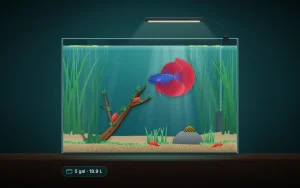
A standard 5 gallon tank measures about 40 x 20 cm, below the published minimum base for nearly every species rated here. Chilis in 6 gallons ate shrimplets. A 10 gallon or a 20 long gives the fish room and the shrimp cover.
Do well-fed fish leave baby shrimp alone?
No study tests it. Keepers report fed fish hunting anyway, and shrimplet losses followed live food in three reports.
Which fish medicine is safe for shrimp?
None has a peer-reviewed shrimp safety record. Most manufacturers label their fish medicines as unsafe for invertebrates, and one Caridina copper LC50 is 3 to 4 µg/L. Treat sick fish in a hospital tank.
Sources
- Tropea et al. 2015, PLOS ONE (hatchling size, incubation)
- Nur and Christianus 2013, hatchling length; Pierre et al. 2025, growth series (N. denticulata)
- Arthington 1989, platy diet; Walker 2004, cardinal tetra diet; Romand 1985, lampeye diet
- Roberts 2007, celestial pearl danio description; Mihalitsis and Bellwood 2017, prey size
- Vazquez et al. 2022 on moss; Warfe et al. 2004 on plant structure; Williams et al. 1991 on copper
- Seachem labels: ParaGuard, MetroPlex, Cupramine
- Seriously Fish species profiles; Garnelio; Aquarium Co-Op; Practical Fishkeeping; UKAPS
- Keeper counts are approximate and self-selected.