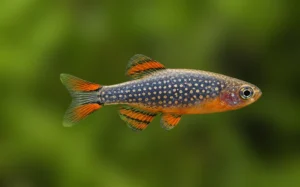
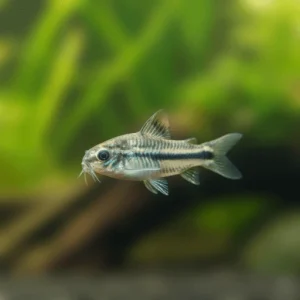
The smallest freshwater fish on Earth becomes an adult before its skull is finished.
Paedocypris progenetica holds the record. Females carry ripe eggs at 7.9 mm standard length, less than half the width of an American dime. The largest specimen ever measured was 10.3 mm (Kottelat et al., 2006). It lives in acidic blackwater peat swamps on Sumatra and Bintan, Indonesia. A genome study published in PNAS in October 2026 still names it the smallest fish in the world.
It is not an aquarium fish. The smallest fish sold regularly are Boraras rasboras. The exclamation-point rasbora reaches about 16 mm, and the chili rasbora about 20 mm.
Quick facts on Paedocypris progenetica
| Feature | Value |
|---|---|
| Smallest adult | 7.9 mm SL (0.31 in), female with ripe eggs |
| Largest known | 10.3 mm SL (0.41 in), female |
| Range | Sumatra and Bintan Island, Indonesia |
| Habitat | Slow blackwater streams in peat-swamp forest |
| Family | Paedocyprididae, in the carp order |
| Described | 2006, Proceedings of the Royal Society B |
| IUCN status | Near Threatened (2019), population decreasing |
The skeleton stays larval for life. Several skull bones never form, so bone does not cover the top of the brain. Biologists call this progenesis. The fish breeds while its body keeps a juvenile shape.
The species depends on peat-swamp forest. Logging, oil palm plantations, shrimp farms, and the fires of 1997 have cut into that forest. IUCN records the fish from only 10 to 20 locations.
How “smallest” is measured
Three rules decide which fish wins. Most pages state none of them.
Standard length versus total length
Standard length runs from the tip of the jaw to the end of the spine and excludes the tail fin. The record figures are standard length (SL). Guinness World Records calls the 7.9 mm figure total length. The original paper says standard length.
Smallest adult or largest known adult
Paedocypris progenetica has the smallest proven adult. On maximum size, an Amazon sleeper goby comes out smaller. Leptophilypnion pusillus is known from 3 specimens, the largest 9.1 mm SL, with gravid females at 9.0 and 9.1 mm (Roberts, 2013). With so few specimens, its true maximum is unknown.
Free-living fish or dwarf males
Some deep-sea anglerfish males are smaller still. They live in the sea, fused to females many times their size.
The smallest freshwater fish, ranked
| Rank | Species | Where | Smallest adult (SL) | Largest known (SL) |
|---|---|---|---|---|
| 1 | Paedocypris progenetica | Sumatra and Bintan | 7.9 mm | 10.3 mm |
| 2 | Paedocypris micromegethes | Sarawak, Borneo | 8.8 mm | 11.6 mm |
| 3 | Leptophilypnion pusillus | Tapajós basin, Brazil | 9.0 mm | 9.1 mm (3 specimens) |
| 4 | Leptophilypnion fittkaui | Negro basin, Brazil | not recorded | 9.7 mm |
| 5 | Danionella translucida | Myanmar | 10 to 11 mm | 12 mm |
| 6 | Danionella cerebrum | Myanmar | 10 to 15 mm (genus) | 13.5 mm |
No freshwater fish described between 2015 and October 2026 has been shown to mature below 7.9 mm, so the 2006 record still stands.
Leptophilypnion species are sleeper gobies from the central Amazon. Every specimen collected measures under 10 mm SL. Roberts reported that the stream population of L. pusillus near Santarém was probably lost to urban runoff. No fish in the Americas is smaller.
Danionella species stay transparent as adults, so the brain can be watched through the skin. Neuroscientists study D. cerebrum for that reason. A 2024 PNAS study measured its drumming males at more than 140 dB re 1 µPa at one body length. Underwater decibels use a different reference from decibels in air, so headlines comparing the sound to a gunshot are misleading.
Smaller fish that do not count
Several fish beat 7.9 mm on some measure. None of them lives in fresh water.
| Species | Size | Why it is excluded |
|---|---|---|
| Photocorynus spiniceps, deep-sea anglerfish | Mature male 6.2 mm | Marine; male fused to a 46 mm female |
| Schindleria brevipinguis, stout infantfish | Mature female 8.4 mm SL | Marine, Great Barrier Reef |
| Trimmatom nanus, midget dwarfgoby | Mature females 8 to 10 mm SL | Marine reefs |
| Pandaka pygmaea, dwarf pygmy goby | Males mature near 9 mm | Mainly brackish mangroves |
| Brachygobius jennie, described 2026 | Under 9 mm SL | Brackish; maturity unknown |
Paedocypris also lost the title of smallest vertebrate. A New Guinea frog, Paedophryne amauensis, averaged 7.7 mm in 2012. A 2024 study named the Brazilian flea toad, Brachycephalus pulex, smaller still.
Common claims, checked
Each claim below appears on a high-ranking page, including Guinness World Records and Wikipedia.
| Claim | What the evidence shows |
|---|---|
| “7.9 mm total length” | The paper measured standard length, without the tail. |
| “Found in Sumatra and Sarawak” | P. progenetica lives on Sumatra and Bintan. Sarawak has P. micromegethes. |
| “The dwarf pygmy goby held the record before 2006” | The 2006 paper names Danionella translucida as the previous freshwater record holder. |
| “The smallest vertebrate” | Frogs took that title in 2012 and 2024. |
| “Lives at pH 3” | The paper gives no pH. The figure came from press coverage. |
| “Critically endangered” | IUCN lists it as Near Threatened. |
| “The least killifish is North America’s smallest fish” | A 2010 review names the spring pygmy sunfish. |
Smallest freshwater fish by region
| Region | Smallest species | Size |
|---|---|---|
| World | Paedocypris progenetica | Adult at 7.9 mm SL |
| South America | Leptophilypnion pusillus | 9.1 mm SL maximum |
| Africa | Barboides britzi, Benin | 12.9 mm SL maximum |
| North America | Spring pygmy sunfish, Elassoma alabamae | 25.5 mm SL maximum |
| Europe | Trichonis dwarf goby, Economidichthys trichonis | Adult at 18 mm SL |
| UK and Ireland | Nine-spined stickleback | Smallest native species |
| Australia | Red-finned blue-eye | To 3 cm TL |
| India | Scarlet badis and Danionella priapus | About 15 to 16 mm SL |
| Philippines | Sinarapan, Mistichthys luzonensis | Adult near 1 cm |
North America
Bennett and Conway (2010) reviewed every North American freshwater fish under 50 mm. Only the spring pygmy sunfish counted as a miniature on maximum size, at 25.5 mm SL. It survives in a few Alabama springs and is critically endangered. The least killifish has smaller males, near 2 cm, but its females reach 30 mm SL.
Philippines
The sinarapan of Lake Buhi is the country’s smallest strictly freshwater fish, and Guinness lists it as the smallest fish caught commercially. The dwarf pygmy goby is smaller but lives mainly in brackish mangroves. FishBase considers it extinct in the Philippines.
The smallest freshwater fish to keep
Small size does not make a fish easy to keep. Most tiny species swim in active groups, need very fine foods, and fail in tanks that are not biologically mature.
Sizes are maximum standard length, mostly from Seriously Fish profiles. Tank figures are minimum base dimensions.
| Species | Maximum size | In the trade | Minimum base |
|---|---|---|---|
| Micro glassfish, Danionella translucida | 11 mm | Occasional | 45 x 30 cm |
| Boraras micros | 13 mm | Rare | 45 x 30 cm |
| Exclamation-point rasbora, B. urophthalmoides | 16 mm | Common | 45 x 30 cm |
| Dwarf pencilfish, Nannostomus anduzei | 16 mm | Uncommon | 45 x 30 cm |
| Scarlet badis, Dario dario | 15 to 20 mm | Common | 45 x 30 cm |
| Chili rasbora, Boraras brigittae | 20 mm | Common | 45 x 30 cm |
| Ember tetra, Hyphessobrycon amandae | 20 mm | Common | 45 x 30 cm |
| Kubotai rasbora, Microdevario kubotai | 20 mm | Common | 60 x 30 cm |
| Least killifish, Heterandria formosa | Males 20 mm, females 30 mm | Hobbyist circles | 30 x 20 cm per pair |
| Celestial pearl danio, Danio margaritatus | 21 mm | Common | 45 x 30 cm |
| Pygmy corydoras, Corydoras pygmaeus | 24 to 30 mm | Common | 45 x 30 cm |
| Pea puffer, Carinotetraodon travancoricus | 25 mm | Common | 30 x 20 cm per fish |
Micro glassfish (Danionella translucida)
The smallest fish an aquarist can realistically buy. Adults measure 9 to 11 mm SL and look like glass splinters with eyes. Shipments are irregular and often mixed with D. cerebrum. Keep a group in a planted species tank with gentle flow and feed live microfoods. Not suitable for community tanks.
Exclamation-point rasbora and Boraras micros
Boraras micros is the smallest true rasbora, at 13 mm SL, but it is rarely exported. The exclamation-point rasbora reaches 16 mm and is often sold as chili rasbora. A dark spot at the base of the tail identifies it. Do not add any Boraras to a newly cycled tank.
Chili rasbora (Boraras brigittae)
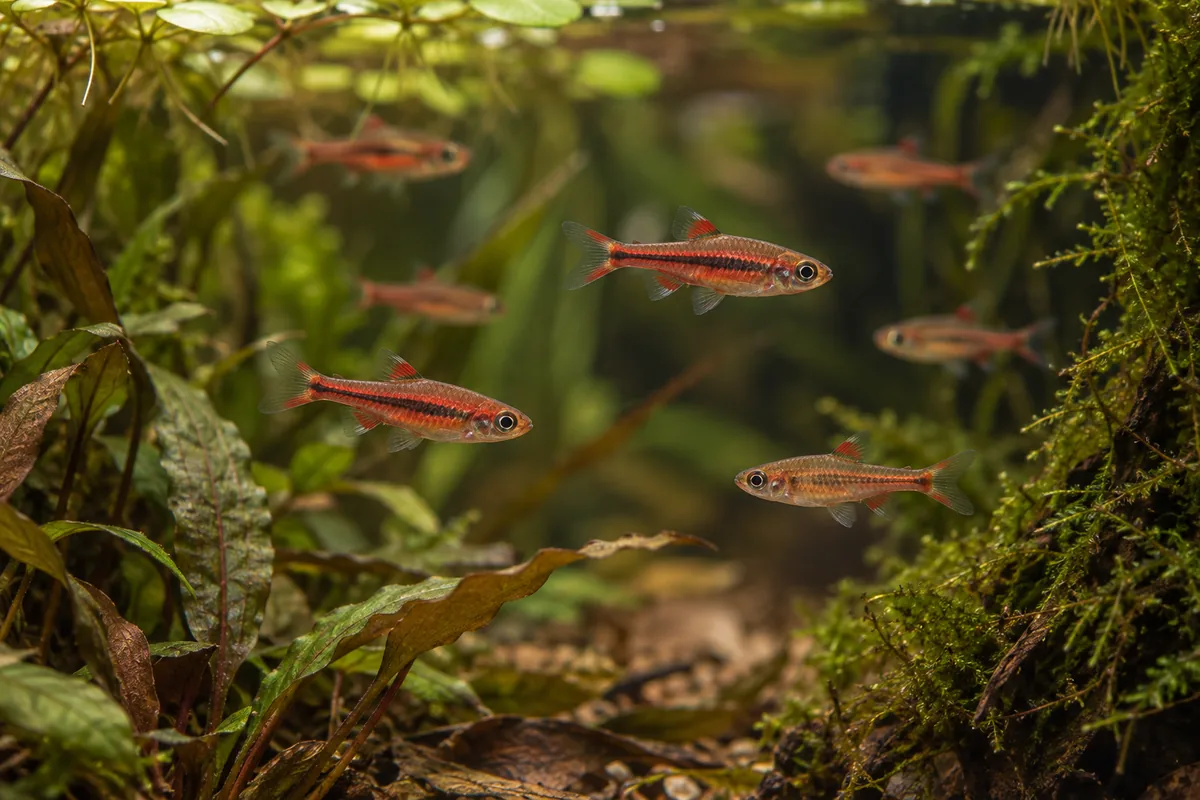
Chili rasboras reach 20 mm SL. Males turn deep red with a black stripe. Keep 8 or more in soft, slightly acidic water with plants and leaf litter. Feed fine foods such as Artemia nauplii and crushed flake. See the chili rasbora care guide, the chili rasbora breeding setup, and the chili vs phoenix rasbora comparison.
Scarlet badis (Dario dario)
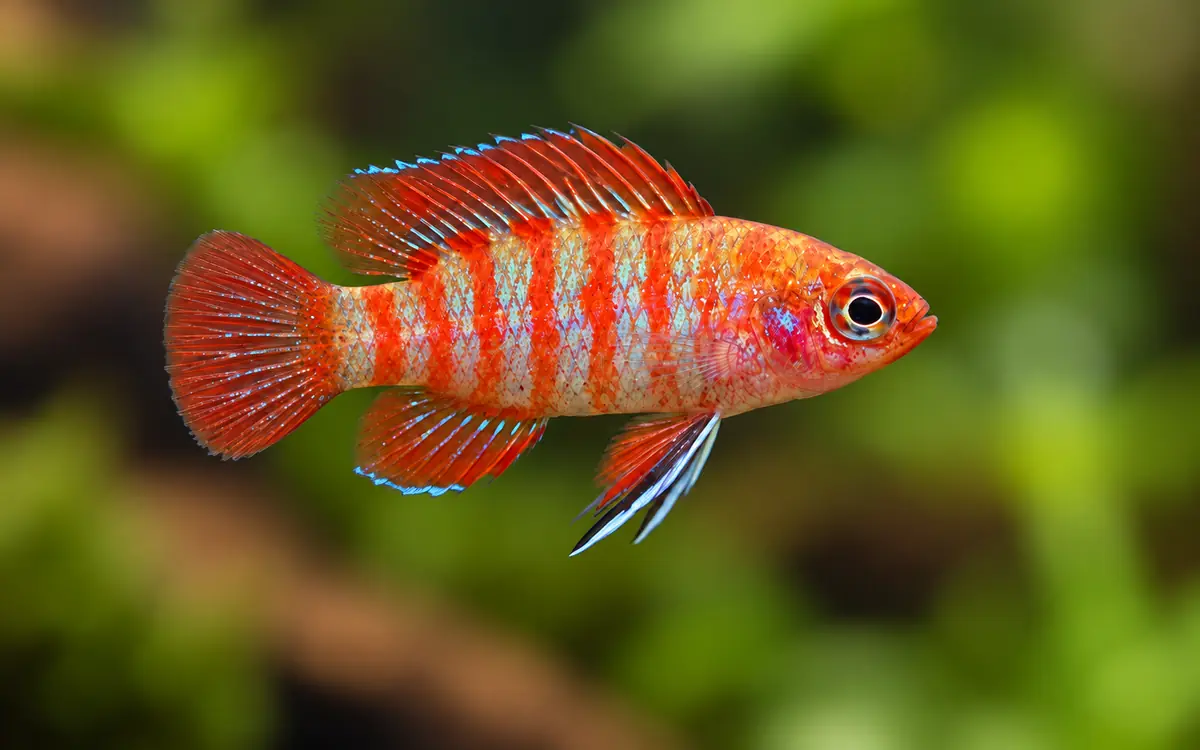
FishBase gives 15 mm SL for males and 12 mm for females. Males fight, so keep one male with two or three females in a dense planting. Most refuse dry food. See the scarlet badis care guide and the scarlet badis breeding guide.
Ember tetra (Hyphessobrycon amandae)
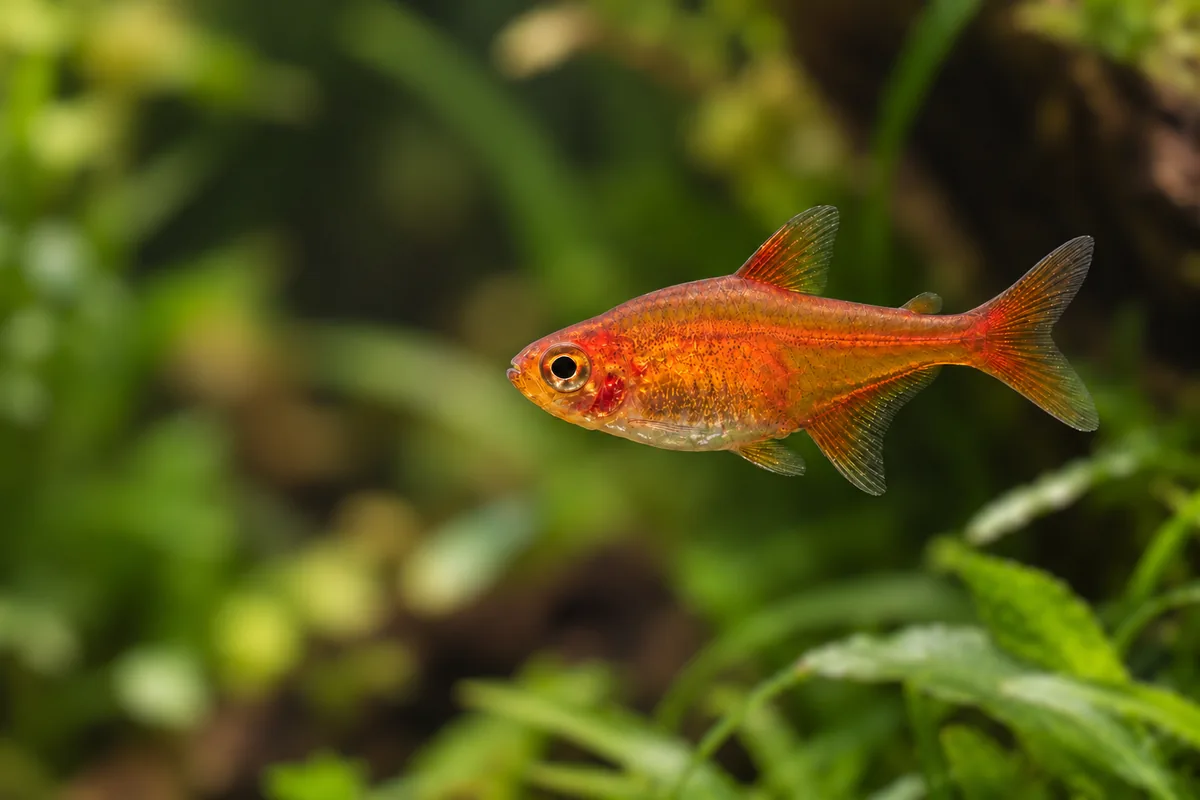
A 20 mm orange tetra that accepts dry food and tolerates a wider pH range than Boraras. Keep 10 or more. See the ember tetra care guide and the ember tetra breeding guide.
Kubotai rasbora (Microdevario kubotai)
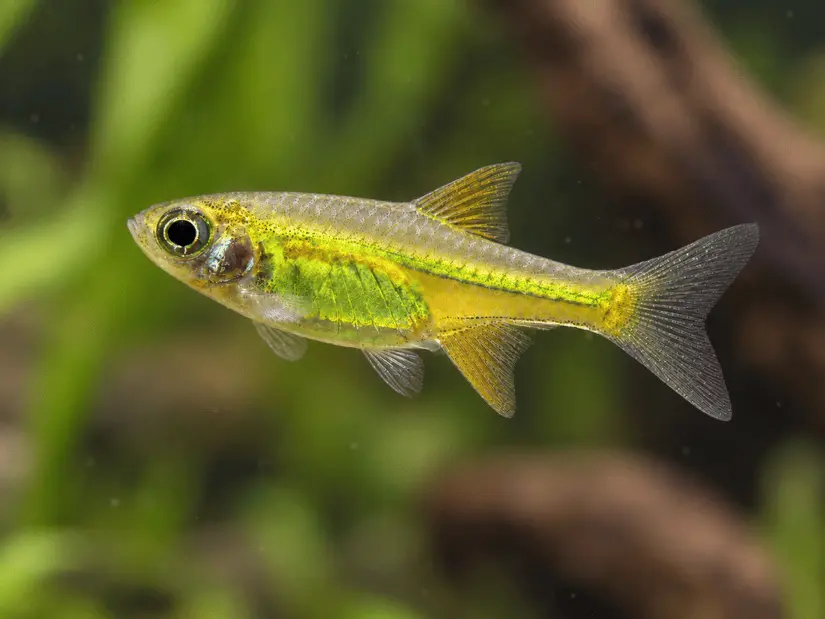
A 20 mm green rasbora that schools in open water and needs a 60 cm tank, longer than the others. Color depends on light and diet. See the kubotai rasbora care guide and the kubotai rasbora breeding guide.
Least killifish (Heterandria formosa)
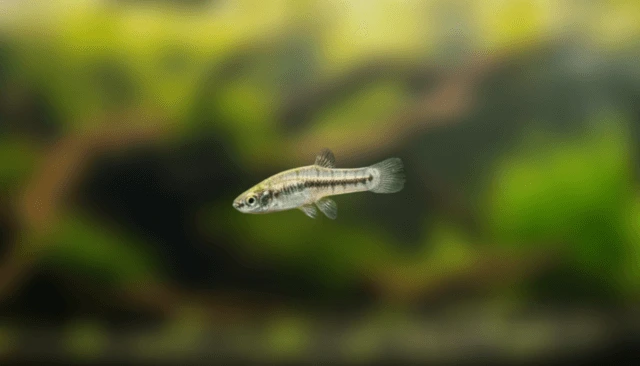
Despite its name, a livebearer from the southeastern United States. A pair can live in a tank 30 x 20 x 20 cm. Not suitable for community tanks, since other fish eat the small males. It is often called the smallest livebearer, but several South American livebearers are smaller.
Celestial pearl danio (Danio margaritatus)
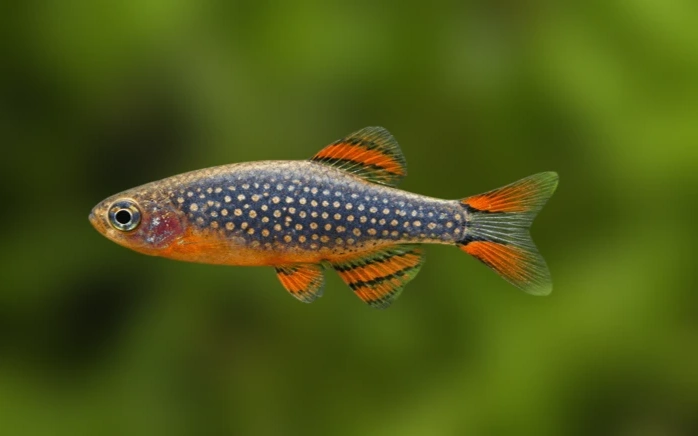
A 21 mm danio from Myanmar with pale spots on a dark body and orange fins. Males spar but rarely injure each other. Keep in cool to moderate temperatures with dense plants. See the celestial pearl danio care guide and the celestial pearl danio breeding guide.
Pygmy corydoras (Corydoras pygmaeus)
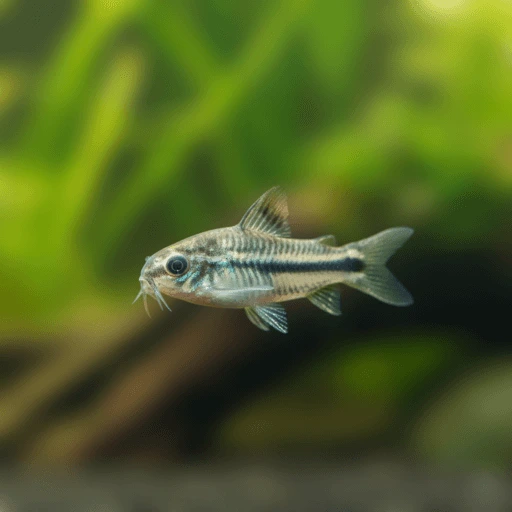
Museum specimens top out at 23.7 mm SL. Unlike larger corydoras, pygmies hover in mid-water in groups. Keep 8 or more over sand. See the pygmy corydoras care guide and the pygmy corydoras breeding guide.
Pea puffer (Carinotetraodon travancoricus)
The smallest pufferfish in the trade, at 25 mm SL. One puffer fits in a tank 30 x 20 x 20 cm. Groups need 2 to 3 gallons (8 to 11 litres) per fish and dense plants to break lines of sight. Feed live and frozen foods plus small snails, which wear down the teeth. Not suitable with shrimp.
Paedocypris in the aquarium
Paedocypris reaches the trade only in sporadic shipments, usually labeled P. carbunculus or ruby rasbora. No published care guide exists. Not recommended for anyone without experience with blackwater fishes.
For stocking numbers, the aquarium fish stock calculator gives a count per species, and best fish for a 5 gallon tank lists tested plans. The nano fish guide compares 14 nano species side by side.
The smallest fish in each group
Smallest freshwater stingray
The cururu stingray, Potamotrygon wallacei, is the smallest known species of its genus. Its 2016 description gave the largest specimen as about 31 cm disc width. It lives in the middle Rio Negro, Brazil, and at that size no nano tank can hold it.
Smallest freshwater eel
True eels of the genus Anguilla outgrow any home aquarium. The spiny eels kept by aquarists belong to a different family. The barred spiny eel, Macrognathus pancalus, from India, Pakistan, and Bangladesh, reaches 18.9 cm TL and is one of the smallest. The kuhli loach, often sold as an eel, belongs to the loach family.
Smallest freshwater pufferfish
The pea puffer and Carinotetraodon imitator, both from Kerala, India, are about the same size, at 25 to 26.5 mm SL. Both live only in fresh water.
Smallest freshwater shark
No true shark lives in a freshwater aquarium. Aquarium sharks are carp relatives or catfish. The smallest common one is the red-tailed black shark, Epalzeorhynchos bicolor, at 13 cm TL. Too large and territorial for nano tanks.
Smallest freshwater goby
The smallest gobioid in fresh water is Leptophilypnion pusillus, at 9.1 mm SL. Among true gobies, the sinarapan matures near 1 cm.
Smallest freshwater pleco
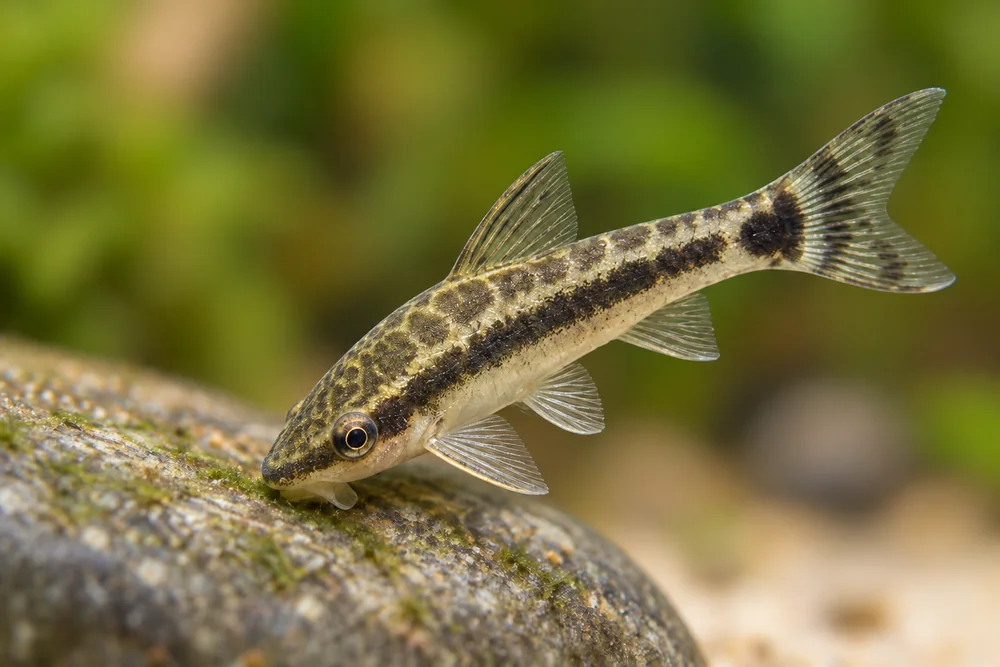
The smallest member of the pleco family is Parotocinclus halbothi from Brazil and Suriname, at 19.9 mm SL. It is not in the trade. Otocinclus, at about 35 mm SL, are the smallest sold regularly and need mature tanks with grown-in algae.
Other groups
| Group | Smallest species | Maximum size |
|---|---|---|
| Catfish | Scoloplax dolicholophia | 12.0 mm SL |
| Tetra order | Microcharacidium weitzmani | 12.0 mm SL |
| Rasbora | Boraras micros | 13 mm SL |
| Loach | Kottelatlimia katik | About 14 mm SL |
| Killifish | Fluviphylax palikur | 13.9 mm SL |
| Cichlid | Apistogramma staecki | 21 mm SL |
The shell-dweller Neolamprologus multifasciatus is often called the smallest cichlid. It reaches about 45 mm SL, twice the size of A. staecki.
Frequently asked questions
What is the smallest freshwater fish in the world
Paedocypris progenetica from Sumatra and Bintan, Indonesia. Females are adult at 7.9 mm SL. The largest known specimen is 10.3 mm.
What is the smallest fish in the world, including saltwater
Parasitic males of the anglerfish Photocorynus spiniceps mature at 6.2 mm. Among free-living fish with proven maturity, Paedocypris progenetica is the smallest.
Is the dwarf pygmy goby the smallest fish
No. Males mature near 9 mm, and the species lives mainly in brackish water.
What is the smallest fish to keep in a nano tank
The exclamation-point rasbora at 16 mm and the chili rasbora at 20 mm are the smallest sold regularly. Micro glassfish are smaller but rare.
Why is the smallest fish missing part of its skull
Paedocypris matures while keeping a larval skeleton. Several skull bones never develop, so bone does not cover the top of the brain.
Sources
- Kottelat M, Britz R, Tan HH, Witte K-E (2006). Proceedings of the Royal Society B 273: 895-899.
- Sudasinghe H, et al. (2026). Convergent genome streamlining in the world’s smallest fishes. PNAS 123(42).
- Lumbantobing D (2019). Paedocypris progenetica. IUCN Red List.
- Roberts TR (2013). Leptophilypnion. aqua, International Journal of Ichthyology 19(2): 85-98.
- Bennett MG, Conway KW (2010). North America’s diminutive freshwater fish fauna. Ichthyological Exploration of Freshwaters 21(1): 63-72.
- Toledo-Piza M, Mattox GMT, Britz R (2014). Miniature Neotropical freshwater fishes. Neotropical Ichthyology 12(2).
- Britz R, Conway KW, Rüber L (2021). Danionella cerebrum. Scientific Reports 11: 18942.
- Cook VANO, et al. (2024). Sound production in one of the smallest vertebrates. PNAS 121(10).
- Watson W, Walker HJ (2004). Schindleria brevipinguis. Records of the Australian Museum 56(2).
- Rittmeyer EN, et al. (2012), PLoS ONE; Bolaños WH, et al. (2024), Zoologica Scripta 53(4).
- de Carvalho MR, Rosa RS, Araújo MLG (2016). Potamotrygon wallacei.
- Eschmeyer’s Catalog of Fishes; FishBase; Seriously Fish; US Mint coin specifications.