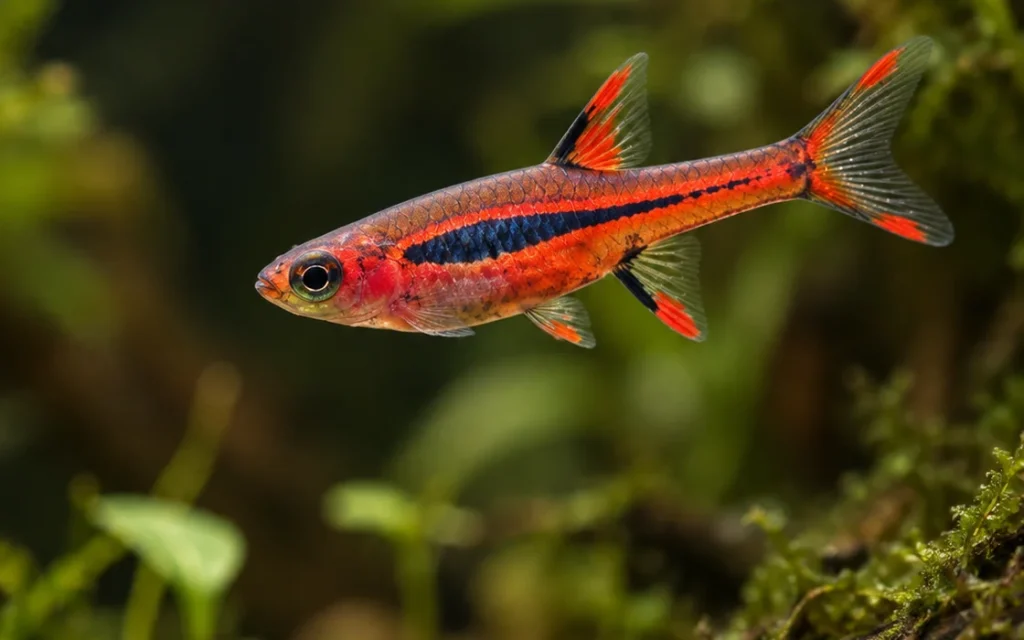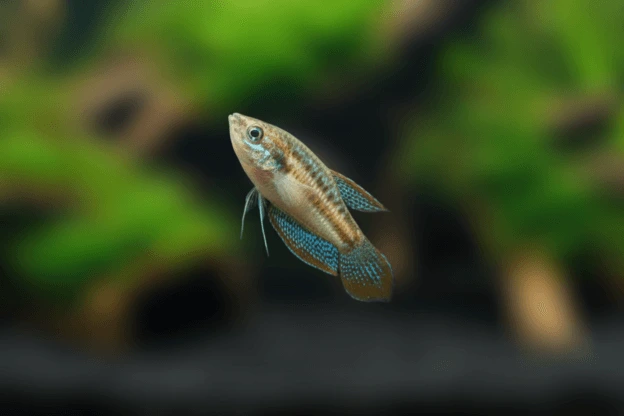
The smallest croaking gourami is also the loudest. At 4 cm, Trichopsis pumila produces fight croaks about 8 to 9 dB louder than its two larger relatives, and both sexes make them. The sparkling gourami is a talking fish, a bottom-loving gourami and a fierce little territory holder in one body. Care succeeds when the tank respects all three.
| Fact | Detail |
|---|---|
| Scientific name | Trichopsis pumila (Arnold, 1936) |
| Other names | Pygmy gourami, dwarf croaking gourami |
| Adult size | Up to 4 cm standard length, usually about 3 cm |
| Tank | 45 x 30 cm footprint for a pair or trio |
| Temperature | 24 to 27°C, 27 to 28°C for breeding |
| Water | pH 6.0 to 7.0, GH up to 12 dGH |
| Group | 1 male with 1 or 2 females, or 6 or more in a large tank |
| Diet | Small live and frozen foods, crushed flake |
| Lifespan | About 3 to 4 years in keeper reports |
| Origin | Thailand, Cambodia, Laos and Vietnam |
Seven rules that decide success
- Count males, not litres. Keep one male in a 45 cm tank, and give two or more males a larger, densely planted tank.
- Cover the tank and leave a 2 to 5 cm air gap above the water.
- Keep the water still and quiet, with a sponge filter and the outflow below the surface.
- Plant low and dense, and shade the surface with floating plants.
- Feed small live or frozen food low in the tank, and check bellies daily in the first month.
- Choose small, calm, slow tank mates. A cherry shrimp colony will not survive a group.
- Plan for fry before buying, since pairs often spawn within days of arrival.
The croak: who makes it, how and when
Both sexes croak. A 2020 study at the University of Vienna recorded croaks from 13 of 20 females and 12 of 17 males during contests. That overturned a 1980 anatomy paper, which concluded that females could not make sound. Many care sheets still repeat the old claim.
The sound is plucked like a guitar string. Each pectoral fin holds two thickened tendons, which are stretched and snapped over a bony bump on the fin rays. The fins beat alternately, and each croak is a run of 1 to 4 short bursts. The dominant pitch sits at about 1.5 to 2.5 kHz.
Male tendons are twice as thick, and male croaks are lower and about 14 dB louder than female croaks. Heavier males croak lower and louder again. Rivals can judge size by ear. In the laboratory, same-sex contests lasted about 8 minutes, and no injuries were seen. This species alone beats its tail while croaking, and it attacks less than its relatives.
“Purring” belongs to a different fish. Female croaking gouramis (T. vittata) make short, quiet purrs before spawning. Nobody has recorded the same sound from sparkling gouramis.
Many keepers never hear the croak at all. When it is heard, it carries across rooms and even between floors. People notice it most at dawn, in the evening and at night, and often blame the filter, the heater or a cricket first. Phone recordings rarely capture it well.
Aquarium noise matters to a fish that talks. Filters measured 114 to 119 dB underwater in one laboratory study, loudest when the outflow splashed above the surface. Wild Thai marshes measured about 102 to 105 dB.
In the croaking gourami, steady noise at 110 dB raised hearing thresholds by 12 to 18 dB. The air in the labyrinth organ also works as a hearing aid in other gouramis. No study has tested filter noise on sparkling gouramis. A quiet sponge filter and an outflow below the waterline keep the tank closer to wild conditions.
Silent tanks usually have a simple cause, such as no rival male, females only, a noisy air pump, or fish that have not settled yet.
Sparkling, croaking or dwarf gourami
Shops mix these fish up, and croaking gouramis regularly end up in sparkling gourami bags. Check size and stripes before buying.
| Fish | Maximum size | Field marks |
|---|---|---|
| Sparkling gourami (Trichopsis pumila) | 4 cm | One solid dark stripe with a row of dark blotches above it, 5 anal-fin spines |
| Croaking gourami (Trichopsis vittata) | 7 cm | Larger, 6 to 8 anal-fin spines |
| Three-stripe croaking gourami (Trichopsis schalleri) | Larger than pumila | Upper stripe fades with mood |
| Honey gourami (Trichogaster chuna) | 5.5 cm | Different genus, needs a 60 cm tank |
| Dwarf gourami (Trichogaster lalius) | 8.8 cm | Different genus, despite “sparkling dwarf gourami” labels |
Tank size: count the males
A 45 x 30 cm footprint, about 40 litres, suits a pair or a small group. A single fish or one pair fits a 20-litre tank, as covered in the 5 gallon stocking guide. Several males need 60 cm or more, dense planting and broken sightlines. One German breeder recommends groups only in tanks at least 1 m long.
The common rule of 10 extra gallons per fish has no basis. Territory decides space, and males hold territory. Height adds little, and a tank 25 to 30 cm tall is enough. A low tank also makes breeding easier.
Lid, air gap and jumping
Sparkling gouramis are excellent jumpers. Keepers lose them through lid holes, filter cut-outs and feeding gaps. One keeper lost 3 fish overnight after a top-off raised the water by 5 cm, so refill slowly.
Leave 2 to 5 cm of warm, humid air under the lid. The fish breathe air from the surface, and experts agree on the covered air gap. For adults it is a sensible precaution without direct evidence. For fry it is essential, since the labyrinth organ starts working in weeks 3 to 4. Rimless tanks work with the water lowered a few centimetres and emergent plants at the edges.
Water: temperature, pH and hardness
| Parameter | Target | Tolerated |
|---|---|---|
| Temperature | 24 to 27°C | 22 to 28°C |
| Breeding temperature | 27 to 28°C | Up to 30°C for spawning |
| pH | 6.0 to 7.0 | 5.0 to 7.5 |
| Hardness | GH 1 to 12 dGH | Breeding recorded up to 20 dGH |
| Ammonia and nitrite | 0 | 0 |
| Water changes | Small and regular | Avoid large sudden changes |
A heater is needed in most homes, since the species does not thrive below 20°C. Colour improves at the warm end. A Czech breeder found fish at 24 to 26°C healthy but paler and less willing to spawn than at 26 to 32°C.
Soft water is not required. German and Czech breeders spawned them in water of 19 to 20 dGH. Soft, slightly acidic water still gives the best colour.
No field measurements of water chemistry exist for this species. The widely copied “native” range of pH 6 to 7.5 and dH 5 to 19 comes from an aquarium atlas, not from the wild.
Setup: quiet water and low cover
Unlike most gouramis, the sparkling gourami lives in the lower half of the tank. It forages near the bottom, often head-down at a 45-degree angle, and usually nests under a low leaf. Cover belongs low as well as high.
- Dense low planting: Cryptocoryne, Java fern and moss on wood, such as flame moss
- Floating plants to shade the surface
- Dried beech leaves or similar leaf litter for cover and microfauna
- Small caves, such as half coconut shells or clay pots
- An air-driven sponge filter set to turn over gently
The fish sparkle in the right light. Light from the front at about 45 degrees shows the iridescent blue and green. Overhead light and pale sand make them look dull, as covered in why nano fish lose colour.
Settling a shy fish
New sparkling gouramis hide for anything from 3 days to about 4 weeks. Pale new fish usually colour up within a week. Keepers report the fastest results in a smaller, denser tank with floating plants, where whole groups were out within 2 days.
- Dim the light and cover most of the surface with floating plants.
- Add all fish on the same day, so the hierarchy forms once.
- Keep the room quiet, and use no fast or boisterous tank mates.
- Target-feed small live food low in the tank.
- Check every belly daily for the first two weeks.
- Leave the tank alone, with no rescaping and no heavy pruning.
A visible predator reduces displays in croaking gouramis. Large fish in view, even through glass, keep a shy group hidden.
Males, females and aggression
Sparkling gouramis are not a schooling fish. Pairs and loose groups hold small territories low in the plants.
Laboratory fights end without injury. Home tanks are harsher, and keepers report more than a dozen cases of fish dying one at a time in tanks of 25 to 75 litres, usually after spawning. Females are often the bully, and one backlight-sexed female killed three tankmates. Heavy plant trimming has triggered fights and deaths.
- Keep 1 male per 45 cm tank, with 1 or 2 females.
- Keep groups only in large, densely planted tanks with more females than males.
- Trim plants in stages and never strip cover in one session.
- Remove a fish at the first torn fins, and do not wait for the next death.
Feeding
Sparkling gouramis are micropredators. In the wild they eat zooplankton and aquatic insects. Captive fish take dried food once they recognise it as food, but they need small live or frozen food for colour and condition.
- Live: Daphnia (see Daphnia culture), Cyclops, baby brine shrimp and mosquito larvae
- Frozen: Daphnia, Cyclops, Artemia and finely cut bloodworm
- Dry: crushed flake and slow-sinking micro pellets
They are slow eaters that look before they bite, and they quietly starve in busy community tanks. Feed small amounts twice a day, low in the tank where they forage. A Japanese keeper sinks crumbs of pleco tablet in the morning and evening for fish that graze. Size every food to the mouth, since juveniles choke on oversized larvae. Vegetable-based diets, suggested on some care sites, do not suit them.
Sparkling gourami tank mates
| Verdict | Species | Reason |
|---|---|---|
| Good | Chili rasbora and other Boraras | Tiny, calm, same water |
| Good | Kubotai rasbora, small Trigonostigma species | Calm mid-water fish |
| Good | Kuhli and other Pangio loaches | Share the wild habitat, peaceful |
| Good | Otocinclus, nerite snails, Amano shrimp | Left alone, or too big to eat |
| Conditional | Pygmy corydoras | Usually fine, but some keepers report attacks |
| Conditional | Ember tetra | Fine if they do not take all the food |
| Conditional | Scarlet badis | Both need small live food |
| Conditional | Clown killifish | Untested pairing, both need tiny live food |
| Avoid | Cherry and Caridina shrimp colonies | Groups hunt adult shrimp |
| Avoid | Bettas | Fights in both directions |
| Avoid | Pearl and dwarf gouramis | Much larger gouramis |
| Avoid | Guppies, Endlers and platies | Fast feeders, and young livebearers get killed |
| Avoid | Medaka | Prefers cooler water |
Shrimp deserve a clear warning. Groups of 2 to 6 sparkling gouramis hunt adult cherry shrimp together, and some keepers lost whole colonies within days. Single fish in mature tanks often spare adults, but shrimplets always disappear. Snails lose their antennae to nipping.
Sparkling gouramis also eat fry, including guppy fry. A community tank with sparklers raises no fry of any species.
Buying and the first month
Shops mostly sell males, and juveniles are hard to sex. Buy about 6 young fish and let pairs form. A torch shone behind the bag sexes adult fish. The female’s belly looks triangular toward the rear, since the ovaries rise into it, while the male’s looks rounded. Males also carry longer, more pointed fins and brighter colour.
Losses cluster in the first weeks after purchase. Quarantine new fish for 2 to 4 weeks in a covered, planted tank. Velvet has not been documented in this species, but it is common in imported licorice gouramis, a related group, so watch for gold dust, clamped fins and rapid breathing. Mouth wounds from fights can turn fungal and slowly stop a fish from eating.
Expect to pay about £2 to £4 each in the UK and about $4 to $5 online in the USA.
Breeding sparkling gouramis
Breeding often happens within 1 to 14 days of purchase, even in community tanks. Warm water at 27 to 28°C, shallow water and live food encourage spawning, and breeders report most spawns in the quiet evening hours.
The nest is small, from a few bubbles to the size of a walnut. Males usually build it under a broad or curled leaf, often the oldest and most curled leaf in the tank. Caves, the heater and floating-plant roots also serve.
The pair embraces in an X shape below the nest. The eggs sink, so the male catches them in his mouth, 1 to 5 eggs per embrace, and spits them into the nest. A full spawn holds about 50 to 200 eggs. The female often helps guard the outer nest area, so removing her is optional in a large planted tank.
| Water temperature (breeder reports) | Hatching time |
|---|---|
| 25°C | 24 to 36 hours |
| 27°C | 36 to 48 hours |
| 28°C | 24 to 36 hours |
| 30°C | 22 to 30 hours |
The larvae hang from the nest by threads on their heads. They swim free about 3 to 4 days after hatching, at roughly 3 mm long. The male catches strays and spits them back into the nest, which is often mistaken for fry eating. Adults usually leave free-swimming fry alone.
Hunger kills more fry than anything else. The fry are too small for baby brine shrimp and even vinegar eels at first. Breeders in four countries reached the same cure, a mature tank with mulm, old moss and leaf litter. One Japanese breeder lost two broods kept in clean water.
- Before spawning, add a clump of moss from an established tank and a few dried leaves.
- From day 1, feed infusoria and green water, and leave the mulm in place.
- From about day 4, offer rotifers and tiny copepod nauplii.
- From about day 10, offer the smallest baby brine shrimp, with microworms soon after.
- During weeks 3 to 4, keep the lid tight and the food small while the labyrinth develops.
Snails destroy nests, so remove them from breeding tanks. Fry reach about 2 cm at 3 to 4 months, and one Czech breeder had them spawning at about 3 months.
Where sparkling gouramis come from
Sparkling gouramis live in the lower Mekong and Chao Phraya basins of Thailand, Cambodia, Laos and Vietnam. They favour still, weedy water, such as swamp forest, peat swamps, floodplains, rice paddies and roadside ditches. The water is often low in oxygen and densely covered with floating plants. Wild companions include croaking gouramis, three-spot gouramis, a wild Betta species, kuhli-type loaches and climbing perch. Reports of the species in Malaysia and Indonesia have no support in the scientific catalogues.
The species is listed as Least Concern by the IUCN (assessed 2011), and Thailand’s environment agency confirmed that status in 2020 and 2025. Thai records also list it as a food fish. Keepers report lifespans of about 3 to 4 years, with some reaching 5, but no study has measured it.
Sparkling gourami FAQ
Do female sparkling gouramis croak?
Yes. A 2020 study recorded croaks from 13 of 20 females in contests. Female croaks are about 14 dB quieter and higher pitched than male croaks, so they are harder to hear.
Why do some sparkling gouramis never croak?
Croaks mostly happen between rivals. A tank without a second male, a tank of females only, a noisy filter or unsettled fish can stay silent. Listen in a quiet room with the filter switched off.
How many sparkling gouramis fit in a 10 gallon tank?
One male with 1 or 2 females. A 10 gallon tank, about 40 litres and 45 cm long, holds one territory. Two males in that space fight, and losses are common.
Can sparkling gouramis live with cherry shrimp?
Not as a breeding colony. Groups of sparkling gouramis hunt adult cherry shrimp, and every fish eats shrimplets. Amano shrimp are the safer choice.
Can sparkling gouramis live with a betta?
Not reliably. Both fish defend space, and fights run in both directions. Small, calm fish such as chili rasboras make safer companions.
Are sparkling and croaking gouramis the same fish?
No. Both belong to the genus Trichopsis and both croak. The croaking gourami, T. vittata, grows to 7 cm, while the sparkling gourami, T. pumila, stays at about 4 cm.
How long do sparkling gouramis live?
Keepers report about 3 to 4 years, and some reach 5. No study has measured lifespan, and shop fish are already a few months old.
Sources
- Liesch, N. & Ladich, F. (2020). Both sexes produce sounds in vocal fish species: testing the hypothesis in the pygmy gourami. Journal of Experimental Biology 223. doi.org
- Kratochvil, H. (1980). Geschlechtsdimorphismus beim Lautapparat des Knurrenden Zwerggurami. Zoomorphologie 94. doi.org
- Ladich, F. & Schleinzer, G. (2018). Sound production in female Trichopsis schalleri. Bioacoustics 29. europepmc.org
- Bischof, C. (1996). Diversity in agonistic behavior of croaking gouramis and the paradise fish. Aggressive Behavior 22. doi.org
- Ladich, F. (2007). Females whisper briefly during sex. Animal Behaviour 73. doi.org
- Gutscher, M., Wysocki, L. E. & Ladich, F. (2011). Effects of aquarium and pond noise on hearing sensitivity in an otophysine fish. Bioacoustics 20. doi.org
- Maiditsch, I. P. & Ladich, F. (2022). Noise-induced masking of hearing in a labyrinth fish. PeerJ 10:e14230. doi.org
- Seriously Fish. Trichopsis pumila (revised 2026). www.seriouslyfish.com
- Aquarium Glaser, F. Schäfer (2020). Trichopsis pumila. www.aquariumglaser.de
- Eschmeyer’s Catalog of Fishes. Genus Trichopsis (October 2026). researcharchive.calacademy.org
- IUCN Red List. Trichopsis pumila, Least Concern. www.iucnredlist.org
- Thailand Biodiversity Information Facility (ONEP). Trichopsis pumila. thbif.onep.go.th
- Eliáš, J. (2007). Der Knurrende Zwerggurami. Verein Kölner Aquarien- und Terrarienfreunde (archived). web.archive.org