Spotted blue eye care rests on three points. The tank needs enough floor area, the group needs at least 8 to 10 fish, and the food must be small enough to swallow. Care sheets often miss one of them.
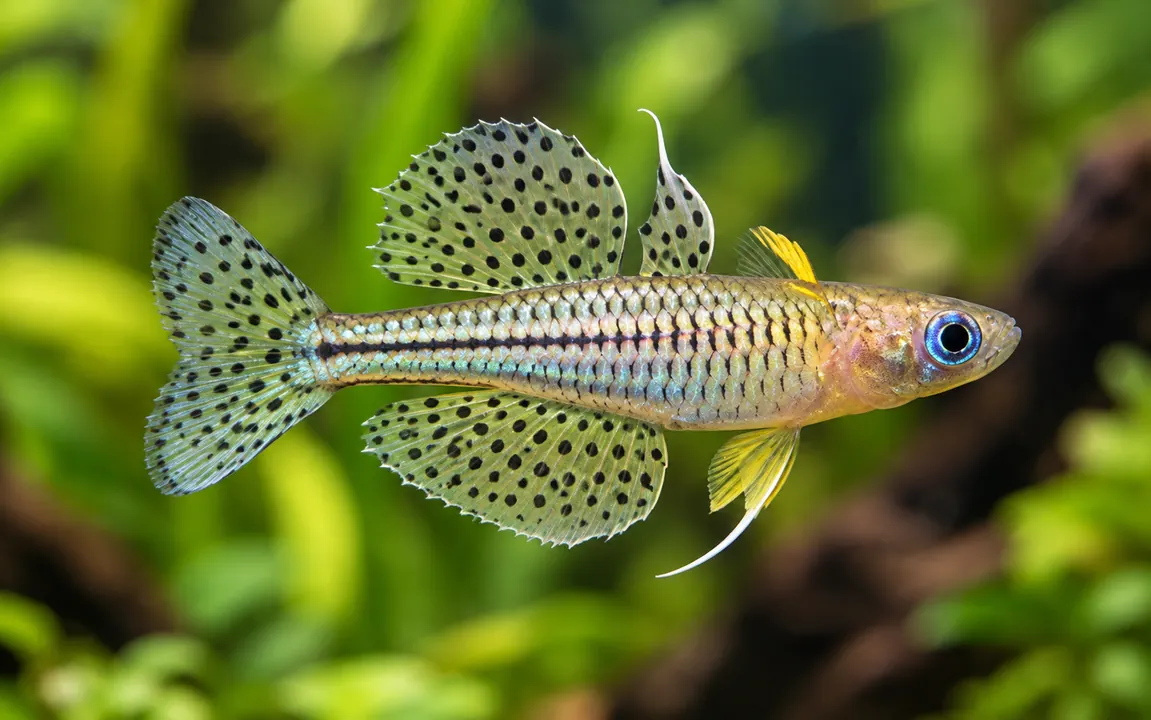
Pseudomugil gertrudae is a blue-eye, a close relative of the rainbowfishes, and the Australian Native Fish Association (ANGFA) rainbowfish manual covers it. Adults reach about 3 to 4 cm. Males have larger, spotted dorsal, anal and pelvic fins, with extended filaments on the first dorsal and pelvic fins. Confirm the species before buying. P. paskai and P. luminatus (the red neon blue-eye) look similar, and trade names such as “paskai” or “red neon” do not identify a fish.

In this guide
Spotted blue eye care quick facts
| Adult size | 3 to 4 cm |
| Minimum tank | 45 x 30 cm base (about 40 L), 60 x 30 cm preferred |
| Group | 8 to 10 or more, both sexes; 2 to 3 females per male for breeding |
| Temperature | 23° to 27°C (published range 21° to 28°C) |
| pH | 6.0 to 7.5 (published range 4.5 to 7.5) |
| Hardness | 5 to 12 dGH (published range); not critical |
| Food | Newly hatched Artemia, small Moina and Daphnia, microworm, crushed flake |
| Hatching | About 10 to 12 days at 27°C; 4 to 21 days across sources |
| Lifespan | Up to 4 years in captivity |
Tank size and footprint
The floor matters more than the volume. The smallest sensible base is 45 x 30 cm, which holds about 40 L at a water depth of 30 cm. A tall 40 L tank with a smaller base does not qualify.
The ANGFA manual describes a 50 L aquarium with floating water sprite, driftwood, and aquatic moss for a small mixed group. Gerald Allen’s 1995 handbook calls 20 L suitable for the species and for blue-eyes generally recommends 40 L for a group of 10 to 15 adults. Later specialist advice sets the floor higher. A 60 x 30 cm tank (about 54 L) leaves more margin. Extra length lets males display at one end while other fish rest under cover at the other.
The minimum assumes a mature filter, dense planting along the edges, and no competing fish. A new tank of any size is a poor home. A mature 40 L tank can outperform a new 80 L tank. No trial has set a tank-size threshold, so these figures are specialist practice, not measured welfare limits. The aquarium fish stock calculator shows how a larger group changes the load on a small tank.
Group size and sex ratio
Keep at least 8 to 10 of the same species, and more if the tank allows. Males display to each other and to females. A group of four hides more, and each fish draws more attention from the rest.
Keep both sexes. Males raise the first dorsal fin, spread the dorsal and anal fins, and chase rivals in short runs. This is courtship and rivalry. Torn fins, a fish cornered for long periods, or a female driven off the food are the signs of a problem.
No proven ratio exists. Breeders commonly keep 2 to 3 females per male, and Allen recommends the same for spawning groups of 10 to 15. If one female is always chased, add cover before changing numbers.
Sex the fish by color and fin development. Males are brighter, with more ornate dorsal and anal fins. Females generally have the deeper body, though some retailers state the reverse. Keep fish from different localities apart. Allen recognizes at least five Australian populations: northern Cape York, the Murray Swamps near Tully, the Finniss River near Darwin, Melville Island, and eastern Arnhem Land. Genetic work shows separate lineages, so label each line with its locality.
Spotted blue eye care: water temperature, pH and hardness
Aim for 23° to 27°C and a stable pH of 6.0 to 7.5. The published range for aquarium stock is 21° to 28°C, pH 4.5 to 7.5, and 5 to 12 dGH. Allen recommends pH 6.0 to 7.0 and 23° to 28°C.
Wild records are wider. Collectors have found the species at 12° to 34°C, pH 3.68 to 9.4, and hardness of 0 to 320 ppm. Allen reports a tolerance of pH 3.8 to 7.8, with wild readings usually between 5.2 and 6.7. These numbers come from many separate sites. They show where the species occurs, not what a tank should hold. Blackwater creeks with a pH below 5 exist, but trade fish do not need them, and chemical pH correction can destabilize the filter.
Both acidic and alkaline water work. Some breeders add boiled peat moss to aged tap water for a pH of 5.5 to 6.9, and others report good results at pH 7.0 to 7.5. Allen finds hardness not critical for rainbowfish and blue-eyes generally. Pick one regime and hold it steady.
Stability counts more than the target. Match replacement water to the tank in temperature and hardness. A weekly change of 20 to 30% is a sound starting point, and Allen finds that regular changes also stimulate spawning in rainbowfish. Ammonia and nitrite should read zero. Very soft water with low KH lets pH drift in an ordinary filter, so test KH as well as pH.
Setup: substrate, plants, cover and flow
The species lives in vegetated lagoons, creeks, and swamp margins, usually over mud or silt, with floating plants and leaf litter. Allen notes Pandanus-lined creeks with muddy bottoms and abundant submerged logs. It is seldom found in turbid water, even where plants are dense.
Substrate matters little, and fine sand or smooth gravel works. Spend the effort on plants. Use fine-leaved moss such as Taxiphyllum or Java moss, hornwort, Myriophyllum, Cabomba, and floating plants with trailing roots. Plant both ends of the tank and leave a clear middle for display. Shade about one third of the surface and leave the rest open for feeding and gas exchange. Lighting should be gentle, and an 8 to 10 hour timer is a reasonable start.
Use a mature sponge filter or a baffled filter, and aim the outflow along the glass. The fish should hold position without effort. Slow water is not stagnant water, and warm water holds less oxygen, so keep the surface moving. Cover intakes with fine foam. A fitted lid is a sensible precaution for small active fish, although no jump data exist for this species.
The fish are shy and easily upset. Place the tank in the quietest part of the room, away from foot traffic. For rainbowfish and blue-eyes generally, Allen notes that 1 to 2 hours of early morning sun improves color, though direct sun is not essential.
Food: what fits the mouth
The mouth is small, so size decides what the fish eats. In the wild the diet is general: small crustaceans, aquatic insects, tadpoles, algae, diatoms, and a few flies. In the tank, offer Artemia nauplii, small Moina and Daphnia, copepods, mosquito larvae, and microworm. Dry flake alone is a poor base. Allen advises live or frozen food every day alongside a good flake, and the ANGFA manual advises the same supplement for best results. Large frozen pieces, big bloodworms and adult Daphnia are too big.
Prepared food counts only if it is swallowed. Watch a fish take a particle and keep it. A fish that mouths a granule and spits it out has not eaten.
Feed small portions once or twice a day, and twice suits timid fish. Most food is taken near the surface, so sunk food is wasted. Spread the food at two points far apart so slow eaters reach it. Watch the smallest female over several weeks. A rounded belly after meals and steady body condition show that she is getting enough. Remove leftovers, since microworms sink fast. Use a fine complete food as the base and rotate live foods through the week. Live food alone is not a complete diet.
Spotted blue eye tank mates
A species-only tank is the safest choice. The fish is small, shy, and easily outcompeted, even by fish that never bite. A peaceful neighbor is not a compatible one, since a quick eater can empty the surface before a blue-eye reaches it.
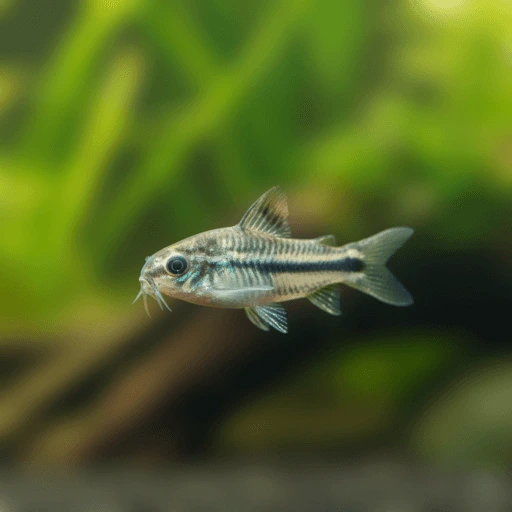
Conditional partners are small and slow to feed. These include Boraras, small gentle tetras, and small peaceful bottom fish such as pygmy corydoras in a tank of 60 cm or more. The ANGFA manual pairs the related Iriatherina werneri with other small native species such as this one, and Allen records both in the same wild streams, along with Melanotaenia maccullochi. A shared stream does not prove that the fish eat side by side in a tank. Both species are timid feeders, so feed at two points and check that each species eats. Adult Neocaridina and Caridina shrimp are usually safe. Newborn shrimp are the right size for a meal.
Avoid angelfish, larger gouramis and cichlids, aggressive livebearers, large rainbowfish, and nippy barbs and tetras. Fast danios and other quick shoalers take the food first. Any predator will eat them. Allen warns that hybrids appear easily when related rainbowfish share a tank. The same risk is sensible to assume for lookalike blue-eyes such as P. paskai, so keep them apart. More small species are covered in the guide to the best nano fish for small aquariums.
Behavior and health signs
Midwater swimming is normal in a healthy tank. The fish cruise through the upper and middle water, hover near stems, and rise to the surface for food. Males flutter and display, and the group shoals loosely, scatters, and regroups. Spots on the body and fins darken during display. A male can look pale after a disturbance.
Depth alone says nothing about health. Look for combinations. The signs that matter are the whole shoal gasping at the surface, fish crowding under the filter outflow, fast gill movement, clamped fins, loss of balance, refusal of food, weight loss, ulcers, and sudden deaths. One fish pinned in a corner or hiding constantly also needs attention.
Test the water first. Check temperature, ammonia, nitrite and pH. Water faults cause many early problems and mimic disease. Do not medicate without a diagnosis. Most wild fish die in their first year, and captive fish can reach 4 years. Egg output can fall after 12 to 18 months, so plan replacements early.
Buy fish that look sturdy. Skip hollow-bellied or emaciated fish and any tank that holds sick fish. For rainbowfish and blue-eyes, Allen suggests a simple test: move fingers near the glass at the surface, and well-conditioned fish flock toward the hand for food. Pale color in a shop tank is not a warning, since colors are often muted in barren tanks. Acclimate over 1 to 2 hours by floating the bag and adding tank water slowly. Allen quarantines new rainbowfish and blue-eyes for 1 to 2 weeks, while the Merck guidance is at least 30 days in a separate cycled tank, which is the safer figure for delicate fish.
Breeding
Spawning needs no trigger, but diet matters. Allen reports that the species spawns readily and links spawning to a varied diet that avoids exclusive dry flake. In the wild the season starts with the early wet, from October to December, but aquarium fish spawn all year in suitable conditions. A cold snap, rain simulation or pH shock is unnecessary. Condition the adults for 1 to 2 weeks on fine live foods, and keep the water steady at 24° to 28°C.
Males display in the late morning and early afternoon. The male never touches the female. The pair shake hard and push deep into fine plants or mops, shedding 1 to 3 eggs at a time. A female can release 10 to 12 in a day. Spawning continues if several pairs share the tank. The eggs are clear to amber and about 1.3 mm across. Adhesive filaments hold them to plants, the roots of floating plants, or the fibers of a spawning mop. Those filaments measure 15 to 20 mm, so the eggs are not that large.
Allen reports that eggs are laid within about 10 cm of the bottom. Place Java moss or mops low in the tank, or lower the water to 15 to 20 cm if a mop hangs from the surface. A thick mat of Java moss near the bottom needs no change in water level. Allen finds that mops of 8-ply acrylic yarn in olive green or brown work best for rainbowfish and blue-eyes.
A colony tank with dense moss yields some fry. For more, set up a 28 to 40 L tank with a thin layer of gravel, moderate aeration, and a spawning medium. Filtration is optional. Stock 10 to 15 fish at 2 to 3 females per male, or one male with two or three females. Adults eat eggs and fry, so move the eggs. If no fry appear after about 2 weeks in a planted tank, inspect the moss for eggs.
Check every 1 to 3 days. Allen finds that rainbowfish and blue-eye eggs are tough and survive 10 to 15 minutes out of water if kept moist. Squeeze the excess water from a clump of moss, pull the strands apart, and look for clusters of 2 to 5 eggs. Leave the eggs attached to the strand to limit handling, and move it to a hatching tank with gentle aeration and a temperature held within 1°C. Remove opaque or fungused eggs.
Hatching times differ by source. The ANGFA manual gives 4 to 9 days, depending on temperature, and Allen gives 10 to 12 days at 27°C. Fishes of Australia reports 2 to 3 weeks, and Seriously Fish about 10 days. Label each mop with its date and check daily until day 21 before discarding it. Shaking eggs to force hatching is anecdotal and carries a risk of damage.
The larvae measure 3 to 4 mm and swim in the top 1 cm of water. Allen reports that rainbowfish and blue-eye larvae in general sink at first, rise after 12 to 24 hours, and carry yolk for about 12 hours. The ANGFA manual says they feed within hours, so start feeding on day one.
Start a paramecium or rotifer culture before collecting eggs. Allen feeds infusoria, vinegar eels, green water, and fine dust food, then moves to newly hatched brine shrimp, microworms, and ground flake after 1 to 2 weeks. The ANGFA manual lists powdered dry food, newly hatched Artemia, copepods, and microworm. Offer Artemia only when the fry guts turn orange. Feed several times a day, change a little water often, and protect intakes with foam. Fry reach maturity in about 3 months at about 2 cm. Grade them by size if growth differs. The full walkthrough is in the Pseudomugil gertrudae breeding guide.
Sources
- Allen, G.R. (1995). Rainbowfishes in Nature and in the Aquarium. Tetra-Verlag, pp. 25-39 and 154-156.
- Rainbowfishes: Their Care & Keeping in Captivity (ANGFA, 2011).
- Bray & Thompson (2024), Spotted Blue Eye, Fishes of Australia.
- Seriously Fish, Pseudomugil gertrudae species account.
- Tappin, Pseudomugil gertrudae species account, ANGFA.
- Howe (1987), Australian Journal of Marine and Freshwater Research 38:885-895.
- Merck Veterinary Manual, Management of Aquarium Fish.